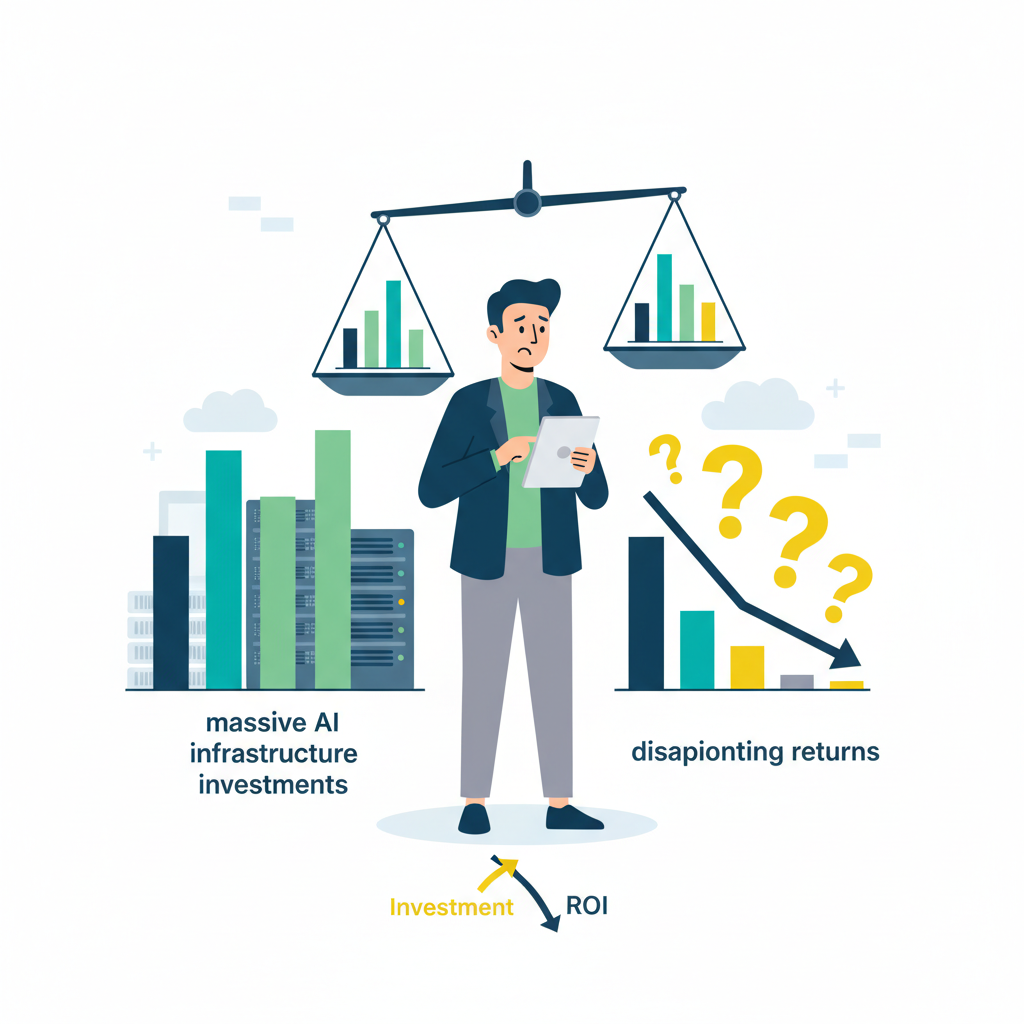

Enterprises invested over $500 billion in AI infrastructure in 2025. Yet 95% of generative AI pilots deliver zero ROI, and only 25% of AI initiatives meet expected returns.
What’s causing this disconnect? This isn’t a technology problem. The models work. This is an infrastructure mismatch problem.
Your organisation invested in AI capabilities without the supporting infrastructure needed to deploy them successfully. Your pilots stall, costs spike, and deployments fail—but the gap isn’t mysterious. Five infrastructure constraints block AI ROI: data readiness, bandwidth limitations, latency challenges, inference cost spirals, and architecture decisions made without understanding workload placement trade-offs.
This comprehensive guide maps these five root causes and navigates you to detailed solutions for each challenge. Whether you’re diagnosing why pilots won’t scale, managing unexpected cost overruns, or building your first infrastructure roadmap, you’ll find diagnostic frameworks and actionable guidance.
What you’ll learn:
- How much companies are actually investing (and where the money goes)
- Why only 6-13% of organisations have AI-ready data infrastructure
- How bandwidth and latency constraints affect 59% and 53% of organisations respectively
- Why AI costs spiral when moving from proof of concept to production
- How to choose between cloud, on-premises, and hybrid infrastructure
- What a practical modernisation roadmap looks like
Use this hub to: Diagnose your specific bottlenecks and find detailed guidance for addressing them. Each section provides overview content and links to comprehensive cluster articles covering assessment frameworks, technical solutions, cost modelling, and implementation roadmaps.
How Much Are Companies Actually Investing in AI Infrastructure?
Enterprises are committing substantial capital to AI infrastructure. Hyperscalers alone are investing over $300 billion in 2025, with total AI infrastructure spending estimated at $500 billion globally. Yet despite this massive investment, only 25% of AI initiatives deliver expected ROI, and 95% of generative AI pilots fail to achieve rapid revenue acceleration. This creates mounting pressure on CTOs who face board-level questions about whether continued AI infrastructure investment is justified when early projects aren’t delivering measurable business value.
The numbers tell a stark story. Organisations invested $47.4 billion globally in AI infrastructure during H1 2024 alone—a 97% year-over-year increase. Eight major hyperscalers expect a 44% increase to $371 billion in 2025 for AI data centres and computing resources.
This capital funds purpose-built AI data centres (what Deloitte calls “AI factories”), network upgrades for AI workloads, specialised storage systems for AI data pipelines, and GPU clusters for training and inference. Meta alone plans to spend up to $72 billion this year on AI infrastructure, with CEO Mark Zuckerberg saying he’d rather risk “misspending a couple of hundred billion dollars” than be late to superintelligence.
The ROI expectation was straightforward: AI would drive significant productivity gains and revenue growth. The reality? IBM research shows only 25% achieve expected returns, with 46% of proof-of-concept projects abandoned before reaching production.
Companies project 75% budget growth for LLM initiatives over the next year. Yet without addressing the underlying infrastructure gaps, this additional spending risks expanding the loss rather than closing the ROI gap.
Navigate deeper:
- Understand the cost dynamics: Understanding Inference Economics and Why AI Costs Spiral Beyond Proof of Concept
- Build your business case: Building an AI Infrastructure Modernisation Roadmap That Actually Delivers Results
What’s Really Holding Back AI Deployment Success?
AI deployment failures aren’t caused by insufficient model capabilities—the technology works. The bottleneck is infrastructure gaps across five areas: data readiness (only 6-13% of organisations have AI-ready data infrastructure), bandwidth constraints (affecting 59% of organisations), latency challenges (impacting 53%), inference cost spirals that catch teams by surprise, and architecture decisions made without understanding workload placement trade-offs. Addressing these infrastructure gaps requires strategic investment, not just more compute power.
The evidence is overwhelming. 42% of companies scrapped) most of their AI initiatives in 2025, up sharply from just 17% the year before. Perhaps most telling: 88% of AI pilots never make it to production), meaning only about 1 in 8 prototypes becomes an operational capability.
Here’s what’s actually causing these failures.
The legacy infrastructure problem: Most organisations built data and network infrastructure for traditional applications, not AI workloads which have fundamentally different requirements. You optimised your data pipelines for batch analytics—processing data in scheduled jobs—not the continuous real-time access AI requires. Your network was designed for kilobyte transactions, not gigabyte model updates. Your cost models assumed predictable resource consumption, not usage that scales linearly with every user query.
Why throwing money at the problem doesn’t help: Simply buying more GPUs or upgrading to larger cloud instances doesn’t address underlying data pipeline bottlenecks, network architecture limitations, or cost structure mismatches. Cisco’s 2025 AI Readiness Index found only 13% of organisations are truly AI-ready, with IT infrastructure cited as the top barrier by 44% of respondents.
The five infrastructure challenges are interdependent. Poor data readiness increases bandwidth requirements because you’re moving more data to compensate for quality gaps. Latency issues drive costly architecture workarounds like excessive caching or edge deployment. Poor cost modelling leads to expensive emergency fixes when inference bills spike unexpectedly.
Research from multiple sources confirms this pattern. While 74% of organisations report positive ROI from generative AI investments, significant barriers prevent wider success. The primary reasons for failure are organisational and integration-related, rather than weaknesses in the underlying AI models themselves.
The pilot-to-production chasm: Proof-of-concept projects succeed in controlled environments but fail at scale because PoC infrastructure doesn’t reveal the constraints that emerge under production loads. You test with curated datasets, limited concurrent users, and forgiving latency expectations. Production requires messy real-world data, thousands of simultaneous queries, and sub-second response times. The infrastructure gap only becomes visible when you try to scale.
Of the 54% of models that successfully move from pilot to production, most still face significant scaling challenges. This is what industry leaders call “pilot purgatory”—a continuous cycle of testing and small-scale trials because the infrastructure foundation wasn’t built to support production AI workloads.
Explore further:
- Diagnose your infrastructure readiness: Data Readiness Is the Hidden Bottleneck Blocking Your AI Deployment Success
- Understand technical constraints: How Bandwidth and Latency Constraints Are Killing AI Projects at Scale
Why Is Data Infrastructure the Primary Barrier to AI Success?
Data infrastructure has emerged as the number one barrier to AI deployment because AI workloads require fundamentally different data characteristics than traditional applications. AI models need high-quality, properly structured, continuously refreshed data with comprehensive metadata and governance. Yet Cisco research shows only 6-13% of organisations have achieved this level of data readiness. Without AI-ready data infrastructure, even the most sophisticated models fail because the input data is incomplete, inconsistent, or inaccessible at the speed and scale AI requires.
The data readiness gap represents a key predictor of AI deployment success, yet fewer than 1 in 8 enterprises meet the threshold. This isn’t about having data—every organisation has data. It’s about having the right data infrastructure to support AI workloads.
What “AI-ready data infrastructure” actually means: It requires data pipelines that can deliver continuous updates rather than batch processing. It needs vector databases (which enable AI models to find semantically similar information), not just traditional relational tables. It demands knowledge graphs that capture context and relationships, not isolated data points. And it necessitates governance frameworks that ensure data quality and compliance without creating bottlenecks that slow AI applications.
Traditional data warehouses aren’t sufficient. Classic ETL processes designed for batch analytics can’t support real-time inference workloads. Relational database structures don’t align with how AI models consume and learn from data. Your decade-old data architecture was optimised for business intelligence queries, not the continuous, high-volume data access patterns that AI requires.
Data scientists spend approximately 80% of their time on data preparation and cleaning tasks. This isn’t a productivity problem—it’s a signal that your data infrastructure wasn’t designed for AI. When data isn’t properly prepared, structured, and accessible, teams compensate by building manual workarounds that don’t scale.
The cascading impact: When data isn’t ready, teams build expensive compensations. Manual data preparation for every project. Redundant storage systems because data isn’t properly catalogued. Over-provisioned compute to handle inefficient data access patterns. Each workaround adds cost and complexity while masking the underlying infrastructure gap.
Many organisations find that data readiness is one of the toughest challenges on the road to AI. Data is spread across silos, trapped in legacy systems, riddled with errors, or locked behind privacy and compliance restrictions. Only 21% of companies have sufficient GPU capacity for their AI needs, but data infrastructure gaps often prevent effective GPU utilisation even when compute resources are available.
Assessment starting point: You need to evaluate current data infrastructure against AI requirements before making other infrastructure investments. Data gaps will undermine everything else. If your data pipelines can’t deliver high-quality, properly structured data at the speed AI requires, additional GPUs and network capacity won’t solve your deployment problems.
The good news? Data readiness improvements often require more engineering effort than capital. Implementing better data pipelines, governance frameworks, and quality processes costs time and expertise but not necessarily major hardware purchases.
Dive deeper:
- Complete data readiness assessment and solutions: Data Readiness Is the Hidden Bottleneck Blocking Your AI Deployment Success
How Do Bandwidth and Latency Constraints Affect AI Project Success?
Even with data infrastructure in place, network constraints create the next major bottleneck. Bandwidth and latency constraints have become major AI bottlenecks. Bandwidth issues affect 59% of organisations, while latency challenges impact 53%. AI workloads transfer vastly more data than traditional applications—large language model inference can require hundreds of megabytes per query, and training runs move terabytes between GPUs. When network infrastructure can’t handle these volumes at acceptable speeds, AI projects slow to a crawl, costs spiral from inefficient resource utilisation, and real-time use cases become impossible.
The year-over-year acceleration tells the story. Network infrastructure is falling further behind AI demands, not catching up. 29% of organisations cite network bandwidth or latency bottlenecks as their biggest pain point for moving large data and AI traffic. CISOs prioritise network bandwidth as a limitation holding back AI workloads at a rate of 50%.
Why AI is different from traditional workloads: Conventional enterprise applications might transfer kilobytes per transaction. AI inference moves megabytes. Training distributes gigabytes across GPU clusters. This represents orders of magnitude more network demand. Your network was designed for email, web applications, and file transfers—workloads measured in kilobytes or low megabytes. AI workloads are fundamentally different.
Consider the scale difference. A typical web application request might transfer 50KB of data. An AI inference query for a large language model can transfer 200MB. That’s a 4,000x difference in network demand per interaction. Multiply that by thousands of concurrent users, and you understand why network infrastructure that handled traditional applications perfectly well becomes a bottleneck for AI.
The latency-sensitive nature of inference: Real-time AI applications like chatbots, recommendation engines, and automated decision systems require sub-second response times. Network latency directly impacts user experience and business value. While inference computation time (roughly 20 seconds for a ChatGPT response) dominates total latency for many use cases, network delays compound these times and create poor user experiences. For latency-sensitive applications like real-time fraud detection or autonomous systems, even milliseconds matter.
The split is clear in the data: 49% of respondents view performance matters as important, though a bit of latency or downtime is tolerable. But 23% say AI services must respond in real-time with near-zero downtime. Your use case determines your tolerance.
Bandwidth constraints as a hidden cost multiplier: When networks can’t deliver data fast enough, organisations compensate in expensive ways. Over-provisioned GPU resources that sit idle waiting for data. Excessive local data caching which creates consistency and governance challenges. Redundant compute infrastructure placed closer to data sources. Each workaround adds cost while masking the underlying network constraint.
Organisations are responding with multiple approaches. 42% are using high-performance networking including dedicated high-bandwidth links and low-latency network fabric. 32% deploy content caching or CDNs to reduce latency for AI data and content. 31% use edge computing or deploy AI services closer to users and data sources to cut down latency.
The edge computing driver: Latency and bandwidth limitations are major factors pushing organisations toward edge AI deployments. Edge computing handles decisions requiring real-time response. Manufacturing automation, autonomous vehicles, and real-time analytics can’t tolerate cloud round-trip delays. Edge deployment addresses latency but creates new architecture complexity around model distribution, update management, and edge infrastructure maintenance.
Learn more:
- Technical deep-dive on diagnosing and solving network bottlenecks: How Bandwidth and Latency Constraints Are Killing AI Projects at Scale
- Architecture decisions driven by latency requirements: Cloud vs On-Premises vs Hybrid AI Infrastructure and How to Choose the Right Approach
Why Do AI Costs Spiral When Moving Beyond Proof of Concept?
AI costs spiral at scale because inference economics—the cost of running models in production—behaves fundamentally differently than the upfront training costs most organisations budget for. A PoC might cost hundreds of dollars per month in cloud API calls, but the same application at production scale with thousands of users can jump to tens or hundreds of thousands monthly. This happens because inference costs are per-query or per-token, meaning they scale linearly (or worse) with usage, and because real-world usage patterns rarely match PoC assumptions about query volume, response length, and peak load timing.
The PoC-to-production cost surprise catches most organisations off-guard. You budget based on pilot costs, then discover production expenses are 10x-100x higher because usage volume, query complexity, and service level requirements differ dramatically from controlled testing. Some enterprises are starting to see monthly bills for AI use in the tens of millions of dollars.
Understanding inference economics: While training is a one-time or periodic cost, inference is an ongoing operational expense that scales with every user interaction. For high-volume applications this can quickly exceed training costs by orders of magnitude. Inference costs account for the majority of operational expenses in AI-native applications achieving product-market fit and starting to scale.
Here’s the compounding problem: while inference costs have plummeted, dropping 280-fold over the last two years, enterprises are experiencing explosive growth in overall AI spending because usage has dramatically outpaced cost reduction. Lower costs per query mean AI becomes economically viable for more use cases, which drives higher query volumes, which increases total spend despite lower unit costs.
Large language model tools based on APIs work for PoC projects but become cost-prohibitive when deployed across enterprise operations. Agentic AI involves continuous inference, which can send token costs spiralling as the biggest cost contributor.
The Deloitte 60-70% threshold: Deloitte research shows that when cloud AI costs reach 60-70% of what on-premises infrastructure would cost, organisations should seriously evaluate repatriation or hybrid approaches. But many don’t model costs properly until they’ve already exceeded this threshold. At that point you’re making reactive decisions under financial pressure rather than strategic choices based on workload analysis.
For sustained usage beyond 6 hours per day, on-premises infrastructure becomes more cost-effective than cloud. The tipping point exists, but most organisations don’t calculate it accurately because they underestimate production usage patterns.
Variable vs. fixed cost structures: Cloud inference pricing is variable (pay per use), which seems attractive initially but creates budget unpredictability and can become expensive at scale. On-premises infrastructure requires upfront capital but offers fixed operational costs. The right choice depends on your workload characteristics and cost tolerance.
Watch for these warning signs: Storage sprawl, cross-region data transfers, idle compute, and continuous retraining often make up 60% to 80% of total AI spend. Cloud invoice increases exceeding 40% month-over-month without proportional traffic growth signal architectural inefficiencies. Cross-region transfer costs exceeding 15% of overall spend suggest design flaws in how compute and storage are geographically distributed. Idle resource hours making up more than 20% of total compute time reflect low operational efficiency.
The optimisation challenge: Reducing inference costs requires technical optimisations—model quantisation, caching strategies, batch processing—that weren’t necessary for PoC success. These add complexity and require expertise many teams lack. Higher throughput means serving more requests per GPU. Faster token generation means handling more concurrent users on the same infrastructure. But achieving these optimisations requires understanding inference architecture at a level most teams haven’t developed.
Get the full picture:
- Complete guide to inference cost modelling and management: Understanding Inference Economics and Why AI Costs Spiral Beyond Proof of Concept
- Architecture decisions based on cost thresholds: Cloud vs On-Premises vs Hybrid AI Infrastructure and How to Choose the Right Approach
Should You Choose Cloud, On-Premises, or Hybrid AI Infrastructure?
The cloud-vs-on-premises choice for AI infrastructure isn’t binary. Leading organisations are adopting a three-tier hybrid model that places workloads based on their requirements. Cloud makes sense for variable workloads, experimentation, and burst capacity (elasticity). On-premises works better for consistent high-volume inference, latency-critical applications, and data sovereignty requirements (consistency). Edge computing handles decisions requiring real-time response (immediacy). The decision framework centres on cost thresholds, latency requirements, regulatory constraints, and intellectual property protection needs rather than choosing a single architecture for all AI workloads.
The false binary has pushed organisations to choose “cloud or on-prem” when the reality is that different AI workloads have different optimal infrastructure placement. 42% of respondents favour a balanced hybrid approach between on-premises and cloud infrastructure. IDC predicts that by 2027, 75% of enterprises will adopt a hybrid approach to optimise AI workload placement, cost, and performance.
The three-tier hybrid model: Leading organisations are implementing three-tier architectures that leverage the strengths of all available infrastructure options. This aligns infrastructure characteristics with workload requirements rather than forcing all AI workloads into a single deployment model.
Cloud for elasticity: Public cloud handles variable training workloads, burst capacity needs, experimentation phases, and scenarios where existing data gravity makes cloud deployment logical. Cloud advantages include rapid deployment without capital expenditure, elastic scaling, and access to managed AI services.
On-premises for consistency: Private infrastructure runs production inference at predictable costs for high-volume, continuous workloads. On-premises benefits include greater control over data, potentially lower costs for predictable workloads, and compliance advantages. Industries with stringent compliance requirements such as finance, healthcare, and manufacturing continue to invest in modernised on-premises infrastructure for long-term control and compliance.
Edge facilities for immediacy: Edge handles decisions requiring real-time response. However, edge facilities are used by just 4% due to the complexity and resource demands of deploying AI at the edge. Despite being touted as ideal for AI, practical edge deployment remains challenging.
The data shows deployment preferences: public cloud hosting is selected by 35% of respondents, largely due to cost-effectiveness and flexible scalability. Only 15% of organisations rely primarily on on-premises data centres. But 42% choose hybrid, suggesting that single-deployment models don’t serve most organisations’ needs.
AI factories vs. retrofitting: Some organisations are building purpose-built greenfield “AI factories” optimised for AI workloads rather than retrofitting existing data centres. AI factories are integrated infrastructure ecosystems specifically designed for AI processing with AI-specific processors, advanced data pipelines, high-performance networking, algorithm libraries, and orchestration platforms. These can be faster and more cost-effective despite higher initial capital requirements.
Data sovereignty and IP protection: Regulatory requirements and competitive concerns drive on-premises or private cloud decisions for many organisations, particularly in regulated industries or when AI models represent proprietary intellectual property. Data sovereignty isn’t just about compliance—it’s about maintaining control over intellectual property and competitive advantages embedded in AI models and training data.
The cost-latency-sovereignty triangle: Architecture decisions require balancing three often competing factors—cost efficiency, performance (latency), and data/IP control. Different workloads prioritise these differently. Training a foundation model? Cost and sovereignty might dominate. Real-time fraud detection? Latency becomes paramount. Customer service chatbot? Balance all three based on service level requirements and data sensitivity.
Migration and workload placement: The key question isn’t “where should our AI infrastructure be?” but rather “which workloads belong where, and how do we manage across environments?” Organisations might train models in the cloud but deploy inference at on-premises or edge devices, enabling businesses to balance performance, compliance, and cost-effectiveness.
Navigate deeper:
- Complete decision framework for architecture choices: Cloud vs On-Premises vs Hybrid AI Infrastructure and How to Choose the Right Approach
- Cost analysis for architecture decisions: Understanding Inference Economics and Why AI Costs Spiral Beyond Proof of Concept
How Do You Move from Identifying Problems to Actually Solving Them?
You’ve identified your bottlenecks. Now what? Moving from diagnosis to solution requires a structured modernisation roadmap that prioritises infrastructure investments based on your biggest bottlenecks, available budget, and business goals. Start with comprehensive infrastructure assessment, build a business case that quantifies both costs and expected returns, then implement in phases that deliver incremental value rather than attempting complete infrastructure overhaul simultaneously. The roadmap should balance quick wins that demonstrate progress with longer-term structural improvements, and include measurement frameworks to track whether investments are actually closing your specific ROI gaps.
Approximately 70% of AI projects fail due to lack of strategic alignment and planning gaps. The typical timeline for enterprise AI implementation is 18-24 months, but phased approaches can deliver value much sooner.
Assessment as the mandatory first step: You can’t prioritise effectively without understanding which infrastructure gaps are blocking your specific AI initiatives. Data readiness, network constraints, cost issues, or architecture mismatches all require different solutions. Organisations must conduct comprehensive readiness assessment across data maturity, technical infrastructure, organisational capabilities, and business alignment.
Gap analysis evaluates current capabilities against future goals to build a prioritised AI strategy, identifying gaps in governance, infrastructure and readiness using a proven AI framework.
Building the business case: CTOs need board approval for significant infrastructure investment, which requires translating technical infrastructure needs into business value projections, risk mitigation, and competitive positioning arguments. The business case must address why previous AI initiatives underperformed and how infrastructure investment will change outcomes.
Organisations require a comprehensive AI implementation roadmap that provides structured guidance from initial strategic planning through full-scale deployment and governance. A proven six-phase methodology includes strategic alignment, infrastructure design, data strategy, model development, deployment/MLOps, and governance/ethics.
Prioritisation with limited budgets: Most organisations can’t afford to fix everything simultaneously. Prioritisation frameworks help identify which investments will have the greatest impact on AI deployment success relative to cost. Break modernisation into small, manageable increments where each increment delivers specific features or functionalities, prioritising most critical or problematic components first.
Prioritisation and roadmap creation involves strategic AI roadmap aligned with business value, cost and feasibility, building an AI readiness checklist and implementation plan.
Phased implementation approach: Breaking modernisation into phases (typically 3-6 month increments) allows organisations to demonstrate progress, learn from early implementations, and adjust priorities based on results rather than committing to multi-year plans that may not align with evolving AI needs.
The implementation phase establishes IT environment, rolls out initiatives, trains teams, develops processes, implements security controls and conducts rigorous testing. Organisations should implement proof of concept on a separate feature or module to ensure the envisioned modernisation approach works as planned before fully committing.
Modernisation roadmaps should include short-term, medium-term, and long-term goals and key performance indicators (KPIs) to ensure each phase is achievable and measurable.
Governance and measurement: Dell Technologies’ architecture review board approach provides a model for ongoing governance that ensures AI infrastructure investments remain aligned with business priorities and that progress is measured against specific ROI objectives. Establish ongoing review process conducting periodic audits, monitoring adoption and performance, assessing security and compliance risks, and implementing governance policies.
Post-implementation, monitor performance against KPIs. Gather feedback, track results and continuously refine AI initiatives for sustained impact and long-term value.
Common pitfalls to avoid: Rushing to buy GPUs before fixing data infrastructure is the most common mistake. Choosing architecture based on vendor hype rather than workload analysis wastes capital. Implementing AI infrastructure without corresponding team skill development creates expensive infrastructure that sits underutilised because teams don’t have expertise to leverage it effectively.
Don’t pause AI initiatives waiting for perfect infrastructure. Align AI initiative scope with current infrastructure capabilities while systematically improving infrastructure in parallel. Run pilots at scales your current infrastructure supports, focus on use cases that aren’t blocked by your specific constraints, and use pilot learnings to inform infrastructure priorities.
Navigate deeper:
- Complete roadmap building framework: Building an AI Infrastructure Modernisation Roadmap That Actually Delivers Results
- Start with data readiness assessment: Data Readiness Is the Hidden Bottleneck Blocking Your AI Deployment Success
- Prioritisation based on cost analysis: Understanding Inference Economics and Why AI Costs Spiral Beyond Proof of Concept
What If You’re Already Facing These Challenges?
If you’re already experiencing AI infrastructure challenges—pilots that won’t scale, unexpected cost overruns, or deployment delays—you’re not alone, and the situation is recoverable. The 95% pilot failure rate means most organisations are struggling with the same issues. Start by diagnosing which specific infrastructure gap is your primary bottleneck (use the cluster articles as diagnostic guides), then address that constraint before attempting to scale AI initiatives. Often a single focused infrastructure improvement—fixing data pipelines, upgrading network capacity, or implementing proper cost monitoring—can unblock multiple stalled AI projects simultaneously.
The “AI pilot purgatory” pattern is common. Many organisations have 5-10 successful PoC projects that can’t move to production because infrastructure wasn’t designed to support production AI workloads. 88% of AI pilots fail to reach production, creating what industry calls “pilot purgatory”—a continuous cycle of testing and small-scale trials due to insufficient strategy or leadership commitment.
This is fixable by addressing the underlying constraints.
Triage and prioritisation: If you’re facing multiple infrastructure issues, identify the single biggest bottleneck first—usually data readiness—because fixing it often alleviates pressure on other areas. Pilot projects typically rely on specific, curated datasets that do not reflect operational reality, where real-world data is messy, unstructured, unorganised, and scattered across hundreds of systems.
Organisations whose primary constraint is data readiness might implement vector databases and improve data pipelines in 2-3 months, unblocking stalled AI projects without waiting for complete infrastructure overhaul.
The sunk cost trap: Organisations sometimes continue investing in failing approaches because they’ve already spent significantly. Better to acknowledge infrastructure gaps) and address them systematically than to keep funding projects destined to fail.
Two conflicting fears paralyse enterprise boards: anxiety about missing AI-driven opportunities versus fear of costly failures, with the latter typically dominating decision-making. Breaking this paralysis requires demonstrating that infrastructure gaps, not AI technology limitations, caused previous failures.
Quick wins to demonstrate progress: While comprehensive infrastructure modernisation takes quarters or years, targeted improvements in specific areas can often unlock stalled projects within weeks, providing evidence that the overall strategy is working. Focus on the constraint blocking your highest-value use case and address it systematically.
When to bring in expertise: Infrastructure modernisation for AI often requires specialised knowledge in areas like vector databases, GPU orchestration, or inference optimisation. Knowing when to hire specialists or engage consultants versus training internal teams is a key decision point. For organisations without AI infrastructure specialists, priorities are: train existing infrastructure teams on AI-specific requirements, hire 1-2 AI infrastructure specialists to guide strategy, and partner with vendors or consultants for specialised implementations.
Building stakeholder confidence: CTOs facing sceptical boards or executive teams after AI disappointments need to demonstrate a clear understanding of what went wrong and a credible plan to address it. The cluster articles provide frameworks for building these explanations and plans. Success in enterprise AI implementation requires investment in laying the right foundation, focusing on business-first strategy, data governance, and enterprise data architecture.
Navigate deeper:
Diagnostic frameworks for each major constraint area:
- Data issues: Data Readiness Is the Hidden Bottleneck Blocking Your AI Deployment Success
- Network problems: How Bandwidth and Latency Constraints Are Killing AI Projects at Scale
- Cost concerns: Understanding Inference Economics and Why AI Costs Spiral Beyond Proof of Concept
- Architecture decisions: Cloud vs On-Premises vs Hybrid AI Infrastructure and How to Choose the Right Approach
Recovery and remediation roadmap:
- Building an AI Infrastructure Modernisation Roadmap That Actually Delivers Results
Resource Hub: AI Infrastructure ROI Gap Library
This resource hub connects the comprehensive coverage in this pillar article with detailed cluster articles that dive deep into each infrastructure constraint. Each cluster article provides practical frameworks, assessment tools, and implementation guidance for its specific domain. Together, these resources form a complete system for diagnosing and addressing AI infrastructure ROI gaps at any scale.
Start here if you’re diagnosing why your AI initiatives aren’t delivering:
Understanding the Problem
Data Readiness Is the Hidden Bottleneck Blocking Your AI Deployment Success Read time: 10 minutes
Why only 6-13% of organisations have AI-ready data infrastructure and how to assess your readiness. Includes self-assessment framework, component checklist, and practical improvement steps for growing tech companies.
How Bandwidth and Latency Constraints Are Killing AI Projects at Scale Read time: 10 minutes
Technical deep-dive on the 59%/53% constraint statistics, diagnostic frameworks for identifying bottlenecks, and solutions at multiple budget levels. Covers network requirements for different AI use cases including agentic AI.
Once you’ve identified constraints, these guides help you choose the right approach:
Making Architecture and Cost Decisions
Understanding Inference Economics and Why AI Costs Spiral Beyond Proof of Concept Read time: 10 minutes
Financial framework for modelling AI costs and understanding the PoC-to-production cost spiral. Includes TCO analysis, Deloitte’s 60-70% threshold, and strategies for managing inference costs at scale.
Cloud vs On-Premises vs Hybrid AI Infrastructure and How to Choose the Right Approach Read time: 12 minutes
Decision framework for choosing architecture based on workload requirements, cost thresholds, and sovereignty needs. Covers the three-tier hybrid model, AI factories concept, and when each approach makes sense.
Ready to build your roadmap? This comprehensive guide walks you through implementation:
Taking Action
Building an AI Infrastructure Modernisation Roadmap That Actually Delivers Results Read time: 12 minutes
Step-by-step framework for prioritising investments, building business cases, and implementing phased modernisation. Includes vendor evaluation criteria, common pitfalls, and governance approaches for SMB scale.
FAQ Section
Why are only 25% of AI initiatives delivering expected ROI despite massive infrastructure investment?
You invested in AI capabilities—models, platforms, tools—without the supporting infrastructure to deploy them. Five infrastructure gaps block ROI: data readiness (only 6-13% of organisations are prepared), bandwidth constraints (affecting 59%), latency issues (impacting 53%), inference cost spirals that catch teams by surprise, and architecture decisions that don’t match workload requirements. Each gap independently can prevent AI deployment success; together they create the 95% pilot failure rate. The solution requires addressing infrastructure systematically, not just buying more AI technology.
What’s the difference between AI infrastructure and traditional IT infrastructure?
AI infrastructure differs fundamentally in three ways: data requirements (AI needs continuously refreshed, high-quality, structured data with semantic relationships, not just historical transaction records), network demands (AI workloads transfer orders of magnitude more data—megabytes or gigabytes per inference query vs. kilobytes for traditional apps), and compute patterns (AI requires specialised processors like GPUs with high-speed interconnects, not general-purpose CPUs). Traditional data centres optimised for transaction processing, email, and business applications can’t support AI workloads without significant architectural changes to data pipelines, network topology, and compute resources. This mismatch is why the Cisco AI Readiness Index found only 13% of organisations have truly AI-ready infrastructure.
How long does it take to achieve AI-ready infrastructure?
Infrastructure modernisation timelines vary based on starting point and scope, but typically require 6-18 months for meaningful progress across all five constraint areas (data, bandwidth, latency, cost management, architecture). However, phased approaches can deliver quick wins in 6-12 weeks by targeting the single biggest bottleneck first. For example, organisations whose primary constraint is data readiness might implement vector databases and improve data pipelines in 2-3 months, unblocking stalled AI projects without waiting for complete infrastructure overhaul. The key is diagnosis-driven prioritisation rather than attempting comprehensive modernisation simultaneously.
Can we fix AI infrastructure issues without major capital investment?
Yes, though the approach depends on which constraints you’re facing. Data readiness improvements often require more engineering effort than capital—implementing better data pipelines, governance frameworks, and quality processes costs time and expertise but not necessarily major hardware purchases. Network optimisation through better routing, compression, and caching can address some bandwidth constraints without infrastructure replacement. Cost management through model optimisation, caching strategies, and workload placement can reduce inference expenses significantly. However, some solutions do require capital—adding network capacity, purchasing GPUs for on-premises deployment, or building purpose-built AI infrastructure. A proper roadmap balances engineering optimisations with targeted capital investments based on ROI potential.
Should we pause AI initiatives until infrastructure is ready?
No—pausing creates competitive risk and loses organisational momentum. Instead, align AI initiative scope with current infrastructure capabilities while systematically improving infrastructure in parallel. Run pilots at scales your current infrastructure supports, focus on use cases that aren’t blocked by your specific constraints, and use pilot learnings to inform infrastructure priorities. For example, if data readiness is your primary gap, focus AI pilots on use cases with already-available high-quality data while you improve data infrastructure for more complex applications. This approach maintains AI progress while building the foundation for larger-scale deployment, avoiding both the “pilot purgatory” trap and the competitive disadvantage of waiting for perfect infrastructure.
How do we know which infrastructure gap to fix first?
Start with data readiness assessment because data infrastructure is foundational—bandwidth, latency, and cost issues often stem from poor data architecture forcing inefficient workarounds. If data infrastructure is already solid, use actual project failures to diagnose: are pilots failing because they’re too slow (latency), too expensive (cost), or can’t scale (bandwidth)? The cluster articles provide diagnostic frameworks for each area. Generally, address constraints in this order: (1) data readiness, (2) architecture decisions (proper workload placement reduces other constraints), (3) network capacity (bandwidth/latency), (4) cost optimisation. However, if a specific constraint is causing immediate business pain—for example, a high-value use case blocked specifically by latency—address that first to demonstrate progress while planning systematic improvement.
What skills do we need to manage AI infrastructure effectively?
AI infrastructure requires hybrid skills spanning traditional infrastructure (networking, storage, compute capacity planning) and AI-specific expertise (vector databases, GPU orchestration, inference optimisation, LLM fine-tuning). Key roles include: data engineers who understand AI data pipeline requirements, network engineers familiar with high-throughput low-latency design, infrastructure architects who can design hybrid cloud/on-prem/edge deployments, and ML engineers who understand model serving and optimisation. For organisations without these specialists, priorities are: (1) train existing infrastructure teams on AI-specific requirements, (2) hire 1-2 AI infrastructure specialists to guide strategy, (3) partner with vendors or consultants for specialised implementations. Most teams find that developer-background CTOs can learn AI infrastructure concepts quickly, but hands-on implementation often requires bringing in expertise initially.
Are there industry benchmarks for AI infrastructure spending?
While benchmarks are still emerging, available data shows: hyperscalers are investing $200-400 per employee annually in AI infrastructure, enterprises with serious AI initiatives spend 15-25% of IT budgets on AI-related infrastructure, and organisations in early AI adoption stages typically allocate $50-100K for initial infrastructure improvements (data pipelines, network upgrades, initial GPU capacity or cloud credits). Deloitte’s 60-70% threshold provides a useful benchmark—if your cloud AI costs reach 60-70% of what on-premises infrastructure would cost over 3-5 years, it’s time to evaluate alternatives. For growing tech companies (50-500 employees), pragmatic initial investments range from $25-75K for foundational improvements, scaling based on AI adoption success and ROI evidence.