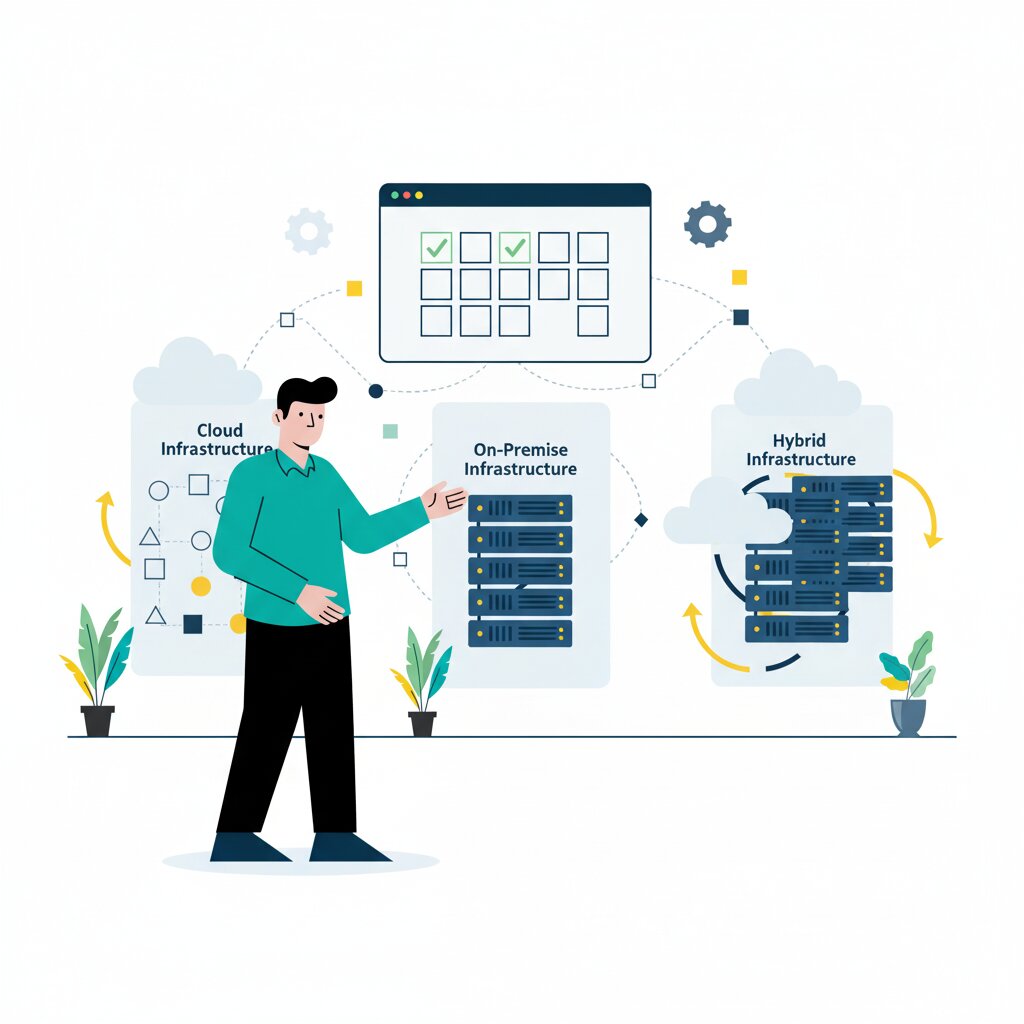

You’re facing mounting pressure to pick the right AI infrastructure approach. Cloud costs are spiralling. On-premises investments loom large. And everyone’s telling you something different.
Here’s what successful companies do: they use hybrid infrastructure optimised for different workload types. They don’t pick cloud or on-premises—they use both strategically.
This guide is part of our comprehensive look at why enterprise AI infrastructure investments aren’t delivering and what to do about it. While the broader challenge stems from multiple factors, choosing the right architecture approach is a critical decision point.
This article gives you a practical decision framework. You’ll learn when each approach makes financial and technical sense, how to assess existing infrastructure, and what triggers should prompt changes. The framework addresses real constraints: limited budgets, existing data centres, compliance requirements, and the need to show ROI quickly.
What is hybrid AI infrastructure and why does it matter?
Hybrid AI infrastructure integrates cloud, on-premises, and edge resources under unified orchestration. It’s different from just using multiple cloud providers without thinking about where each workload should actually run.
42% of organisations favour a balanced approach between on-premises and cloud. IDC predicts that by 2027, 75% of enterprises will adopt hybrid infrastructure to optimise AI workload placement, cost, and performance.
Why does this matter? Pure cloud gets expensive at scale. When you hit sustained utilisation above a certain level, on-premises typically becomes cheaper. Pure on-premises lacks elasticity for experimentation and you can’t access the latest accelerators without major capital investment.
Hybrid balances cost efficiency, performance optimisation, and regulatory compliance while maintaining flexibility.
Here’s what each piece means. Cloud uses virtualised GPU instances and managed services. On-premises means owned hardware in your own or colocation data centres. Edge handles local processing for latency-sensitive workloads.
Platforms like Rafay and Kubernetes enable centralised management across environments. As David Linthicum notes: “The biggest challenge is complexity. When you adopt heterogeneous platforms, you’re suddenly managing all these different platforms while trying to keep everything running reliably”.
How does the three-tier hybrid model work in practice?
The three-tier model distributes AI workloads strategically. Cloud handles elasticity. On-premises provides consistency. Edge manages latency-sensitive processing.
The cloud tier handles variable training workloads where compute demand fluctuates. When you need to scale to hundreds of GPUs for a training job, then release resources when complete, cloud makes sense. It gives you burst capacity during peak periods and access to cutting-edge AI services.
The on-premises tier runs production inference at scale with predictable utilisation. It processes sensitive data with sovereignty requirements and handles sustained high-volume workloads where cost-per-inference matters. Organisations gain control over performance, security, and cost management while building internal expertise.
The edge tier processes latency-critical applications. Applications requiring response times of 10 milliseconds or below can’t tolerate cloud-based processing delays. Manufacturing environments, oil rigs, and autonomous systems need proximity to data sources.
49% of respondents say performance is important, requiring AI services to respond in real-time with near-zero downtime.
Workload placement uses specific criteria. Utilisation patterns determine whether workloads run constantly or intermittently. Latency requirements separate applications that tolerate delays from those requiring instant response. Data sensitivity distinguishes public data from regulated information. Cost thresholds determine whether usage-based pricing or fixed costs make more sense.
A manufacturing company might train predictive models in the cloud using anonymised historical data, then deploy those models on-premises where they process real-time operational data.
You don’t need to build everything simultaneously. Start with one tier, typically cloud. Add tiers as specific triggers are met: cost threshold crossed, compliance requirement emerges, latency constraint appears.
When does cloud AI infrastructure make financial sense?
Understanding the three-tier model raises the practical question: when does each tier make financial sense? Let’s start with cloud.
Cloud becomes economical for workloads with lower sustained utilisation. Variable costs beat fixed infrastructure investment when usage fluctuates.
Development and experimentation benefit from cloud’s pay-per-use model. Spin up resources for weeks or months without a multi-year commitment.
Variable training workloads suit cloud elasticity. AI workloads typically require instant bursts of computation, particularly during model training or mass experimentation.
Small-scale deployments rarely justify on-premises capital investment. Under 8-16 GPUs equivalent, the operational overhead of managing physical infrastructure tips economics toward cloud.
Access to latest hardware without capital risk: new GPU generations like H100 or Blackwell become available immediately through cloud providers. Cloud platforms provide access to cutting-edge hardware through managed services, eliminating procurement complexity.
Managed AI services reduce operational complexity. AWS SageMaker, Google Vertex AI, and Azure services simplify infrastructure management if you don’t have deep ML infrastructure expertise.
Geographic distribution requirements often favour cloud. Deploying in multiple regions for latency optimisation is easier than building multiple data centres.
But watch the costs. AI costs can increase 5 to 10 times within a few months of deployment. A model costing a few hundred dollars to train might generate cloud bills in the thousands within weeks.
Spot pricing offers 30-70% discount for interruptible workloads. Reserved instances provide 30-40% discount with commitment. These pricing tiers extend cloud viability, but you need workload characteristics that fit the constraints.
When should you choose on-premises AI infrastructure?
Cloud has clear use cases at lower utilisation levels. On-premises becomes compelling when utilisation patterns shift.
On-premises becomes cost-effective at 60-70% sustained utilisation. Fixed costs amortise better than variable cloud pricing when you’re running workloads consistently.
Production inference at scale strongly favours on-premises. Predictable high-volume workloads with consistent resource requirements are where cloud economics fall apart.
The breakeven point is usually within 12-18 months. After that, on-premises delivers significant cost benefits. If your system runs more than 6 hours per day on cloud, it becomes more expensive than the same workload on-premises.
Data sovereignty and compliance requirements mandate on-premises for regulated industries. Finance, healthcare, and defence sectors have strict data residency rules.
Long-term training projects benefit from fixed-cost infrastructure. Multi-month or continuous training programmes accumulate substantial cloud costs.
You can fine-tune GPU settings, memory configurations, and networking to extract better performance. Dedicated hardware ensures consistent performance, eliminating fluctuation from shared cloud resources.
The majority of enterprises’ data still resides on premises. Organisations increasingly prefer bringing AI capabilities to their data rather than moving sensitive information to external services.
TCO analysis over 3-5 years typically shows 40-60% savings for sustained workloads compared to cloud.
Colocation provides a middle ground: host in third-party data centres to get on-premises control without the facility burden.
How do you assess existing infrastructure for AI workloads?
Whether choosing cloud or on-premises, many organisations face a practical constraint: existing data centres. Here’s how to assess whether your brownfield infrastructure can support AI workloads.
Brownfield assessment evaluates four dimensions: power capacity, cooling capability, network infrastructure, and physical space.
Start with power capacity. AI workloads require 10-30 kW per rack versus 5-10 kW for traditional computing. Modern AI servers can consume 5-10 kW per unit, requiring robust power delivery. Calculate available capacity in your existing facility.
If your facility can’t provide 10-30 kW per rack, you’ll need electrical upgrades. Expect costs from $50K for a single rack upgrade to $500K+ for comprehensive electrical system modernisation.
Cooling systems need evaluation next. GPU heat density demands advanced cooling beyond standard CRAC units. High-density deployments often require liquid cooling.
Standard air cooling maxes out around 20-25 kW per rack. If you’re planning higher density, budget $100K-$300K for liquid cooling infrastructure per row of racks.
Network infrastructure matters. AI requires high-bandwidth low-latency networking—100 Gbps or higher, RDMA capable—versus traditional 10/25 Gbps enterprise networking. Understanding bandwidth considerations is essential for planning adequate network capacity.
If you’re running 10 Gbps switches, upgrading to 100 Gbps or higher means $50K-$200K per rack for switching and cabling.
Physical space assessment verifies adequate room for planned deployment. GPU servers require more rack space than traditional servers.
Electrical infrastructure audit checks power distribution units, circuit capacity, and backup power systems can handle AI load characteristics.
Existing data centres feature raised floors, standard cooling, and orchestration based on private cloud virtualisation—all designed for rack-mounted, air-cooled servers. This physical infrastructure mismatch could become a bottleneck.
Cost analysis compares modernisation investment versus greenfield build versus colocation options. Often partial retrofit proves more economical than complete rebuild.
A pilot approach validates assumptions before committing to full-scale retrofit. Test a single rack deployment to see what actually happens.
What are the practical cost thresholds for switching infrastructure approaches?
Understanding inference economics is critical for making sound infrastructure decisions. The breakeven point sits at 60-70% sustained utilisation. That’s where on-premises CapEx plus OpEx becomes cheaper than cloud usage-based pricing.
Cloud spot pricing extends cloud viability to 75-85% utilisation for interruptible workloads like training or batch inference.
Small-scale threshold: below 8-16 GPU equivalents, cloud typically wins due to operational overhead of managing physical infrastructure.
Large-scale threshold: above 100+ GPUs, on-premises advantages compound through volume pricing, optimised infrastructure, and operational efficiency.
Time horizon matters. Breakeven calculations require 3-5 year analysis. Shorter horizons favour cloud. Longer horizons favour on-premises.
Here’s a specific example. 64 H100 GPUs running inference at 70% utilisation costs approximately $800K per year in cloud versus $400K per year on-premises, including CapEx amortisation. These cost threshold analyses should account for your specific workload patterns and growth trajectory.
Hidden costs impact calculations. Cloud egress charges and storage costs add up. On-premises requires staffing, facilities, and maintenance contracts.
Workload variability affects thresholds. Consistent workloads favour on-premises. Spiky workloads favour cloud or hybrid.
Organisations typically waste approximately 21% of cloud spending on underutilised resources.
Cloud optimisation tactics shift the numbers. Reserved instances provide 30-40% discount with commitment. Spot pricing offers 30-70% discount for interruptible workloads. But these require workload characteristics that fit the constraints.
How do you build a practical decision framework for infrastructure choices?
Start with workload characterisation. Classify by utilisation pattern: variable or sustained. Latency requirements: tolerant or instant response needed. Data sensitivity: public or regulated. Expected scale: small or large.
Add a financial analysis layer. Calculate TCO for each option. Identify cost thresholds. Determine breakeven points based on utilisation projections.
Technical requirements assessment evaluates performance needs, latency constraints, bandwidth requirements, and integration with existing systems. Interactive applications require sub-500ms response times.
Compliance evaluation maps data sovereignty requirements, regulatory constraints, and security controls to infrastructure options.
Organisational readiness checks assess team capabilities, operational expertise, capital availability, and risk tolerance.
The decision tree uses characteristics to route to optimal tier. Cloud for variable low-volume. On-premises for sustained high-volume. Edge for latency requirements under 10 milliseconds.
50% of CISOs prioritise network bandwidth as a limitation holding back AI workloads. 33% cite compute limitations as the biggest performance bottleneck.
Establish review triggers: metrics and thresholds that signal when to reassess infrastructure. Utilisation crossing breakeven. Cost overruns. Performance degradation.
Start small with a single high-value workload to develop expertise safely. This pilot approach proves the concept before full commitment. Budget 10-20% of full deployment cost for a meaningful pilot. Once you’ve validated your architecture choice, you’ll need a structured implementation roadmap to execute the decision effectively.
What role do AI factories and specialised infrastructure play?
The frameworks above apply to standard deployments. Some organisations operate at a scale requiring specialised infrastructure.
AI factories are purpose-built data centres designed specifically for AI workloads. Tens to thousands of GPUs orchestrated as single computational unit with AI-optimised networking, advanced data pipelines, and unified management.
They differ from traditional data centres through specialisation. High-power density: 30-100+ kW per rack. Liquid cooling systems. GPU-optimised networking like NVLink and InfiniBand.
These giant data centres have become the new unit of computing, orchestrated from tens to hundreds of thousands of GPUs as a single unit. The next horizon is gigawatt-class facilities with a million GPUs.
Most relevant for large organisations with sustained high-volume AI workloads. Less applicable to smaller tech companies starting their AI journey.
But even smaller deployments benefit from AI-optimised design principles. Right networking. Adequate cooling. Proper orchestration.
Colocation providers increasingly offer AI factory capabilities. Rent optimised infrastructure without building your own facility.
Future-proofing consideration: design on-premises infrastructure with AI factory principles even at small scale to enable growth.
Whichever architecture you land on, the workload isn’t constant. It spikes while you’re building the thing out and settles once it’s running. SoftwareSeni’s extended development teams scale up for that build phase and back down once the environment is stable, so you’re never left carrying capacity the steady state doesn’t need.
see how extended development teams scale up for a build and back down once it’s running →
“SoftwareSeni has done a great job, working quickly and reliably on all tasks assigned to them. This is exactly the way I foresee us collaborating more in future projects: rapid client engagements with flexibility in terms of scope and time allocated to resources.”
— Andre Gallo, Co-founder & CTO, Triniti
FAQ Section
What’s the difference between hybrid infrastructure and multi-cloud?
Multi-cloud uses multiple cloud providers—AWS plus Azure plus Google Cloud—primarily for redundancy or feature access. Hybrid infrastructure strategically distributes workloads across cloud, on-premises, and edge based on each workload’s characteristics. Hybrid focuses on optimal placement. Multi-cloud focuses on provider diversity. Many organisations use both: hybrid architecture implemented across multiple cloud providers.
Should startups begin with cloud or on-premises AI infrastructure?
Startups should almost always start with cloud infrastructure. Cloud eliminates upfront capital investment, provides immediate access to latest GPUs, and enables experimentation without long-term commitment. Move to on-premises only after achieving sustained high-utilisation workloads—60-70% or higher—where economics clearly favour fixed infrastructure investment. Most startups never reach scale where on-premises makes financial sense.
How long does brownfield data centre modernisation take?
Brownfield retrofitting typically requires 6-18 months depending on scope. Assessment phase: 1-2 months. Design and procurement: 2-4 months. Electrical and cooling upgrades: 3-8 months. Equipment installation: 1-2 months. Testing and validation: 1-2 months. Partial retrofits—single rack or row—can complete in 3-6 months. Pilot approach accelerates timeline by proving concept before full-scale commitment.
Can you run AI workloads without specialised GPU infrastructure?
CPU-only inference works for small-scale deployments—hundreds of requests per day—or simple models. But GPU acceleration becomes necessary at scale. Modern alternatives include cloud-based managed services abstracting hardware complexity, edge TPUs for specific inference scenarios, or ASIC accelerators like AWS Inferentia or Google TPU optimised for inference. Specialised infrastructure requirement scales with workload demands and model complexity.
What’s the typical cost difference between cloud and on-premises at scale?
At sustained 70% utilisation with 50+ GPUs, on-premises typically costs 40-60% less than cloud over a 3-5 year period. Example: 64 H100 GPUs costs approximately $800K per year in cloud versus $400K per year on-premises, including capital amortisation. Cloud advantages: spot pricing offers 30-70% discount for interruptible workloads, reserved instances provide 30-40% discount with commitment, managed services reduce operational costs.
How do data sovereignty requirements affect infrastructure decisions?
Data sovereignty regulations—GDPR, HIPAA, financial services rules—often mandate data remain in specific geographic regions or under organisational control. Cloud providers offer compliant regions, but some regulations require on-premises infrastructure. Hybrid approach satisfies requirements: sensitive data processing on-premises, non-sensitive workloads in cloud. Compliance drives 30-40% of on-premises AI infrastructure adoption.
What team skills are required to manage hybrid AI infrastructure?
Hybrid infrastructure requires GPU systems administration, Kubernetes and orchestration expertise, network engineering for high-performance fabrics, MLOps practices for deployment and monitoring, cloud platform knowledge, and financial analysis for TCO optimisation. Small teams prioritise orchestration platforms like Rafay or cloud-native tools reducing manual management burden. Consider managed services or colocation to reduce operational complexity.
Is cloud repatriation common for AI workloads?
Cloud repatriation for AI workloads is growing significantly. 93% of IT leaders have been involved in a cloud repatriation project in the past three years. Most adopt hybrid approach rather than complete repatriation: keep variable training in cloud, move sustained inference on-premises. Migration typically occurs after 12-24 months of cloud operation when utilisation patterns become predictable.
What are the power and cooling requirements for AI infrastructure?
AI infrastructure requires 10-30 kW per rack for GPU servers versus 5-10 kW for traditional computing. Large deployments exceed 100 kW per rack requiring liquid cooling. Facility must provide adequate electrical capacity—calculated in MW for large installations—cooling capability often requiring CRAC unit upgrades or liquid cooling, and power distribution infrastructure with high-capacity PDUs and redundant circuits. Power availability increasingly constrains on-premises AI deployment locations.
How do you validate infrastructure decisions before full commitment?
Pilot-first approach validates assumptions. Select a single high-value workload. Deploy in proposed infrastructure tier—cloud, on-premises, or edge. Measure actual costs, performance, and operational requirements over 3-6 months. Compare against projections. Adjust strategy based on learnings. Pilots develop team expertise, prove technical feasibility, and validate financial models before scaling investment. Budget 10-20% of full deployment cost for meaningful pilot.
What triggers should prompt infrastructure approach reassessment?
Key reassessment triggers: sustained utilisation crossing 60-70% threshold suggests considering on-premises. Cloud costs exceeding projections by 30% or more means validate pricing assumptions. Latency requirements tightening suggests evaluate edge deployment. New compliance requirements emerging means assess data sovereignty needs. Workload characteristics changing significantly—variable to sustained or vice versa. New technology availability like next-gen GPUs or pricing changes. Review quarterly for growing AI deployments.
Can you mix GPU vendors in hybrid infrastructure?
Technically possible but operationally complex. Different software ecosystems: CUDA versus ROCm. Different driver requirements. Different performance characteristics. Different optimisation approaches. Most organisations standardise on single vendor per environment—NVIDIA on-premises, AMD in cloud for cost optimisation, or vice versa—rather than mixing within environment. Software ecosystem maturity—NVIDIA’s CUDA—often outweighs AMD’s cost advantages for production deployments.
Choosing the right AI infrastructure approach is one critical piece of addressing the enterprise AI infrastructure challenge. By applying the decision frameworks in this guide, you can match your infrastructure choices to your actual workload characteristics, cost constraints, and performance requirements—avoiding both cloud cost spirals and premature on-premises investments.
Will this infrastructure build need its peak engineering capacity forever, or just to get there? Talk to us about extended development teams