
There’s a simple equation doing the rounds in the coding-agent world: Agent = Model + Harness. Its corollary follows: if you’re not the model, you’re the harness. Two years of arguing over which model was smartest have gone quiet. Frontier models have converged, and your team now rents the same capability on the same release cadence.
The centre of gravity has moved to the harness. The proof is a number: identical GPT-5 weights score 35.2% in Terminus 2 and 49.6% in Codex CLI on Terminal-Bench 2.1, and that gap comes from the harness. Understanding the harness is now a decision about what you own and how you govern it, and the widening ownership shift is already underway.
What is an agent harness, and why does it matter more than the model?
An agent harness is everything wrapped around a frontier model: memory, tools, orchestration, governance and context engineering. It is what turns a stateless text generator into an agent that can act and finish multi-step work. Because models have converged into a commodity, the harness is the layer you can own and tune, which is why it now matters more than the model.
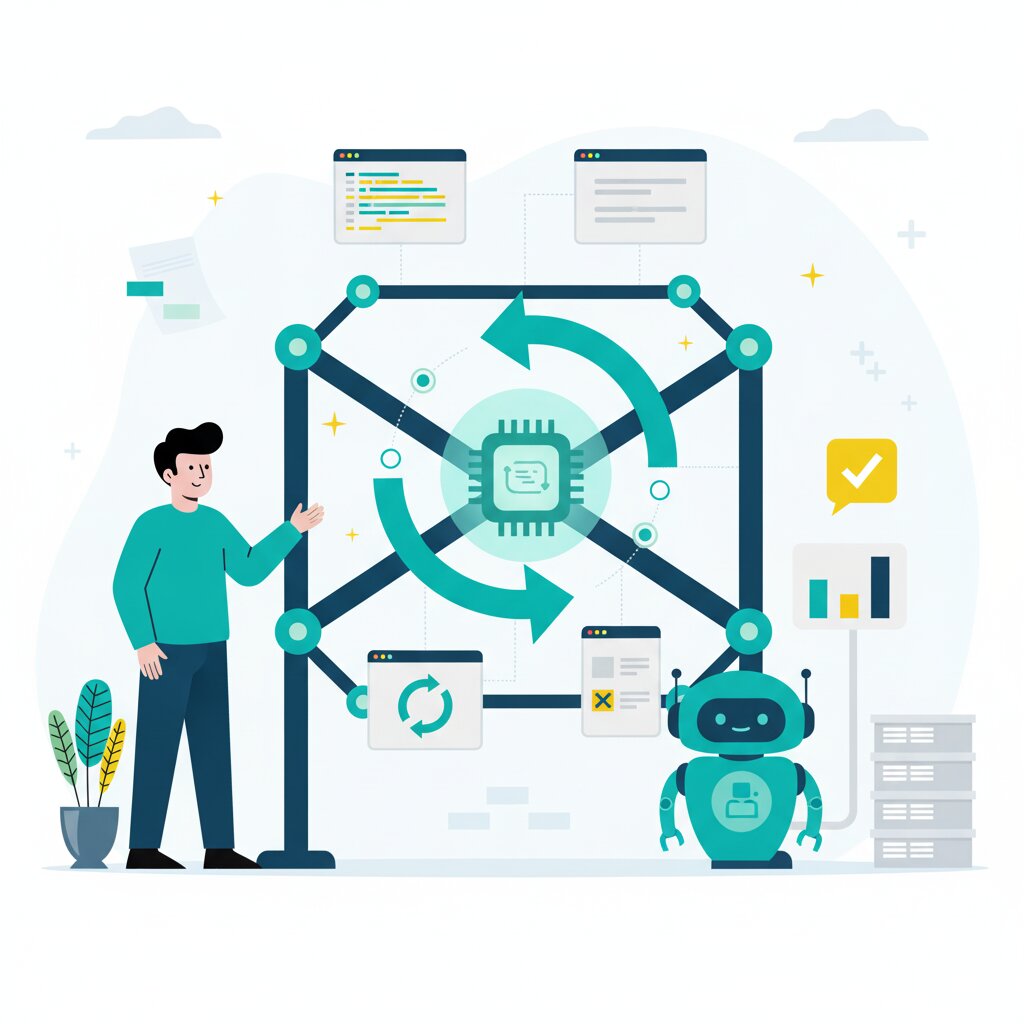
A raw model answers one prompt and stops. It has no memory between calls and no way to execute anything it suggests. The harness fills that gap, with five pillars:
- Memory gives continuity across turns and sessions: working context, durable stores, action logs.
- Tools are the action interface (typed tools, MCP servers, shell execution) that lets the model act, not just suggest.
- Orchestration keeps work moving: sub-agents, handoffs, retries, stopping criteria.
- Governance checks, constrains and repairs execution: tests, linters, LLM-as-judge checks, sandboxing, approval gates, audit trails.
- Context engineering curates the context window (retrieval, compression, progressive disclosure) to fight context rot.
In plain terms, the model is the engine and the harness is the transmission, steering, brakes and dashboard: the parts that make it drivable and safe. That is also why you are building your own. Off-the-shelf scaffolding does not encode your workflow, your coding standards or your governance, so the harness is where your business’s reliability and differentiation live. For the full inventory, see what a harness contains and what owning each component costs. Owning that layer is where the competitive advantage now sits.
Why has the competitive advantage in enterprise coding agents moved from the model to the harness?
Competitive advantage has moved up the stack. Model-layer lock-in is ending, and vendors have shifted the dependency one level higher, into the harness. That is where you now encode workflow, tooling and reliability, and harness engineering has emerged as the discipline that turns that scaffolding into a defensible edge.
For a while, model-layer lock-in was the vendor strategy. That is over. Model-layer lock-in is ending because models commoditise in months, and vendors moved the lock-in one level higher, into the layer that does not commoditise. Your workflow lives in the harness. When you run the same weights as everyone else, what separates you is the tooling, the coding standards and the reliability guarantees you wrap around them, the last mile a model alone does not deliver.
Harness engineering, the successor to prompt engineering, is a system-design concern. Prompt engineering optimises a single instruction; harness engineering designs the whole environment and treats every agent mistake as a signal to convert into a rule, a hook or a verifier. That compounds gains model upgrades alone cannot match, because a decent model with a great harness beats a great model with a bad harness. The commercial consequence is visible: vendors now sell the runtime the way AWS sells compute, an offering people call harness-as-a-service.
Once a harness runs unattended, governance becomes the next frontier. Permission models, sandboxing and audit trails are what keep a reliable harness reliable at scale, which is why the build-versus-buy decision turns on what ownership costs. Build and own the harness; treat the model as a rented input.
How much does the harness actually change an agent’s performance, with the model weights held constant?
With GPT-5 weights held constant, the harness moves performance from 35.2% in Terminus 2 to 49.6% in Codex CLI on Terminal-Bench 2.1. That is a 14.4-point harness performance delta, produced by changing only the scaffolding. It isolates the harness as the lever, though harness-sensitive benchmarks mean any single number is directional rather than definitive.
The pattern generalises. Across the 20 models with at least three observed harness results, the median within-model range is 13.6%, and 14 of the 20 vary by at least 10 points. A controlled factorial put harness-induced variance at 7.8 times model-induced variance.
Treat any single figure as directional, because Terminal-Bench 2.1 and SWE-Bench are harness-sensitive and can disagree. One study found harness choice inducing up to a 40x difference in tokens per solved task while paired pass-rate differences stayed within 0 to 8 points, a warning against reading any leaderboard number as model quality. A good harness generalises across tasks rather than being tuned to one benchmark.
A constant-weights experiment removes the model as a variable, turning an abstract “scaffolding matters” claim into a number you can act on, and it is clear evidence that the harness is the lever worth pulling. If you want to judge your own harness rather than a benchmark, start with harness-aware evaluation, and some of that capability comes from the supply chain underneath the harness.
The model is a rented, converging input. The harness is the asset you build, own and iterate. The question becomes which harness you run, and who governs it.
Harness engineering is where durable edge compounds. Anthropic’s engineers put it this way: every component in a harness encodes an assumption about what the model can’t do on its own. As the model improves, that assumption goes stale, so the harness is a living system that must evolve with it. Governance is what keeps that living system reliable as it runs unattended. If you want to see how it is all shaking out, the build-versus-buy landscape is where the next decision sits.
Frequently Asked Questions
What is the difference between an agent harness and an agent framework?
An agent framework is the software library you build with; the harness is the complete operating layer your agent actually runs inside. A framework like LangChain gives you primitives for agents, whereas the harness adds memory, tools, orchestration, governance and context engineering around a specific model. In practice, teams often start with a framework and end up shaping something closer to a full harness as reliability demands grow.
What is context rot, and how does the harness fight it?
Context rot is the gradual decline in a model’s output quality as its context window fills with stale, redundant or irrelevant content. Because every token competes for the model’s attention, a long-running session degrades unless something manages what stays in view. The harness fights it through context engineering: retrieval, compression and progressive disclosure keep only what matters in the window. That is why two agents on the same model can diverge sharply over a long task.
Is harness engineering just prompt engineering with a new name?
No. Prompt engineering optimises a single instruction; harness engineering designs the system around the model and treats every agent failure as a signal to convert into a rule, hook or verifier. It is closer to platform engineering than to prompt writing, because it spans memory, tools, orchestration, governance and context. Prompt craft still matters, but it is now one small component inside a much larger discipline.
Does a better harness mean I can get away with a cheaper model?
Often yes, and that is the practical upside of harness investment. A strong harness compensates for model weaknesses with retrieval, verification and retries, so a cheaper or smaller model can clear tasks that would previously have needed the frontier tier. The caveat is that the raw reasoning ceiling still belongs to the model; the harness raises reliability and consistency more than it raises absolute capability.
Is it true that the model no longer matters at all?
Yes, but as a floor rather than a differentiator. The model sets the ceiling on raw reasoning, so a weak model will still fail hard problems no harness can rescue. What has changed is that the frontier tier has converged, so most competitors start from a similar floor. The edge then comes from how well your harness exploits that floor.
Is Cursor or GitHub Copilot already an agent harness?
Partly. Tools like Cursor, GitHub Copilot and Codex CLI are harnesses, because they wrap a model with tools, memory and orchestration rather than exposing it raw. What they are not is your harness: they encode someone else’s defaults for workflow, permissions and verification, not your coding standards or governance. Many teams run one of these while building the parts they need to own.
How do I know whether my agent harness is actually any good?
Judge it the way you judge any system: on outcomes, not demos. Measure task completion and rework on a representative set of your own repositories, track how often the agent needs a human rescue, and watch latency and token cost per task. A good harness generalises across tasks rather than topping a single benchmark, so build a harness-aware evaluation suite and rerun it on every change.
What happens if I swap models but keep my harness the same?
You keep your reliability. Because the harness holds memory, tools, orchestration and governance, swapping the underlying model becomes an upgrade rather than a rewrite. Your prompts, verifiers and workflows keep working, and you can A/B the new weights against the old inside the same scaffolding. That portability is exactly why the harness, not the model, is the layer worth owning.
Can I buy an agent harness instead of building one?
You can, and for many teams buying is the right starting move. Harness-as-a-service and open-source scaffolds get you running quickly with sensible defaults. The trade-off is the last mile: vendor tooling rarely encodes your workflow, coding standards and governance, so the more reliability you need, the more you end up owning. Treat it as a component-by-component decision rather than a single yes or no.
Is it safe to let a coding agent run unattended with a good harness?
A good harness makes unattended runs viable, not automatically safe. Reliability comes from the same governance primitives that make it dependable: sandboxing, permission models, approval gates and audit trails. Start with tight permissions and human checkpoints, then loosen them as your evidence accumulates. Once agents run unattended, governance stops being a feature and becomes the control that keeps the harness trustworthy.
Where does MCP fit into an agent harness?
MCP, the Model Context Protocol, is the standardised way a harness connects a model to external tools and data. Think of it as the plug layer: instead of hand-writing an integration for every service, the harness speaks one protocol and inherits a growing library of servers. It expands what your tools pillar can reach without changing the model itself.
Does the harness matter for tasks outside coding?
The same principles apply to any agent that takes multi-step action, including research, operations and support workflows. The coding case is simply where the benchmarks are sharpest, which is why the evidence is clearest there. If an agent needs memory, tools, orchestration and governance to be reliable, the harness logic transfers, even though the specific tools and verifiers will differ.