
Enterprise organisations are deploying AI agents in production and watching them fail. Not because of poor implementation — because the underlying architecture is wrong for the environment. Judson Althoff, Microsoft’s CEO for commercial business, put a number on it: north of 80% of enterprise AI projects fail. Menlo Ventures found that agentic AI remains a niche compared to copilot usage, where humans stay in the loop. Enterprises are voting with their wallets.
This article does two things. First, it diagnoses exactly why pure LLM-based agents break in B2B environments — the failure modes are specific, documented, and structural. Second, it gives you a practical architecture path forward you can act on now.
This article sits within the broader enterprise agent platform war — a fast-moving competitive landscape where vendors are racing to claim the category. The platforms claiming to solve the problems described here are covered in the landscape overview of OpenAI Frontier, Salesforce Agentforce, IBM WatsonX, and the race to own enterprise AI. This article is about the technical foundation those platforms must be built on.
Why Does Enterprise B2B Demand a Different Standard Than Consumer AI?
Enterprise B2B workflows are long-horizon, multi-step processes — not single-turn interactions. A contract approval can span days and touch dozens of systems. A regulated claims process must produce a complete audit trail from intake to resolution.
There are three requirements in enterprise B2B that simply do not apply to consumer AI.
Auditability. Every decision must be timestamped, traceable, and producible on demand. This is a legal obligation under SOC 2, HIPAA, GDPR, and the EU AI Act. Regulated industries cannot accept “the agent decided” as an explanation for a consequential action.
SLA compliance. If a pure LLM agent produces a different answer to the same input on consecutive runs — which it structurally can — then any SLA built on top of it is not actually guaranteed.
Regulatory constraints. FinTech companies must demonstrate full process traceability. HealthTech companies must reconstruct exactly what happened to a piece of patient data, at what step, and why. The EU AI Act applies regardless of where the developer is headquartered — including Australian and US SaaS companies with EU user bases.
When consumer AI fails, it’s annoying — a wrong answer, a hallucinated fact. When enterprise B2B AI fails, it’s costly and sometimes irreversible: an incorrect financial transaction, a regulatory non-compliance finding, a violated SLA.
The word that matters here is “deterministic.” A deterministic system produces exactly the same output every time it receives the same input — same request, same result, always. LLMs are probabilistic: outputs vary even for identical inputs. In consumer applications, that’s a feature. In audit-required enterprise workflows, it’s a structural disqualifier for serving as the control logic.
What Are the Four Failure Modes of Pure LLM Agents in Production?
Pure LLM agents do not fail randomly. They fail in four specific, documented ways.
Failure Mode 1: Context window exhaustion. LLMs have a hard ceiling on working memory. In multi-step enterprise workflows spanning hundreds of operations, agents lose track of prior state. Constraints established early in the workflow get forgotten or violated later. This is not a tuning problem — it is a hard technical ceiling.
Failure Mode 2: Hallucination under consequential actions. LLMs generate plausible but incorrect outputs or tool calls. In an enterprise context where the agent is writing to a CRM, initiating a financial transaction, or modifying a regulated record, a hallucinated value in an early step can cascade and corrupt the entire workflow. If an agent has a 99% accuracy rate per step across a 100-step workflow, the probability of at least one error in that run is approximately 63%. Controlled benchmarks do not compound across real-world task chains.
Failure Mode 3: Non-determinism makes audit trails structurally impossible. Two identical inputs can produce different outputs from the same LLM call. That is an inherent property, not a defect. But it means it is structurally impossible to reconstruct why a specific decision was made — a compliance failure in any regulated industry.
Failure Mode 4: State drift under constraint accumulation. As workflows accumulate intermediate states and conditional branches, pure LLM agents increasingly fail to honour constraints established earlier in the process. The UC Berkeley MAST study identified 14 unique failure modes across 1,600+ annotated multi-agent traces — 41.8% from specification and system design issues. These require structural redesigns, not surface-level fixes.
The vendors claiming to solve these problems — OpenAI Frontier, Salesforce Agentforce, IBM WatsonX Orchestrate, Microsoft Copilot Studio — deserve scrutiny against each of these failure modes before any procurement decision.
What Does Academic Research Actually Say About When Autonomous Agents Will Be Ready?
The gap between where autonomous AI agents are today and where they need to be is not a matter of opinion. It is a matter of research status.
The Agent-R1 team at China’s University of Science and Technology says it directly: “The effective application of RL to LLM Agents is still in its nascent stages and faces considerable challenges.” The field is “emerging,” not solved.
Current LLMs are trained to produce plausible next tokens. Reinforcement learning would train agents differently — by having them take actions, observe consequences, and update behaviour based on rewards and penalties. That is the training methodology that would close the gap between “generates plausible text” and “reliably completes complex multi-step tasks.” DiscoRL, from Google DeepMind, represents the frontier of what RL for agents could become. It is not available for enterprise deployment.
The market has already drawn the practical conclusion. The fastest-growing enterprise AI category is copilot-pattern usage — human-assisted AI, not autonomous systems. When major vendors send on-site “forward deployed engineers” to help enterprises build agentic workflows, that is evidence that self-service enterprise agent deployment is not yet a reality.
“Years away, not here now” is the correct calibration. That gap is precisely why the hybrid architecture is the right design choice for anything built today.
Where Does RPA Still Win — and Where Do AI Agents Actually Add Value?
AI agents and Robotic Process Automation (RPA) solve different problems. The best production architectures embed AI nodes inside RPA workflows — not the other way around.
RPA executes explicit, predefined steps on structured data — reliably, repeatedly, auditably. It is deterministic by design and wins on fully structured, high-volume processes and any regulated workflow where control flow must be explainable to auditors.
AI agents add genuine value at the steps where RPA struggles: natural language document parsing — contracts, support tickets, unstructured emails — where input format varies; classification and routing at intake; draft generation and summarisation.
UiPath VP of Product Management Taqi Jaffri makes the case for keeping existing RPA intact: “Sometimes determinism is good, meaning it works the same way every time. And if it fails, it fails the same way every time.” Predictable failure is debuggable. Unpredictable failure is neither.
Keep LLMs at the boundaries — intake parsing, output summarisation — and run all logic, branching, and consequential actions through deterministic code.
Why Is Integration Infrastructure the Hidden Bottleneck — Not Model Capability?
The limiting factor for enterprise AI agent scale is not the quality of the underlying language model. It is the depth and reliability of the integration infrastructure connecting agents to the data and systems they need to act on. This is The New Stack’s documented finding.
Tray.ai’s survey of over 1,000 enterprises found that 86% require tech stack upgrades before deploying AI agents, and 48% admit their existing iPaaS is only “somewhat ready.” An agent that cannot reliably read current state or write back confirmed results is a prototype, not a production system.
MCP (Model Context Protocol) and the A2A Protocol (Google-backed agent-to-agent coordination) will eventually reduce this bottleneck — both endorsed by Anthropic, Google, Microsoft, OpenAI, and AWS. Both are in early adoption. RAG is the current workaround — fetching relevant documents at inference time — but it cannot recover state accumulated across hundreds of steps in a long-horizon workflow.
Evaluate your integration layer before evaluating agent platforms. Fragmented data across 15 SaaS tools with incomplete API coverage will not be fixed by any agent platform.
What Does Hybrid Agent Architecture Actually Look Like in Practice?
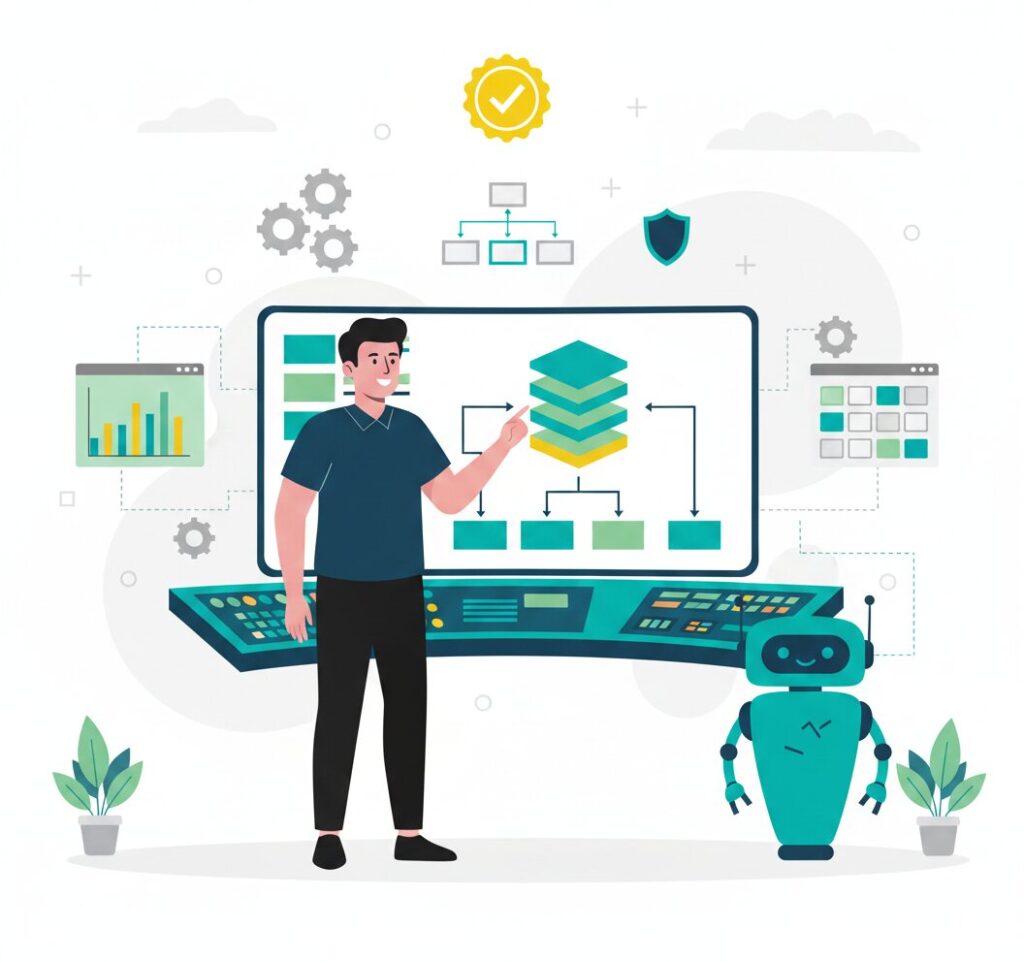
The hybrid architecture is a deterministic workflow backbone with selectively placed LLM nodes. The LLM is a component of the system, not the controller.
The state machine backbone. A state machine is a formal model where every valid state, valid transition, and error path is explicitly defined in code before runtime. Every state transition is a loggable event — which is how you satisfy HIPAA, SOC 2, GDPR, and EU AI Act audit requirements without retrofitting compliance later.
The three-tier decision framework gives you the practical selection model.
Tier 1 — Pure deterministic workflow automation. No AI, fully scripted, maximum auditability. Use for structured data processing, regulatory reporting, rule-based approvals.
Tier 2 — Human-in-the-loop with AI assist. The LLM parses input or generates suggestions; a human approves before any consequential action. Use for contract review, support escalations, regulated financial decisions.
Tier 3 — Autonomous agent within bounded scope. AI acts on low-stakes, reversible decisions within explicitly defined guardrails — draft generation, summarisation, low-risk classification. If the action cannot be undone, it does not belong in Tier 3.
The HITL spectrum. Human-in-the-loop requires approval before each consequential action. Human-on-the-loop lets the system act while a human monitors and can intervene. Out-of-the-loop is fully autonomous within defined guardrails — for demonstrably reversible, low-stakes actions only. Which level you need depends on your regulatory exposure and the reversibility of each action, not a blanket policy across the whole deployment.
The governance dimension of this decision is covered in the organisational counterpart to technical guardrails.
How Do You Evaluate Vendor Claims Against This Framework?
Every major platform — OpenAI Frontier, Salesforce Agentforce, IBM WatsonX Orchestrate, Microsoft Copilot Studio — claims to deliver “agentic” capability. Use the failure mode analysis as your checklist, and use it in vendor conversations, not after them.
Here are the four questions to ask any vendor claiming enterprise-ready AI agents.
Auditability. Can the platform produce a complete, timestamped log of every agent decision for a compliance audit? Vague, conditional, or roadmap answers mean it is not enterprise-grade for regulated industries today.
Rollback and override. Does the platform support human override at defined workflow steps, and can erroneous actions be rolled back? Autonomous systems without override capability are not appropriate for consequential B2B workflows.
Deterministic backbone. Is the workflow execution engine deterministic — same inputs, same outputs, always — or does all logic route through LLM calls? Platforms routing all logic through LLMs cannot satisfy audit requirements structurally.
Integration depth. How does the platform connect to your existing systems — via maintained API integrations, or via surface-level connectors? Evaluate this against your actual systems, not a generic capability list.
Watch out for these red flags: “fully autonomous” framing without guardrails; demos on clean, synthetic data; compliance reporting on the roadmap rather than in the product; pricing that scales with autonomy rather than reliability.
When vendors send on-site engineering teams to help enterprises deploy, that signals self-service enterprise agent deployment is not yet a reality. Factor that implementation cost into your timeline before signing contracts. For a technical reality informs what you’re locking into perspective on these platforms, see the lock-in risk analysis.
What Should You Build Right Now While Waiting for Mature Agentic AI?
The gap between where autonomous AI agents are today and where they need to be is measured in years, not quarters. Build the right foundation now and your infrastructure will integrate with mature autonomous agents cleanly when they arrive.
Here are four concrete actions to take.
1. Audit your existing workflows for determinism readiness. Map which workflows run on structured data with defined decision trees — and which rely on human judgement at ambiguous steps. The second category is where AI nodes will add value. Do this before touching any agent platform.

2. Build the integration layer before buying the agent platform. If your data is fragmented across disconnected SaaS tools, no agent platform will fix that. iPaaS platforms — MuleSoft, SAP Integration Suite, Tray.ai — are available now. Design for MCP compatibility so future upgrades require configuration changes, not rebuilds.
3. Pilot copilot patterns, not autonomous agents. Deploy AI in human-assisted modes — document parsing, draft generation, classification at intake — and measure quality before removing the human gate. The hybrid architecture is the production-proven design, not a stepping stone.
4. Establish agent governance before you need it. IBM’s “AI licence to drive” — requiring builders to demonstrate data privacy, security, and integration competency before building on their platform — prevents agent sprawl before it starts. Governance design before deployment is the lower-cost path.
The hybrid agent architecture is the architecture that survives contact with enterprise B2B requirements. When RL research matures and the autonomy gap closes, the deterministic backbone you built today will integrate with genuinely capable autonomous agents cleanly. You will not be rebuilding. You will be extending.
That is the enterprise agent platform landscape the winning platforms are building toward. The question is whether your foundation will be ready when they get there. To evaluate platform claims against these failure modes, see the structured platform comparison. For a complete map of the vendor landscape, strategic risks, and how this technical analysis fits into the broader picture, see the enterprise agent platform war overview.
Frequently Asked Questions
Is ChatGPT an AI agent?
No. ChatGPT is a conversational AI assistant — a copilot, not an autonomous agent. It responds to prompts but does not independently decompose goals or execute multi-step tasks without human direction. OpenAI Frontier is the enterprise agent management platform — that’s a distinct product category.
When will AI agents be reliable enough for enterprise use?
Full autonomous reliability is measured in years, not months. The Agent-R1 team at China’s University of Science and Technology describes the field as “still in its nascent stages.” DiscoRL (Google DeepMind) represents promising future capability that is not enterprise-deployable today. Hybrid architectures — deterministic workflow backbones with selective AI nodes — are enterprise-reliable now. That is what to build.
Should I replace my RPA tools with AI agents?
No. The production-proven approach, exemplified by UiPath Maestro, embeds LLM-based agent nodes inside existing RPA workflows at the specific steps where natural language ambiguity genuinely exists. For repeatable tasks with well-defined rules, there is no benefit to introducing agent variability — and meaningful downsides in auditability.
What is “deterministic” in plain English?
Same input, same output, every time. LLMs are probabilistic — outputs vary even for identical inputs. In consumer applications, that is a feature. In audit-required enterprise workflows, it is a structural disqualifier for serving as the control logic. Deterministic workflows form the backbone of the hybrid architecture.
What is the difference between human-in-the-loop and human-on-the-loop?
Human-in-the-loop means a human must approve before each consequential action — required for regulated steps like financial transactions or medical data writes. Human-on-the-loop means the system acts but a human monitors and can intervene. Out-of-the-loop means fully autonomous within explicitly defined guardrails. The appropriate level depends on regulatory exposure and reversibility — not a blanket policy across an entire deployment.
Does my company need to comply with the EU AI Act if we are based in Australia or the US?
Yes, if your system processes data from EU residents or is deployed to EU customers. The EU AI Act applies regardless of where the developer is headquartered. For FinTech and HealthTech companies with EU user bases — common for Australian SaaS companies expanding internationally — this creates an obligation to classify AI agent systems by risk level and implement corresponding governance requirements.
What is agent sprawl and how do I prevent it?
Agent sprawl is the ungoverned proliferation of AI agents built independently across teams — the AI equivalent of shadow IT. Gravitee’s State of AI Agent Security 2026 report found more than 3 million AI agents now operating within corporations; only 47.1% are actively monitored or secured. Prevention requires governance before deployment begins, not retrofitted after. IBM’s “AI licence to drive” — competency certification before building on enterprise AI infrastructure — is the most concrete published model.
What is RAG and is it a substitute for a better memory architecture?
RAG (Retrieval-Augmented Generation) grounds LLM responses in current enterprise data by fetching relevant documents at inference time — reducing hallucination on factual questions. It is a workaround, not a solution: it cannot recover state accumulated across hundreds of steps in a long-horizon workflow. Use it within a deterministic workflow backbone, not instead of one.
What is MCP and why should I care about it now?
MCP (Model Context Protocol) is an emerging standard — endorsed by Anthropic, Google, Microsoft, OpenAI, and AWS — for connecting AI agents to backend systems in a consistent, secure way. Think of it as the REST API standard for agent-to-system communication. It is in early adoption, not yet the production default. Design for MCP compatibility now so future upgrades require configuration changes, not architectural rebuilds.
How do I know if a vendor’s “agentic” product is actually autonomous or just a workflow with AI decoration?
Use the four questions from the Vendor Evaluation section: audit log completeness, human override and rollback support, deterministic execution engine, and integration depth against your actual systems. A product that cannot answer all four satisfactorily is not enterprise-grade for regulated B2B environments.
Is integration infrastructure really the bottleneck, or is it the AI model quality?
Integration infrastructure is the bottleneck — this is The New Stack’s documented finding. The best language model available cannot reliably take actions in your enterprise systems if it cannot read current state or write confirmed results back through reliable integrations. Tray.ai’s survey confirms it: 86% of enterprises need tech stack upgrades to deploy AI agents, 90% view integration as necessary. Assess your integration layer depth before evaluating any agent platform.
What is the difference between an AI copilot, an AI agent, and an agentic workflow?
Copilot: An AI assistant where the human initiates and approves each consequential action. AI agent: An autonomous system that independently decomposes a goal into steps and executes multi-step tasks without human approval at each step — still in research phase for complex enterprise tasks. Agentic workflow: A deterministic workflow with AI nodes at specific steps, maintaining human oversight and deterministic control logic for the overall process — the hybrid architecture recommended in this article.