
The enterprise agent platform war is forcing every CTO to make a call. Pick a control plane, and lock-in starts — quietly, across multiple layers, compounding with every month of deployment.
Snowflake committed $200 million to OpenAI and simultaneously maintained live partnerships with Anthropic, Google, Meta, and Mistral. ServiceNow signed multi-year deals with both OpenAI and Anthropic in January 2026 and framed it explicitly as a customer optionality feature. These are not accidents. They are deliberate multi-model portability strategies executed at scale by companies that understand what lock-in actually costs.
This article gives you a practical framework: how lock-in works across four distinct layers, what Snowflake and ServiceNow did and why, a vendor negotiation checklist, a TCO model, and the build-vs-buy decision for the orchestration layer. Let’s get into it.
How does platform lock-in actually work with enterprise AI agent platforms?
Enterprise AI agent platform lock-in is what happens when switching vendors becomes prohibitively expensive — not because of a contract clause, but because of accumulated technical and organisational dependencies that built up while you were busy shipping.
The lock-in moment is earlier than most CTOs expect. It happens when you select an agent control plane — the orchestration layer that governs which agents run, what data they access, and how they are monitored. That layer becomes the connective tissue of your entire AI operations stack. Replacing it means re-architecting everything connected to it.
Here is the distinction that matters most. Most CTOs conflate model lock-in — which AI provider you use — with control plane lock-in — which orchestration layer governs your agents. These are separate risks. You can switch your model provider without touching your control plane, and you can be deeply locked into a control plane while maintaining complete freedom at the model layer. Get that distinction wrong and you will be solving the wrong problem.
What are the four layers of lock-in and how do they compound?
There are four distinct lock-in types in the enterprise AI agent context. Most procurement frameworks address one or two. The others accumulate undetected.
Control Plane Lock-In is the deepest layer. AWS AgentCore stores agent definitions, memory, and tool integrations in AWS-native services. Azure AI Foundry integrates tightly with Azure Active Directory and Azure Monitor — portability to another cloud requires a rewrite. LangGraph offers the lowest lock-in but the highest implementation complexity.
Data Lock-In covers proprietary data schemas, vector store formats, and knowledge graph structures that cannot be cleanly migrated. Standard data portability clauses address raw data, but they rarely cover embeddings, fine-tuning datasets, and prompt libraries that accumulate during normal operation.
Model Lock-In is dependence on a specific provider’s model APIs, fine-tuning pipelines, or prompt engineering patterns optimised for one model family. This is the layer most CTOs focus on — which is exactly why the others get underestimated.
Behavioural Lock-In is the most underestimated and fastest-growing layer. Persistent AI agents accumulate institutional memory — learned workflows, user preferences, domain-specific context — that is proprietary to the vendor’s platform and cannot be exported as raw data. Data portability regulations do not address this. The more capable your agents become, the more this layer compounds invisibly.
Each layer adds switching cost independently. Together they create a situation where no single mitigation resolves the full exposure. A CTO who negotiates data portability clauses but ignores behavioural lock-in has addressed the easiest problem. Understanding what you are actually locking yourself into — including the technical architecture that makes agents reliable enough to justify the commitment — is prerequisite to any rational lock-in strategy.
How did Snowflake avoid lock-in while still signing a $200M OpenAI deal?
The Snowflake $200 million OpenAI partnership is simultaneously the most visible large-enterprise AI vendor commitment on record and the clearest documented example of multi-model portability strategy in practice. Both things are true at once.
What Snowflake actually signed: a multi-year partnership embedding OpenAI GPT-5.2 into Snowflake Cortex AI, giving 12,600 enterprise customers access to GPT-5.2 for data analysis (Cortex Code) and natural language data querying (Snowflake Intelligence). Before this deal, Snowflake customers accessed OpenAI models through Azure. The direct partnership improved performance and commercial terms without deepening the architectural dependency.
What Snowflake did not do: abandon any other model partnership. Baris Gultekin, VP of AI at Snowflake, stated: “We remain intentionally model-agnostic. OpenAI is one of several frontier model providers available on Snowflake today, alongside Anthropic, Google, Meta, and others.” This came two months after Snowflake announced a separate $200 million Anthropic partnership on nearly identical terms. The dollar figure reflects negotiating leverage, not architectural exclusivity.
The portability mechanism: Snowflake integrates at the data layer, not the model layer. Cortex AI routes queries to whichever model is most appropriate, with OpenAI, Anthropic, Google, Meta, and Mistral available simultaneously. The customer selects a model per use case; Snowflake handles the routing.
The platforms covered in detail here include a breakdown of how each one positions its lock-in depth.
Why did ServiceNow sign with both OpenAI and Anthropic at the same time?
In January 2026, ServiceNow signed multi-year enterprise deals with both OpenAI and Anthropic within weeks of each other. ServiceNow President, COO, and CPO Amit Zavery was direct about why: they wanted to give their customers and employees the ability to choose which model they wanted based on the task at hand.
OpenAI models power multimodal and speech-to-speech agents in ServiceNow’s Now Assist. Anthropic’s Claude is the default engine for Build Agent and for healthcare and life sciences workflows. All models run through a unified control plane.
The numbers make the logic obvious. Anthropic now earns approximately 40% of enterprise LLM spend, up from 12% in 2023, while OpenAI’s enterprise share has declined from 50% to 27% over the same period, per Menlo Ventures‘ 2025 State of Generative AI in the Enterprise report. A platform betting exclusively on OpenAI is structurally excluding the model preference of the largest and fastest-growing share of the enterprise market.
The practical test for CTOs evaluating platforms: ask every vendor how multi-model support is implemented architecturally. “We support multiple models” is easy to claim. Ask for specifics on routing logic, fallback behaviour, and what happens to your agents if one model provider raises prices.
What should you negotiate with an AI vendor to protect multi-model portability?
Technical architecture and contractual provisions both need to address the same risks — one without the other leaves exposure. Here are six provisions to put in front of any AI agent platform vendor before you sign.
-
Data portability clause: Right to export all data, agent configurations, and embeddings in standard, machine-readable formats at any time — not only on contract termination. Require format specifications; “we will provide your data” without a format commitment is operationally meaningless.
-
Behavioural data portability provision: Right to export agent memory, learned workflows, and conversation history in transferable formats. Vendors will not include this unless you ask explicitly.
-
Exit clause: Terms specifying a clean termination process including a data retrieval window (minimum 90 days), format guarantees, and transition assistance.
-
Pricing transparency requirement: Contractual commitment to itemised pricing including token consumption costs and model access fees. None of the major enterprise agent platforms — OpenAI Frontier, Salesforce Agentforce, IBM WatsonX Orchestrate, Microsoft Copilot Studio — publishes clear pricing. That opacity is a procurement signal.
-
Model substitution rights: The contractual right to switch the underlying model provider without a new contract or re-implementation.
-
Short initial contract term: Negotiate 12-month initial terms with renewal options rather than 36-month commitments until you have validated actual switching costs.
When you get vendor responses, distinguish between vague commitments (“we support data portability”) and specific technical ones (“we support ONNX model export and MCP-compliant API access”). Vague is a no.
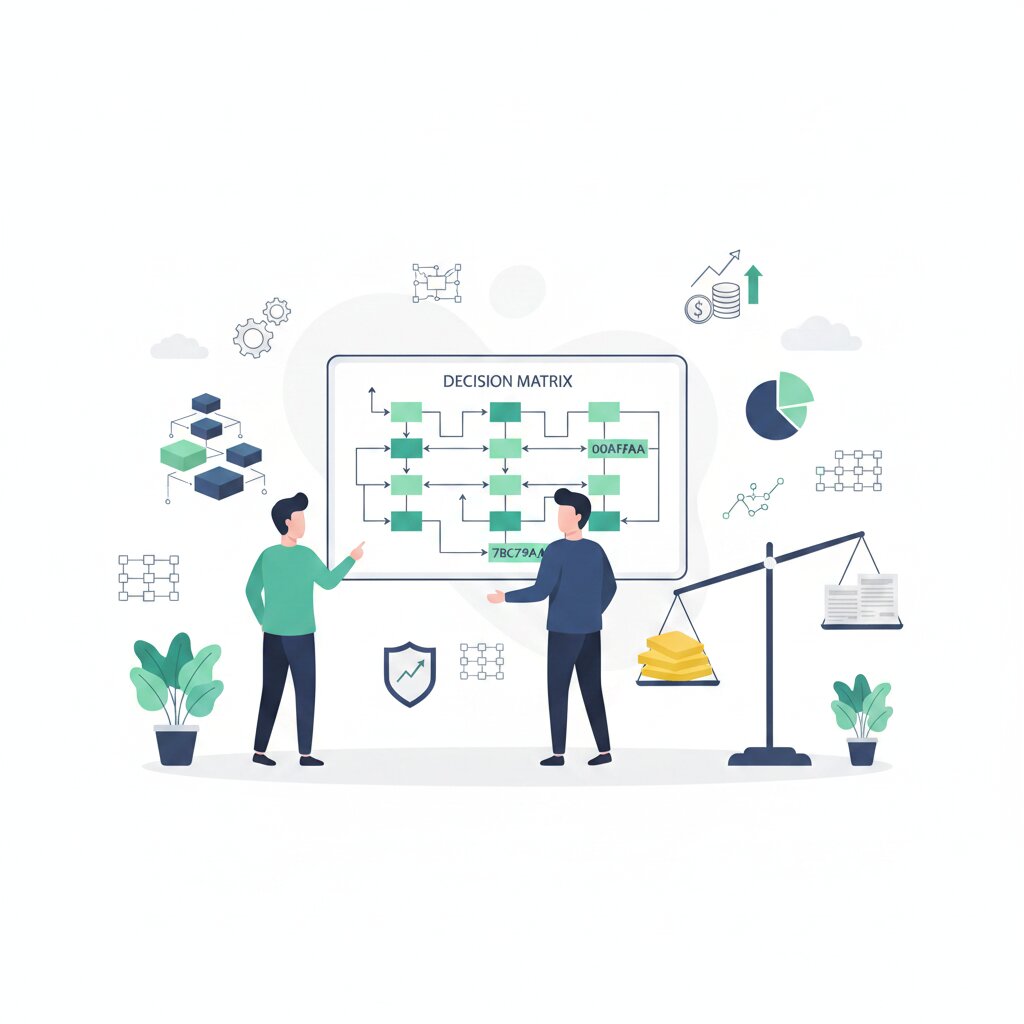
For overall vendor posture evaluation, use the Kai Waehner Trust vs. Lock-In Matrix. Anthropic ranks in the “Trusted and Flexible” quadrant based on its Constitutional AI governance approach and authorship of the Model Context Protocol (MCP) — the open standard that standardises how AI agents connect to enterprise tools and data sources. Requiring MCP compliance is a practical lever for reducing integration-layer lock-in.
How do you calculate the true total cost of owning an enterprise AI agent platform?
Enterprise AI agent platform TCO is consistently underestimated. Traditional procurement frameworks were designed for software licences, not systems whose operational cost scales with usage and compounds with model drift.
IBM CIO Matt Lyteson, deploying WatsonX Orchestrate at scale, identified token cost management as a critical metric that was not in the initial procurement calculus. That finding applies across all platforms — token consumption at production scale regularly dwarfs the licence fee within months of deployment.
Five components to account for:
Platform and model access costs: Licensing fees, API call costs, token consumption rates. Apply a 3x buffer when projecting monthly token volume — the gap between test usage and production is rarely pleasant.
Integration and implementation costs: Engineering time to connect agents to data sources, CRM, ticketing, and enterprise APIs. MCP-compliant vendors reduce this significantly.
Model drift remediation costs: Monitoring and responding when model outputs change without code changes. Budget 15–25% of inference compute cost annually.
Behavioural re-training costs: Retraining agent behaviour after model updates or platform changes. This recurs and does not appear in year-one projections.
Migration and switching costs: Re-implementation, data conversion, retraining, and productivity loss during transition. Everyone underestimates this until they need to switch.
No major platform publishes clear pricing, so every TCO calculation requires direct vendor engagement. Vendors that refuse to provide itemised pricing before contract are signalling something about the post-contract experience.
When is an open-source orchestration layer worth the overhead compared to a commercial platform?
The build-vs-buy decision for the agent orchestration layer is the most consequential architectural choice for lock-in risk. Here is the short version.
Open-source is worth the overhead when three conditions hold simultaneously:
- You have at least one developer with agent framework experience who can own it
- Your use cases are well-defined enough to specify routing logic explicitly
- Vendor lock-in risk is a board-level or compliance concern — standard in FinTech and HealthTech
The minimum viable multi-model setup for a resource-constrained team (3–5 engineers): deploy LiteLLM as an AI gateway (open-source, unified API across all major providers), use LangGraph as the orchestration layer (low lock-in, active ecosystem), and require MCP compliance from any data source integration. That three-component stack gives you multi-model portability without a dedicated platform engineering team.
LangGraph provides stateful, graph-based orchestration — agents can revisit previous steps and adapt to changing conditions. It supports self-hosting or cloud deployment and integrates natively with LangSmith and Langfuse for observability. CrewAI is a lighter alternative for simpler task-automation use cases.
When a commercial control plane is the right call: if you need enterprise support SLAs or compliance certifications (SOC 2, HIPAA, PCI-DSS), commercial platforms justify their lock-in cost. The key is to negotiate portability provisions upfront rather than accepting default terms.
For a platform comparison with lock-in posture as a key dimension, the comparison article in this series has the side-by-side analysis.
Frequently Asked Questions
Does using OpenAI Frontier lock you in to OpenAI models?
OpenAI Frontier nominally supports agents built on third-party models. But the control plane itself is proprietary — build your orchestration on Frontier’s APIs and you face significant migration cost if you ever want to switch control planes. Model portability and control plane portability are separate questions. Frontier addresses the first; it does not address the second.
Can I switch AI agent platforms later if I choose wrong now?
Yes, but the cost compounds with every month of deployment. Data accumulates in proprietary formats, agent memory builds platform-specific context, and workflow integrations embed platform-specific API calls. Switching is always technically possible; the question is whether the switching cost will exceed the cost of staying.
What is behavioural lock-in and is it really different from data lock-in?
Behavioural lock-in arises when a persistent AI agent accumulates learned workflows, user preferences, and domain-specific context embedded in the vendor’s training and memory architecture — not in exportable files. Data portability clauses let you export raw data, but they do not transfer the agent’s learned behaviour. Rebuilding it on a new platform requires re-training proportional to the maturity of the original deployment.
What is multi-model portability and why should CTOs care about it?
Multi-model portability is the capability to deploy, switch between, or simultaneously use AI models from multiple vendors without rebuilding your integration layer. Anthropic’s rise from 12% enterprise market share in 2023 to 40% in 2025 illustrates how quickly model preference shifts. Being locked into a single provider means being unable to switch when a better option emerges or when prices increase.
What is an AI gateway and do I need one?
An AI gateway is middleware inserted between your applications and AI model APIs that decouples your application logic from any specific AI provider. LiteLLM is the most widely adopted open-source AI gateway. If you want the ability to switch providers or run multiple models simultaneously, an AI gateway is the minimum viable implementation of that capability.
What is the Model Context Protocol (MCP) and why does it matter for avoiding lock-in?
MCP is an open protocol, originated by Anthropic, that standardises how AI agents connect to enterprise tools, APIs, and data sources. Vendors that support MCP allow agents to connect through a portable, open standard rather than proprietary integration APIs. The Linux Foundation‘s Agentic AI Foundation has accepted MCP as a founding contribution. Require MCP compliance from any AI platform vendor you evaluate.
Is a single-vendor AI strategy ever the right choice for an SMB?
Yes, under specific conditions: early deployment phase with limited engineering capacity, narrow and stable use cases where model substitution is unlikely to matter, or compliance prerequisites that eliminate open-source alternatives. The risk is not that single-vendor is always wrong — it is that lock-in compounds silently. Build the portability architecture before you need it.
How do I know if I am already locked in to my current AI vendor?
Run a switching cost audit: map every system and workflow that calls your current AI vendor’s APIs directly; identify all proprietary data formats or embeddings generated by that vendor’s platform; assess how much agent behaviour is stored in vendor-controlled memory systems; estimate engineering time to migrate each component. The aggregate is your current lock-in depth and your baseline for negotiating portability provisions.
The bottom line on enterprise AI agent platform lock-in
The four layers compound silently. Control plane lock-in is the deepest. Behavioural lock-in grows fastest. Data and model lock-in are the most visible but the least threatening on their own. Multi-model portability is the mitigation that addresses all four simultaneously — not by avoiding commitment, but by structuring every commitment with exit provisions and routing flexibility built in.
For a full orientation to the competitive landscape driving these decisions, the enterprise agent platform war overview covers all five major platforms, the three strategic risks, and the broader context behind the procurement pressures every CTO is navigating right now.