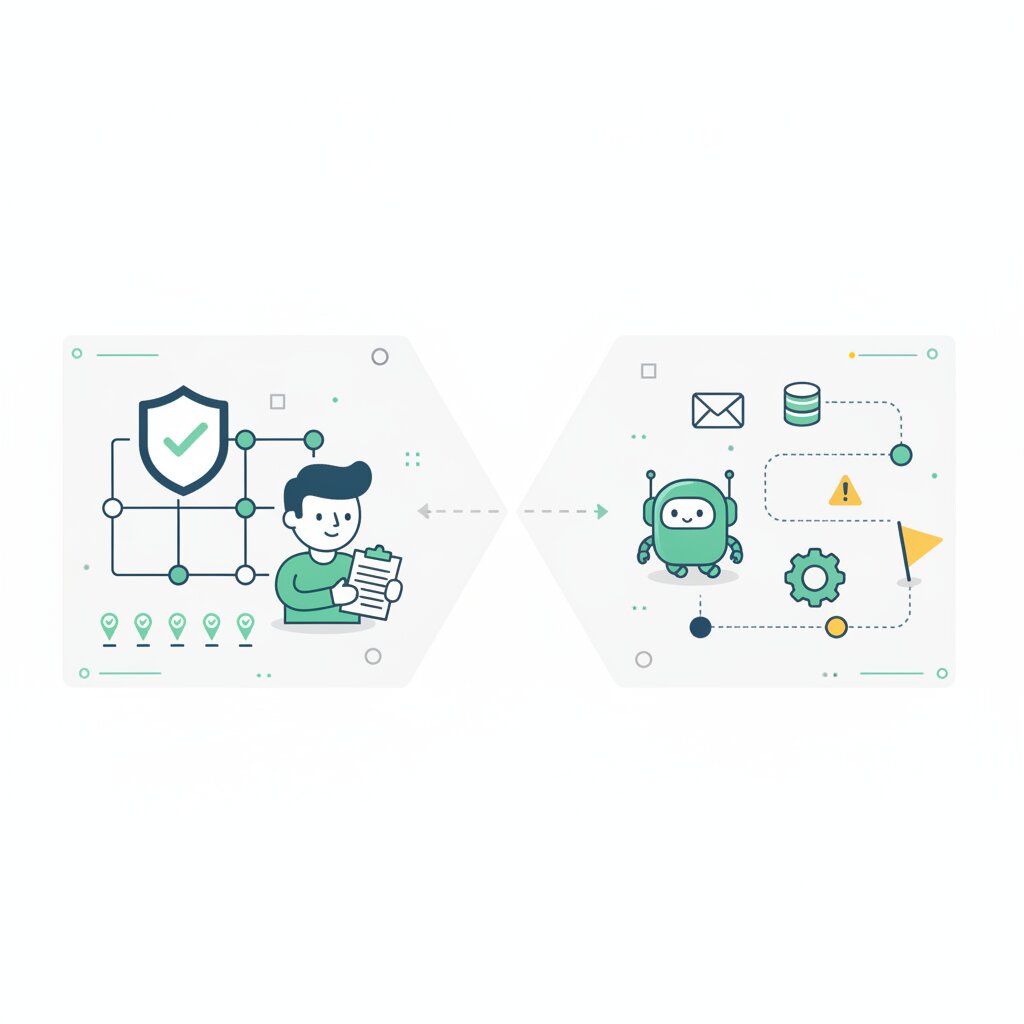

An AI that answers is easy enough to govern. Someone reviews the output, signs it off, and it ships. Every control you run, from model cards to approval queues, is built around that moment. Now picture an AI that does not hand you an answer to check. It reads your CRM, drafts an email, sends it, and updates the record while you are elsewhere. You cannot review that the same way, so the distance between your governance and what the system does widens.
That distance is the AI governance control framework gap. We will define it, separate agentic AI from the generative AI you know, and show why the controls that worked on the latter break on the former. By the end you will have the vocabulary to talk about this precisely: agent versus tool, actor, action trajectory.
What is agentic AI, and how does it differ from generative AI?
Generative AI produces content in response to a prompt and has no agency of its own. You ask, it returns a draft, and the thing you care about is the output. Agentic AI is different in kind, not degree. It pursues a goal through multi-step reasoning, tool use, and memory. Ask it to resolve a disputed charge, and it checks the transaction, applies the refund, and notifies the customer itself.
Both run on large language models, so they get lumped together. But you review a generative output; you supervise an agent’s chain of actions.
The difference runs across four axes:
- Output versus action: you can read a generative output before it matters; an agent’s action carries side effects.
- Single turn versus multi-step pursuit: generative AI performs one inference; an agent loops through perceiving, planning, and acting.
- Stateless versus memory: a generative model starts fresh each request; an agent carries context from tools and past actions.
- Human-reviewable versus non-deterministic: you can check a draft; you can only reconstruct an agent’s path after the fact, which is why response review is not enough.
That is a difference in kind. One produces an output; the other acts. That difference is why the governance gap opens up.
What is the AI governance control framework gap?
The gap is the widening distance between the governance you built for static and generative AI and the controls autonomous agents need. Model cards, response review, perimeter security and human approval queues all assume a person looks at an output before anything happens. Agents remove that assumption, and the distance grows with every new deployment.
Research on agentic identity puts it: enterprises are deploying agents faster than they are building governance to manage them. Gartner projects that 40% of enterprise applications will embed AI agents by 2026, up from less than 5% in 2025.
When a system acts, the unit of control moves from the response to the action trajectory: the chain of decisions and tool calls an agent makes. Governance that only inspects the final output misses every step in between.
The gap is the missing layer between what an agent can do and what your business has authorised. For the full picture, start with the overview; the gap is already showing up in production.
Why does agentic AI break traditional enterprise governance and operating models?
Traditional governance treats systems as tools: a fixed identity, standing access, and human review. Agentic AI turns the system into an organisational actor holding delegated authority, acting on your business’s behalf. That mismatch shows up as four specific failures.
First, identity and authority. Who is the agent acting as? Traditional IAM attaches permissions to a persistent identity. Agents are ephemeral, spinning up and dissolving. Standing access invites privilege drift: teams over-provision scopes, and permissions stack. Microsoft’s agent maturity model flags the same failure: agents amplify human intent through inherited identity and permissions; the problem arrives when that identity and those permissions go ungoverned.
Second, auditability. Can you reconstruct why it acted? Logs built for tools record who accessed what and when, not intent or delegation. When one agent delegates to another, fresh credentials at each hop break the chain back to the originating human.
Third, blast radius. An agent can write to files and call external systems. Its side effects are the product, so a compromised agent can delete a production codebase, not just produce a wrong answer. Legal analysis points to that example.
Fourth, review throughput. Human approval does not scale to the rate an agent works. The queue either stalls the agent or gets bypassed. Oversight belongs at defined checkpoints, like high-stakes actions, not as a review of every step.
NIST’s AI Agent Standards Initiative, launched in February 2026, places agent security and identity among its core pillars. That is the tool-versus-actor shift. Generative AI is a tool you monitor; agentic AI is a digital actor you govern. The control layer has to move to runtime: explicit delegated authority, just-in-time access, intact delegation chains, and policy checked at the moment of action, not a periodic review. That operating model is covered in the Agentic Operating Model.
The wider governance picture
The shift is this: generative AI produces outputs you can review, while agentic AI acts on your business’s behalf through a chain of actions you cannot review one by one. Identity and authority, auditability, blast radius and review throughput break in turn, because each was built for tools, not actors.
The gap widens with every agent you deploy because the unit of governance changed from the response to the action trajectory. Run one diagnostic on every control you rely on: does it assume a human reviews an output before anything happens? If yes, it will not survive an agent that acts.
Frequently Asked Questions
Is the AI governance gap just about models getting more capable or risky?
No. The gap is not a model-quality or risk-rating problem. It widens because the unit of control changes: generative AI produces an output a human reviews, while agentic AI executes chains of actions nobody reviews one by one. The missing control layer sits between what an agent can do and what the organisation has authorised, so extra capability alone does not explain the gap.
What is an action trajectory?
An action trajectory is the chain of decisions and tool calls an agent makes while pursuing a goal, not just its final answer. Governance that only reviews the output misses the steps in between. Because each step can be non-deterministic and carry side effects, the trajectory rather than the response is what you must record, authorise and be able to reconstruct.
What does delegated authority mean for an AI agent?
It means the agent acts on the organisation’s behalf using permissions a human has granted, much as an employee acts within a role. The agent is not merely a tool. It exercises that authority through tool calls and decisions, so governance must track who the agent is acting as and what it has been authorised to do at every step.
Do model cards and response review still matter?
Yes, but they are no longer sufficient. A model card describes a model’s capabilities and limitations, and response review checks an output. Neither governs the chain of actions an agent takes in pursuit of a goal. Keep both as a baseline for the underlying model, then add runtime controls for the trajectory, because the risk has moved from the answer to the action.
Is agentic AI only a governance concern for heavily regulated industries?
No. Every organisation that lets an agent act with delegated authority faces the same four breakage points: identity and authority, auditability, blast radius and review throughput. Regulation raises the stakes and the reporting burden, but the underlying control gap exists wherever a system acts rather than answers. Finance and health care simply feel it first.
Who is accountable when an agentic AI makes a harmful decision?
Accountability still sits with the people who delegated the authority and set the agent’s permissions, not with the model. Because an agent can act thousands of times a day, you cannot wait for harm and then investigate. You need an intact delegation chain and runtime records that show who authorised what, otherwise the answer becomes “nobody can say”, and that is the gap made visible.
What happens if we keep using human approval queues for agents?
Approval queues will bottleneck. Human review does not scale to an agent making thousands of decisions a day, so the queue either slows the agent until it loses its value or gets bypassed under pressure. The control is not stronger, it just breaks. Governance must move to runtime policy enforcement, where the agent is checked at the moment of action rather than after a person catches up.
Can we just restrict which tools an agent can access?
Restricting access narrows the blast radius, but it does not close the gap on its own. A tightly scoped agent can still chain actions in ways nobody anticipated, and standing access remains standing access. You also need just-in-time permissions, an intact delegation chain and the ability to reconstruct why each action happened. Access control is necessary, not sufficient.
How do I know if my organisation already has this governance gap?
Run a simple diagnostic against each control you rely on: does it assume a human reviews an output before anything happens? If yes, it will not survive an agent that acts autonomously. The gap is present wherever identity, permissions, audit logs and approval steps were designed for tools and have not been rebuilt for actors holding delegated authority.
Does this mean organisations should stop deploying agentic AI?
Not necessarily. The point is not to halt deployment but to stop treating actors as tools. Where the value of autonomous action is clear, deploy behind governance that acts at runtime: explicit delegated authority, just-in-time access, audit trails and policy enforcement on the trajectory. The gap is a reason to build the control layer, not a blanket prohibition.