

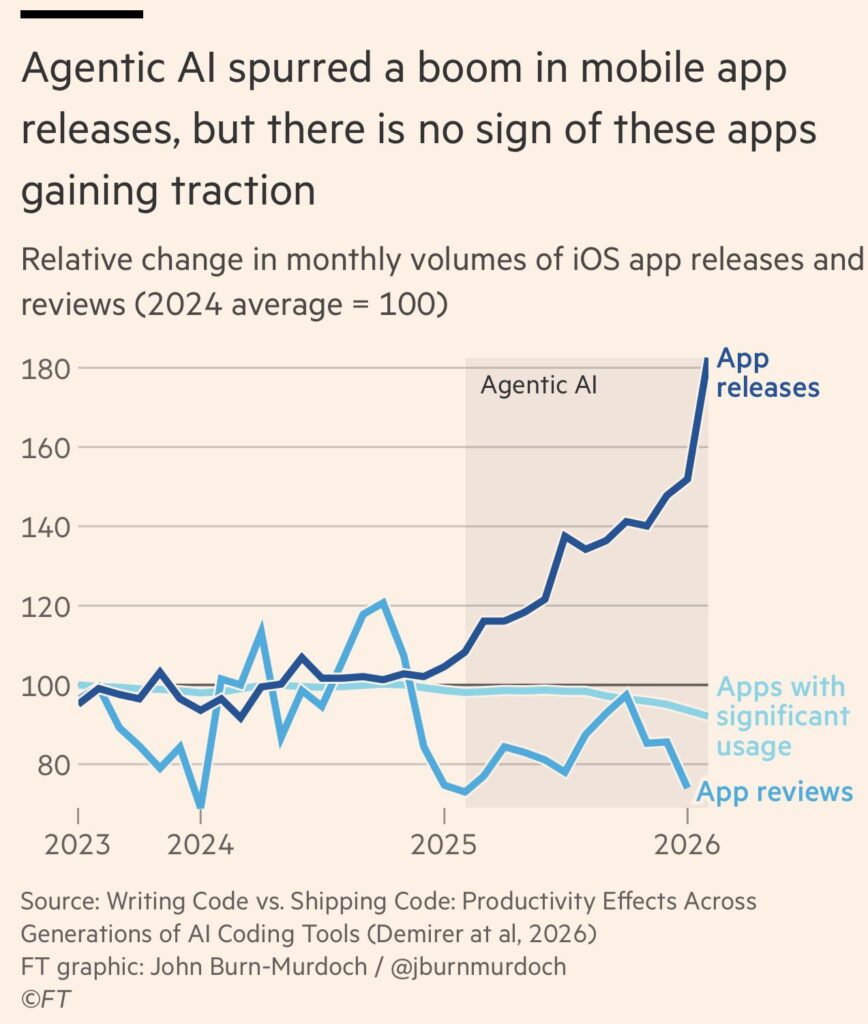
The chart below provides a new take on the “SaaS-pocalypse” talk that has been happening recently. What the chart shows – an explosion in new apps occurring alongside no net increase in app usage. What the means for software-based businesses is what we will be discussing.
Where the chart comes from
The chart comes out of a study by MIT’s Mert Demirer (and co-authors): “Writing Code vs Shipping Code – Productivity Effects Across Generations of AI Coding Tools”. They used Github data to track the evolution of AI usage across lines of code written, number of files edited, the number of projects and features worked on and the actual releases of software.
This span of activities let them compare AI coding tools from first wave of auto-complete tools (eg Cursor and Github Copilot) through coding assistants to coding agents. What they found was that AI had increased productivity at the beginning of the process, with coders creating or editing 300% more files. But once they traced through the product development process to software releases, they found only a 30% increase.
The reason for this precipitous drop – humans in the loop. Amdahl’s Law says a system’s speed is constrained by its slowest step, and in the era of agentic coding we are responsible for all those slow steps. And it is likely that that for some software products, that rate of software releases may not increase much.
While line counts can increase at agentic speed, most processes in this world are still constrained by real world dynamics. You release features 30% faster, but your users aren’t moving 30% faster. Feedback trickles in, it’s contradictory, some users are seeing bugs. Whether or not the feature was a success will take time to resolve. And all the decisions that hang on that feature’s performance will have to wait.
These points where code meets the real, messy world are not going to go away and will continue to place an upper bound on how quickly we can progress.
And as that app chart shows, progressing quickly is not always progressing successfully.
The explosion of apps no-one wants
A common talking point that was part of the SaaS-pocalypse was that anyone could take your SaaS and reproduce it in a weekend. At the same time, “prompt an app” services like Bolt.new and Base44 promised product development for everyone. It did feel like the competition was going to rise to an unprecedented level.
But what has happened in the app stores is very different to the narrative. More apps than ever were created, but very few were being used. There are three broad explanations that alone and together might explain this: the apps work poorly (bad architecture), the apps look unappealing (bad design), no-one knows about them (bad marketing).
Another frequent talking point around the use of AI is “taste”. “Taste” is the knowledge and experience needed to extract professional results from what are supposed to be frontier-level intelligence models. If you don’t have a working knowledge of application architecture can you get AI to build you an app that can grow and improve while handling edge cases and increased traffic? If you don’t understand UX and UI how can you know if your app is well designed and easy to use to others? And if you don’t understand marketing, how do you think people find apps and are onboarded?
To the surprise of no-one, being able to prompt an app (and we’re including web-based services as well in this) is not the same as being be able to run a software-based business. The rush of new competitors into the market is mostly a temporary inconvenience, but other vectors of competition have intensified.
The competitors you need to worry about
For every 100 or 1000 new quick-and-dirty apps in a market there are going to be 2-3 apps built by very small teams who have built exactly the same app for an ex-employer in the past. These new agent-native teams have the ability to reach feature parity faster than bigger orgs with larger teams that haven’t fully integrated AI. They lack the incumbents’ customer relationships and vendor networks, but they can only gain and the customer count they need is much lower than everyone else’s.
The other competitor is the one that has gone all in on AI and is making it work. An example of this is Fin, which you once knew as Intercom. They changed names mid-May. Last June, Darragh Curran, CTO and Head of Engineering at Fin/Intercom announced a goal to 2x their productivity. In April 2026 he announced their success and gave an outline of how they did it. Yes, they are one of those notorious companies that burns through tokens.
Over 9 months Fin 3x-ed the number of PRs. This was their measure, number of PRs, which Curran admits is imperfect for many reasons but served them well.
That 3x, 300%, is 10 times larger than the MIT study’s 30% increase in PRs. But the MIT study was a survey across random Github projects. This was an R&D focused tech company with an explicit goal to pursue.
They succeeded through continuous iteration and experimentation. They settled on a single provider – Anthropic. They built company-wide infrastructure for sharing and automatically updating Claude Skills, so any improvements propagated throughout the ~500 member team. They worked out what they could safely automate away (eg PRs with less than 20 lines of code) and built the infrastructure to make it safe.
This increase in PRs now represents an increase in speed across the company. Their revenue growth is accelerating. And in terms of competition, Curran says:
“we are able to say yes much more frequently, which translates into deals closing that would have been blocked, or accounts churning because we can’t support their evolving needs”
This is an incumbent moving at AI-native speeds but with reputation and relationships on their side.
Where on the MIT study-Fin scale are you?
This article was a little unfair. It started out making you feel better about the increase in competition AI has created, and has now probably left you worried about your existing competitors.
But, as they used to say, forewarned is forearmed. At SoftwareSeni we are constantly exploring best practices in software development across dozens of projects and in every corner of our operation.
If you ever want to chat about what we’re learning or if you’re interested in extending your team with developers trained in AI-assisted coding and embedded in an organisation dedicated to doing quality work with AI, get in touch.