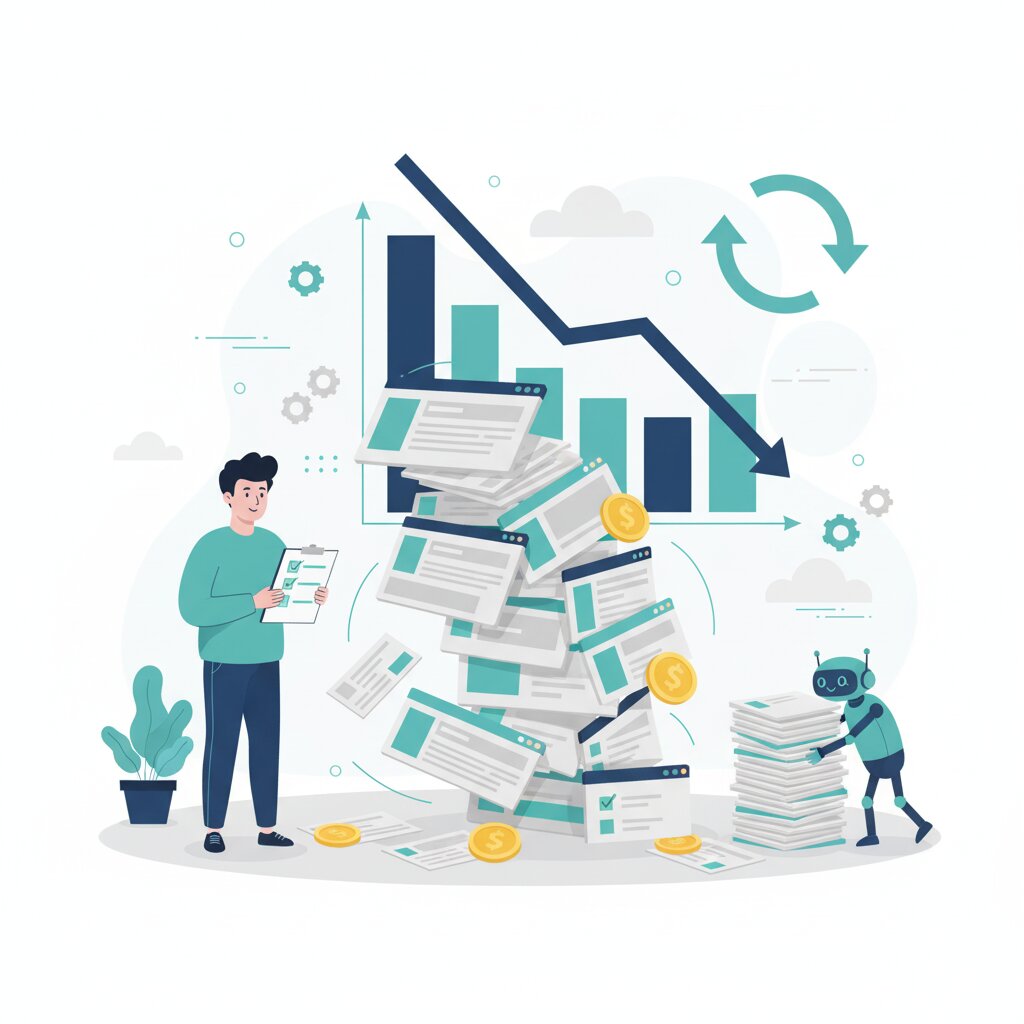

In the first week of February 2026, over $1 trillion in market capitalisation was erased from software stocks. HubSpot dropped 51%. Monday.com fell 44%. ServiceNow shed 36%. The press called it the SaaSpocalypse. The more accurate label is the SaaS Reckoning: an accountability moment for an industry whose core business model — charging per seat for software that AI agents can now operate without human seats — is under pressure from a shift in how work gets done.
Per-seat pricing dropped from 21% to 15% of SaaS vendors in twelve months (Bain). 35% of dev teams have already replaced at least one SaaS tool with a custom AI-built alternative (Retool 2026). SaaS spending overall is still growing — Forrester projects $512 billion by 2028 — but the distribution across vendors and pricing models is shifting.
This guide is the hub for our seven-article deep dive. Each section answers a key question and links to the full analysis.
In this guide:
- What triggered the SaaS reckoning in January 2026?
- Is SaaS actually dying, or is something more nuanced happening?
- How do AI agents actually attack SaaS business models?
- Which SaaS vendors are most at risk — and which are defensible?
- Are AI-native startups genuinely winning, or is this well-funded hype?
- What is happening to SaaS pricing — and what does it mean at your next renewal?
- What should you actually do about your SaaS stack right now?
- How have AI coding tools changed the economics of building vs buying software?
- Resource Hub: SaaS Reckoning Research Library
- FAQ Section
Suggested reading order: The SaaS Reckoning Explained → Vendor Survival Framework → AI Agent Mechanisms → AI-Native vs Incumbents → Pricing Shift → Audit Playbook → Build vs Buy Economics.
What triggered the SaaS reckoning in January 2026?
The SaaS Reckoning did not arrive from a single event — it arrived from a convergence. Anthropic‘s Claude Cowork launch on January 12, 2026, demonstrated that AI agents could replace multi-seat SaaS workflows. When ServiceNow reported earnings on January 28 and acknowledged slowing growth tied to AI displacement, investors repriced the entire sector. More than $1 trillion in SaaS equity value was erased in the following weeks.
The sell-off exposed an underlying repricing that had been building since late 2025 — Infinite Runway’s “Great SaaS Crash” narrative traces the pressure from November 2025 onwards. HubSpot (-51% YoY), Monday.com (-44%), ServiceNow (-36%), Atlassian (-26.9% YTD) — these are not identical businesses, but the market applied an “uncertainty tax” to each because the five-year revenue model is now opaque. The collapse was not a repeat of the 2022 SaaSacre (rising rates, over-valued growth stocks) — this time the structural threat is to the business model itself, not just multiples. SaaSpocalypse is the informal label; SaaS Reckoning is the more accurate frame — an imposed accountability moment, not extinction.
Full analysis: The SaaS Reckoning Explained
Is SaaS actually dying, or is something more nuanced happening?
SaaS is not dying — it is bifurcating. Global enterprise SaaS spending is still projected to grow from $318 billion (2025) to $512 billion (2028). What is collapsing is a specific business model: software that charges per seat for orchestrating workflows that AI agents can now perform without human seats. Systems of record — ERP, compliance infrastructure, core HR — remain structurally sound. The risk is concentrated in workflow wrappers.
The K-shaped bifurcation framework is the key analytical lens: some SaaS companies will adapt and emerge stronger; others will lose revenue as seat counts compress without a pricing model replacement. “System of record” versus “workflow wrapper” is the vocabulary to bring to every vendor review — it is the single most useful diagnostic for whether a tool is defensible. The “dumb pipe” risk — where SaaS becomes commoditised storage beneath an AI agent layer — is real but not universal; it applies primarily to horizontal workflow software. SaaS spending overall will grow; what will shrink is per-seat licence revenue at the layer AI agents are replacing.
Deep dives: The SaaS Reckoning Explained | Which SaaS Vendors Will Survive
How do AI agents actually attack SaaS business models?
AI agents attack SaaS business models through seat compression: they complete multi-step workflows — form submission, data retrieval, ticket routing, CRM updates — without a human operator at each step. Because SaaS vendors charge per seat, fewer human operators means less licence revenue, even if the same amount of work is being done. The revenue model depends on human headcount; AI agents decouple output from headcount.
Seat compression is the mechanism: the number of paid user licences a customer needs falls as AI agents absorb task sequences previously requiring human attention. AI unbundling goes further — AI agents can replicate the core function of a workflow wrapper without any SaaS licence at all, effectively reducing the tool to zero marginal value. The “dumb pipe” risk is the extreme version: SaaS becomes infrastructure (storing data) while an AI agent layer above it does the actual workflow work — vendors collect storage fees while the value migrates upward. Three tiers of disruption risk emerge from mechanism analysis: (1) deterministic workflow wrappers (highest risk), (2) probabilistic systems requiring human judgement (medium risk), (3) regulated systems of record (lowest risk).
Full mechanism breakdown: How AI Agents Actually Attack SaaS Business Models
Which SaaS vendors are most at risk — and which are defensible?
Vulnerability maps to two factors: how much of the vendor’s value is in workflow orchestration (vs. proprietary data storage), and how deterministic the workflows are (structured sequences vs. complex judgement calls). Project management tools, basic CRM data entry, and customer support ticketing are most vulnerable. ERP systems, regulatory compliance infrastructure, and vertical industry SaaS with deep data moats are most defensible.
Bain’s four-scenario framework provides a useful classification: Core Strongholds (defensible), Open Doors (vulnerable workflow wrappers), Gold Mines (AI-native challengers taking share), Battlegrounds (incumbent vs. AI-native fight in progress). Vendor evaluation requires looking past the AI washing — many incumbents are bolting chatbots onto existing products without structural architectural change; Salesforce Agentforce and ServiceNow Now Assist are test cases for whether this strategy constitutes genuine adaptation. Systems of record (Workday, SAP, Veeva) carry high switching costs, deep data integration, and regulatory compliance — AI agents need these data backbones, not replacements for them. Horizontal SaaS (project management, HR tools, generic CRM) faces the most structural disruption; vertical SaaS built for specific industries (HealthTech, FinTech, legal, construction) has defensible domain data moats.
Full framework: Which SaaS Vendors Will Survive the AI Reckoning
Are AI-native startups genuinely winning, or is this well-funded hype?
The evidence leans toward genuine structural shift, not hype. AI-native companies captured 63% of the enterprise application layer in 2025, up from 36% in 2024 (Menlo Ventures). Cursor reached $1 billion ARR with 300 employees. Harvey reached $8 billion valuation at $100 million ARR. But the Jasper AI trajectory — peak $1.5 billion valuation followed by rapid decline as ChatGPT commoditised its niche — is a necessary counterpoint.
The valuation premium for AI-native companies at Series D is 50–80x vs. 6–12x for traditional SaaS (SaaStr data) — investors are pricing in the structural advantage of being built around AI from inception rather than retrofitting it. Enterprise AI spending grew from $1.7 billion in 2023 to $37 billion in 2025 (Menlo Ventures) — this is not a speculative market; it is an accelerating reallocation of budget from SaaS seats to AI capability. AI-native challengers exist in nearly every major SaaS category: DayAI (vs. Salesforce CRM), Decagon/Sierra (vs. Zendesk), Rillet (vs. traditional ERP) — this is not a distant threat for most CTO portfolios. The cautionary signal: AI-native companies that do not own proprietary data or workflow complexity face their own commoditisation risk as AI capabilities become more accessible.
Full evidence analysis: AI-Native Startups vs SaaS Incumbents
What is happening to SaaS pricing — and what does it mean at your next renewal?
Per-seat pricing is declining as the dominant SaaS revenue model — it dropped from 21% to 15% of SaaS vendors in 12 months (Bain). The replacements are usage-based pricing (pay per API call or transaction) and outcome-based pricing (pay for results). Gartner predicts 40% of SaaS spending will shift away from seat-based models by 2030. Your next renewal conversation will likely include a new pricing structure, whether you initiate it or not.
Usage-based pricing (UBP) is already the dominant model among AI-native SaaS — 83% of AI-native vendors offer UBP vs. a minority of incumbents (Maxio survey data). Outcome-based pricing is earlier stage but directionally significant: Zendesk was the first major incumbent to offer an outcome-based tier (August 2024), pricing by resolved tickets rather than agent seats. Salesforce’s Agentic Enterprise License Agreement (AELA) signals how major incumbents are restructuring contracts to account for AI agents — a template for what you may see from other enterprise vendors. At the 50–500 employee scale, per-seat pricing often means you are paying for seats tied to headcount that AI tools are already reducing — the renewal window is your leverage point to restructure terms.
Full pricing analysis: SaaS Pricing Is Shifting from Per-Seat to Usage and Outcome
What should you actually do about your SaaS stack right now?
Four actions, in sequence: Audit your current stack to identify tools with high AI disruption exposure. Renegotiate contracts using AI alternatives as pricing leverage before auto-renewal windows close. Evaluate AI-native alternatives against each at-risk tool. Decide: keep, renegotiate terms, replace with an AI-native product, or build a custom alternative using AI coding tools. The Forrester REAP model structures exactly this sequence with a practical decision matrix.
The audit step requires a scoring framework: vulnerability (workflow wrapper or system of record?), replaceability (does a credible AI-native alternative exist?), renewal timing (how much runway before the next contract window?). The renegotiate step has time-bound leverage — the existence of AI alternatives changes your BATNA (Best Alternative to a Negotiated Agreement); this leverage is strongest before renewal auto-triggers. The evaluate step is where vendor AI roadmap credibility becomes critical: distinguish between genuine agentic capability (Salesforce Agentforce, ServiceNow Now Assist — in progress) and AI washing (chatbot added to a 2019-era product interface). The decide step feeds directly into build-vs-buy calculations — AI coding tools have materially lowered the cost floor for custom-built replacements, which affects the ROI threshold for the “build” option.
Step-by-step playbook: Auditing and Rebuilding Your SaaS Stack | Pricing negotiation: SaaS Pricing Shift
How have AI coding tools changed the economics of building vs buying software?
AI coding tools — Cursor, GitHub Copilot, and comparable tools — have materially lowered the cost and skill floor for custom software development. Vibe coding (natural-language-prompted AI development) now makes replacing a mid-market SaaS tool with a custom-built alternative economically viable in timeframes that previously would not have justified the development cost. Retool’s 2026 survey found 35% of dev teams had already replaced a SaaS tool with a custom AI alternative.
The build-vs-buy calculus has historically favoured buy for all but the most specialised workflows; AI coding tools have shifted the cost input substantially, particularly for teams with existing developer capacity. Vibe coding is not zero-cost: governance, security review, maintenance, and compliance obligations (critical for FinTech/HealthTech CTOs under HIPAA or SOC 2 requirements) add TCO that does not appear in the initial development estimate. Shadow IT risk is elevated in the vibe coding era — individual contributors can now build functional SaaS-replacing tools without IT oversight, creating data governance and security exposure. The decision framework: build makes sense when the SaaS tool is a workflow wrapper (not a system of record), when a credible AI-native replacement does not yet exist, and when the team has the capacity to maintain what it builds.
Full economic analysis: How AI Coding Tools Have Changed the Economics of Building vs Buying Software
Resource Hub: SaaS Reckoning Research Library
Understanding the Event and the Mechanism
- The SaaS Reckoning Explained — What Happened to Enterprise Software in 2026: The definitive explainer covering the January–February 2026 market dislocation — chronology, data, and structural analysis including the K-shaped bifurcation framework.
- How AI Agents Actually Attack SaaS Business Models — A Mechanism-Level Breakdown: Architecture-level analysis of how AI agents disrupt SaaS revenue through seat compression, AI unbundling, and the dumb pipe risk.
- AI-Native Startups vs SaaS Incumbents — The Evidence for Who Is Winning the Application Layer: Data-driven analysis of AI-native company trajectories vs. incumbent adaptation, using Menlo Ventures data, SaaStr valuation multiples, and specific company evidence.
Evaluating and Renegotiating Your Stack
- Which SaaS Vendors Will Survive the AI Reckoning — A Framework for Evaluating Your Stack: A classification framework built on Bain’s four-scenario model and the Forrester REAP model — maps named vendors into defensibility quadrants.
- SaaS Pricing Is Shifting from Per-Seat to Usage and Outcome — What Changes at Your Next Renewal: Practical guide to the pricing model transition — what to expect at renewal negotiations and how to approach the move from per-seat to usage/outcome models.
Taking Action
- Auditing and Rebuilding Your SaaS Stack in the Age of AI — A Practical Playbook: Step-by-step playbook for the full audit → renegotiate → evaluate → decide sequence, with templates and decision matrices.
- How AI Coding Tools Have Changed the Economics of Building vs Buying Software: TCO analysis and governance guide for teams weighing custom-built AI alternatives against SaaS renewals in the vibe coding era.
FAQ Section
Is SaaS dead?
No. Global enterprise SaaS spending is projected to grow to $512 billion by 2028. What is under structural pressure is a specific revenue model — per-seat pricing for workflow orchestration software — not enterprise software as a category. Systems of record, vertical SaaS with deep domain data, and platforms with genuine AI integration are all positioned to grow through the transition.
Deep dive: The SaaS Reckoning Explained
What is the SaaSpocalypse?
SaaSpocalypse is the informal industry label — popularised by Forrester analyst analysts in late 2025 and widely adopted in media coverage — for the wave of SaaS valuation collapses and business model disruption driven by AI agent adoption. The term has high search volume and genuine cultural resonance, but it overstates the uniformity of the outcome. Not all SaaS faces the same disruption risk.
What is “seat compression”?
Seat compression is the mechanism by which AI agents reduce the number of paid user licences a SaaS customer needs. When AI agents automate multi-step workflows that previously required a human operator at each step, the headcount required to do the same amount of work decreases — and with it, the number of seats the customer must purchase. This is the primary structural threat to per-seat SaaS revenue models.
Deep dive: How AI Agents Actually Attack SaaS Business Models
Which SaaS categories face the highest disruption risk?
The highest-risk categories are horizontal workflow wrappers: project management tools, basic CRM data-entry layers, customer support ticketing at the human-interaction tier, and generic marketing automation. The lowest-risk categories are systems of record with deep regulatory integration (ERP, core HR, compliance infrastructure) and vertical SaaS built for specific regulated industries (HealthTech, FinTech, legal, construction).
Deep dive: Which SaaS Vendors Will Survive the AI Reckoning
What is “vibe coding” and how does it affect the build vs. buy decision?
Vibe coding refers to AI-assisted software development using natural-language prompts to tools like Cursor or GitHub Copilot, enabling developers (and increasingly non-developers) to produce functional code rapidly. It has significantly lowered the cost floor for custom-built internal tools, making the “build” option economically viable for use cases where the SaaS renewal cost exceeds the vibe-coded replacement cost plus ongoing maintenance.
Deep dive: How AI Coding Tools Have Changed the Economics of Building vs Buying Software
How do I know if my SaaS vendor’s AI claims are genuine or AI washing?
AI washing is the practice of relabelling existing product features as “AI-powered” without structural capability change — typically manifested as a chatbot interface overlaid on a 2019-era product architecture. Key interrogation signals: Does the vendor’s AI capability function as an autonomous agent (multi-step workflow execution) or as a single-turn assistant? Can it take actions, or only surface recommendations? Is the AI layer trained on your proprietary data, or generic?
Deep dive: Which SaaS Vendors Will Survive the AI Reckoning
What is the Forrester REAP model?
The Forrester REAP model is a four-step framework for SaaS buyers navigating the AI disruption transition: Renegotiate existing contracts using AI alternatives as leverage; Evaluate AI-native alternatives against at-risk tools; Audit the current stack for disruption exposure; Prioritise action based on renewal timing and risk score. It provides the structural backbone for the audit → renegotiate → evaluate → decide action sequence described in this cluster.
Deep dive: Auditing and Rebuilding Your SaaS Stack in the Age of AI