
In the first week of February 2026, more than $1 trillion in software market capitalisation vanished. The market called it the SaaSpocalypse. What most technology buyers still lack is a framework for reading it correctly.
Here is the thing: AI disruption does not hit your SaaS stack evenly. The February sell-off made no distinction — Procore and Zendesk got hammered equally, as if they face identical risks. They do not.
Bain’s four-scenario model, from its Technology Report 2025, gives you the map. It places every SaaS vendor on two diagnostic axes and produces four quadrants. This article makes it usable for mid-market CTOs, with real named vendors in every quadrant.
One data point first. Publicis Sapient reduced its traditional SaaS licences by approximately 50% — including Adobe — replacing them with generative AI tools. That is not a forecast. That is a company that ran this analysis and acted. The question is which of your vendors would survive the same scrutiny.
Why do some SaaS vendors look defensible while others look doomed — and what determines the difference?
Two things distinguish defensible from doomed. First: whether AI can now perform the complete workflows the vendor’s software orchestrates. Second: whether the vendor’s revenue depends on human seat counts, or on something harder to displace — proprietary data governance, compliance infrastructure, or domain integrations built over years.
Vendors whose revenue is built on human seats doing things AI can now do face direct compression. Agentic AI does not replace HubSpot — it replaces the five marketing coordinators who each needed a HubSpot seat to run campaigns. The platform may persist; the licence revenue shrinks. This is what people are calling the “starved not killed” dynamic.
The median EV/Revenue multiple for public SaaS companies stood at 5.1x in December 2025, down from 18–19x at the pandemic peak. The market has already priced in structural change — it has just done so indiscriminately. The Bain framework disaggregates which repricing is justified and which is noise.
The outcome is K-shaped bifurcation: vendors in Core Strongholds and Gold Mines are adapting and emerging stronger; Open Doors and Battlegrounds vendors face double pressure from AI-native competition and shrinking seat demand. For how agentic AI attacks SaaS business models at the mechanism level, see our analysis here.
What is the Bain four-scenario framework and how do its two axes work?
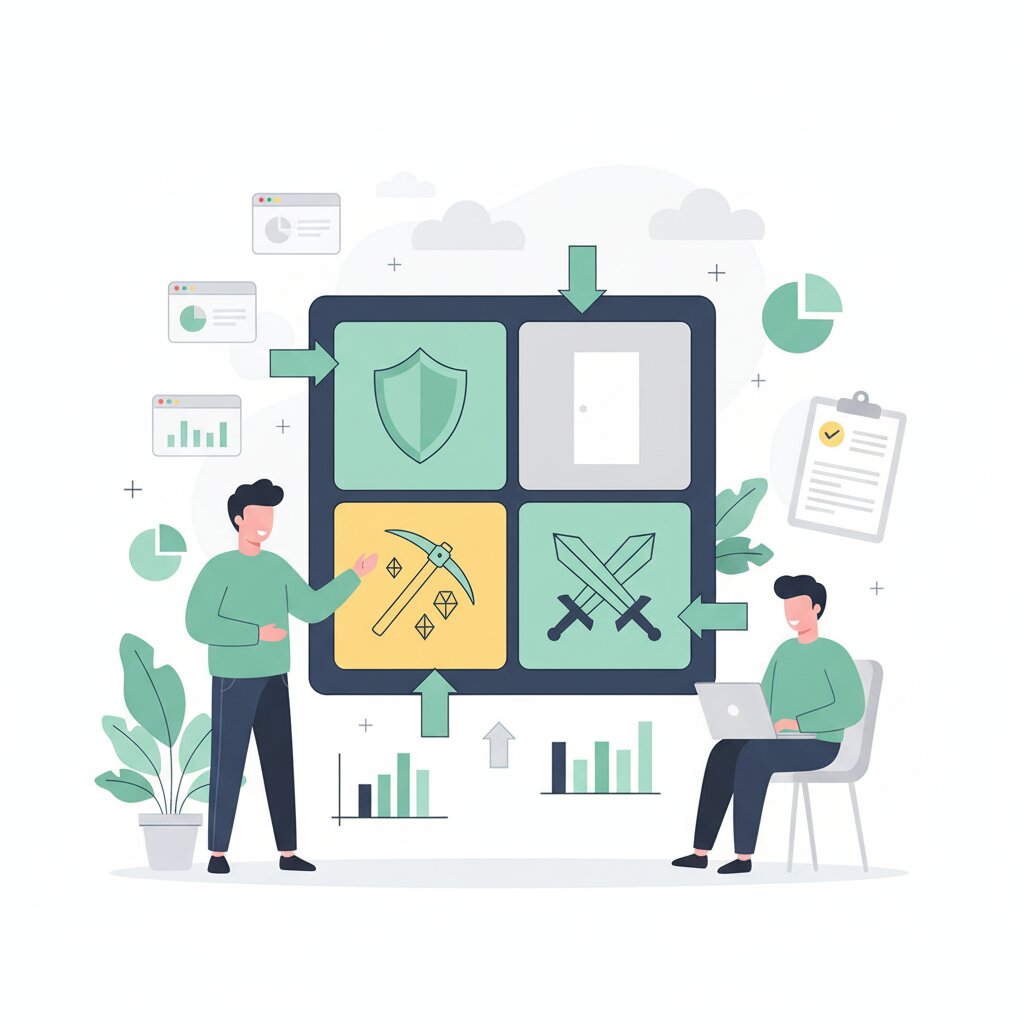
Bain plots SaaS workflows on two independent axes. Their intersection produces four quadrants.
Axis 1 — user automation potential: Can the humans using this tool be automated away? Monday.com task coordination is structured and repetitive — high automation potential. Procore site management involves liability chains requiring human judgment — low automation potential.
Axis 2 — AI penetration potential: Can AI now perform the tasks this tool handles with equivalent accuracy? Customer support tickets score high — AI resolves them reliably today. Clinical trial data validation scores low — regulatory requirements mandate deterministic accuracy that AI cannot certifiably meet.
The two axes are independent, which is what gives you four distinct quadrants rather than a simple safe/at-risk binary:
- Core Strongholds (low/low): AI enhances SaaS. Hard to displace.
- Open Doors (low user automation, high AI penetration): Spend compresses. Risk is seat reduction, not immediate replacement.
- Gold Mines (high user automation, low AI penetration): AI creates new value. AI-native tools are winning here.
- Battlegrounds (high/high): AI cannibalises SaaS. Direct displacement risk.
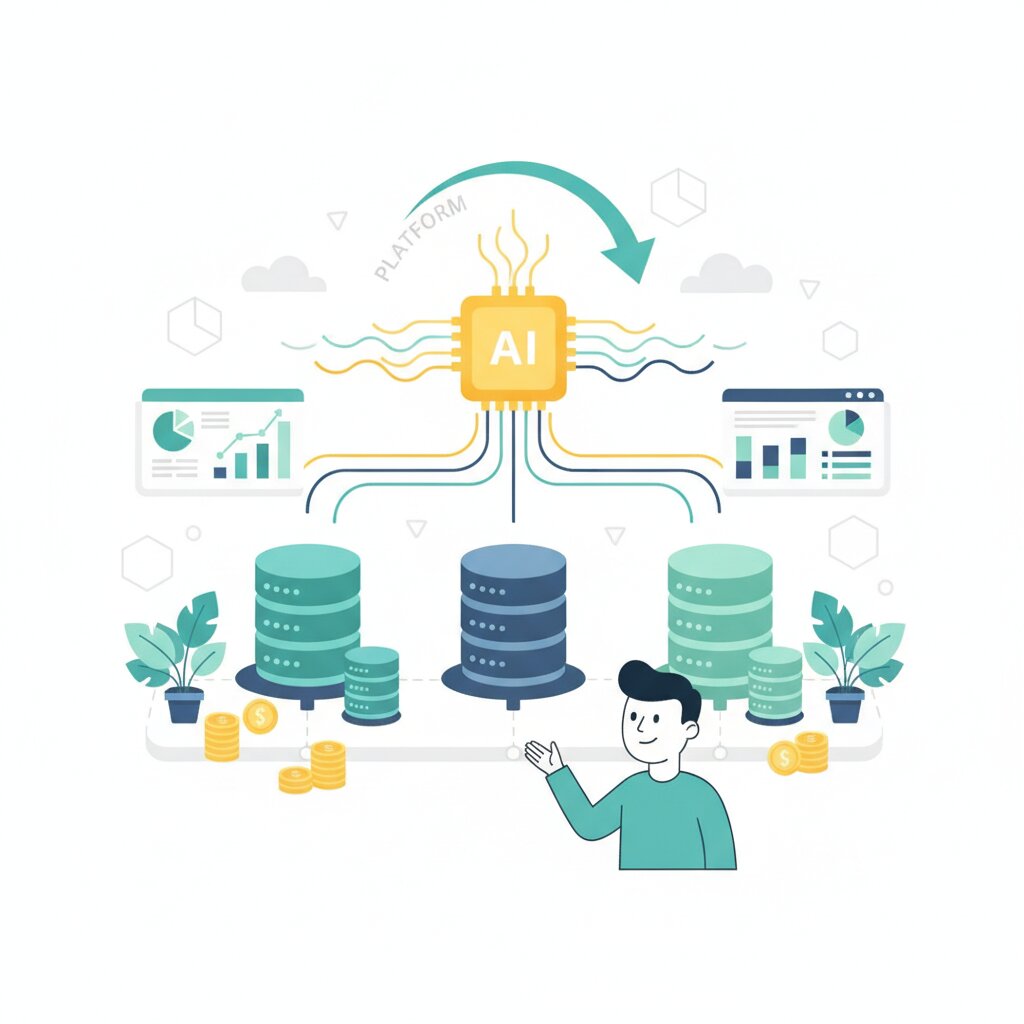
AI competition happens at the orchestration layer — precisely where most SaaS workflow coordination lives. Vendors without defensible data or compliance moats face displacement from the layer below them. The mechanism-level breakdown is in our agentic AI analysis.
Which SaaS vendors are Core Strongholds — and what makes them genuinely hard to displace?
Core Strongholds sit in the low/low quadrant. What makes them defensible is not brand strength. It is compliance-critical data governance, deep proprietary datasets that AI-native competitors cannot quickly replicate, and switching costs that exceed the benefit of substitution.
Procore — construction project management requires strict oversight around site safety, subcontractor liability, and regulated data flows. The liability chain cannot be delegated to an AI agent without legal exposure. Core Stronghold.
Medidata — clinical trial randomisation requires 100% accuracy as a regulatory requirement. Patient safety stakes and audit trail obligations make AI replacement a compliance risk before it is even a technology question. Core Stronghold.
Epic and Cerner — both control proprietary patient data under HIPAA governance. The data moat is also a regulatory moat. Core Stronghold.
IQVIA — its proprietary pharmaceutical dataset accumulated over decades creates a moat that AI-native competitors would need years to match. Core Stronghold.
Guidewire — holds exclusive insurance claims data, placing it firmly in Core Stronghold territory on its data advantage side. It also occupies Gold Mine territory by actively embedding AI-enhanced underwriting into that proprietary data foundation.
The data moat is the most important Core Stronghold defence. Bain puts it plainly: “Your data is your moat. While models such as GPT-4o are everywhere, the real value lies in the proprietary data you own.” An AI-native competitor can access the same foundation models. It cannot access decades of proprietary transaction history.
One limit worth noting: the data moat protects the system of record, not the engagement layer sitting above it — a tension Workday and Epic are actively navigating.
For the broader picture of how this bifurcation plays out across the market, see our pillar analysis.
Which vendors are Open Doors — and what does that classification mean for your contracts?
Open Doors vendors sit in the low/high quadrant. AI can perform the tasks these tools handle, but human participation has not yet been eliminated end-to-end. The risk is spend compression — seat-based revenue under sustained pressure as AI reduces the number of humans needed.
HubSpot — marketing automation, email campaigns, and lead scoring are probabilistic tasks AI replicates with sufficient accuracy that the human coordinator role is being compressed. UncoverAlpha puts it bluntly: AI replicates HubSpot’s core function at approximately 1% of the cost. HubSpot’s stock fell from $880 to approximately $200–233. Open Door.
Monday.com — task assignment, status tracking, and deadline management are structured and automatable. The team that needed 15 seats to coordinate a project may need five. Monday.com fell 77% in the same period. Open Door.
Atlassian — layer-dependent. The project management and ticketing tier is an Open Door. The developer tooling layer is considerably more defensible.
LegalZoom — document generation and lower-complexity compliance workflows are increasingly AI-replicable. Open Door trending toward Battlegrounds.
Contract strategy: use renewal timing to renegotiate seat counts. Open Doors vendors know they are vulnerable and may offer flex credits across seats and AI agents. Evaluate by layer, not as a monolithic product. The renegotiation playbook is in ART006.
What makes Gold Mines and Battlegrounds the most contested SaaS categories in 2026?
Gold Mines and Battlegrounds both involve high AI capability. The direction is what differs. Gold Mines is where AI creates new value legacy SaaS cannot match. Battlegrounds is where AI directly replicates what incumbents do.
Gold Mines
Cursor — an AI-native code editor that displaced legacy IDEs not by replicating their feature sets but by doing something they structurally cannot: generating code rather than assisting humans who type it. Cursor hit $1 billion ARR in less than 24 months. AI-native companies are achieving approximately $700K ARR per employee versus traditional SaaS requiring far larger teams for equivalent revenue. The evidence on who is winning these Gold Mine categories is in our AI-native versus incumbent analysis.
Guidewire on its AI-enhanced side is a legacy vendor successfully transitioning to Gold Mine territory. Its insurance-specific dataset is the asset; AI-enhanced underwriting built on proprietary data creates more value than an AI-native competitor starting from general-purpose models.
Battlegrounds
Intercom — conversational AI has directly replicated Intercom’s core function. The agentic AI handling support tickets today does not need Intercom’s routing and escalation workflow — it is the routing and escalation. Highest near-term displacement risk in the mid-market stack.
Tipalti — accounts payable automation (invoice processing, approval routing, payment execution) is precisely the multi-step, rules-based workflow that agentic AI was designed to handle.
ADP — payroll itself is deterministic and defensible. The engagement layers are Battlegrounds territory. Classify by revenue exposure: if the licence revenue comes from the engagement layer, the vendor is Battlegrounds-exposed.
Zendesk — ticket routing, escalation management, and agent assignment is precisely what agentic AI does autonomously.
Salesforce straddles the framework. CRM data depth — 15+ years of customer history — is a Core Stronghold asset. The workflow coordination layer is Battlegrounds territory. Whether incumbency plus AI pivot is sufficient to defend against AI-native CRM alternatives is the most actively contested question in enterprise software right now. For mechanism-level detail on how agentic AI attacks these workflows, see our analysis.
What does the deterministic vs. probabilistic distinction add to the Bain analysis?
When you are auditing a thirty-tool stack, a rapid first-pass filter helps. The deterministic/probabilistic distinction gives you exactly that.
Deterministic SaaS requires 100% accuracy. Payroll cannot be approximately right. Compliance reporting cannot tolerate meaningful error. CIOs are already rejecting AI replacement in financial services for this reason — a system correct “six out of ten times” is insufficient. Deterministic SaaS is inherently more defensible.
Probabilistic SaaS tolerates approximation. Marketing content needs to be good enough to generate engagement. Task coordination needs to be adequate, not optimal. AI handles these functions with sufficient accuracy that seat-based workflows become optional.
The overlay maps cleanly: deterministic SaaS maps predominantly to Core Strongholds; probabilistic SaaS maps predominantly to Open Doors and Battlegrounds.
For straddlers like ADP, Salesforce, and Workday — each has a deterministic data layer (defensible) and a probabilistic engagement layer (exposed). Classify by revenue exposure: which layer generates the licence revenue?
A quick first-pass for a representative mid-market stack:
- Payroll tool: Deterministic → Core Stronghold. Continue investment.
- CRM: Straddler. Negotiate engagement-layer seat reduction while preserving data layer access.
- Project management: Probabilistic → Open Doors. Renegotiate at renewal.
- Support platform: Probabilistic, high AI penetration → Battlegrounds. Evaluate AI-native alternatives now.
- Marketing automation: Probabilistic → Open Doors to Battlegrounds depending on use case.
The mechanism connecting deterministic/probabilistic to how agentic AI attacks these workflows is in our agentic AI analysis.
What is the Forrester REAP model and how does it complement the Bain framework?
The Bain framework classifies. The Forrester REAP model tells you what to do about it. They address different parts of the same problem.
REAP is Forrester’s application disposition matrix: Reassess, Extract, Advance, Prune.
- Reassess: Technical strength, unclear business value — investigate whether to redirect or retire. Open Doors vendors.
- Extract: Delivering value, technically stable — harvest efficiently. Core Strongholds not undergoing AI transition.
- Advance: Requires ongoing modernisation. Core Strongholds actively embedding AI (Workday, Epic) and Gold Mines being adopted.
- Prune: To be removed — careful decommissioning requiring dependency analysis. Battlegrounds vendors. Forrester chooses “Prune” over “Eliminate” deliberately — exiting a deeply integrated vendor without operational disruption is non-trivial.
Applied to named vendors: Procore → Extract with Advance. HubSpot → Reassess. Cursor → Advance. Tipalti, Zendesk, Intercom → Prune.
REAP’s limitation: it gives you disposition categories, not timing strategy. Knowing you should Prune Zendesk does not tell you when to exit or how to sequence the transition. That belongs to the contract audit and action playbook.
Bain is richer for classification; REAP is richer for portfolio governance. Using both eliminates the two most common failure modes — classification without action, and action without classification rationale. See also the broader strategic context in our SaaS reckoning overview.
What does the Klarna experience tell us about applying these frameworks in practice?
Klarna is the most instructive real-world data point for organisations considering aggressive AI substitution — not because the results were uniformly positive, but precisely because they were not.
Klarna deployed an AI customer support agent handling work equivalent to 700–853 human agents. Since 2022, it reduced its workforce approximately 50% through attrition while growing revenue from $300,000 to $1.3 million per employee. It replaced Salesforce’s CRM engagement layer with an in-house AI stack — running, in effect, its own Battlegrounds analysis and concluding the engagement layer was replaceable. The cost thesis was directionally correct.
Where it went wrong: customer satisfaction declined. The nuance lost in aggressive AI substitution was quality in complex, high-stakes interactions — the deterministic edge cases where probabilistic AI performs poorly. Klarna reversed course and began rehiring human support staff.
The lesson here is important. The Bain framework is a classification tool, not a replacement guarantee. A correct Battlegrounds classification means the vendor faces structural displacement risk — not that the AI-native alternative is ready for 100% of the workflow on day one. Klarna did not abandon the thesis; it recalibrated the application.
For Salesforce specifically: Klarna replaced the engagement layer. The data depth question is different and more complex. The Bain framework forces you to make that layer distinction explicitly rather than treating the product as a single binary choice.
The operational playbook for managing these transitions is what to do next. This article establishes the framework.
Every vendor this framework tells you to replace still has to be replaced by someone. SoftwareSeni’s extended development teams take on that replacement work, scaled to the size of each transition and wound back once the new vendor is bedded in, so the switch stays a project instead of a standing addition to your team.
see how extended development teams can take on a vendor transition without a permanent hire →
“SoftwareSeni are extremely valuable partners of our business, and have been integral to our growth to date. They have provided a range of technical resources, which could be scaled up or down depending on our requirements. For any one looking to expand their development team or establish from scratch, we would highly recommend seeking our their services.”
— Joshua K, Co-Founder, rePrecinct
Frequently Asked Questions
How do I know if my SaaS vendor will survive the AI disruption?
Apply the Bain two-axis test: (1) can AI now perform the tasks this tool handles with equivalent accuracy? (2) can the human users be automated away, reducing seat demand? Yes to both means Battlegrounds. No to both means Core Stronghold. Use the deterministic/probabilistic first-pass before the full test: if the tool requires 100% accuracy for its core function, it is likely more defensible.
Can AI really replace Salesforce or Workday for my company?
Not in full. Both have deep data layers that are defensible. What AI is replacing is the engagement layer — workflow coordination, approvals, service interfaces. Klarna replaced Salesforce’s CRM engagement layer, not its data depth. Evaluate each vendor by layer, not as a monolithic product.
What is the difference between SaaS vendors that are safe from AI and those that aren’t?
Safe vendors (Core Strongholds) share three characteristics: compliance-critical data governance AI cannot reliably own, deep proprietary datasets AI-native competitors cannot quickly replicate, and switching costs that exceed the benefit of substitution. At-risk vendors rely on seat-based revenue from human workflows that AI can now replicate.
What does “deterministic SaaS” mean and why does it matter?
Deterministic SaaS requires 100% accuracy for its core function — payroll, ERP, healthcare records, compliance management. AI can assist but cannot govern these workflows at current accuracy levels. Probabilistic SaaS tolerates approximation — content, marketing, task coordination — which is why AI is displacing it faster.
Why did Klarna replace Salesforce, and should I do the same?
Klarna concluded Salesforce’s CRM engagement layer was in the Battlegrounds quadrant and built an AI-native replacement. The cost savings were real; the customer satisfaction decline was also real. Whether to follow depends on your vendor’s quadrant classification for your specific workflows and your tolerance for transition risk. The action playbook is here.
What SaaS tools should I cut because AI can replace them?
Battlegrounds vendors — Tipalti, Intercom, and Zendesk are the clearest near-term candidates. Open Doors vendors (HubSpot, Monday.com) warrant renegotiation before exit. Do not exit a deeply integrated Battlegrounds vendor without first running dependency analysis and evaluating whether the AI-native alternative handles your deterministic edge cases. The audit playbook addresses that process.
What is the Forrester REAP model and where can I find the full version?
REAP stands for Reassess, Extract, Advance, and Prune — a portfolio disposition framework from Forrester Research that converts Bain quadrant classification into a decision instruction. The full methodology is paywalled. Publicly available framing: Core Strongholds → Extract or Advance; Open Doors → Reassess; Gold Mines → Advance; Battlegrounds → Prune.
Is the SaaSpocalypse a real structural shift or overblown market panic?
Both. The February 2026 sell-off treated Procore and Zendesk as equivalent risks. The structural shift is real for Battlegrounds and Open Doors vendors; it is overstated for Core Strongholds. The median EV/Revenue multiple compressing from 18–19x to 5.1x reflects structural repricing — but the sell-off applied it uniformly. The Bain framework disaggregates signal from noise.
How does seat-based pricing create AI disruption risk for SaaS vendors?
Seat-based pricing ties vendor revenue to the number of human users. When AI agents reduce the number of humans needed to execute a workflow, seat count drops even if the platform remains in use. A team needing 20 HubSpot seats to run marketing operations may need eight when AI handles content generation and campaign reporting.
What is the three-layer agentic stack and why does it matter for SaaS?
The three-layer agentic stack: systems of record at the base (governed data, compliance logic), agent operating systems in the middle (the orchestration layer), and outcome interfaces at the top. AI competition with SaaS happens at the orchestration layer — where agentic AI is replicating the workflow coordination functions that SaaS platforms were built to provide. Early agent operating systems include Microsoft’s Azure AI Foundry, Google’s Vertex AI Agent Builder, and Amazon Bedrock Agents. Vendors without defensible data or compliance moats face displacement from below.
What does the Bain framework say to do if most of my SaaS spend is in the Battlegrounds quadrant?
Treat those vendors as disposal candidates and begin transition planning. Battlegrounds classification means the vendor faces structural revenue decline as AI agents replicate their core workflows — on a timeline of months to a few years, not decades. The practical steps — exit sequencing, contract timing, AI-native tool evaluation — are the subject of the practical playbook.
Should I wait for my SaaS vendor’s AI product to mature before acting?
Only if the vendor is in Open Doors or Core Strongholds — where watching the AI transition play out is rational. For Battlegrounds vendors, the AI alternative is maturing faster than the incumbent’s AI pivot in most cases. Waiting for Zendesk to out-innovate agentic customer support AI is a lower-probability bet than beginning evaluation now. The audit playbook addresses the timing question in full.
How many vendor transitions is your team actually staffed to run at once? talk to SoftwareSeni about extended development teams