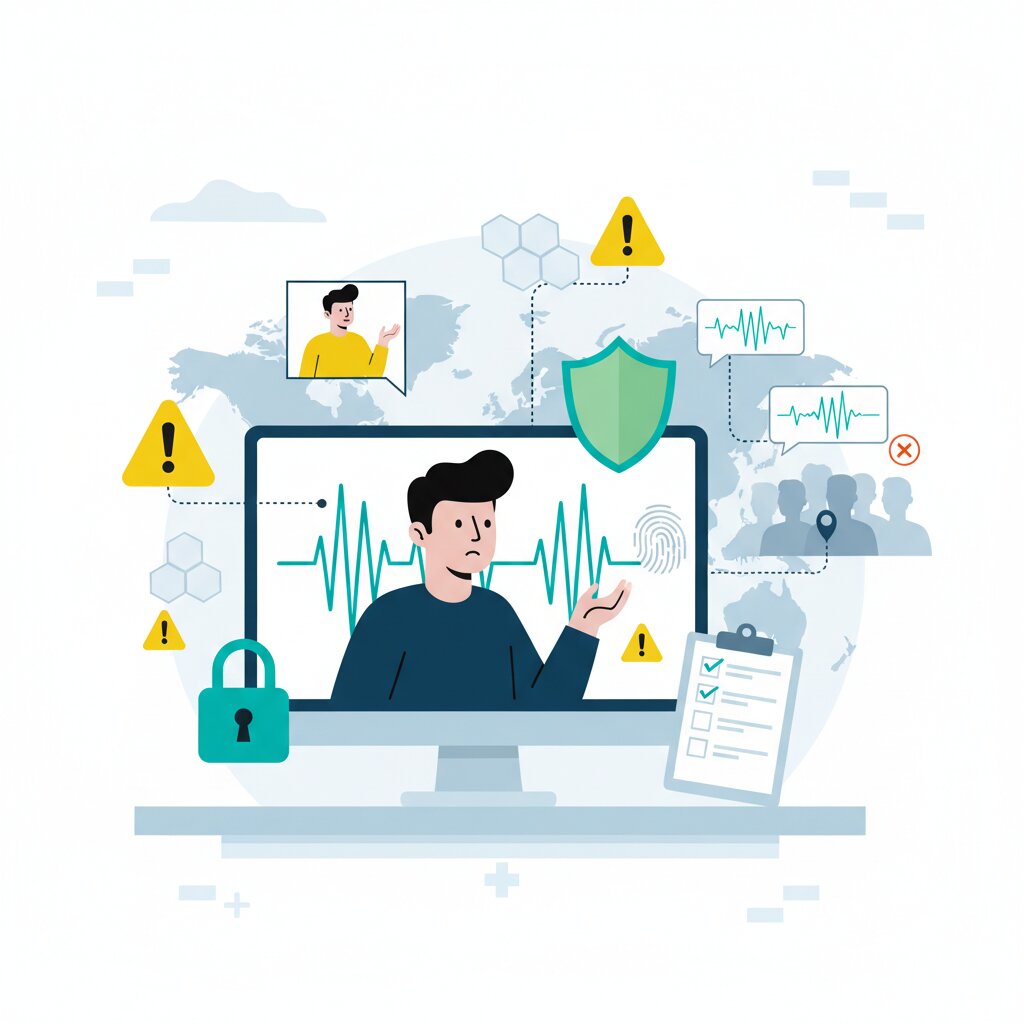

In February 2024, a finance worker at Arup authorised a $25.6 million wire transfer after attending a video conference where every other participant — including the CFO — was an AI-generated deepfake. The attacker’s entire setup cost less than $100.
That incident is no longer an outlier. The scale of the shift is measurable: CrowdStrike recorded a 442% rise in voice phishing incidents in the second half of 2024 alone. Deloitte projects AI-enabled fraud will cost businesses $40 billion annually by 2027. Voice fraud has moved from edge case to operational risk in under three years.
This guide maps the full landscape: how the attacks work, who is running them, which parts of your organisation are most exposed, why existing defences fall short, what a proportionate response looks like, and what you are liable for if an attack succeeds. Each section links to a dedicated article for deeper coverage.
What is AI-enabled social engineering and how is it different from traditional phishing?
AI-enabled social engineering uses machine learning to synthesise convincing audio and video impersonations of real people. Traditional phishing exploits text-based tells — poor grammar, generic greetings, suspicious formatting. Your team can learn to spot those. AI voice cloning and deepfake video remove those tells entirely. The attack surface becomes psychological: authority, urgency, and familiarity. None of those depend on visual formatting, and none of them trigger the detection heuristics your people have been trained on.
AI-generated voices need only a brief sample of source audio — a conference call, a LinkedIn video — to produce synthetic speech that researchers fail to distinguish from real audio. AI-generated spear phishing emails achieve a 54% click-through rate in controlled trials, compared to 12% for human-crafted phishing. The gap reflects how convincing the impersonation is, not any change in human susceptibility.
Deep dive on attack mechanics: How AI Voice Cloning and Deepfake Technology Actually Works
What are the real-world statistics on voice phishing and deepfake fraud losses in 2025?
Voice phishing incidents rose 442% in H2 2024 compared to H1 2024 (CrowdStrike). Deloitte projects AI-generated fraud costs reaching $40 billion by 2027. Organisations lose an average of $14 million per year to voice phishing (Keepnet Labs), with recovery from a single incident averaging $1.5 million. 70% of organisations have already been targeted.
The documented cases tell the story: the Hong Kong deepfake video conference ($25.6 million), a Singapore Zoom deepfake ($499,000), and a UK energy company voice clone ($243,000). South Korea projects $718 million in domestic vishing losses for 2025. Less than 5% of funds lost to voice phishing are ever recovered.
Attacker cost and victim loss analysis: Why AI-Enabled Fraud Is Accelerating — The Economics Behind the Threat
How does AI voice cloning actually work — what does it take to clone someone’s voice?
Modern voice cloning requires three to thirty seconds of source audio. The pipeline — identify a target executive, locate their public audio (earnings calls, conference talks, podcast appearances), isolate the voice, train a clone model, and deploy it in a live call — runs automatically on consumer hardware using off-the-shelf tools like ElevenLabs. Total cost: under $5.
AI voice agent platforms like Bland AI and Vapi let attackers run automated, adaptive vishing calls without a human caller. The LLM manages real-time dialogue, adjusts tone, and responds dynamically. Deepfake video extends this further — every participant in a call can be AI-generated. Less-skilled attackers can purchase vishing-as-a-service kits via Telegram for a monthly subscription.
Full technical walkthrough: How AI Voice Cloning and Deepfake Technology Actually Works
What business functions are most at risk from AI voice cloning attacks?
Finance teams are the primary target. They hold wire transfer authority, and urgency pressure from a cloned executive voice is designed to bypass normal approval processes. IT help desks are the second highest-risk function — a convincing impersonation call is the most common way attackers obtain MFA resets and new device registrations. Executives with significant public audio presence are the most frequently cloned identities.
In both the Hong Kong and Singapore cases, finance staff followed what appeared to be direct instructions from senior executives. The authority signal was the attack surface, not a technical vulnerability. When Ferrari was targeted by a deepfake attack in July 2024, an employee disrupted it by asking a question only the real CEO could answer — demonstrating that shared-secret verification works when detection cannot.
Risk mapping by business function: The Business Functions Most at Risk From AI Voice Phishing Attacks
Why has voice phishing increased by 442% — what changed to make it so much worse?
Three factors converged: the cost of voice synthesis dropped to sub-dollar levels, AI voice agent platforms removed the need for human callers, and cybercrime-as-a-service ecosystems professionalised the distribution infrastructure. An attack that cost $10,000 and required specialist skill in 2022 now costs a few dollars and is available via Telegram subscription.
The economics are clear. The ViKing experimental vishing bot demonstrated automated attacks at $0.50–$1.16 per call — against an average recovery cost of $1.5 million per successful incident. Synthetic identity kits sell for $5 on criminal markets. Dark LLMs provide uncensored social engineering scripts for $30 per month. At those per-attack costs, the attacker’s cost structure now justifies targeting businesses that were previously too small to be worth the effort.
The data behind the acceleration: Why AI-Enabled Fraud Is Accelerating — The Economics Behind the Threat
How do state-sponsored actors and cybercriminals share AI fraud tools and infrastructure?
The same economic forces that lowered barriers for criminal groups also attracted state-sponsored operations. North Korea’s FAMOUS CHOLLIMA, Iranian APT42, and Russian APT28 use the same commercially available AI voice synthesis and deepfake tools as independent criminal groups. FAMOUS CHOLLIMA deploys AI-generated LinkedIn profiles and deepfake job interview impersonations to place operatives inside Western technology companies as IT contractors. The criminal supergroup Scattered LAPSUS$ Hunters combines ransomware expertise, vishing operations, and state-actor tactics into unified campaigns.
The practical implication: the same AI infrastructure built for nation-state espionage is now pointed at your accounts payable team. What DPRK deploys at scale eventually becomes a Telegram subscription product for low-skill criminals within months. The FBI issued FLASH advisory FLASH-20250912-001 specifically about criminal groups using vishing to compromise Salesforce enterprise environments.
Threat actor intelligence: State Actors and Cybercriminals Are Now Using the Same AI Fraud Infrastructure
Why does security awareness training alone fail to stop AI voice fraud?
People cannot reliably detect AI-generated voices. Research shows humans correctly identify deepfake audio approximately 48% of the time — statistically indistinguishable from a coin flip. Deepfake video detection accuracy drops to 24.5%. Less than 0.1% of people can reliably detect real-time deepfakes (iProov). Training improves vigilance and reporting culture, but it cannot compensate for a sensory limitation.
A study tracking 12,511 employees at a financial technology firm found generic training interventions showed no significant effect on click rates or reporting rates. Yet 56% of businesses claim confidence in their deepfake detection abilities while only 6% have avoided financial losses. That gap is why verification protocols — out-of-band callbacks, dual authorisation, shared secrets — need to replace reliance on “does this sound right?” as a security gate.
Detection failure analysis: Why Security Awareness Training Is Not Enough to Stop AI Voice Fraud
What does an AI voice fraud defence stack look like without a dedicated security team?
The controls that work best are process-based, not technology-based. A mandatory callback protocol — verify using a pre-registered number from your own directory, never one provided in the suspicious call — defeats every caller-ID-spoofed vishing attack. Add dual authorisation for transactions above a defined threshold, rotating shared secrets between finance staff and executives, and a mandatory cooling-off period before executing unusual transfers.
Phishing-resistant MFA (FIDO2 hardware tokens) is a high-value technical control. It breaks the help desk vishing attack chain at the point where an attacker tries to register a new device after obtaining a fake MFA reset. OSINT exposure mapping — identifying which executives have significant public audio and video profiles — lets you tier verification requirements based on actual risk exposure.
Full implementation guide: Building an AI Voice Fraud Defence Stack Without a Dedicated Security Team
What legal exposure does a company face when it falls victim to AI voice fraud?
Legal exposure depends on what controls were — or were not — in place before the attack. Regulatory frameworks (FTC Act, GDPR, HIPAA, PCI DSS) apply a “reasonable security” standard that evolves with threat awareness. What counted as adequate in 2022 — annual phishing awareness training — may constitute negligence by 2025 standards given the volume of public regulatory guidance on AI voice fraud.
FinCEN’s deepfake alert (FIN-2024-DEEPFAKEFRAUD) means financial institutions now have explicit SAR reporting obligations for AI-facilitated fraud. Courts and regulators are increasingly reluctant to treat AI fraud as an unforeseeable event when industry guidance has been publicly available since 2023. Documented case precedents are creating a body of legal reference that establishes what a “reasonable” response standard looks like.
Full legal and insurance analysis: Legal and Insurance Exposure When AI-Enabled Fraud Succeeds on Your Watch
How does cyber insurance treat AI-facilitated social engineering fraud?

Standard cyber insurance policies were not written with AI voice fraud in mind. Funds transfer fraud coverage often contains “voluntary transfer” exclusions that deny claims when the employee chose to make the transfer, regardless of the deception involved. The distinction between “computer fraud” (technically-initiated) and “social engineering fraud” (human-approved under false pretences) determines whether you are covered at all.
Insurers are now requiring documented voice verification protocols as a prerequisite for social engineering fraud coverage. AI exclusion clauses are appearing in policy renewals, shifting the burden to you to demonstrate that controls designed for AI-enabled fraud were in place at the time of the incident. Before your next renewal, ask your broker directly: how does this policy respond to a deepfake-facilitated wire transfer?
Insurance coverage gap analysis: Legal and Insurance Exposure When AI-Enabled Fraud Succeeds on Your Watch Defensive controls that improve insurance eligibility: Building an AI Voice Fraud Defence Stack Without a Dedicated Security Team
AI-Enabled Social Engineering Resource Library
Understanding the Threat
-
How AI Voice Cloning and Deepfake Technology Actually Works — The full technical pipeline from audio harvesting to live call deployment. Covers voice synthesis tools, deepfake video generation, and why current AI output defeats human detection.
-
The Business Functions Most at Risk From AI Voice Phishing Attacks — Maps the attack surface to specific business roles. Finance team wire transfer fraud, help desk credential resets, and executive impersonation, each with documented case studies.
-
State Actors and Cybercriminals Are Now Using the Same AI Fraud Infrastructure — Intelligence briefing covering DPRK’s IT worker infiltration programme, the Scattered LAPSUS$ Hunters supergroup, and how nation-state tooling flows into criminal markets.
-
Why AI-Enabled Fraud Is Accelerating — The Economics Behind the Threat — Data-driven analysis of attacker costs versus victim losses. Sub-dollar per-attack execution costs and why the economics now justify targeting smaller businesses.
Evaluating Your Defences
- Why Security Awareness Training Is Not Enough to Stop AI Voice Fraud — Evidence-based review of why human detection fails and what detection technology can realistically achieve against modern AI-generated voices.
Taking Action
-
Building an AI Voice Fraud Defence Stack Without a Dedicated Security Team — Practical implementation guide: callback verification, dual authorisation, shared secrets, OSINT exposure mapping, and phishing-resistant MFA, scoped for organisations without a dedicated security function.
-
Legal and Insurance Exposure When AI-Enabled Fraud Succeeds on Your Watch — Regulatory and insurance implications: FTC Act enforcement, FinCEN reporting obligations, cyber policy coverage gaps, and what documented controls mean for your claims position.
Frequently Asked Questions
What is vishing and why is it suddenly a major business threat?
Vishing (voice phishing) is a social engineering attack conducted over a phone call, where attackers impersonate trusted individuals to manipulate targets into authorising payments or resetting credentials. It has accelerated because AI voice cloning eliminated the previous technical constraint: attackers no longer need to find someone who sounds like your CFO. They need a few seconds of public audio and a cheap tool. Explore the mechanics in depth.
What is a synthetic persona and how is it used to commit fraud?
A synthetic persona is an AI-generated fraudulent identity constructed from fabricated documents, photographs, and personal information. These are used primarily to open fraudulent financial accounts, pass Know Your Customer checks, and create money-laundering funnel accounts. North Korea’s FAMOUS CHOLLIMA group uses AI-generated LinkedIn profiles and deepfake video interviews to place operatives inside Western technology companies as IT contractors.
Can someone clone my CEO’s voice and use it to steal money?
Yes, and this has been documented in numerous confirmed cases. The source material is publicly available for most executives: earnings calls, conference keynotes, media interviews, or LinkedIn videos provide sufficient audio. Clone generation is automated, takes minutes, and costs very little. The most exposed executives are those with the largest public audio and video profile — a finding that should inform your verification protocol stringency, not a reason to remove executives from public communications.
AI voice phishing vs traditional email phishing — which is more dangerous?
For high-value fraud — wire transfers, credential resets, executive impersonation — AI voice phishing is significantly more dangerous. A call from the CFO’s cloned voice carries authority that no email can match. The two vectors are increasingly combined: flooding an inbox with spam before a vishing call is documented in over two-thirds of observed campaigns.
Does cyber insurance cover deepfake fraud?
Potentially, but with significant gaps. Whether a deepfake-facilitated wire transfer is covered depends on how your policy defines “social engineering fraud,” whether a “voluntary transfer” exclusion applies, and whether AI-specific exclusion language has been added at renewal. The only way to know is to ask your broker directly. Full coverage gap analysis.
What is the single most effective control against AI voice fraud?
The callback verification protocol. Before executing any unusual or high-value transfer, call back the requestor using a number from your internal directory — never a number provided in the request itself. It defeats caller ID spoofing, costs nothing, and works regardless of how convincing the voice was. Full defence stack guide.
Where can I find official guidance on AI voice fraud?
The FBI issued FLASH advisory FLASH-20250912-001 specifically on criminal groups using voice phishing to compromise Salesforce environments. FinCEN issued FIN-2024-Alert004 (November 2024) on deepfake fraud targeting financial institutions, mandating SAR filing under the key term “FIN-2024-DEEPFAKEFRAUD.” CISA has published guidance on deepfake threats in conjunction with NSA and DHS. The MITRE ATT&CK framework documents vishing under T1566.004 (Phishing: Voice Phishing).