


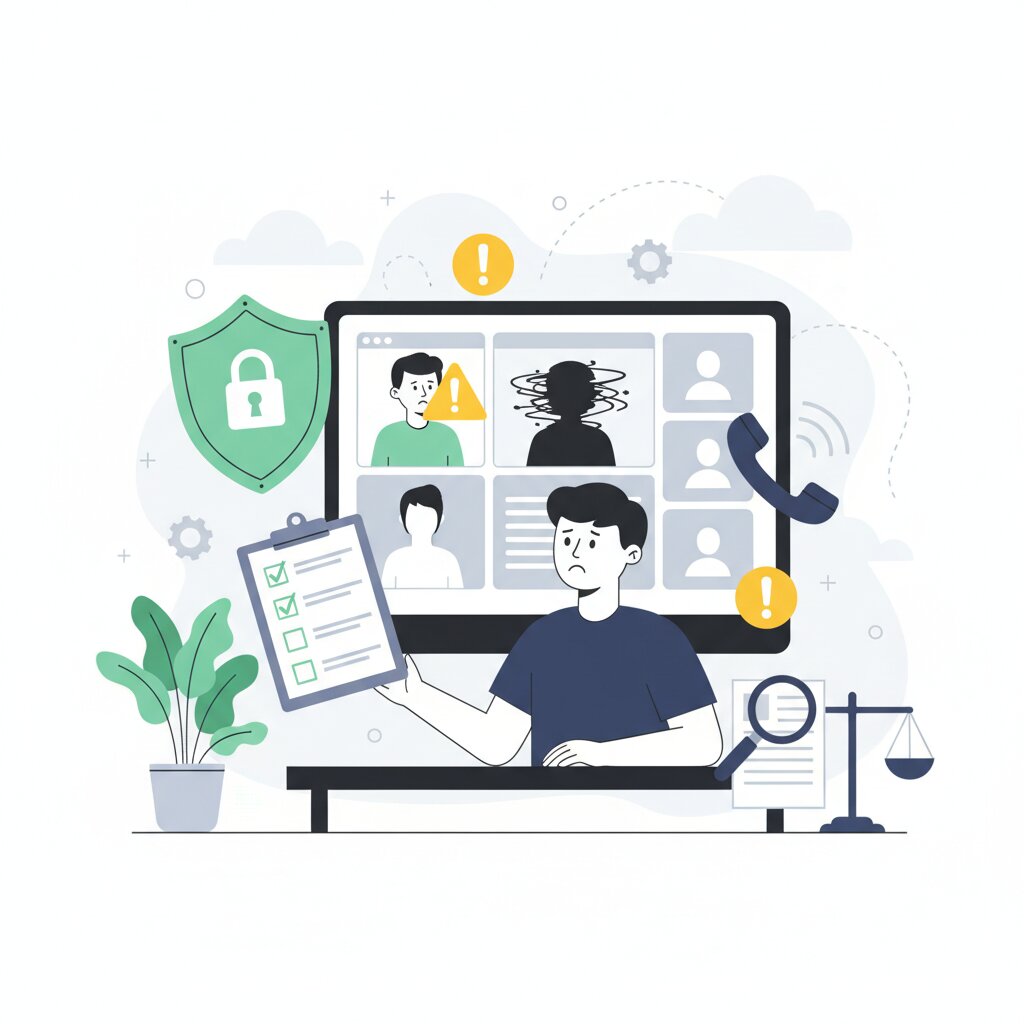
When the wire transfer clears on a deepfake voice fraud, most people think the damage is done. It’s not. That’s when three more problems start: legal exposure, regulatory notification obligations, and the very real chance your insurer denies the claim.
The FBI Internet Crime Complaint Centre recorded 21,442 BEC complaints totalling $2.7 billion in losses in 2024. Regulatory notification obligations under GDPR, HIPAA, and PCI DSS can be triggered completely independently of the financial loss — and cyber insurance claims are getting denied when organisations can’t show they had documented verification controls in place.
This article is about what happens after prevention fails. If you want the full scope of AI social engineering risk, the pillar guide covers that. Here we’re mapping the legal, regulatory, and insurance consequences you need to understand now.
Why does it matter legally if deepfake fraud succeeds — is it not just a financial loss?
It’s three problems at once, not one.
Deepfake voice fraud creates exposure on three fronts simultaneously: the financial loss itself (usually irreversible), regulatory notification obligations if data was accessed, and insurance coverage risk if your controls were undocumented.
Wire transfers executed on fraudulent instructions are classified as authorised push payment fraud. Your organisation authorised the transfer, which dramatically limits what the bank owes you. In the US and Australia, there is no automatic compensation mechanism for corporate entities. That money is gone.
But here’s what most organisations miss in the first hours: if the attacker got in via a credential reset or MFA bypass, you now have a data breach sitting alongside the fraud. Data access — not financial loss — is what triggers GDPR, HIPAA, and PCI DSS obligations. A lot of organisations don’t realise this until it’s too late to respond properly.
And then there’s the personal liability question. D&O (Directors and Officers) liability can attach personally to executives who failed to mandate verification controls. The criminal conviction of Uber’s former CISO and the SEC action against the SolarWinds CISO make this concrete — personal liability for security governance failures is real, not theoretical.
Put it together and you see why the documented losses are only part of the story. A $7.3M wire fraud loss is bad. That same loss plus a GDPR enforcement action plus an insurance claim denial is materially worse. The board needs to understand all three fronts exist, not just the one that shows up in the bank statement.
What do cyber insurance policies now require for voice fraud protection?
Your cyber policy probably covers less voice fraud than you think — and the coverage you do have may come with conditions attached.
Most cyber insurance policies treat social engineering fraud separately, under a rider or extension with much lower sub-limits. We’re talking $100,000–$250,000 typically. You might have a $5 million cyber policy and only $250,000 of social engineering fraud coverage. And that $250,000 can be denied if you didn’t document your verification controls.
Coalition began covering deepfake-enabled wire fraud in 2024 and expanded in 2025 to cover AI-generated audio and video. In February 2026, Upcover added Coalition’s Deepfake Response Endorsement to eligible Australian policies — the first time deepfake-specific cover reached the local SMB market in any serious way. These policies come with conditions attached.
The key condition is the verification clause. This is a policy requirement that your organisation confirmed changes to payment instructions via a previously known contact method before making payment. If you paid a fraudulent invoice without a documented callback procedure, your insurer has grounds to deny the claim.
So here’s what you need to do. Request your policy’s social engineering fraud extension wording. Find out exactly what verification conditions are required. Document your compliance before an incident occurs. Building a verification protocol is exactly what insurance verification clauses are asking for — one process satisfies both requirements.
What are the GDPR, HIPAA, and PCI DSS implications when voice fraud enables a data breach?
The regulatory trigger is data access. Not financial loss.
A failed fraud attempt that gave the attacker access to customer records triggers notification obligations. A successful $500,000 wire transfer with no data access may not. That distinction matters enormously for how you respond in the first hours.
The help desk credential-reset vector is where this gets serious: voice impersonation leads to MFA reset, which leads to credential access, which leads to a data breach, which starts the regulatory clocks running. This is the chain that connects voice fraud to regulatory exposure, and it’s not theoretical — it’s how these attacks play out.
GDPR. The 72-hour breach notification window starts at awareness. Not at confirmation. Not after a full forensic investigation. It starts when you know there’s been a breach. Penalties can reach 4% of global annual turnover, and GDPR applies to any organisation handling EU personal data regardless of where you’re headquartered. The operational tension is real: 72 hours isn’t enough time to complete a forensic investigation, which means you may be required to notify before you fully understand the scope.
HIPAA. The notification window is 60 days for breaches of Protected Health Information. HIPAA applies to business associates too — any tech company that stores, processes, or transmits PHI on behalf of a healthcare entity. C-suite executives face civil fines up to $1.5 million and criminal penalties up to 10 years’ imprisonment.
PCI DSS. When voice social engineering compromises payment systems or cardholder data, PCI DSS obligations may apply. Non-compliance post-breach can mean fines, higher transaction fees, and loss of card acceptance rights.
The NY DFS Part 500 regulation (23 NYCRR 500) sets an explicit standard of care — mandatory MFA, documented access controls. Courts outside New York may reference it as a benchmark even for organisations that don’t technically fall under its jurisdiction. Get qualified legal counsel involved before a crisis, not during one.
What are the documented financial losses from AI voice fraud — the evidence from real cases?
These aren’t projections. These are investigated, documented incidents. Understanding the attacker economics behind these cases explains why the volume keeps rising even as awareness grows.
Gatehouse Dock Condominium Association (Florida). Nearly $500,000 lost to a BEC scheme — money contributed by residents for essential building repairs. This is a reminder that SMBs and non-corporate entities aren’t exempt from significant losses.
H2-Pharma (Alabama). More than $7.3 million lost in a BEC attack — money intended for cancer treatments and children’s allergy drugs. Both H2-Pharma and Gatehouse Dock are co-plaintiffs in Microsoft’s civil action against RedVDS infrastructure, and both losses are largely unrecovered.
Arup, Hong Kong (January 2024). $25.6 million (HK$200 million) transferred in a single day. Every other participant in the video conference was a real-time AI-generated deepfake, including the CFO and multiple colleagues. None of the funds have been recovered.
FBI IC3 2024 aggregate. $16.6 billion in total cybercrime losses. 21,442 BEC complaints with $2.7 billion in losses. BEC is the single highest-loss cybercrime category — by a wide margin.
Now look at those numbers against a typical insurance sub-limit. A $250,000 social engineering fraud sub-limit covers less than half of the Gatehouse Dock loss, 3.4% of H2-Pharma, and less than 1% of Arup. That’s the gap you’re working with.
What does the FBI IC3 recommend when deepfake wire fraud has already succeeded?
Speed is the variable you can still control. The FBI IC3 has a process for exactly this: the Financial Fraud Kill Chain, coordinated through the IC3 Recovery Asset Team. In 2024, the RAT achieved a 66% success rate, freezing $469.1 million in domestic fraudulent funds. That’s real money recovered — when the process is followed quickly enough.
Step one: file an IC3 report via ic3.gov immediately. This activates the RAT and creates the official record you’ll need for insurance claims and legal proceedings. One documented case: a $956,342 BEC wire reported two days after transfer — the RAT froze the account and returned $955,060. Speed matters more than completeness. The report can be updated later, but the recovery window cannot be extended.
Step two: contact the sending bank’s fraud division in parallel. Not after filing the IC3 report. At the same time. Parallel action is what determines how much is recoverable.
For financial sector entities, FinCEN Alert FIN-2024-Alert004 applies — include the key term “FIN-2024-DEEPFAKEFRAUD” in SAR filings. And note that the FBI’s out-of-band verification recommendations are the same controls that satisfy your insurer’s verification clauses. One documented callback protocol covers both requirements.
What should your organisation do in the first 24 hours after a suspected deepfake fraud event?
The first 24 hours determine your recovery options, your insurance eligibility, and your regulatory compliance. The sequence is not arbitrary.
Hour 0–2: Preserve evidence. Before anything else. Call logs, transaction records, email trails, any recorded audio. Do not delete, overwrite, or forward potentially compromised communications. This is the one thing you cannot recover if you get it wrong.
Hour 0–4: File IC3 and contact the bank — in parallel. File an IC3 report via ic3.gov and contact the sending bank’s fraud division at the same time. Hours, not days.
Hour 1–4: Contact legal counsel. Get a lawyer who specialises in cyber incident response. They’ll advise on regulatory notification obligations based on what data the attacker may have accessed.
Hour 2–6: Contact your cyber insurer before any public communication. Most policies require insurer pre-notification as a condition of coverage. A premature public statement can jeopardise the claim.
Hour 4–12: Conduct initial scope assessment. Did the attacker access data, or was this purely financial fraud? If data access is possible, assume the GDPR 72-hour clock is already running. Operate on the most conservative assumption until you know otherwise.
Hour 12–24: Brief the board. Document what happened, what’s been done, what exposure exists, and what decisions need to be made. This is the governance record that matters for D&O liability.
The defensive controls that reduce your legal exposure — verified callback protocols, documented out-of-band verification, dual authorisation — address all three fronts simultaneously. They satisfy your insurer’s requirements and demonstrate reasonable governance to a regulator or court. If you’re reading this after an incident, the absence of those controls is the exposure.
This article covers the consequences of a failure. For the broader AI fraud threat landscape — how these attacks work, who the targets are, and what the full scope of risk looks like — the pillar guide covers all of that.
FAQ
Can executives face personal liability if the company is scammed by a deepfake call?
Under certain D&O liability scenarios, yes. If a court or regulator finds that the absence of documented verification controls constituted a governance failure, personal liability can attach to executives who had authority to mandate those controls. The sophistication of the fraud is not a mitigating factor. Worth noting: 38% of CISOs are not covered by their company’s D&O policy. Check whether your role is an “insured” under the policy terms before you need to find out the hard way.
Does our cyber insurance cover deepfake fraud or just ransomware?
Most cyber policies treat social engineering fraud separately, under a rider or extension with sub-limits commonly at $100,000–$250,000. The main cyber policy limit probably does not apply to voice fraud wire transfer losses. Social engineering fraud often falls into a gap between cyber insurance (breach response) and crime insurance (fraud losses) — most organisations don’t know which policy responds until they file a claim. Find out now.
What is a verification clause in a cyber insurance policy?
It’s a policy condition requiring you to have confirmed payment instruction changes via a previously known contact method before making payment. It’s the primary mechanism by which insurers deny social engineering fraud claims. Without a documented callback procedure, the clause may void your claim entirely.
Do I have to notify customers if an AI voice scam led to a data breach?
If the attacker gained access to personal data via credential compromise, notification obligations are likely triggered. Under GDPR, the 72-hour clock starts at awareness of the breach — not at confirmation. Get qualified legal counsel involved immediately to assess your specific obligations by jurisdiction.
How long do I have to report a wire fraud to the FBI IC3 for the best chance of recovery?
File immediately. The IC3 Recovery Asset Team achieved a 66% success rate in 2024. Recovery rates decline significantly as funds move through intermediary accounts. File even if you don’t have the full picture yet — the report can be updated, but the recovery window cannot be extended.
Can a tech company that is not in healthcare still face HIPAA exposure from voice fraud?
Yes, if the company is a business associate of a healthcare entity — storing, processing, or transmitting Protected Health Information on behalf of a covered entity. A cloned voice convincing a help desk to reset credentials that grant PHI access triggers HIPAA notification obligations regardless of your company’s primary industry.
Are social engineering fraud sub-limits ($100,000–$250,000) enough to cover a real deepfake BEC loss?
Not for a serious incident. Documented losses range from $500,000 (Gatehouse Dock) to $25.6 million (Arup). A $250,000 sub-limit covers less than half of the smallest documented case. Review your sub-limits against realistic incident scenarios — not against the sub-limit that looked reasonable when you bought the policy.
What is the Financial Fraud Kill Chain and how does it work?
It’s an FBI-managed inter-bank rapid recall process coordinated through the IC3 Recovery Asset Team. When a victim files an IC3 report, the RAT contacts the receiving bank to freeze and recall the fraudulent transfer. It achieved a 66% success rate in 2024, freezing $469.1 million in domestic fraudulent funds. File the IC3 report first and contact your bank simultaneously — both within hours of discovery.
This article provides general information about legal, regulatory, and insurance considerations related to AI-enabled fraud. It does not constitute legal advice. Consult qualified legal counsel for advice specific to your organisation’s circumstances and jurisdiction.