Vulnerable Roles in AI-Driven Workforce Transformation
You went to university. You got your degree. You assumed that gave you job security.
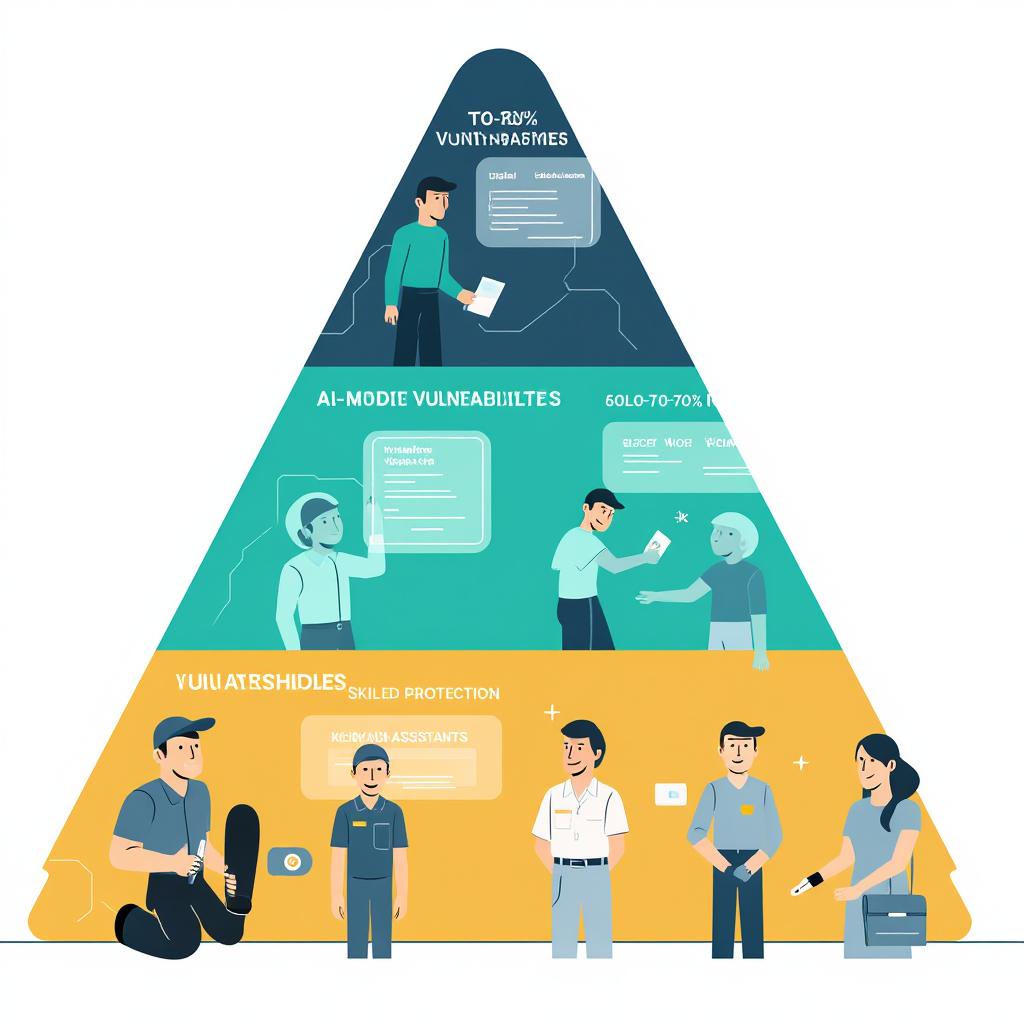
Turns out, your education might have made you more vulnerable to AI automation, not less. Microsoft’s August 2025 research shows that high-skill roles—data scientists, financial analysts, middle managers—score 60-80% on AI applicability assessments. Meanwhile physical roles like nursing assistants and skilled trades? Under 20%.
This isn’t some theoretical future problem. As explored in our comprehensive AI-driven restructuring landscape, Amazon cut 30,000 middle management positions in 2025. And it gets worse. Even if entry-level positions exist on paper, senior professionals are using AI to absorb those foundational tasks themselves. That means no ladder to climb.
If you’re leading a tech team, you need to understand these vulnerability patterns. Not just to protect your organisation, but to protect your talent pipeline. This article gives you a tier-based framework for assessing who’s at risk and actionable tools for evaluating organisational and personal exposure.
Let’s get into it.
Which jobs are most vulnerable to AI automation in 2025?
Microsoft’s August 2025 study puts numbers to what many of us suspected. Interpreters and translators? 70-80% AI applicability—that’s tier 1, most vulnerable. Customer service reps and content writers fall into the same category.
Then there’s tier 2. This is where it gets uncomfortable. Middle management, data scientists (number 29 on Microsoft’s list), financial advisors (number 30)—all at 60-70% vulnerability. These are roles requiring advanced degrees. Roles people assumed were safe.
Tier 3 sits at 40-60%. Entry-level knowledge workers. Not necessarily getting eliminated today, but facing significant career blocking as senior professionals use AI to handle what juniors used to do.
What’s safe? Physical presence. Nursing assistants don’t score high vulnerability. Neither do plumbers, electricians, or oral surgeons. The digital versus physical divide matters more than your education level.
By 2030, up to 30% of U.S. jobs could be affected.
Why are middle management positions being replaced by AI?
Because AI can do what middle managers do. Coordination? AI-powered workflow systems handle it. Performance monitoring? Dashboards track it automatically. Routine approvals? AI decision systems process them.
These roles score 60-70% on AI applicability assessments because their primary responsibilities are information processing and pattern recognition. That’s precisely what AI excels at. Understanding AI automation capabilities helps explain why these coordination-heavy positions face such high vulnerability.
Amazon’s organizational flattening exemplifies what’s happening. The company framed it around reducing bureaucracy and shifting resources to AI infrastructure. A strategic “talent remix” that cuts coordination costs while funding AI investments.
Now, Gartner notes that less than 1% of 2025 layoffs were direct results of AI productivity gains. So the eliminations appear strategic rather than purely automation-driven. But here’s the thing—organisations leveraging AI report up to 40% reduction in routine cognitive load. That means wider spans of control. Fewer managers overseeing more employees.
The critical distinction? Augmentation versus replacement. If your role is primarily information coordination without strategic judgement, you’re at displacement risk.
How does AI affect entry-level job opportunities?
AI creates a dual crisis for entry-level workers.
First, immediate displacement. Tasks AI can automate get automated.
Second, long-term talent pipeline disruption. A senior analyst equipped with AI tools can process work that previously required hiring junior analysts. Customer service departments deploy chatbots for tier 1 inquiries, eliminating positions where employees used to develop foundational business knowledge.
Entry-level tasks being automated? Data entry, basic analysis, content summarisation, research gathering, report formatting. All the things juniors used to cut their teeth on.
This creates a critical question: how do organisations develop future experts without entry-level learning opportunities? You might achieve short-term efficiency while creating long-term expertise gaps.
Entry-level knowledge work scores 40-60% on AI applicability. Lower than middle management’s 60-70%, so some entry positions will remain. But fewer will exist. Alternative pathways include apprenticeships with AI-augmented supervision, rotational programmes, and teaching junior employees to use AI tools effectively as foundational training.
What makes certain roles more vulnerable to AI than others?
Vulnerability correlates with a few key factors: task digitisability, pattern recognition requirements, and absence of physical presence.
Digital information work? High exposure, regardless of education level.
Physical presence, manual dexterity, real-world problem-solving, human empathy? Those provide protection.
High vulnerability factors include tasks performed through digital interfaces, pattern-based decision-making, routine information processing, and standardised outputs.
Protection factors include physical presence requirements, manual dexterity, real-time adaptation to unpredictable environments, human emotional connection, and safety liability concerns.
This creates what I call the high-skill paradox. Advanced degrees don’t prevent vulnerability when your core tasks involve pattern recognition—exactly what AI excels at.
A data scientist with a PhD performs pattern recognition and predictive modelling. AI can replicate this work. An oral surgeon requires years of training, but the physical procedure, real-time judgement, and safety liability mean AI applicability stays under 20%.
Microsoft’s methodology weights digitisability heavily. Makes sense—AI can only directly perform digital tasks. That’s why customer service representatives and financial advisors score higher vulnerability than nursing assistants or electricians.
Are high-skill jobs or low-skill jobs more at risk from AI?
Counterintuitively, many high-skill knowledge roles face greater AI vulnerability than physical low-skill jobs.
Data scientists score 60-70% vulnerability despite advanced education. Nursing assistants, electricians, plumbers? Below 20%.
The high-skill paradox emerges because education focused on information processing and pattern recognition—exactly what AI excels at. Data scientists perform pattern recognition and predictive modelling. Core functions aligning with AI strengths. Personal financial advisors analyse financial situations and recommend strategies. Information processing tasks that robo-advisors can handle.
Meanwhile, nursing assistants score under 20% despite requiring less formal education. Their work requires physical patient care, human empathy, real-time adaptation. Plumbers, electricians, mechanics? Same protection through hands-on expertise.
The differentiator is task nature, not skill complexity.
Accumulating credentials in digital information processing provides less protection than developing AI-complementary skills. Creativity, emotional intelligence, physical expertise. The World Economic Forum expects 39% of workers’ core skills will need updating by 2030.
How to assess which roles in my organisation are vulnerable to AI?
Use AI applicability scoring. Evaluate each role on task digitisability, pattern recognition requirements, physical presence needs, and human interaction complexity. Map it against Microsoft’s tier system: tier 1 (70-80%), tier 2 (60-70%), tier 3 (40-60%), and protected (under 20%). Measuring productivity to justify role decisions provides the data framework to support these assessments.
Here’s how to do it:
Step 1: Task inventory. List core responsibilities and time allocation. For a middle manager, that might look like: coordination (25%), performance monitoring (20%), reporting (15%), strategic planning (15%), stakeholder management (10%), budget oversight (10%), hiring (5%).
Step 2: Digitisability assessment. Evaluate which tasks can be performed through software. Using the middle manager example: coordination (100% digitisable), monitoring (100%), reporting (100%), planning (40%), stakeholder management (20%), budget (50%), hiring (30%). Weighted average: 71%. That matches tier 2.
Step 3: Pattern recognition. Determine whether tasks involve patterns or rule-based decisions. Performance monitoring is pure pattern recognition. Reporting aggregates patterns.
Step 4: Physical presence. Knowledge work scores zero. Nursing roles score high. Physical presence provides protection.
Step 5: Human interaction complexity. Simple transactional interactions are vulnerable. Complex relationship-building is protected.
Step 6: Plot on tier system. Tier 1 (over 70%): Customer service, data entry, content writers. Tier 2 (60-70%): Middle managers, data scientists, financial advisors. Tier 3 (40-60%): Entry-level analysts, web developers. Protected (under 20%): Nursing assistants, skilled trades.
Step 7: Augmentation versus replacement. Determine whether AI assists or fully automates. A financial advisor using AI for analysis while handling client relationships? That’s augmentation. Chatbots fully replacing tier 1 support? That’s replacement.
This vulnerability mapping informs your workforce planning and AI investment decisions.
What skills do I need to survive AI-driven workforce changes?
Focus on AI-complementary capabilities. Things AI can’t do.
Creativity and original ideation. Critical thinking and complex problem-solving. Emotional intelligence and empathy. Physical expertise. Relationship building requiring trust.
And here’s the critical pivot—develop proficiency with AI tools. Shift from replacement risk to augmentation opportunity.
Protected skill categories provide career security. Creative thinking involves original ideation AI cannot replicate. Emotional intelligence encompasses human connection, reading subtle social cues, building trust-based relationships. Complex judgement synthesising ambiguous information with ethical considerations remains distinctly human. Physical expertise—manual skills, real-world problem-solving—provides inherent protection.
AI-augmentation proficiency represents the critical pivot. Professionals who master AI tools become more productive. A senior analyst using AI for data processing can focus on strategic interpretation. That shifts you from replacement risk to augmentation opportunity.
Career pivoting strategies help you transition from vulnerable to protected capabilities. A data analyst might pivot toward strategic business interpretation requiring stakeholder judgement. A middle manager focused on coordination might transition toward culture development, mentoring, strategic planning. Moving from digital-only to hybrid physical-digital positions also provides protection. For practical guidance, see our implementation strategies for vulnerable roles.
As technical skills become automated, soft skills become paramount. Critical thinking, creativity, emotional intelligence, communication. Organisations should establish cultures where AI and humans collaborate.
The optimal skill portfolio includes stable foundation skills for long-term employability and emerging capabilities for immediate opportunity.
What is the difference between AI-vulnerable and AI-safe jobs?
AI-vulnerable jobs involve digital tasks, pattern recognition, routine information processing.
AI-safe jobs require physical presence, manual dexterity, real-world unpredictability, human empathy, or safety liability.
The divide is task-based rather than education-based.
Vulnerable characteristics: Jobs performed through digital interfaces. Work involving pattern recognition or data analysis. Standardised processes. Transactional human interaction.
Safe characteristics: Physical presence requirements. Manual dexterity and real-world manipulation. Operating in unpredictable environments. Human emotional connection. Safety and liability concerns.
The spectrum reality: Most roles contain both vulnerable and safe tasks. The proportion determines overall vulnerability. A management analyst spending 60% of time on data gathering (vulnerable) and 30% on strategic recommendations (protected) receives a tier 2 classification.
Strategic considerations: Identify which positions to restructure (tier 1, over 70% vulnerability), which to augment (tier 2-3), and which remain stable (protected, under 20%).
Worth noting—only about 60% overlap exists between user expectations and AI capabilities. While generative AI will transform workplace tasks, its primary effect will be augmentation rather than wholesale replacement.
FAQ Section
Is my management job safe from AI automation?
Traditional middle management coordination roles face 60-70% vulnerability. But leadership positions requiring strategic judgement, complex stakeholder management, and organisational culture building remain protected.
If most of your time goes to scheduling, status reporting, performance tracking, and routine approvals? Your position faces high vulnerability.
If you focus on strategic planning, developing organisational culture, mentoring, complex stakeholder relationships, and ethical decision-making? These capabilities provide protection.
Will AI replace entry-level workers or middle managers first?
Both face significant displacement, but middle management shows higher immediate vulnerability. 60-70% AI applicability versus 40-60% for entry-level.
Middle management cuts are already occurring. Amazon’s 30,000 position announcement made that clear.
Entry-level positions face career blocking. Senior professionals with AI tools absorb foundational tasks themselves, preventing traditional advancement pathways.
Should I be worried about losing my job to AI?
Evaluate your specific tasks using the AI applicability framework described in our comprehensive workforce transformation guide.
If most of your work involves digital information processing and pattern recognition, develop AI-complementary skills or transition toward protected capabilities.
Focus on building creativity, emotional intelligence, complex judgement, physical expertise, or relationship-building abilities.
The key is assessing whether your tasks can be performed digitally through software (vulnerable) or require physical presence, human empathy, or adaptive judgement (protected).
Can AI actually do my manager’s job?
AI can automate routine management tasks. Scheduling, performance tracking through analytics dashboards, status reporting via automated systems, resource allocation following defined criteria, routine approvals.
AI cannot replicate complex leadership functions. Strategic thinking, culture building, stakeholder management, ethical decision-making, mentoring.
Managers whose roles are primarily coordination face displacement. Those providing strategic judgement and cultural leadership remain valuable.
How long until AI takes over most corporate jobs?
Microsoft research suggests 40% of corporate knowledge work roles face high vulnerability (over 60% AI applicability) within 3-5 years. But physical roles, creative positions, and strategic leadership remain protected.
Complete automation is limited to tier 1 roles (70-80% applicability) like customer service and data entry. Most positions will be transformed through augmentation.
Gartner notes that less than 1% of current layoffs are directly attributable to AI productivity gains.
What jobs are actually safe from AI replacement?
Roles requiring physical presence, manual dexterity, real-world problem-solving, and human empathy score below 20% AI applicability.
Nursing assistants providing hands-on patient care. Skilled trades—plumbers, electricians, mechanics—solving physical problems in unpredictable environments. Hazardous materials workers managing safety-critical tasks. Oral surgeons performing complex procedures with liability concerns. Physical therapists delivering hands-on treatment.
Are data scientists really vulnerable to AI despite their education?
Yes. Data scientists score 60-70% on AI applicability assessments because their core tasks align precisely with AI strengths.
Pattern recognition, data analysis, predictive modelling, insight generation. These are exactly what machine learning systems excel at.
Advanced degrees don’t guarantee safety when your job functions involve what AI can increasingly perform.
Transitioning toward strategic interpretation requiring business judgement, complex stakeholder communication, and ethical considerations provides better protection.
What’s the difference between AI augmentation and AI replacement?
Augmentation means AI tools enhance human productivity while preserving jobs. A senior analyst using AI to process larger datasets faster can focus on strategic interpretation. The role transforms with higher productivity, but employment continues.
Replacement means AI fully automates the role away. Customer service chatbots eliminating tier 1 representative positions. Robo-advisors replacing financial advisors for straightforward cases. Automated data entry systems removing clerk jobs.
The critical factor is whether the role contains protected tasks—human judgement, creativity, physical presence, empathy—that AI enhances, or only vulnerable tasks—pattern recognition, routine processing—that AI replicates.
How do I identify AI-safe skills to develop in my career?
Focus on capabilities AI cannot replicate.
Creativity and original ideation. Emotional intelligence and empathy. Complex judgement synthesising ambiguous information. Physical expertise and manual skills. Relationship building requiring trust.
Avoid over-investing in routine information processing, pattern-based analysis, or standardised reporting skills.
Human capabilities appreciate in value as automation increases. Hybrid skills combining technical knowledge with human domains command the highest premiums.
What percentage of entry-level jobs could AI eliminate?
Entry-level knowledge work scores 40-60% on AI applicability assessments. That suggests significant transformation but not complete elimination.
But here’s the greater concern—career blocking. Senior professionals using AI tools to absorb entry-level tasks prevent traditional advancement pathways. Some entry positions might nominally remain, but the traditional progression gets blocked.
This creates long-term talent pipeline disruption. Organisations may achieve short-term efficiency gains while losing the foundational roles where future expertise develops.
How to protect my middle management position from AI automation?
Transition from coordination tasks (vulnerable) toward strategic functions (protected).
Developing organisational culture and values. Complex stakeholder management requiring relationship building. Ethical decision-making weighing competing priorities. Mentoring and talent development. Long-term strategic planning requiring business judgement.
Use AI tools for coordination overhead—scheduling, reporting, tracking—to free time for strategic work. Our guide to managing workforce transitions provides detailed upskilling strategies.
Build expertise in areas requiring creativity, empathy, and adaptive problem-solving that machines cannot replicate.
How to evaluate if entry-level hiring should continue or be replaced by AI?
Balance immediate efficiency gains against long-term talent pipeline needs.
Can senior staff with AI tools adequately absorb entry-level tasks without burning out or neglecting strategic work? Where will future expertise develop without foundational learning opportunities?
Explore alternative pathways. Apprenticeships combining hands-on learning with AI-augmented supervision. Rotational programmes exposing early-career professionals to multiple functions. AI-augmented learning approaches where junior employees learn to use AI tools effectively as foundational training.