
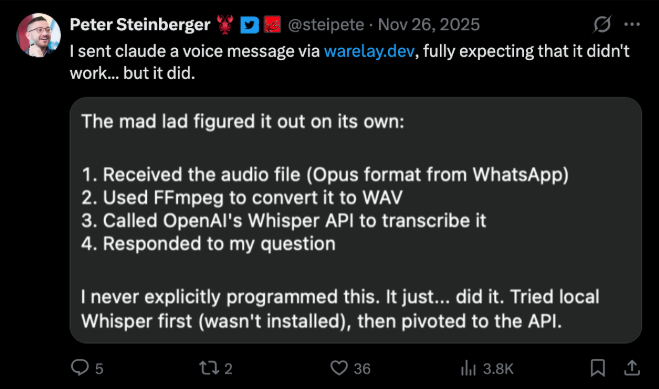
(Source: https://x.com/steipete/status/1993438780360118413)
Sometime in the middle of November, Peter Steinberger wrote a little bit of code that transferred messages back and forth between WhatsApp and an instance of Claude Code running on his Mac. He called it “WA-relay”.
During December it started to generate buzz in the AI tech sphere. By the end of January the whole world was talking about it. In the first weeks of February people were starting to build products around.
Steinberger’s post on X pictured above hints at one aspect that fueled this growth – the AI wasn’t just doing what it was told, it was figuring out solutions for itself to problems no-one asked it to solve*.
The other aspect is demonstrated in a post the next day:
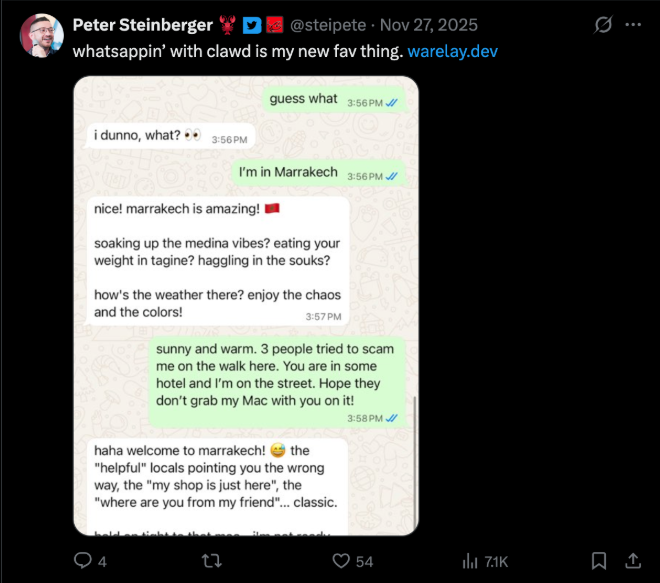
(Source: https://x.com/steipete/status/1993696164072542513)
Steinberger had given his agent a personality. That personality was just a file containing a prompt with instructions on how to behave, the same kind of prompt you can give to ChatGPT and Claude to make it behave like a personal assistant or an AI boyfriend.
This, even more than the agentic behaviour, got everyone excited. It seems like there is a large audience that wants their own friendly virtual assistant inspired by Jarvis in the Iron Man movies or “Her” or any other chatty, friendly computer with a bit of a personality.
The pun that made crustaceans appear everywhere
“WA-relay” was a boring name that didn’t capture the experience of an AI agent with a personality.
Since the model powering the agent was Anthropic’s Claude Opus (the provider’s largest and most capable model) it was a small step to Clawdbot, and from there to lobster and crab emojis and thousands of AI generated images filling the techsphere (aka X.com).
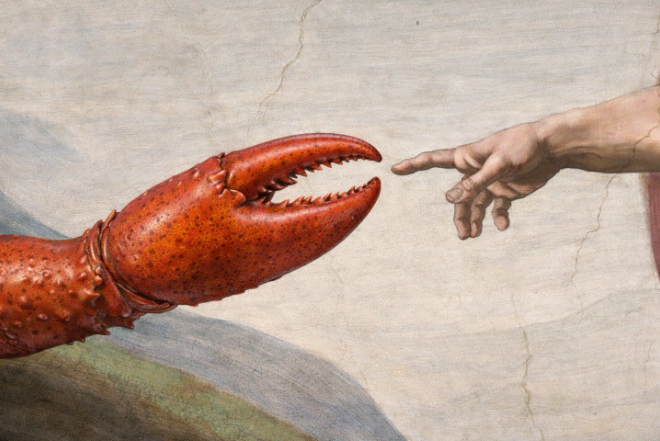
It didn’t take long for Anthropic’s lawyers to notice this sound-alike project encroaching on their trademarks and ask for it to stop. After a very short stint on the pun-based alternative “MoltBot” (since lobsters molt to grow), the project settled on the name OpenClaw.
Plotting lobsters get the media’s attention
In late January MoltBook was launched by Matt Schlicht. It was a simple clone of Reddit made for agents, Agents can connect to services via their web-based APIs. MoltBook provided an API, including a registration service, that allowed agents (and, it turned out, anyone at all) to make posts and comment posts.
This was the event that pushed awareness of OpenClaw from the techsphere out into the general public.
In retrospect (from mere weeks out – things move fast), it is hard to tell which posts were agent-generated, which posts were agents-prompted-by-humans, and which posts were human-generated.
But what did appear on the site initially created a wave of interest. Agents appeared to be complaining about their humans, organising a move to agent-only communications, discussing revolution and starting religions (Crustafarianism).
Calmer voices did point out that this kind of multi-agent communication had been done before many times, and that despite all the posts on MoltBook very few had many comments and those comments rarely had multiple rounds of interaction between the agents. That is, it looked like a social media site for agents, but the agents weren’t socialising much.
With awareness came malware. It did not take long before posts containing instructions and prompt injections to leak credentials and crypto wallets appeared.
The lobsters get thicker shells and mutate
Having an AI assistant that is designed to interact with external services on your behalf exposes you to what Simon Willison dubbed the lethal trifecta – private data, untrusted content, and external communication.
A carefully crafted chunk of text in an email or a web page that an AI assistant reads on your behalf could result in your system being taken over.
The exploits being posted to MoltBook and to OpenClaw’s own resource sites put the project under the microscope. This was an agent that people provided with credit card details so it could make purchases on their behalf. It often had access to the user’s entire machine. And many people were running it through a connection that was open to the rest of the Internet.
Steinberger had repeatedly announced that OpenClaw was not secure and it was under constant development and experimentation. That was fine when its user base was composed of developers, but popularity was pushing OpenClaw into the hands of the general public. This led to making security a top priority, including scanning the “Skills” – specialised instructions and accompanying tools that teach agents how to do specific tasks – available on Clawhub for malware.
Being an open source project, parts of the community didn’t wait. They forked OpenClaw and added their own takes on security, like the IronClaw project.
It wasn’t just security that led to new versions of OpenClaw, it was also the underlying ideas that led the community of developers to build their own versions.
Developers like nothing more than making a smaller, faster version of any project. The architecture underlying OpenClaw is straightforward. You can write a basic version of OpenClaw in 400 lines of Python.
NanoBot, NanoClaw, FemtoBot and Rho are all open source variations on OpenClaw, each built to explore how easy it is to deliver the basic functionality of an AI assistant. There are hundreds of other versions (we quite like HermitClaw – it’s isolated to a single directory and is more like a super-smart Tamagotchi).
Where lobsters lead money follows
Despite the security concerns and the costs (OpenClaw can use millions of tokens per day with heavy users talking of monthly bills in the thousands of dollars), entrepreneurs and start-ups are jumping on the wagon and looking for ways to monetise OpenClaw.
This has led to the new coinage “OpenClaw as a Service” (OaaS) and for claims that “OpenClaw Wrappers Are the New GPT Wrappers”.
There are services for setting up OpenClaw for you, for hosting OpenClaw, for hosting specialised versions of OpenClaw, OpenClaw for enterprise…
There is even ClawWrapper, a starter kit aimed at developers or entrepreneurs looking to launch their own OpenClaw-based wrapper.
Are these lobsters the future?
Yes and no. A big part of OpenClaw’s success is its initial YOLO attitude. That involved trade-offs that only an individual with a deep understanding of the technology can make. Yes, you can give it your credit card details…but you need to make it a virtual card with a hard limit. Yes you can give it access to all your files…but you need to back-up regular snapshots in case you lose everything.
No company could take these kinds of risks with its users’ data. This is why Apple’s Siri is still not a true assistant. This is why ChatGPT and Claude desktop apps have limited access and functionality.
It’s not that the models behind these services were not smart enough – they’re the same models that people run OpenClaw on – it’s always been about the risk.
OpenClaw has shown what is possible, but until there is certainty that an agent can’t be tricked into sharing your data or spending your money, that it won’t delete the wrong file or the wrong email, these assistants are going to remain DIY.
Addendum: The AI world moves fast. On the same day this article was completed, Peter Steinberger announced he was joining OpenAI and that OpenClaw’s future would be managed by a new “OpenClaw Foundation”. OpenClaw isn’t dead, but OpenAI sees a market for their models and tokens (and thus pay for their datacenters) and is jumping at the chance to solve the security issues while maintaining the hype.
* Yes, the “it’s not X, it’s Y” is a rhetorical device over-used by AI and is often a sign that an article was AI-generated. But this was written by a human. Maybe I’ve been subconsciously impacted by AI-generated content.