

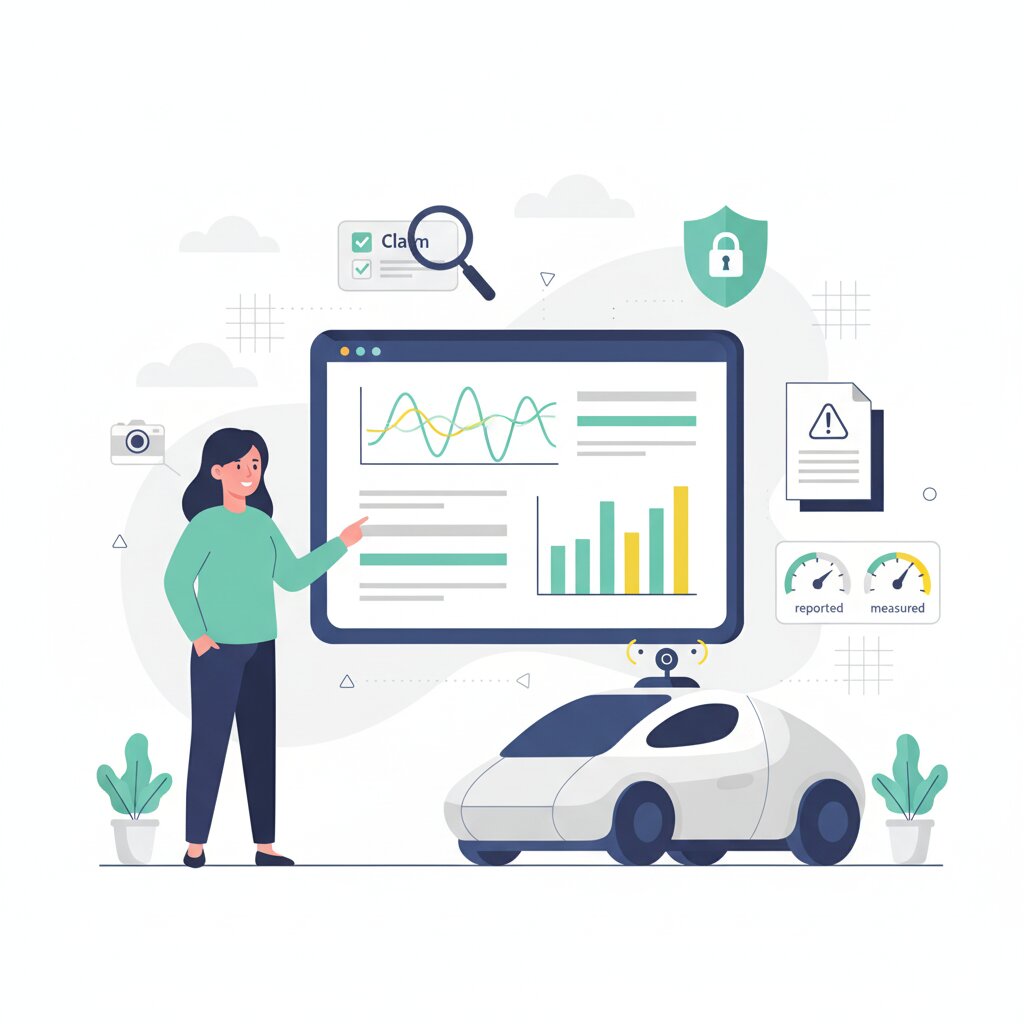

Robotaxi operators publish dashboards: a crash-per-mile figure, a graph sloping downward, a comparison to human drivers. A headline crash rate is only as strong as its source, its definition, and its denominator. The number is a claim, published by whoever stands to gain from you believing it.
So treat every operator number as evidence to interrogate: check who reports it, how it is defined, what it excludes, and whether an independent party verified it. We will run that test over the metric everyone quotes, then over the data a robotaxi collects. It is the evidence layer of the scale-up, where safety narratives fall apart.
What should you look for when evaluating an AV operator’s safety claims and self-reported metrics?
A safety number is only as trustworthy as its source. Run the four-part test before comparing any two rates.
Operators publish their own dashboards; the independent baseline comes from someone with no stake in the result. The Insurance Institute for Highway Safety ran the first independent per-mile crash benchmark of a driverless fleet and found Waymo’s vehicles were involved in 68% fewer crashes per mile than human drivers.
Then check the definition and denominator. AV operators must report any physical contact with property damage, injury, or fatality, while human crash data needs enough damage for a police report. That gap is why Waymo’s safety impact hub applies a 32% underreporting correction to its human benchmark. Before trusting any crash-per-mile figure, ask for the vehicle miles travelled and the severity threshold used.
Look at what is missing. Crash-per-mile is a floor rather than a definitive measure of trust, according to Philip Koopman. Cross-check against NHTSA’s Standing General Order crash reports, the only national crash-collection channel, where operators can redact details and are not required to report mileage.
When someone says “independently verified”, verify the verifier: Aurora’s CEO sits on the board of Edge Case, which audited its safety case. The same scepticism travels to unit economics, as with Tesla’s cost-curve claims.
Verification, not assertion, is how trust fits the wider picture of the robotaxi scale-up.
Why has Waymo’s disengagement rate not meaningfully improved over a decade of testing?
A disengagement is the moment the driving task shifts from the software back to a safety driver, reported annually to the California DMV for a decade. An analysis of monthly test data found no net improvement over that time, with 2024 slightly above 2016 and 2017 levels.
The reason is mostly the metric itself. The DMV states disengagement reports are “not designed for comparative analysis across companies“, and outliers skew the aggregate: in 2018, Apple and Uber logged about 97% of all disengagements while representing only about 5% of the miles. Once those outliers are removed, the trend improves, according to EE Times.
A flat rate is not evidence of stalled capability. Safety drivers intervene for cautious or training reasons, and as test environments grew more complex from 2017, a growing denominator held the rate flat. The near-misses that never become a crash stay absent from the statistics.
So read disengagements as a testing-intensity signal. California’s new reporting shifts toward behaviour that matters, such as system failures, immobilisations, hard-braking events, and mandatory mileage, part of the regime operators now face. For the “how safe” question, the independent IIHS benchmark answers more directly.
How do you evaluate the privacy and data-handling risk of an AV fleet before adopting it?
Treat a robotaxi as a mobile sensor platform. Cameras, lidar, radar, and microphones record continuously, so riders and nearby pedestrians are captured whether they consent or not. Before your business adopts a fleet, ask what it records, where it flows, who can access it, and how long it is kept.
Map the flows. Footage and sensor data feed back into development, and can leave the operator’s control. Courts have issued warrants for robotaxi sensor data, and police have requested self-driving footage, according to the Southern California Law Review. As Vital City puts it, companies “have strong incentives to do favours for law enforcement and little incentive to protect bystander privacy”.
Then consider repurposing. Ride history and location data can feed personalised pricing, charging a rider who has given up a personal vehicle a higher fare because their demand is inelastic. One incident shows how far this goes: a Waymo detected a terms-of-service violation involving a firearm, pulled the car over, and alerted emergency services before police arrested the passengers, according to The Verge.
Frame this as a risk assessment. Ask how long data is kept, who it can be transferred to, what happens on insolvency, and how police requests are logged. Regulator-facing safety documents largely omit privacy and surveillance risk, so a privacy policy describes intent rather than practice.
Wrapping it up
The question is whether the number would survive independent scrutiny and whether you accept the data risk behind it. A crash-per-mile figure is a floor rather than a verdict. A flat disengagement rate is a property of the metric. A robotaxi is a sensor platform you map before adoption.
Keep the four-part test in your pocket; it turns a self-published number into something you and your team can judge. For the full overview beyond the pilot, step back to the wider guide that connects each layer of the scale-up.
Frequently Asked Questions
Is a robotaxi genuinely safer than a human driver?
Not automatically, and not on the strength of an operator’s own numbers. A safer-than-human claim only holds once you know the denominator (vehicle miles travelled), the crash definition, and whether an independent party such as the IIHS verified it. Until a robotaxi’s per-mile record survives that scrutiny against a human benchmark, treat “safer than a driver” as a claim to test, not a settled fact.
Does every robotaxi operator have to report the same safety data?
Broadly, yes: NHTSA’s Standing General Order is the national channel and applies across operators, so self-selected dashboards are not the only record. But the comparisons still stumble. Reporting categories differ, there is no mandatory mileage reporting, and operators can redact details, so the same rule does not produce directly comparable data.
Where are NHTSA’s Standing General Order crash reports published?
They are published in NHTSA’s public crash-reporting database, accessible through nhtsa.gov. Operators file reports under the Standing General Order, and NHTSA releases them as a searchable, periodically updated record. It is the closest thing to a national crash-collection channel for automated vehicles, though redaction rights and the absence of mandatory mileage reporting limit what the entries can tell you.
Where can I find the IIHS independent per-mile crash benchmark for Waymo?
The Insurance Institute for Highway Safety publishes it, so start at iihs.org and search its research library for the per-mile crash analysis of Waymo. Unlike an operator’s own dashboard, this benchmark is produced independently, which is why it works as the external baseline you measure a self-published safety narrative against.
Is a “zero crashes” claim a reliable sign of a safe robotaxi?
Rarely on its own. A zero figure usually reflects what the metric excludes (near-misses, minor incidents, disengagement-before-collision events) and how narrow the denominator is, not proof the vehicles never fail. Read it as the floor of a safety narrative: ask who reported it, how a crash was defined, and whether an independent party confirmed the count.
Why can’t I compare one robotaxi operator’s safety record directly with another’s?
Because the numbers are not built to be compared. Definitions of a crash differ, denominators (vehicle miles travelled) are often unreported, and reporting thresholds vary, which is why California’s DMV itself says disengagement data was not designed for cross-company comparison. Compare methodology and baselines before you compare headline rates.
Do robotaxi operators have to report every crash to regulators, and can they withhold details?
No to both, strictly. Operators report under NHTSA’s Standing General Order only for crashes meeting its thresholds, and they hold redaction rights over parts of those filings. Combined with no mandatory mileage reporting, that means the public record is a filtered view: useful for spotting patterns, but not a complete account of what a fleet does on the road.
Can I opt out of being recorded as a robotaxi passenger or a passer-by?
In practice, largely no. Cameras, lidar, radar, and microphones record continuously, which means riders and nearby pedestrians are captured whether they consent or not. Your leverage sits before adoption, not in the vehicle: ask about data minimisation, retention limits, and whether footage of non-riders is anonymised, then decide if the trade is acceptable.
Can robotaxi footage be handed to police without a warrant?
It can be, when the operator shares it voluntarily. Several operators treat law-enforcement requests as a disclosure decision rather than something requiring a warrant, so the practical question is not whether police can ask, but what the operator’s policy commits to. Ask directly how requests are handled, logged, and reported before you rely on the service.
Do robotaxi operators collect data about people who never ride in them?
Yes, and that is the underrated part of the risk. A robotaxi is a mobile sensor platform, so its cameras and microphones sweep up bystanders, pedestrians, and other drivers as it moves. Those people never agreed to anything, which is why surveillance externalities belong in any honest data-risk assessment, not just the privacy of paying riders.
What happens to my ride and sensor data if the operator is sold or shuts down?
That depends entirely on the operator’s retention and transfer terms, which is exactly why you should read them before adoption. Data often survives a sale as a transferable asset, and a wind-down can leave recordings with whoever buys the remains. Ask how long data is kept, who it can be transferred to, and what happens on insolvency.
Is an operator’s privacy policy enough to judge its data risk?
Usually not. Regulator-facing safety documents largely omit privacy and surveillance risk, and a privacy policy describes intent rather than practice. Treat it as one input, then probe directly: what is collected, where it flows, who can access it, how long it is retained, and whether sharing arrangements are disclosed. Map the data lifecycle rather than ticking off a policy.