Dozens of companies are now selling what they call an “AI SRE.” Most will tell you their product replaces your most experienced on-call engineer. What they won’t tell you is exactly how it works — or what it actually does when your DynamoDB table starts throttling writes at 3am.
This is the autonomous incident response revolution. In this article we’re going to cover the architectural mechanics — what AI SRE is, how multi-agent systems work inside an incident, and why the traditional runbook model is under real pressure. One caveat: the technology is real, but it’s still maturing.
What Is AI SRE and What Makes It Different from Everything That Came Before?
AI SRE is software that performs the investigative, diagnostic, and remediation work of a human SRE — using large language models and multi-agent architectures — at machine speed, without needing a human to direct it at each step.
What it removes is the investigative bottleneck. The information you need to resolve a failure is scattered across logs, deployment pipelines, configuration histories, and monitoring tools. Assembling it typically takes 30–60 minutes before anyone even starts on mitigation.
The difference between AI SRE and AIOps comes down to causal depth. AIOps correlates alerts, groups related events, and reduces notification noise — all read-only operations against your monitoring data stream. AI SRE generates hypotheses, queries the observability stack for evidence, closes the loop with a root cause finding, and can act on it. One saves you 5 minutes of reading. The other saves 30 minutes of investigation.
“Agentic SRE” is the more precise term. It captures what actually happens: the system perceives its environment, reasons about what it sees, and takes action — rather than generating a report for a human to act on. Three things converged to make this possible right now: LLM reasoning capability sufficient for multi-step tool-use chains; observability data pipelines rich enough to give agents meaningful context; and orchestration frameworks like LangGraph and MCP that connect agents to production tooling without custom glue code for every integration.
The quantitative anchor: the AWS DevOps Agent reduced MTTR from hours to minutes in production — 77% improvement at WGU, 75% at Zenchef. Treat these as existence proofs under favourable conditions, not typical benchmarks. For more on the broader AI SRE landscape, including vendor evaluation and ROI frameworks, the pillar article covers the strategic context.
How Does a Multi-Agent System Actually Investigate an Incident?
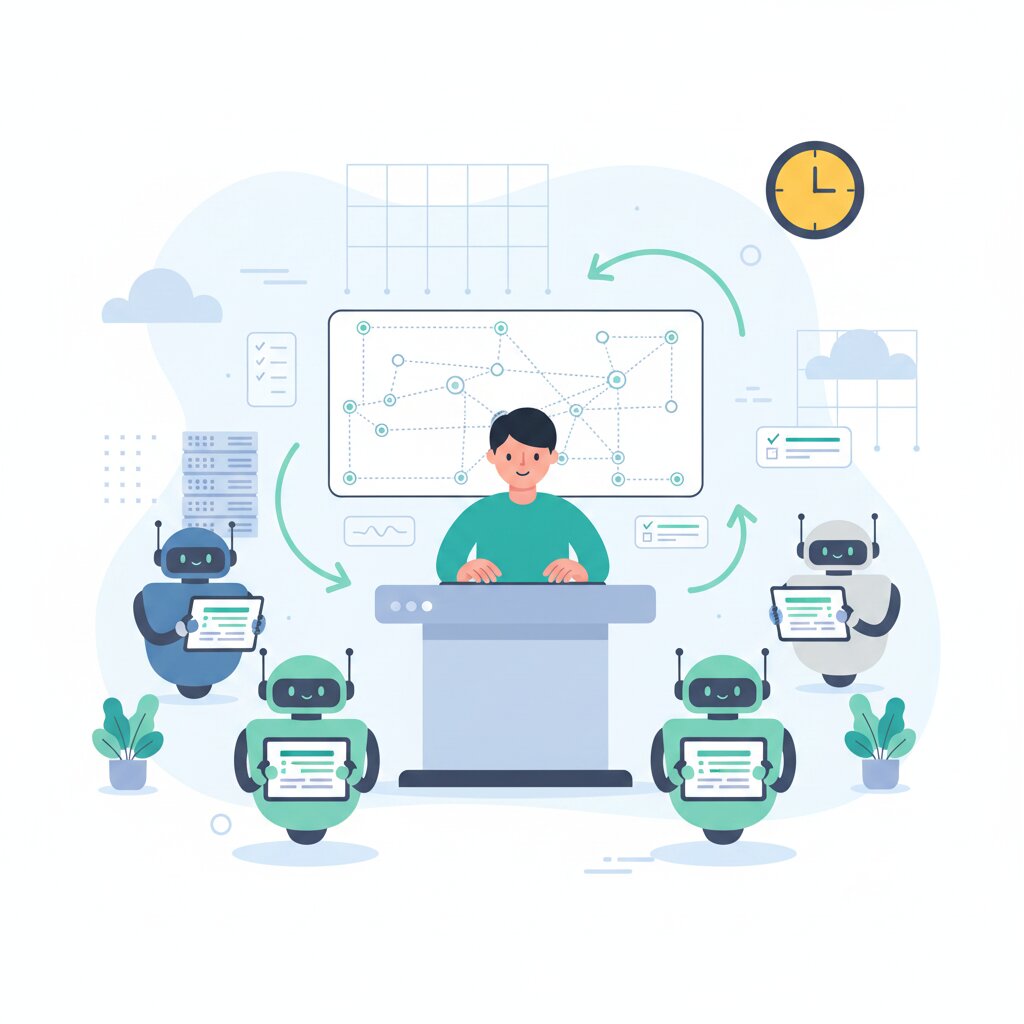
The core investigative unit is not a single agent — it is a coordinated team. Specialist agents assigned to distinct domains (logs, metrics, service topology, runbook history) work in parallel rather than in sequence.
The investigation follows a hypothesis testing loop. An anomaly is detected. The system generates two to four candidate hypotheses ranked by relevance to the failure signature. Each is assigned to the relevant specialist agent. Those agents query their respective domains independently. Findings return to the supervisor, which evaluates which hypotheses gained or lost support, refines if inconclusive, or selects the winning root cause. Remediation planning follows.
OpsWorker demonstrates the pattern concretely: a supervisor delegates subtasks to a log agent, metrics agent, topology agent, and runbook agent — each operating in their own domain, with the AWS Bedrock multi-agent architecture following the same supervisor-plus-specialists structure.
The AWS DevOps Agent case study puts numbers on it. A CloudWatch alarm fires due to elevated 5xx errors. The agent detects the alarm, investigates autonomously, identifies that a traffic spike exceeded the DynamoDB table’s provisioned capacity, and posts a mitigation plan in Slack — all before the on-call engineer finishes reading the page. Total time: under 5 minutes.
Why parallel agents rather than one capable agent? The fixation problem. A single agent anchors on an initial hypothesis and fails to consider alternatives — the same cognitive trap that causes engineers to spend 45 minutes debugging the wrong layer. Parallel agents explore multiple branches simultaneously and converge on the most supported explanation. Context window limits make single-agent approaches non-starters for complex incidents.
To see how these mechanics play out during a live incident, the companion article walks through a complete incident from page to resolution.
What Is a Supervisor Agent and Why Does Everything Depend on It?
The supervisor agent receives the initial alert, breaks the investigation into subtasks, assigns those tasks to specialist agents, enforces role boundaries, and aggregates findings into a unified diagnosis.
Without proper supervision, multi-agent systems degrade in predictable ways. Agents fixate on the same hypothesis independently. They duplicate tool calls against the same data source. They produce conflicting findings with no resolution mechanism. In decentralised arrangements — where agents coordinate through peer communication — the coordination overhead wipes out the parallelism benefit. Deadlock, starvation, and race conditions all apply.
Centralised architecture — one supervisor coordinating all specialists — produces faster, more accurate root cause identification. The tradeoff is higher latency and a potential bottleneck at scale, but in incident response the explainability and audit trail matters more. You need to know what the system did and why.
The supervisor also owns the escalation decision: when evidence is insufficient for confident autonomous action, and when human approval is required. This is the primary trust mechanism for production adoption.
LangGraph provides a concrete implementation of the supervisor pattern, giving engineering teams explicit control over agent coordination, branching logic, and state management across the investigation lifecycle. For the safety guardrails that govern autonomous agent behaviour, ART003 covers safety architecture in depth.
How Do AI Agents Connect to Your Observability Stack?
AI agents work with your existing observability stack — metrics, logs, traces, and events remain the evidence base, and AI SRE adds the reasoning and action layer on top. Your Prometheus, Grafana, CloudWatch, or Datadog investments don’t need to be replaced. They need to be connected.
The connection mechanism is the Model Context Protocol (MCP), introduced by Anthropic in 2024. Think of it as the USB-C standardisation moment for AI integrations: a consistent interface that lets agents query tools and data sources regardless of the underlying platform. Before MCP, each agent-to-tool connection required custom integration code.
What agents can see bounds what they can reason about. An AI SRE without trace data cannot reason about latency root causes in distributed systems. One without deployment history cannot identify configuration drift. Observability coverage directly determines investigative depth.
Specialist agents are defined by the observability domain they own: a log agent queries log data; a metrics agent queries time-series data; a topology agent queries service dependency graphs; a runbook agent queries historical incident documentation.
A2A (Agent-to-Agent Protocol), created by Google, handles inter-agent communication across different vendors. It has backing from over 150 organisations but limited current production adoption — the direction of travel for interoperability, not yet a mainstream requirement.
What Separates Genuine AI SRE from AI-Washing?
AI-washing is marketing a summarisation or alert-correlation tool as an autonomous AI SRE.
The diagnostic test is one architectural question: does this system generate hypotheses and query evidence to test them, or does it retrieve and reformat evidence that the monitoring system already surfaced? The first is causal investigation. The second is sophisticated alert correlation.
Three observable differences. Genuine systems produce a root cause finding with supporting evidence — “Payment latency likely caused by Catalog deploy at 14:03 UTC (confidence 0.74)” — not a summary of alerts. Genuine systems propose or execute specific corrective actions, not links to dashboards. Genuine systems improve over time through incident memory, because past resolved failures inform hypothesis ranking for new incidents.
AIOps was a genuine advance over threshold-based alerting — correlating related alerts into incident groups is real operational value. AI-washing tools are often AIOps with an LLM summary layer added, presented as autonomous investigation when the underlying system is still read-only correlation. PagerDuty‘s generative AI summaries and alert grouping are genuinely useful for reducing cognitive load. They do not investigate incidents autonomously.
Watch the language in vendor materials. “AI copilot,” “AI assistant,” and “recommendations” often indicate tools that propose actions for human approval but do not investigate autonomously. Look for platforms that cite their sources and show their work, not black-box outputs. To evaluate which platforms implement these patterns correctly, ART004 covers the evaluation criteria in detail.
What Are the Three Stages of AI SRE Evolution — and What Comes After?
Stage 1 is AIOps: ML-driven alert correlation and noise reduction. Read-only against the monitoring data stream, no investigation, no remediation. Dynatrace and early Datadog represent this category. It is a capability and a step forward. It is not AI SRE.
Stage 2 is AI-Assisted Triage. AI investigates incidents and surfaces findings, proposed actions, and relevant runbook sections for human review and approval. The human remains in the decision loop for every action. Most current commercial AI SRE products operate here — a starting point that delivers investigative depth without the trust requirements of autonomous execution.
Stage 3 is Agentic SRE: autonomous investigation and remediation within guardrail-bounded scope. Humans define guardrail policies, review post-incident reports, and handle escalations. The AWS DevOps Agent demonstrates this stage in production.
The staged progression exists for a reason. Organisations do not move directly from zero automation to autonomous remediation. Model performance, change risk, compliance requirements, and cultural trust all govern how fast that progression moves. Start at Stage 2, validate against actual incidents, then selectively expand autonomous execution scope for well-understood failure classes.
Stage 4 — predictive reliability — is where the technology is heading. AI systems that identify conditions trending toward failure hours in advance, enabling proactive remediation before MTTR even begins. For depth on the fourth stage: predictive reliability engineering, see the companion article.
Why Are Traditional Runbooks Becoming Obsolete?
Traditional runbooks are static documentation: the steps an engineer should follow for a known failure scenario, written at a point in time, rarely updated as systems evolve.
The core failure mode is obsolescence drift. Systems change faster than documentation. A runbook for a service at version N may be actively misleading at version N+6, with no systematic mechanism for detecting this.
AI SRE replaces the runbook paradigm. Instead of following step-by-step procedures, AI agents reason about what actions are appropriate given current system state, historical incident patterns, and the specific failure signature they are investigating.
This addresses the tribal knowledge problem at scale. Experienced SREs hold tacit knowledge about how a system actually behaves — knowledge locked in individual heads and lost when engineers move on. The AWS DevOps Agent surfaced operational knowledge that had only existed in undiscovered internal documentation during WGU’s service disruption analysis. Incident memory — a persistent store of resolved failures, investigation paths, and remediation outcomes — is how AI SRE makes that expertise available at every future incident regardless of who responds.
The practical transition is not runbook deletion. AI SRE systems ingest existing runbooks as context during initial deployment, then progressively replace procedural guidance with adaptive reasoning. Runbooks become training data rather than operational instructions. Static procedures still have a place for very well-understood, stable failure classes — and that is where they should stay.
For the strategic picture, what AI SRE is and why it matters covers the broader category in depth — from graded autonomy and ROI to platform evaluation and what comes next.
FAQ
Is AI SRE just AIOps with a new name?
No. AIOps groups related alerts and reduces notification noise — read-only against the monitoring data stream. AI SRE analyses observability data, generates environment-specific fix proposals, and executes corrective actions. The capability difference is causal depth and autonomous action. The confusion arises because some vendors market AIOps-class tools with AI SRE terminology.
Does a multi-agent SRE system require Kubernetes?
No. The AWS DevOps Agent operates across AWS, multicloud, and on-prem environments. The supervisor-plus-specialist pattern is environment-agnostic — specialist agents need access to the relevant observability data sources for the environment being managed.
What observability data does an AI agent need to function?
At minimum: structured metrics (time-series data for latency, error rate, saturation), application and infrastructure logs, and distributed traces. Deployment and configuration history is valuable for identifying change-induced failures. Investigative depth is directly bounded by observability coverage — gaps in data mean gaps in root cause analysis.
How does an AI agent know when to escalate to a human?
Through guardrail policy definitions set by the engineering team. Actions are classified as auto-execute, propose-and-approve, or blocked. The supervisor triggers escalation when the highest-confidence available action falls into the propose-or-block category. Start with read-only access, moving to controlled agentic actions only after validating their work.
Can AI SRE replace an on-call engineer?
For technical investigation — increasingly yes, for well-understood failure classes. For incident management — communication, coordination, shared situational awareness — not yet. The coordination problem has not been solved. The realistic near-term model is AI SRE handling autonomous investigation for the majority of incidents, with humans engaged for novel failures and coordination decisions.
What is a supervisor agent in plain terms?
The AI equivalent of an incident commander. It receives the alert, breaks the investigation into parallel subtasks, assigns those tasks to specialist agents, collects their findings, and synthesises a unified root cause diagnosis. It also owns the escalation decision — determining when to act autonomously and when to hand off to a human.
What is the hypothesis testing loop?
The cycle at the core of autonomous incident investigation: detect an anomaly; generate candidate explanations ranked by relevance to the failure signature; query evidence from the observability stack for each; evaluate which hypotheses gain or lose support; refine or eliminate; repeat until one hypothesis has sufficient supporting evidence to be designated root cause; execute remediation; verify resolution and update incident memory. The loop runs at machine speed — seconds to minutes rather than hours.
Why do centralised multi-agent architectures outperform decentralised ones?
In centralised architecture, a single supervisor maintains a unified investigation state, prevents duplication, and synthesises all findings. In decentralised architecture, peer communication introduces latency, duplication risk, and inconsistent views of investigation state — deadlock and race conditions from concurrent programming apply directly.
What is MCP and why does it matter for AI SRE?
MCP is a standardisation layer defining how AI agents connect to external tools and data sources through a consistent interface. Before MCP, each agent-to-tool connection required custom integration code. MCP enables connecting an AI SRE system to Prometheus, Grafana, CloudWatch, or any platform through a common protocol.
What does AI SRE not do well?
Novel failure modes with no historical precedent are hard — a ClickHouse experiment found autonomous LLM analysis fell short of human-guided investigation on real root-cause scenarios. The incident management coordination layer — communicating status, maintaining shared situational awareness — is not yet solved. Post-incident review remains a human function.
Is the MTTR improvement figure (75–80%) from AWS DevOps Agent representative?
Treat it as an existence proof, not a benchmark. The figures — 77% improvement at WGU, 75% at Zenchef — come from well-instrumented systems with well-defined failure classes. Actual improvement varies significantly by observability maturity; organisations with limited instrumentation may see much less.
How does incident memory work and why does it matter?
Incident memory is a persistent store of resolved failures — detection signatures, investigation paths, remediation steps, and outcomes. The AI SRE queries this store when generating hypotheses, ranking candidate explanations by similarity to past failures, and updates it after each resolved incident. This is the mechanism through which accumulated on-call expertise becomes available at every future incident regardless of who responds.