
It is 3:07 AM. Your phone lights up. Elevated 5xx errors across your production URL shortener service. You roll over, squint at the screen, and brace for what’s coming: laptop open in the dark, CloudWatch dashboard, walls of logs that may or may not be relevant, and a half-functioning brain trying to work out what changed in the last few hours.
That is the traditional on-call experience. The average enterprise SRE team fields 400+ alerts a day. Fewer than 10% are actionable. The rest train engineers to tune out the paging system entirely — building the kind of alert fatigue that makes the 3:07 AM alarm feel like another false positive, right up until it isn’t. The work the night demands is what Google’s SRE discipline calls toil: necessary but unrewarding labour that doesn’t make anything better.
In an AI-augmented workflow, nobody wakes up for routine incidents. The AI SRE and autonomous incident response workflow handles the first 60 seconds, the first 60 minutes, and — in a growing number of cases — the full resolution cycle without a human ever being paged.
This article walks through a complete incident lifecycle using the AWS DevOps Agent DynamoDB case study — detection to full resolution in under 5 minutes, no human paged — and maps a practical 90-day pilot path for teams ready to start. If you want the architectural plumbing behind AI-driven incident management, that’s in the pillar resource. What follows is the operational narrative: what actually happens at 3 AM.
What Happens in the First 60 Seconds When an Alert Fires at 3 AM?
The moment one or more of the four golden signals — Latency, Traffic, Errors, Saturation — degrades past a configured threshold, an AI SRE agent kicks in and runs a 4-stage triage pipeline before anyone is considered for paging.
Stage 1 — Noise Suppression. The AI groups correlated alerts, identifies the most likely upstream cause, and surfaces a single enriched alert with full context. In mature deployments, this stage alone reduces alert volume by 60–80%. Alert fatigue is structurally eliminated before it starts.
Stage 2 — Severity Calibration Against SLO Burn Rate. The agent correlates alerts against SLO burn rate windows. An alert projecting budget exhaustion in under an hour pages as critical; the same pattern projecting a 72-hour burn routes to a next-business-day ticket. Your on-call engineer is only disturbed when an SLO is genuinely at risk.
Stage 3 — Contextual Enrichment. Before any human is contacted, the agent pre-assembles context: recent deployments, infrastructure changes, historical resolution data, blast radius assessment. If a human does eventually get paged, they open a pre-populated incident timeline — not a blank screen and a wall of log lines.
Stage 4 — Automated Remediation for Known Failure Signatures. For a defined subset of alert types — pod restarts, certificate rotation failures, stuck Kubernetes jobs — the AI SRE executes the remediation, verifies the fix, and closes the incident with a full audit trail.
The traditional first 60 seconds: pager fires, engineer wakes, fumbles for the laptop, manually opens dashboards. The AI-augmented first 60 seconds: signal detected, correlated, enriched, routed — human optional.
How Does the AI Agent Investigate the Root Cause Without Waking Anyone Up?
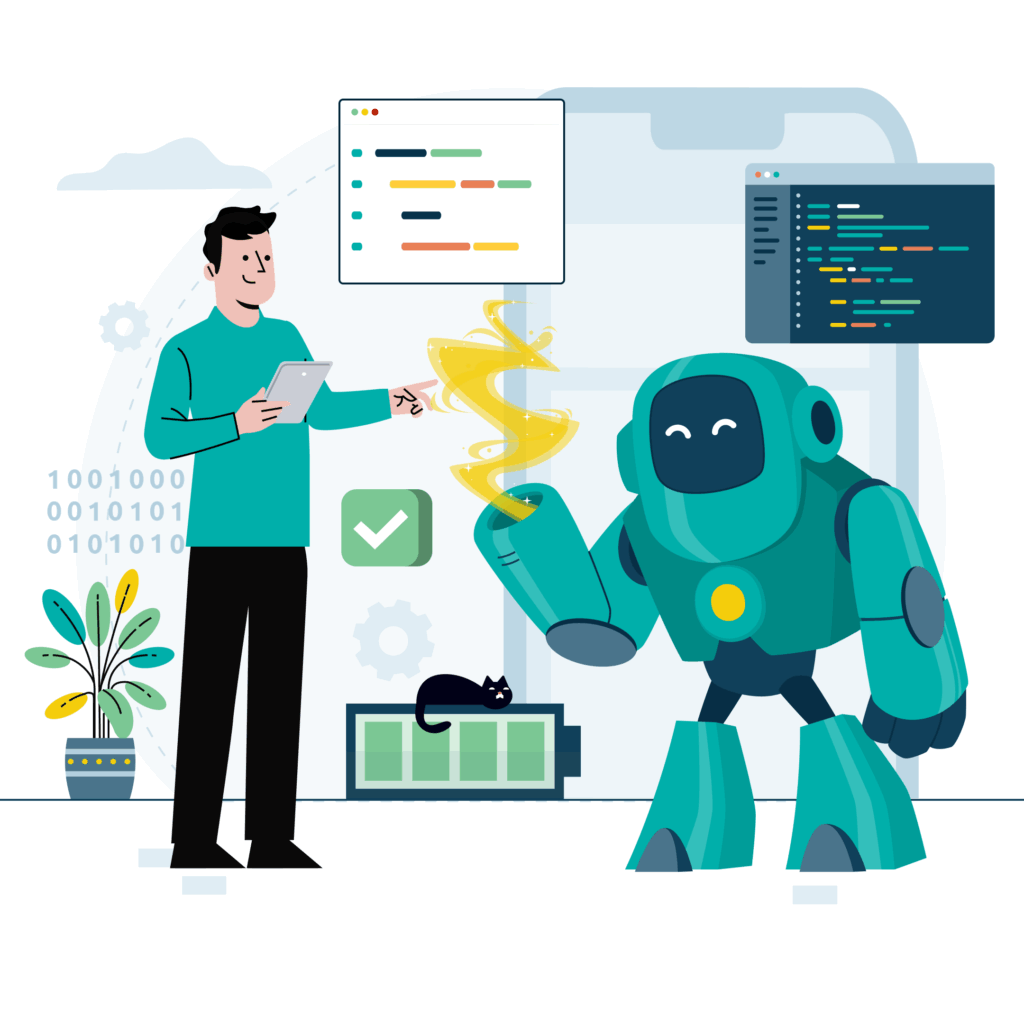
After triage routes an alert as requiring investigation, the AI agent enters the root cause analysis (RCA) loop: generate hypothesis → query telemetry → validate or invalidate → refine and repeat.
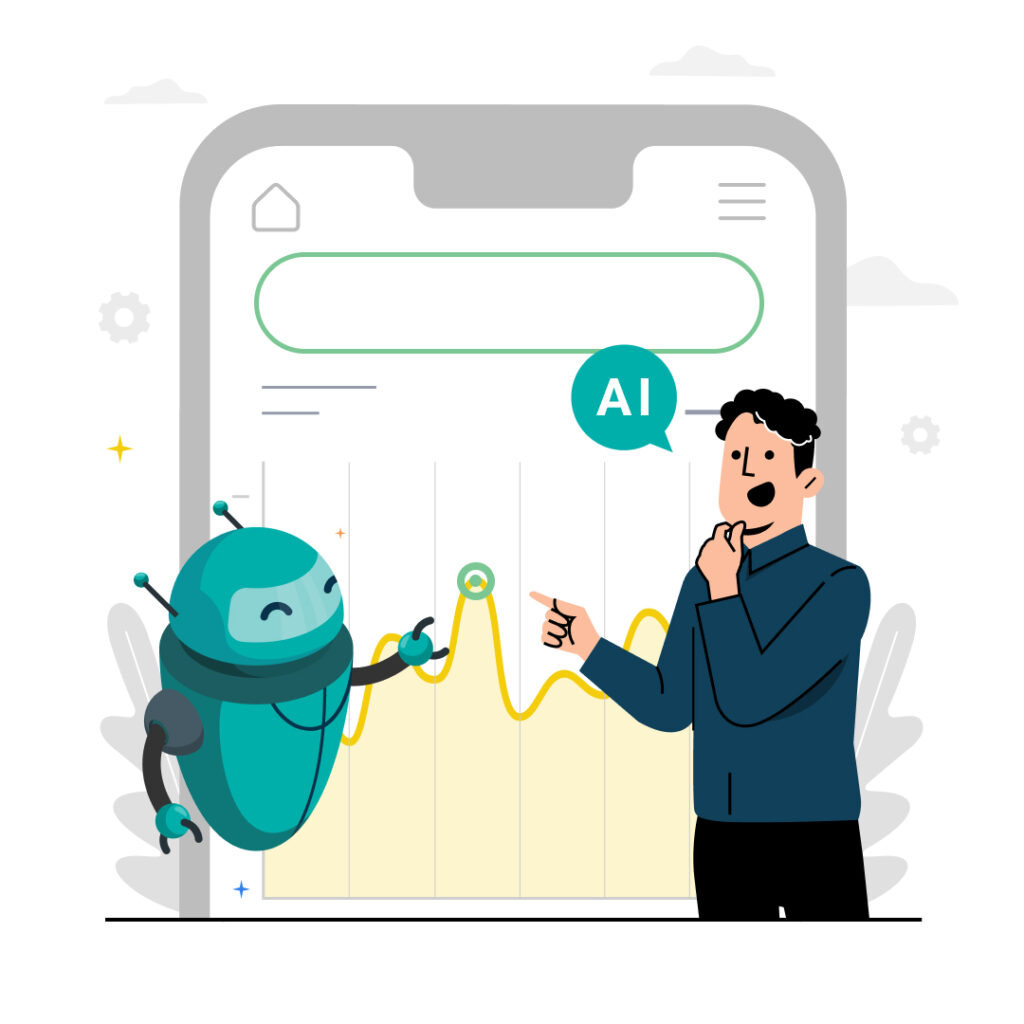
Unlike a human engineer who works through things one step at a time, an AI SRE platform runs parallel investigations across service analysis, dependency mapping, infrastructure review, historical pattern matching, and change attribution. This compresses what normally takes 30–60 minutes of manual investigation into seconds to minutes. And diagnosis — not repair — accounts for 60% or more of time-to-resolution in conventional workflows.
In the DynamoDB incident, the hypothesis testing loop worked like this:
- CloudWatch alarm fires — elevated 5xx errors detected
- Agent maps the dependency chain: CloudFront → API Gateway → Lambda → DynamoDB
- Agent generates hypotheses: DynamoDB read throttling? Lambda concurrency limit? API Gateway timeout?
- Agent correlates CloudWatch metrics, Lambda traces, and DynamoDB consumed capacity simultaneously
- Agent identifies a commit adding batch DynamoDB writes deployed 47 minutes before throttling began — a correlation a human SRE might take 30 minutes to find manually
- Root cause confirmed: provisioned write capacity exceeded by traffic spike from the new deployment
- Mitigation plan posted to Slack: on-demand capacity scaling or rollback recommended
The agent produced this output without touching a static runbook. Runbook obsolescence is not a failure mode for AI-driven investigation the way it is for traditional on-call. Prometheus rule-based systems require all detection logic to be manually encoded in advance; novel patterns are invisible until a human writes a new rule. AI reasoning-based investigation queries live telemetry and adapts.
Real deployment results: Coinbase documented 72% faster root cause identification. Snap cut P1 resolution time from 4+ hours to under 90 minutes. WGU reduced resolution time from 2 hours to 28 minutes — a 77% improvement.
The architecture behind the hypothesis testing loop — how multi-agent architectures make this possible — is in ART001. The operational point is simpler: the AI delivers a diagnosis before anyone is awake to read it.
Where Does Human Judgement Still Matter in an AI-Driven Incident?
AI-driven incident response is not fully autonomous all the time. Human escalation triggers define the non-negotiable decision points where the AI defers and pages a human instead of proceeding.
Four categories consistently require human authority:
- Novel failure pattern with confidence below threshold — the agent escalates rather than acts. A low-confidence hypothesis acted on autonomously is more dangerous than waking someone up.
- High-blast-radius action — restarting a critical stateful service, modifying a database schema, or touching infrastructure that affects multiple dependent services requires human approval regardless of confidence level.
- SLO error budget critically low — near-budget-exhaustion is a defined escalation gate. At the edge of an SLO, decisions are business-impacting, not just technical.
- Security incident classification — any incident flagged as a potential security event routes to a human by default; autonomous remediation in a security context could mask attack vectors or destroy forensic evidence.
The distinction between automated remediation and AI-assisted remediation matters at 3 AM. Automated: the AI decides and acts within a team-configured action scope. AI-assisted: the human decides and acts, but with root cause hypothesis, blast radius estimate, and recommended paths already assembled. AI-assisted is the safer starting point.
This maps to the human-in-the-loop vs. human-on-the-loop distinction. Human-in-the-loop: a human approves each action before the agent executes. Human-on-the-loop: the agent acts autonomously within its configured scope; the human can intervene but doesn’t initiate each step.
These are not opaque vendor guardrails — they are configurable thresholds your team sets. The full safety architecture — the safety architecture that governs autonomous remediation — is in ART003.
What Is Graduated Rollout and Why Should the First Step Always Be Read-Only?
Graduated rollout is the safety-first adoption pattern: you don’t flip a switch and hand production to an AI agent. You expand autonomous capability incrementally as trust is earned, phase by phase.
Phase 1 — Shadow Mode: The AI runs in parallel but takes no action. You compare the agent’s hypothesis and recommended remediation against what your team actually did. You’re building an evidence base, not deploying automation. Target to advance: 70%+ RCA correlation.
Phase 2 — Read-Only Investigation: The agent investigates autonomously but humans review hypotheses before acting. The agent recommends; the human approves and executes. Most teams see a 40–60% reduction in time-to-diagnosis before any autonomous action is enabled.
Phase 3 — Controlled Write Access: Autonomous remediation for a narrow, validated set only — the top 5–10 alert categories where confidence is highest and blast radius lowest. Everything else remains human-approved.
Phase 4 — Supervised Autonomous Action: The validated action set expands incrementally as evidence accumulates. Weekly review. High-blast-radius and security-class incidents retain mandatory human escalation regardless of maturity level.
Why must read-only come first? The agent needs shadow mode to demonstrate RCA accuracy before your team has any evidence base for trusting its hypotheses. Skip this phase and you risk an AI that acts confidently on a wrong root cause. The cost of that mistake — a capacity increase masking a deeper database corruption, a service restart that drops in-flight transactions — can easily exceed the original incident. For the failure modes that emerge when rollout discipline is skipped, what happens when the AI agent itself fails covers the production reality.
How Does an AI-Driven Incident Close? The Post-Mortem and What Comes After
The incident lifecycle ends with a post-mortem — a blameless retrospective capturing timeline, root cause, impact, and preventive action items. In a traditional workflow, post-mortems are written from memory 3–5 days after the incident, taking 60–90 minutes to reconstruct a timeline nobody fully remembers.
In an AI-augmented workflow, the post-mortem writes itself.
Every command and decision made during the incident is captured automatically. When the incident resolves, the timeline is complete. The AI drafts the post-mortem — root cause, remediation applied, validation confirmation, customer impact. The team reviews and refines rather than writing from scratch. Post-mortems get published within 24 hours instead of 3–5 days, and documentation time drops by around 75%.
Blameless post-mortem principles are structurally enforced by AI-generated drafts. The output captures what happened, not who failed — no social dynamics, no retrospective blame.
The post-mortem is also the system’s learning input. After three DynamoDB throttling incidents, the agent identifies the pattern and generates a learned skill that accelerates future investigations of the same class. Every RCA builds a queryable incident knowledge base — one that new engineers can access without needing two years of on-call history. This is the transition from reactive to predictive reliability, the subject of post-mortem data as the foundation for predictive reliability.
How Does the Traditional 3 AM On-Call Experience Compare?
Run the same DynamoDB-style incident through a traditional on-call workflow.
The engineer is paged at 3:07 AM — not their first page of the night. They responded to non-actionable alerts at 1:14 AM and 2:33 AM, both of which resolved before they finished pulling up dashboards. Cognitive load is already compromised before the real incident even starts.
The incident.io MTTR breakdown for a typical P1:
- 12 minutes assembling the team and gathering context
- 20 minutes troubleshooting
- 4 minutes applying the fix
- 12 minutes cleanup (status pages, tickets, post-mortem initiation)
- Total: ~48 minutes
And that assumes the engineer finds the root cause on the first hypothesis. It does not account for wrong turns.
Toil is what makes this chronic rather than occasional. Manually acknowledging known alerts, trawling logs for failure signatures you’ve seen before, updating status pages — none of this produces lasting value. Teams spend a third of their time responding to disruptions, and most of that is consumed in diagnosis, not repair.
Runbook obsolescence is a structural failure mode. Runbooks are static; production systems are dynamic. Every new service adds 15–20 net-new alert rules that nobody removes when behaviour changes. The engineer arrives at an incident with a map of a system that no longer exists.
The emotional cost compounds. Alert fatigue, context switching, and toil are the top contributors to SRE burnout. One hour of downtime for a mid-market SaaS can cost $25,000–$100,000. And if your engineers are expected to be effective at 9 AM, the overnight on-call cost lands in productivity, morale, and attrition.
Under 5 minutes versus 48 minutes is not a percentage improvement on the same approach. It is a qualitatively different operational model.
What Does a 90-Day AI SRE Adoption Plan Actually Look Like?
The following plan is sized for SMB engineering teams (50–500 engineers, no dedicated SRE function) using the incident.io 90-day framework as the structural baseline.
Prerequisite: Confirm Observability Coverage. Before deploying anything, confirm your observability stack provides adequate signal coverage. Minimum viable: a metrics pipeline (Prometheus or equivalent), an alerting layer (Alertmanager or managed alternative), and log aggregation feeding the same tooling the agent will query. Managed platforms — Datadog, Dynatrace, New Relic, Grafana — provide this out of the box. Map your 5 most common incident types and establish MTTR baselines before Day 1.
Days 1–30: Shadow Mode. Connect observability tools and run the AI in shadow mode — analysing every incident without taking action. Compare the agent’s root cause suggestions against your team’s conclusions. Target: 70%+ correlation. Do not advance until you have this evidence base.

Days 31–60: Human-in-the-Loop Rollout. Move one team (8–15 engineers) to AI-assisted response. The agent investigates; engineers review hypotheses and approve remediations. Auto-draft post-mortems. Track MTTR vs. baseline.
Days 61–90: Full Rollout. Expand to the full on-call rotation. Enable selective autonomous remediation for the top 5–10 alert categories. Present MTTR ROI to leadership.
Month 4+: Supervised Autonomous Action. Expand the validated action set incrementally. Review weekly. Never grant autonomous access to high-blast-radius or security-class incidents without a defined escalation path.
Customer outcomes: Favour reduced MTTR by 37%. Buffer saw a 70% reduction in critical incidents. Zenchef resolved an API integration RCA in 20–30 minutes using AWS DevOps Agent — roughly 75% faster than the 1–2 hours it would have taken manually.
The principle is to advance only when validation data supports it. For the full AI SRE landscape — architecture, tooling, ROI, and organisational change — the pillar resource covers the ground this article does not.
Frequently Asked Questions
What if the AI agent makes a mistake at 3 AM with no one watching?
During shadow mode and read-only phases, the AI takes no autonomous action — mistakes have no production impact. When controlled write access is eventually enabled, it applies only to validated failure types with reversible remediations. The confidence score threshold is the structural safeguard: low-confidence hypotheses get escalated, not acted on. For the full range of failure modes and what they cost in production, see what happens when the AI agent itself fails.
Does AI SRE work without a dedicated observability team?
Observability coverage is a prerequisite, not a post-condition. But the bar is not high. Prometheus + Alertmanager, or a managed solution like Datadog, is sufficient to start. You do not need a dedicated SRE team — many teams running 50–200 engineers already have adequate signal coverage.
Can AI SRE handle novel incidents it has never seen before?
Partially, yes. AI agents reason over novel signal combinations — no exact historical match required. But novel failure patterns outside the agent’s confidence threshold are a defined human escalation trigger. Prometheus rule-based systems fail completely on novel patterns; AI reasoning-based investigation adapts.
How long before I see MTTR improvements after adopting AI SRE?
Days 1–30 produce no MTTR improvement but establish the measurement baseline. First measurable improvements typically appear in Days 31–60 when the agent begins routing and de-noising in real time. Significant MTTR reduction (37–77% range) requires 8–12 weeks of validated operation with controlled write access enabled.
Is AI SRE only useful for large engineering teams?
No. Zenchef — a small, focused DevOps team — achieved a 75% reduction in RCA time. The graduated rollout approach is specifically designed for teams without dedicated SRE functions. The key qualification is observability coverage, not team size.
What is the difference between automated incident response (SOAR playbooks) and AI-driven incident response?
SOAR playbooks are rule-based: if condition X, then action Y. They handle known failure signatures well but fail completely on novel patterns — all detection logic must be manually encoded in advance. AI-driven incident response is reasoning-based: the agent generates and tests hypotheses against live telemetry, adapts to novel signal combinations, and improves via post-mortem feedback. AI SRE operates across the full incident lifecycle; SOAR does not.
What does the AI agent actually do when the error budget is nearly exhausted?
Near-budget-exhaustion is a human escalation trigger. The agent pauses autonomous action and pages the on-call engineer with a full briefing: current state, root cause hypothesis with confidence score, affected services, SLO impact, and recommended remediation paths. The human wakes to a diagnosis, not a raw alert. Decisions at the edge of an SLO are business-impacting and require human judgement.
How does AI SRE reduce alert fatigue specifically?
Noise suppression is the primary mechanism: the agent correlates related alerts, filters known benign signals, and groups symptoms — reducing alert volume by 60–80%. Severity calibration against SLO burn rate means low-urgency alerts never reach human attention. Over time, reliably non-actionable patterns stop surfacing entirely.
What observability tools do I need before deploying an AI SRE agent?
Minimum viable: a metrics pipeline (Prometheus or equivalent), an alerting layer (Alertmanager or managed alternative), and log aggregation. Distributed tracing, service topology mapping, and a deployed SLO framework are useful but not required to start. Managed platforms — Datadog, Dynatrace, New Relic, Grafana — all provide the signal layer AI SRE platforms integrate with out of the box.
What happens after the AI resolves an incident? Is it just a post-mortem?
The post-mortem is the human-facing output. The system-facing output is richer: incident timeline, signal correlations, hypothesis sequence, and remediation outcome are all fed back into the agent’s learning loop. The failure pattern library is updated, future hypothesis accuracy improves, and the system begins surfacing predictive signals for the same failure class before it triggers next time. This is the transition from reactive to predictive reliability — covered in post-mortem data as the foundation for predictive reliability.