
Modern distributed systems generate more incidents than any human team can triage manually. A microservices architecture running across multiple clouds, with hundreds of services, produces a signal volume that outpaces human cognitive bandwidth — not occasionally, but continuously. AI SRE is how the industry has responded to that problem, and Gartner’s inaugural Market Guide for AI Site Reliability Engineering Tooling, published January 2026, confirms the category is real. What varies widely is what different platforms actually do under the hood.
This guide covers the eight broadest questions about AI SRE — from what it is and how it works, through limitations, safety, ROI, and audience fit, to platform evaluation and where the technology is heading. Each section links to the cluster article that goes deeper.
What is AI SRE, and how is it different from traditional SRE?
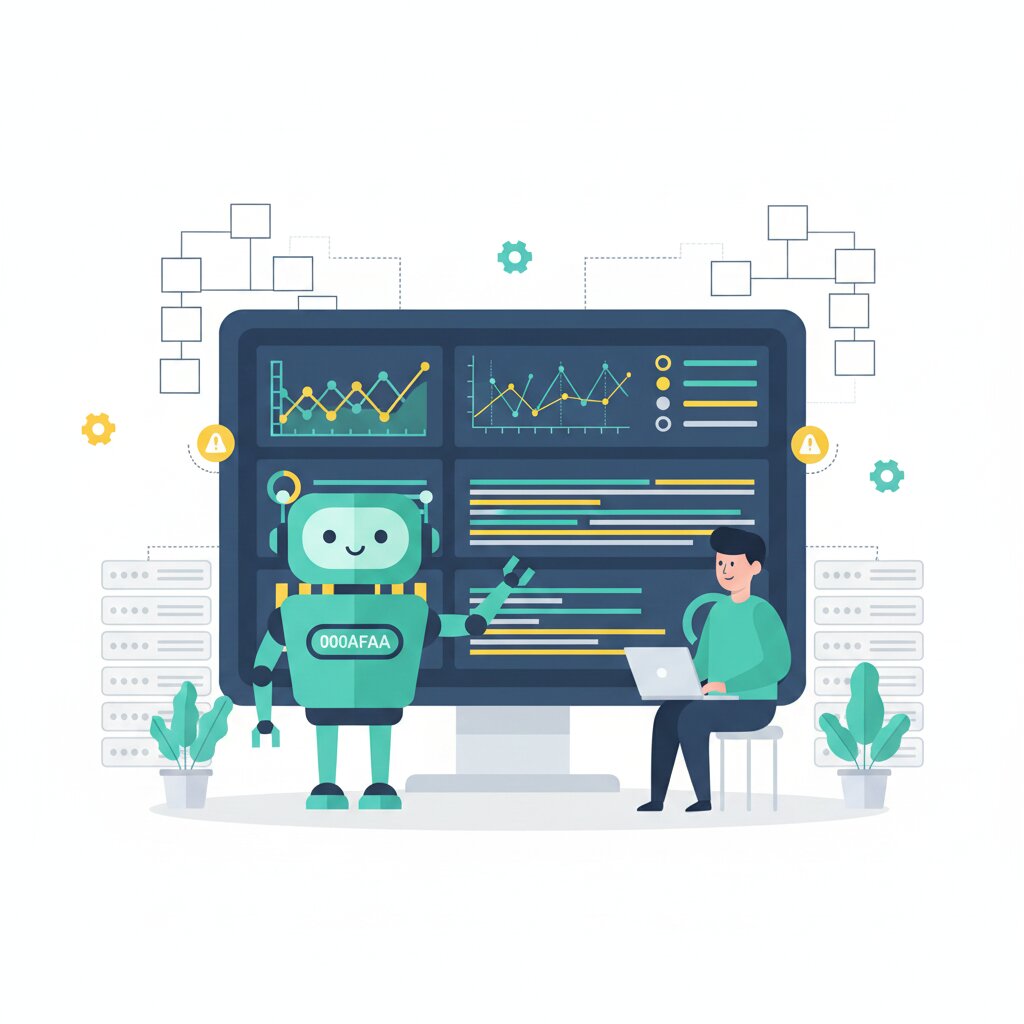
AI SRE is a system that acts as a reliability teammate — detecting anomalies, diagnosing root causes, and remediating incidents either autonomously or with human engineers. Traditional SRE relies on human expertise, manual investigation, and runbook execution. AI SRE replaces linear, human-speed investigation with parallel, cross-domain correlation across logs, metrics, traces, and topology simultaneously. The result is faster triage and shorter resolution times — but not a replacement for engineering judgement.
Traditional monitoring answers “what happened?” AI SRE asks “why did it happen?” AIOps identifies anomalies; AI SRE investigates, forms hypotheses, gathers evidence, and acts through the full incident lifecycle. The gap between the category’s promise and individual vendor implementations is real, and meaningful deployments require investment in integration and training.
See how multi-agent AI systems actually handle site reliability engineering for the architectural detail — agent roles, orchestration patterns, and what separates genuine AI SRE from AIOps relabelling.
How does autonomous incident response actually work?
An AI SRE system monitors telemetry streams continuously, detects anomalies faster than alert thresholds permit, then launches a parallel investigation across every relevant data domain. Specialist agents examine logs, metrics, traces, and topology simultaneously; a supervisor agent synthesises findings, generates root cause hypotheses, and either recommends remediation for human approval or executes approved actions autonomously. Resolution timelines that took hours shrink to minutes — the AWS DevOps Agent resolved a DynamoDB throttling incident from detection to fix in under five minutes.
AI SRE improves each stage of the incident lifecycle — detection, triage, root cause analysis, remediation, and post-mortem — not just the final resolution step. AWS DevOps Agent customers in preview report 75–80% reductions in investigation time; treat those as upper bounds rather than planning assumptions.
Read inside an AI-driven incident at 3 AM for a complete incident walkthrough grounded in real case studies.
What are the real limitations and risks of AI SRE?
The risks are real and quantifiable. Production data shows tool-calling failure rates of 3–15%. LLM hallucination can produce confident but incorrect diagnoses. Novel incidents — where no historical pattern exists — often outperform autonomous investigation when human-guided analysis is used instead. Cost is also a factor: a four-agent configuration can run €8,500 per month. The risks are manageable with the right guardrails; they are not a reason to avoid AI SRE, but they are a reason to plan carefully.
For quantitative failure data and honest analysis of what production deployments actually show, see production reality, failure modes, and what they cost. Understanding these failure modes directly informs your AI SRE pilot budget and risk model.
What is the human-in-the-loop model, and how does graded autonomy work?
Graded autonomy is a four-stage adoption model: read-only observation, advised recommendations, approval-gated remediation, and fully autonomous operation within guardrails. Human-in-the-loop means the AI escalates to a human at defined decision points — irreversible actions, high blast radius, novel incidents — rather than proceeding autonomously. Every credible implementation treats HITL as a foundational safety requirement. You choose where on this spectrum to start.
Most teams begin at Stage 1 or 2 and progress as trust builds. The engineering detail — guardrail design, escalation policy, and governance — is in the cluster article.
For the engineering detail, read guardrails, escalation paths, and human control.
What ROI and business outcomes can you expect from AI SRE?
Well-implemented deployments report 30–50% MTTR reductions — vendor marketing frequently claims 50–80%, but use the lower range for planning. Alert noise reduction of 40–60% in large-scale systems is consistently reported. The more important outcome is toil reduction: fewer manual, repetitive tasks frees engineers for product work. On-call burnout reduction — measured as rotation health and attrition — is the metric most often underweighted in ROI calculations.
MTTR reduction translates to revenue protection. The strategic outcome to track over a 12-month period is engineering roadmap time: capacity available for product development rather than firefighting. Teams that use AI SRE only to fix incidents faster will get faster incident response; teams that also use it to improve system reliability will get both.
For ROI calculation frameworks and cost modelling, see running an AI SRE pilot: budget, team impact, and what to do first.
Who is AI SRE actually for — what systems and team sizes benefit?
AI SRE provides the most immediate value to teams running distributed systems — microservices, containers, Kubernetes — where incident complexity exceeds what on-call engineers can triage manually. Team size matters less than system complexity and incident volume. Smaller teams with limited SRE specialisation often see faster returns than large teams, because AI SRE fills the specialisation gap they cannot afford to staff. A dedicated SRE team is not a prerequisite.
Without dedicated SREs, incident investigation falls to whoever is on-call regardless of domain knowledge. AI SRE’s cross-domain correlation covers what no individual can cover simultaneously — logs, metrics, traces, and topology examined in parallel. The prerequisite is observability: structured logs, distributed traces, and the four golden signals instrumented across your service mesh. If your team doesn’t have that foundation, invest there first. A self-assessment: if you regularly page the same two or three engineers for incidents outside their domain, AI SRE triage is worth evaluating.
What does the AI SRE market landscape look like, and how do I avoid AI-washing?
The market spans three categories: established incident management platforms adding AI layers (PagerDuty Advance, Datadog Bits AI SRE), AI-native startups building autonomous investigation from the ground up (Rootly AI, Ciroos, NeuBird, Resolve AI), and cloud-provider agents tightly integrated with their own infrastructure (AWS DevOps Agent, Azure SRE Agent, Gemini Cloud Assist). The primary evaluation risk is AI-washing — vendors rebranding rule-based alerting as AI SRE. The distinguishing test: does the platform generate and test hypotheses, or does it summarise alerts?
With 46+ vendors using the AI SRE term, the category label tells you nothing about capability. In vendor demos, ask to see hypothesis generation on a real incident — not a scripted scenario — and watch whether the system updates its hypothesis when new evidence arrives. One concrete migration risk: OpsGenie‘s scheduled deprecation in April 2027. Treat that as an opportunity to evaluate the full landscape rather than a straight replacement.
For a principled evaluation framework segmented by team size, see how to evaluate AI incident management platforms.
How does AI SRE move from reactive incident response to predicting failures before they happen?
Predictive reliability is the fourth stage of AI SRE evolution, beyond detection, triage, and remediation. It requires structured incident knowledge pipelines — post-mortem data in machine-readable form — combined with topology mapping, dependency graphs, and adaptive SLOs. The result is a system that correlates deployment risk signals before they become incidents. This is a 12–24 month outcome of building structured observability and incident data disciplines, not a day-one capability.
The data flywheel: every post-mortem generates structured knowledge that trains better pattern recognition, enabling earlier detection and eventually prevention rather than response. It only turns if post-mortems are captured in machine-readable form. AWS DevOps Agent demonstrated this in production — after resolving the same DynamoDB throttling class three times, the system generated a learned skill that skips exploratory hypotheses on that incident type.
Read how AI shifts site reliability from reactive to predictive for the full investment framework.
Resource Hub: AI SRE Complete Guide
Understanding How AI SRE Works
-
How Multi-Agent AI Systems Actually Handle Site Reliability Engineering: Architectural deep-dive into multi-agent AI SRE — agent roles, orchestration patterns, and the difference between genuine autonomous investigation and AI-washing relabelling. Start here if you want to understand the mechanics before evaluating any platform.
-
From Alert to Resolution: Inside an AI-Driven Incident at 3 AM: A complete incident walkthrough from initial alert to post-mortem, grounded in the AWS DevOps Agent DynamoDB case study and the incident.io 90-day adoption framework. Translates architecture into operational reality.
Evaluating AI SRE Safely
-
AI SRE Safety Architecture: Guardrails, Escalation Paths, and Human Control: Engineering the full safety stack — from LLM output constraints and structured output enforcement to error budget governance and audit trail requirements. The prerequisite before granting any AI agent write access to infrastructure.
-
When AI SRE Fails: Production Reality, Failure Modes, and What They Cost: Quantitative failure data — 3–15% tool-calling failure rates, €8,500/month four-agent costs, the UC Berkeley MAST 14-category taxonomy — and honest analysis of what the ClickHouse experiment revealed about AI SRE limits.
-
Beyond the AI-Washing: How to Evaluate AI Incident Management Platforms: Evaluation framework for AI incident management platforms, segmented by team size and architecture. Uses AI-washing as the primary evaluation lens rather than feature checklists.
Strategic and Forward-Looking
-
Beyond Firefighting: How AI Shifts Site Reliability from Reactive to Predictive: The fourth stage of AI SRE evolution — from reactive remediation to failure prevention. Covers the structured incident data pipelines, topology integration, and adaptive SLOs required to reach predictive capability.
-
Running an AI SRE Pilot: Budget, Team Impact, and What to Do First: Strategic synthesis for the decision to invest in AI SRE — ROI calculation, cost modelling, on-call culture change, pilot design (shadow mode to read-only to controlled write access), and vendor lock-in risk.
An AI SRE pilot needs a temporary surge of engineering effort to prove itself. Building out observability and ramping autonomy is real work, but it shouldn’t force a permanent hire before anyone knows if the pilot earns a lasting budget line. SoftwareSeni’s extended development teams add that capacity for the pilot phase and scale back once it’s proven, so the commitment matches the decision instead of running ahead of it.
see how extended development teams scale up for a pilot without a permanent hire →
“SoftwareSeni are extremely valuable partners of our business, and have been integral to our growth to date. They have provided a range of technical resources, which could be scaled up or down depending on our requirements. For any one looking to expand their development team or establish from scratch, we would highly recommend seeking our their services.”
— Joshua K, Co-Founder, rePrecinct
FAQ Section
What is the difference between AI SRE and AIOps?
AIOps applies machine learning to IT operations data — primarily event correlation and anomaly detection — but does not execute the full incident lifecycle. AI SRE extends beyond AIOps by embedding reasoning directly into incident workflows: it investigates, generates root cause hypotheses, and acts on them. AIOps identifies that something is wrong; AI SRE works out why and takes action. For a detailed breakdown, see how multi-agent AI systems actually handle site reliability engineering.
Can AI SRE replace on-call engineers?
No — and the credible vendors are explicit about this. AI SRE replaces the low-value toil of incident triage and routine remediation, freeing engineers for higher-complexity investigation and product work. Human judgement remains essential for novel incidents, irreversible decisions, and escalation paths that require organisational context. The on-call rotation changes in character — fewer 3 AM pages for recoverable issues — but it does not disappear. For a grounded look at what that operational shift feels like in practice, read inside an AI-driven incident at 3 AM.
How do I know if my observability is ready for AI SRE?
AI SRE capability is directly bounded by observability coverage. The minimum baseline: structured logs (JSON or key-value format), distributed traces across service boundaries, and the four golden signals (latency, traffic, errors, saturation) instrumented across your service mesh. If significant parts of your architecture are dark — no traces, inconsistent log formats, gaps in metric coverage — invest in observability before AI SRE tooling. The AI will only surface what the telemetry exposes.
What does graded autonomy look like in practice?
Stage 1 is purely observational: the AI monitors and reports, you act. Stage 2 adds recommendations: the AI proposes a root cause and remediation, you approve before anything executes. Stage 3 allows pre-approved actions — scaling a service, restarting a healthy pod — without approval, but escalates anything outside those bounds. Stage 4 requires robust guardrails, error budget governance, and audit trails; most teams reach it for a defined subset of incidents after 6–12 months. See guardrails, escalation paths, and human control for the engineering detail. For what happens when those guardrails are insufficient, see production reality, failure modes, and what they cost.
How long does an AI SRE take to investigate an incident?
Datadog Bits AI SRE generates a root cause hypothesis with supporting evidence in seconds once investigation is triggered. Detection-to-triage timelines in well-instrumented production systems typically improve from 10–45 minutes (human-led) to under two minutes (AI-led). Novel incidents — no historical precedent, unusual dependency interactions — take longer and benefit most from human-in-the-loop escalation rather than autonomous investigation. For a step-by-step walkthrough of that timeline in a real scenario, read inside an AI-driven incident at 3 AM.
Is AI SRE worth evaluating for a team without dedicated SREs?
Yes — and potentially more valuable than for teams with deep SRE specialisation. Without dedicated SREs, incident investigation often falls to the engineer most recently on-call regardless of domain knowledge. AI SRE provides cross-domain correlation across logs, metrics, topology, and traces simultaneously — covering domains that no individual on-call engineer can cover at the same time. The prerequisite is solid observability instrumentation as the data foundation. For guidance on how to structure and budget an initial evaluation, see running an AI SRE pilot: budget, team impact, and what to do first.
What should I look for to distinguish genuine AI SRE from AI-washing?
Ask one question: does the platform form and test hypotheses, or does it summarise alerts? Genuine AI SRE actively reasons — forming a hypothesis about what caused an incident, gathering evidence to confirm or refute it, and iterating. AI-washing takes an existing alert stream and produces a narrative summary without original analysis. In vendor demos, ask to see the hypothesis generation step on a real incident, not a scripted scenario. See how to evaluate AI incident management platforms for the full evaluation framework. For the production failure data that informs those evaluation criteria, see production reality, failure modes, and what they cost.
Where does predictive reliability fit in the AI SRE roadmap?
Predictive reliability — where the AI prevents incidents rather than responding to them — is a 12–24 month investment outcome, not a day-one feature. It requires structured post-mortem data, topology mapping, and adaptive SLO governance built progressively. For the full investment framework and the technical prerequisites, see how AI shifts site reliability from reactive to predictive.
Does an AI SRE pilot really need a permanent hire before it’s proven itself? Talk to us about extended development teams