

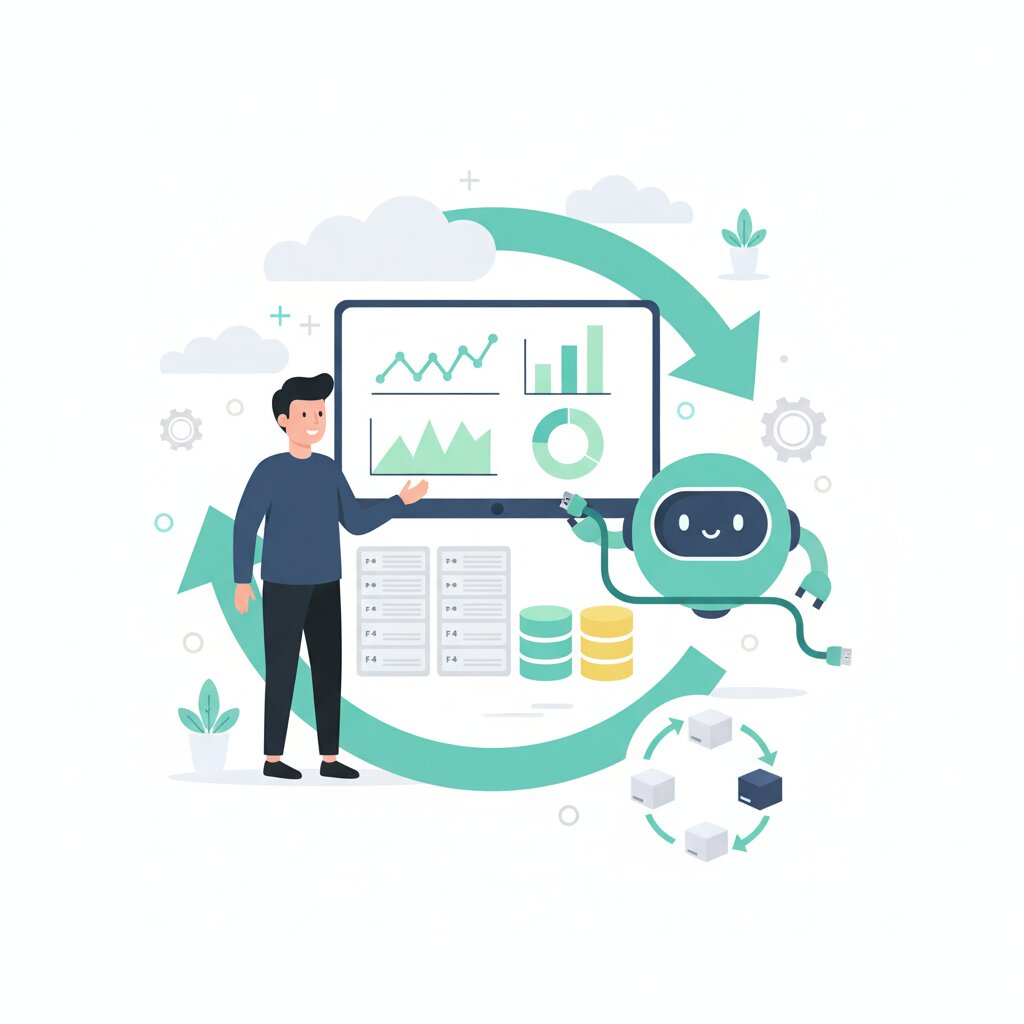
If you run a data platform, two changes that had been building for years finally ran into each other in 2026. For a decade, data teams have been consolidating the warehouse, the lakehouse, governance and the AI runtime under one platform. Meanwhile, AI agents became a real workload: many small, stateful, unpredictable queries. Agents don’t consume dashboards; they fire hundreds of tiny queries, sit idle while a tool call returns, and write to the same tables. That shift changes the arithmetic behind consolidation, because a platform sized for a handful of people and scheduled jobs now has to serve a very different kind of traffic.
Apache Iceberg won the table-format war, so your files are portable. The lock-in now lives in the catalog, the context layer and the governance model. This five-part guide walks that chain; the linked articles carry the depth.
In This Series
- Should You Consolidate Your Data Platform or Query in Place for AI Agents — The fork: one platform versus many engines on shared data, and how agents change the calculus.
- Choosing Databricks or Snowflake on Workload Fit Benchmarks and Real Cost — Choosing on evidence and a full cost model, not benchmark theatre.
- Unity Catalog vs Snowflake Horizon vs AWS Glue Which Catalog to Standardise On — Where lock-in now lives: the catalog.
- Context Layers and What AI Agents Actually Need from a Database — The governed meaning layer agents consume.
- Who Owns Data Governance and the Analyst Role When Purview Retires — Who governs when agents act and Purview retires.
Should you consolidate your data platform or query in place for AI agents?
In 2026, consolidation no longer means “one warehouse for everything”; it means a single platform claiming to own storage, compute, governance and the AI runtime. Query in place offers the alternative: many engines reading the same Iceberg data in object storage with no single owner. Agents tip the balance — they issue many small, latency-sensitive, unpredictable queries that punish data movement and reward locality. Weigh data locality, latency sensitivity, budget, and where lock-in would land.
Snowflake’s break the sequence pitch says you can start AI on the data you have while modernisation runs separately; test it, and count the hidden cost of moving data, which is the egress, migration, re-modelling and re-governance you pay before AI can run.
Query in place got real in September 2026 when DuckLabs joined AWS. DuckDB now runs inside Aurora PostgreSQL, joining live rows to Iceberg and Parquet in S3 with no ETL.
Should You Consolidate Your Data Platform or Query in Place for AI Agents walks the fork in full and points forward to choosing on evidence.
How do you choose a data platform on workload fit and real cost, not benchmarks?
Vendor benchmark headlines — 47%→83% and 52%→84.5% accuracy, 77% SQL improvement, sub-second p50 latency — are run by the vendors themselves on question sets they won’t publish, which means they measure a workload that isn’t yours. Start from your dominant workload mix: thousands of concurrent short queries favour Snowflake’s multi-cluster warehouses; heavy SQL and ETL at scale favour Databricks. Then model full cost — migration, egress, governance compute and idle agent compute — because licence cost alone misses most of the spend.
Databricks’ October 2026 post claims a 77% improvement in its SQL mix since 2022 and sub-second p50 latency on TPC-DS 1-TB workloads at 74% lower cost. The same vendor has conceded the flip side: a poorly maintained lakehouse can run “dramatically slower than a warehouse despite identical hardware.” That is why the number to trust is the one you measure on your own workload, not a published headline.
Neither is consolidating away: Databricks raised $5B at a $190B valuation; Snowflake posted $1.55B in revenue, up 35%. You are matching a platform to the workload mix you actually run, which is what decides whether it feels fast or slow in your hands.
Agents break the single-number cost model: idle compute waits on a tool call, agents write concurrently, queries spike.
Choosing Databricks or Snowflake on Workload Fit Benchmarks and Real Cost shows what benchmarks measure and how to model the full cost.
Where does vendor lock-in actually live now — the catalog or the context layer?
Iceberg won the format war, so your files are portable, and lock-in moved up a layer. It now lives in the catalog — tables, schemas, permissions, lineage — and in the context layer, the governed meaning an agent consumes. Moving files is easy; moving attribute-based access policies and metric definitions is not. The practical question is which catalog — Unity Catalog, Snowflake Horizon or AWS Glue — and whether the context layer above it ranks retrieved snippets or genuinely reasons over your data.
A table catalog is the metadata and governance layer deciding which engines can safely read and write your data; once files are portable, the permissions and lineage on top are what bind you. The three worth comparing are Unity Catalog with its cross-engine attribute-based access control (ABAC), Snowflake Horizon plus Apache Polaris as the open path, and AWS Glue as the AWS-native default with a weaker cross-engine story.
Above the catalog sits the context layer, the governed meaning between raw tables and agents. Snowflake and Databricks both shipped one within two weeks in June 2026, and Microsoft’s Fabric IQ is the third signal, drawing on the more than 22 million Power BI semantic models in daily use. Almost everything sold as a context layer runs on one of five mechanisms: it can retrieve relevant context, rank it, generate SQL, traverse the relationships in your data, or reason over it, and most of what is on the market stops at ranking rather than reasoning. Agents need state, memory and tool results, the working information an agent has to carry across multiple steps and sessions rather than the single answer a dashboard query returns.
Unity Catalog vs Snowflake Horizon vs AWS Glue Which Catalog to Standardise On compares the three catalogs. Context Layers and What AI Agents Actually Need from a Database explains the five mechanisms and what agents require.
Who owns data governance when Purview retires and agents write the queries?
Governance is where the decision chain ends, and Microsoft retiring Purview — support ends November 12, 2027 — turns governed-context lock-in from theory into a deadline. The real fork is build versus buy: an open, portable control plane, or a vendor’s integrated platform that may recreate the lock-in you’re leaving. Agents complicate it further, needing scoped, revocable identity distinct from human users. The analyst role shifts toward verification, metric definition and judgement rather than disappearing.
Lock-in like this happens when your governance rules, lineage and metric definitions are embedded in a platform you cannot exit. Because a governance investment outlasts a vendor product cycle, the question of who owns it cannot be put off until later.
A Purview-to-Fabric migration can re-bury the same lock-in under a new name unless the catalog and control plane are the exit strategy. Agents act on behalf of people and share credentials, so they need scoped, auditable, revocable identity apart from human role-based access control (RBAC). The analyst demotes from query-writing to verification and interpretation, which is the human judgement that a model cannot supply.
Who Owns Data Governance and the Analyst Role When Purview Retires covers the fork, agent identity, and where the analyst role goes.
Resource Hub: Data Platform Consolidation Meets the AI Agent — Deep Dives
Choose Your Architecture
- Should You Consolidate Your Data Platform or Query in Place for AI Agents — You’ll learn what consolidation means now, how agents change the movement-versus-locality calculus, and the decision criteria for the fork.
- Choosing Databricks or Snowflake on Workload Fit Benchmarks and Real Cost — You’ll learn what benchmarks actually measure, how to profile your dominant workload, and how to model full cost including idle agent compute.
Build the Foundation
- Unity Catalog vs Snowflake Horizon vs AWS Glue Which Catalog to Standardise On — You’ll learn what a table catalog is, why lock-in moved there, and how Unity Catalog, Horizon and Glue compare on cross-engine governance.
- Context Layers and What AI Agents Actually Need from a Database — You’ll learn what a context layer really is, the five mechanisms behind every claim, and what agents genuinely need from a database.
Own the Outcome
- Who Owns Data Governance and the Analyst Role When Purview Retires — You’ll learn what governed-context lock-in means, the build-versus-buy fork, agent identity, and where the analyst role goes.
Suggested order: read the five articles in sequence if you’re weighing all decisions at once; otherwise jump to the article matching your current stage.
Where to start
Start where your decision is — consolidation fork, platform choice, catalog, context layer, or governance — and read the five-part guide in order if you’re weighing all of them at once. The consolidation story is a chain of five decisions: whether to consolidate or federate, which platform to choose, which catalog to standardise on, what context layer to build, and who owns governance. If you haven’t chosen consolidation or federation yet, start with the fork.
Frequently Asked Questions
Is Iceberg enough to avoid vendor lock-in?
No. Iceberg makes your files portable, but lock-in simply moved up a layer. Once files are portable, the permissions, lineage and metric definitions sitting on top are what bind you to a platform. Portable files do not equal portable access policies. That is why the catalog and the context layer, not the table format, are now the real decision.
Do AI agents even need a warehouse?
Not in the classic sense. Agents do not consume dashboards; they fire many small, stateful queries, sit idle during a tool call, and write to the same tables. They need locality and low latency on governed data, not a large warehouse built for report queries. Many agent workloads run better on a query engine close to object storage than on a heavy warehouse.
What is the difference between a catalog and a context layer?
The catalog is the metadata and governance layer: which engines can safely read and write which tables, plus permissions and lineage. The context layer sits above it and holds the governed meaning an agent consumes, the metric definitions and relationships between raw tables and answers. Think of the catalog as the locks on the doors and the context layer as the map of the house.
What does “break the sequence” actually mean?
It is Snowflake’s pitch that you can start AI on the data you already have while your modernisation runs separately, instead of waiting for migration first. The catch is to name the hidden cost of moving data: egress, migration, re-modelling and re-governance. You get a faster start, but the total cost of the move does not disappear; it just arrives later.
How do I give an AI agent access to data without sharing my credentials?
Agents act on behalf of people and share credentials, so they need scoped, auditable, revocable identity separate from human RBAC. Give the agent a narrow role with a short-lived credential, log every query it runs, and keep the ability to revoke access instantly. A shared human password with no audit trail is how agent workloads go wrong.
Do I have to migrate off Microsoft Purview by November 2027?
Support ends November 12, 2027, so you need a plan, but you do not have to accept a like-for-like migration. A Purview-to-Fabric move can re-bury the same lock-in under a new name unless your catalog and control plane are the exit strategy. Use the deadline to move to an open, portable control plane, not just a newer vendor portal.
Should agent queries run on the same warehouse as my dashboards?
It depends on your mix, but agents break the single-number cost model. Idle compute waits on a tool call, agents write concurrently, and queries spike. Mixing many small, latency-sensitive agent queries with long report jobs means paying for warehouse compute that sits idle. Often you want agents close to the data but on a separate, lower-cost runtime.
Why do agents punish data movement?
Because they issue many small, latency-sensitive queries. Copying or re-modelling data so an agent can answer faster costs egress and migration on every hop, and the agent sits idle while a tool call returns. Locality matters far more for hundreds of tiny queries than for a nightly batch job. Keep the compute next to the data, not the data next to the compute.
Can DuckDB inside Aurora PostgreSQL replace my warehouse?
For many queries, yes. It joins live rows to Iceberg and Parquet in S3 with no ETL, covering the roughly 90% of queries under a terabyte. It is not a full governance platform, so you still need a catalog and a context layer on top. Treat it as a query-in-place engine for the long tail, not a replacement for the control plane.
Is a context layer just RAG?
No. RAG retrieves and ranks snippets; a context layer is the governed meaning between raw tables and agents. Behind every claim sit five mechanisms, retrieve, rank, generate SQL, traverse and reason, and most products rank rather than reason. Agents need state, memory and tool results, which plain retrieval does not provide. RAG is one piece, not the whole layer.
What happens to the analyst role when agents write the queries?
The analyst shifts from query-writing to verification and judgement. Agents generate SQL fast, but someone still has to check the answer is right, interpret it, and own the outcome. Governance does not disappear; it moves. The role becomes checking the agent’s work and deciding what it means, rather than producing the query in the first place.
How worried should I be about egress costs?
Worried enough to model them, because licence cost alone misses most of the spend. Every hop an agent or a migration takes across clouds adds egress, and many small queries multiply it. Before choosing consolidation or query in place, put egress, migration, re-modelling and re-governance into the cost model, not just the per-seat price.