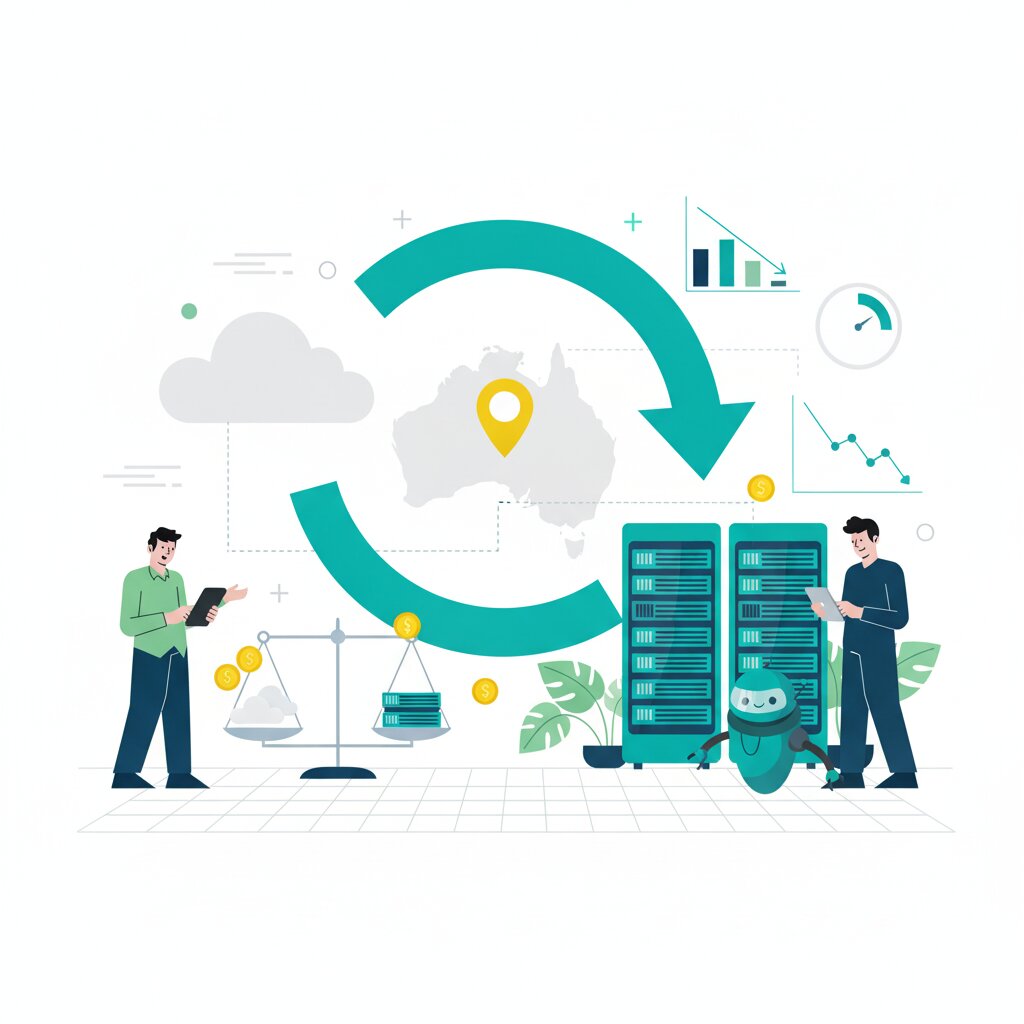

Cloud repatriation is now a mainstream infrastructure decision, and the numbers are messier than either side admits. Flexera, Broadcom, Barclays and IDC each describe the same market differently, so the survey a vendor quotes says more about the vendor than the market. The question this page frames: is this a stampede or a selective correction?
That question is parked for the first section. The second driver is newer and just as messy: digital sovereignty now sits alongside cost as a placement factor in Australia, where procurement guidance is thin and “sovereign” claims outrun genuine control.
Each section below frames one part of the debate; this page maps it, and the linked articles resolve it. Keep your scepticism handy.
In This Series
- Cloud Repatriation Reality Check and the Return of the Internal Service Provider: the conflicting figures and what repatriation does to the team.
- VMware Licensing, Egress Fees and the Real Cost of Cloud Lock-In: the licensing reset and how to tell a genuine saving from a headline claim.
- Digital Sovereignty, Sovereign Cloud and the Problem with Sovereignty Washing: what sovereignty means beyond a local region.
- Sovereign Cloud Premiums, Regulatory Risk and Australian Procurement Guidance: what Australian buyers should pay for sovereignty, and where guidance is thin.
- Private AI Inference and the Workload Placement Decision: where workloads and AI inference should actually run.
Is cloud repatriation real, and what is actually driving the cost reset?
Repatriation is a selective correction, not a mass exodus. Flexera puts repatriated workloads at 21%, rising to 23%, against 73% hybrid estates, while IDC pegs full-repatriation intent at 8-9%. What changed is economics: Broadcom’s VMware reset, egress fees and 29% cloud waste made “stay by default” indefensible, and cost overtook security as the top concern. The consequence is organisational: the internal service provider returns.
Each survey counts something different. Broadcom’s 50%, up from 35% a year earlier, counts any workload pulled back, however small, while Barclays counts a company moving one database the same as one moving 40% of its estate. Against that sits Gartner’s forecast of 21.5% public cloud growth. 37signals walked away from a $3.2 million AWS bill, a single company.
Broadcom’s VMware reset moved to per-core pricing with a 72-core minimum, and Australian renewals now run two to five times their prior cost. Egress fees add a structural cost to data-intensive workloads, and the lock-in threshold marks where leaving costs more than staying saves. Repatriation underperforms where workloads are elastic or where a FinOps reset would fix the bill.
Bringing workloads home changes the skills you hire for and how the team is structured. Gartner projects 80% of large software engineering organisations will run a platform team by 2026. The sovereignty overlay and the placement end-state that follow feed the same decision.
Go deeper: is repatriation real, and what happens to the team, plus what is actually driving the cost reset.
What does digital sovereignty actually require — and what should you pay for it?
Sovereignty is about control. Data residency answers where data sits; sovereignty answers who governs it, who can access it, and whether you can leave. A mature sovereign cloud adds key ownership, local operations, auditability and exit viability beyond a domestic region. Gartner puts sovereign cloud IaaS at US$80 billion in 2026, and sovereignty washing is easy to spot: a domestic region sold as sovereignty without independence.
A United States provider can offer genuine Australian residency yet still be subject to United States law. Sovereignty has overtaken jurisdiction-specific compliance as the leading geopolitical factor. Australian law adds APP 8, the Security of Critical Infrastructure Act and the Australia-US CLOUD Act Agreement. The EU’s GDPR, Data Act and DORA are the closest worked example.
The premium is real, with BCG putting it at 10-30% over standard public cloud. It buys control and exit optionality, but it only pays off where a workload requires it, so tier the controls rather than paying them uniformly. Australian procurement guidance is thin: IRAP and ASD-style assurance expectations exist, but authoritative guidance on what sovereignty means is fragmented. You are largely left to work it out yourself.
Who holds the keys? Who can access the data? What happens if the provider is acquired or sanctioned? How portable is the exit? A claim that cannot answer those questions is a residency pitch wearing a sovereignty label.
Go deeper: what a sovereign cloud includes, plus what Australian buyers should pay for sovereignty.
Where should workloads and AI inference actually run?
There is no single right destination: it depends on the workload. Steady-state, data-heavy and compliance-bound workloads generally get cheaper when repatriated; bursty, globally distributed and serverless workloads usually do not. The shift is sharpest in AI, where production inference is moving in-perimeter as GPU-hour economics and data-governance pressure shift the trade-off. Weigh compliance, data volume, latency, scaling pattern and AI intensity per workload, and design for reversibility.
The inference flip is a placement change. Training still lives largely in public cloud, where the newest GPUs are easiest to rent, but inference, the part that touches customers, is moving in-perimeter. Public cloud’s share of production inference fell from 56% to 41% in a single year, pushed by GPU-hour cost and data gravity.
The core mechanism is steady-state versus burst. Predictable demand favours owned capacity; elasticity favours rented. For high-GPU-intensity inference, owned hardware can pay for itself in six to nine months, and self-hostable models like Llama and Mistral cover 85-90% of use cases.
Baseline metrics captured before a move are how you prove the migration worked. The end-state is a three-tier view of edge, cloud and on-premises, chosen workload by workload and designed for reversibility. It loops back to the cost reset in the first section and the sovereignty constraints in the second.
Go deeper: where production AI inference should run.
Resource Hub: Cloud Repatriation and Digital Sovereignty Deep Dives
Start with the reality check to define the problem, the cost reset to decide the economics, or the procurement comparison to act on sovereignty.
The Repatriation and Cost Picture
- Cloud Repatriation Reality Check and the Return of the Internal Service Provider: the conflicting survey figures and what repatriation does to the team.
- VMware Licensing, Egress Fees and the Real Cost of Cloud Lock-In: the licensing reset and egress economics behind the cost reset.
Sovereignty, Regulation and Procurement
- Digital Sovereignty, Sovereign Cloud and the Problem with Sovereignty Washing: what sovereignty means beyond a local region and how to spot a residency rebrand.
- Sovereign Cloud Premiums, Regulatory Risk and Australian Procurement Guidance: the premium weighed against regulatory risk, and where Australian guidance is thin.
Placing Workloads and AI Inference
- Private AI Inference and the Workload Placement Decision: why production inference is leaving public cloud and where each workload belongs.
Suggested reading order: reality check, cost analysis, sovereignty definition, procurement comparison, workload placement.
Where to go from here
The cloud is being renegotiated, workload by workload, with cost and sovereignty as the two deciding factors. Start with the reality check, then follow the path that matches the decision in front of you.
Frequently Asked Questions
Will moving workloads back on-premises actually save my organisation money?
Not automatically. Repatriation pays off for steady-state, data-heavy and compliance-bound workloads, but it underperforms where demand is elastic or seasonal, where you lean on high-value managed services, or where the real problem is tagging, idle resources and discount coverage. Flexera puts wasted cloud spend at 29% in 2026, so fix the bill you already have before you move it. Test any saving against your own workload mix, not a headline case study.
What is FinOps, and why should I fix it before I repatriate anything?
FinOps is the practice of managing cloud cost continuously, through tagging, usage visibility, discount coverage and accountability. It matters because moving a workload is not a substitute for understanding its bill. In Australia, 77% of infrastructure leaders sit under board-mandated optimisation targets but only 14% have mature FinOps practices, so most organisations are trying to shrink spend they cannot yet see clearly. Fix the practice first, then decide what genuinely belongs at home.
Can I use the threat of repatriation to negotiate a better cloud contract?
Yes, and it often works before you move anything. Buyers who modelled shifting even 20% of an estate to an alternative platform recovered 15 to 30% on a Broadcom renewal quote simply by demonstrating genuine exit optionality. The lever is credible modelling, not bluffing, so understand your egress costs, reskilling effort and timeline first. A credible exit plan strengthens your position even if you never leave.
Is on-premises hardware really cheaper if component prices keep rising?
Not necessarily, and the comparison is not one-sided. DRAM contract prices rose sharply through late 2025 and hardware costs are climbing, so owned capacity carries its own inflation and CapEx risk. The honest trade-off weighs CapEx and operational complexity against predictable OpEx. NVIDIA still estimates on-premises AI infrastructure can run roughly 30% cheaper than equivalent public cloud capacity, but only where utilisation is high and steady.
Does the Australia-US CLOUD Act Agreement mean US authorities can access my Australian data?
Not automatically, but jurisdiction questions are no longer hypothetical. The Australia-US CLOUD Act Agreement came into force in January 2026, and a United States provider can offer genuine Australian residency while still being subject to United States law. Under APP 8 of the Privacy Act, you also stay legally responsible for personal information after transferring it overseas. Residency alone does not close that gap; contractual and architectural controls do.
What is IRAP, and do I need it to claim sovereignty?
IRAP is the Australian government’s Information Security Registered Assessors Program, an independent assessment that many public sector buyers treat as a baseline. It is a useful anchor, but it is not the same as sovereignty. Being IRAP-assessed says a system met certain security controls; it does not tell you who holds the encryption keys, who can access the data, or whether you can leave. Treat it as one input, not the whole answer.
Is sovereign cloud only relevant to government agencies?
No. Sovereignty now sits alongside cost as a placement factor across the private sector too. A February 2026 survey found 63% of Australian business leaders discuss data sovereignty at board level and 80% consider it a requirement for scaling AI. Regulated industries such as banking, health and critical infrastructure have the sharpest obligations, but any organisation handling sensitive customer data or facing audit and contractual scrutiny should weigh it.
What kinds of workloads should never be repatriated?
Bursty, globally distributed, serverless and high-egress workloads usually get more expensive when you move them home, and inherently elastic or seasonal demand is a known repatriation failure pattern. Workloads that lean heavily on managed services are also poor candidates, because cloud AI platforms bundle experiment tracking, model versioning and autoscaling that are genuinely hard to replicate. Where GPU scarcity, capability gaps and 15 to 25% hardware inflation eat the savings, leave it in the cloud.
What metrics should I capture before I move a workload?
Capture latency, cost per request, error rate and utilisation before anything changes, or the migration has no way to prove it worked. Baseline metrics are the cheap insurance that turns a claim into evidence, and they should be gathered per workload rather than across the estate. Without them, you cannot separate a genuine saving from a shift in how the bill is allocated, and you lose the ability to reverse the decision cleanly.
Do I need a private data centre to run AI inference on-premises?
No. Colocation and owned hardware both work, and for high-GPU-intensity inference the payback can be six to nine months. Self-hostable open-source models such as Llama and Mistral now cover 85 to 90% of enterprise use cases, which removes the old argument that only hyperscalers could serve production models. The trade-off is operational: you own the GPU refresh cycle, the utilisation problem and the expertise that public cloud used to absorb.