
Amazon has committed $33 billion in equity to Anthropic — $8 billion up front, then another $25 billion in April 2026. On top of that, there’s a separate agreement where Anthropic will spend up to $100 billion on AWS infrastructure over the next decade. Google turned around almost immediately and announced a parallel $40 billion in cash and compute. At that scale, these are not portfolio bets. The big cloud providers are locking in their preferred AI model vendors at every layer of the stack.
This is part of the AI infrastructure arms race that’s reshaping how enterprises think about technology procurement in 2026. If you’re evaluating your AI vendor strategy, the question that actually matters isn’t whether these deals are good for Anthropic. It’s what they mean for your vendor neutrality — and what you should do about it.
What “vertical integration” actually means when a cloud company invests $25 billion in an AI lab
Vertical integration in the traditional sense means a company controlling multiple stages of its own production process — a car maker owning its own steel mill. In the AI-cloud context it works a bit differently.
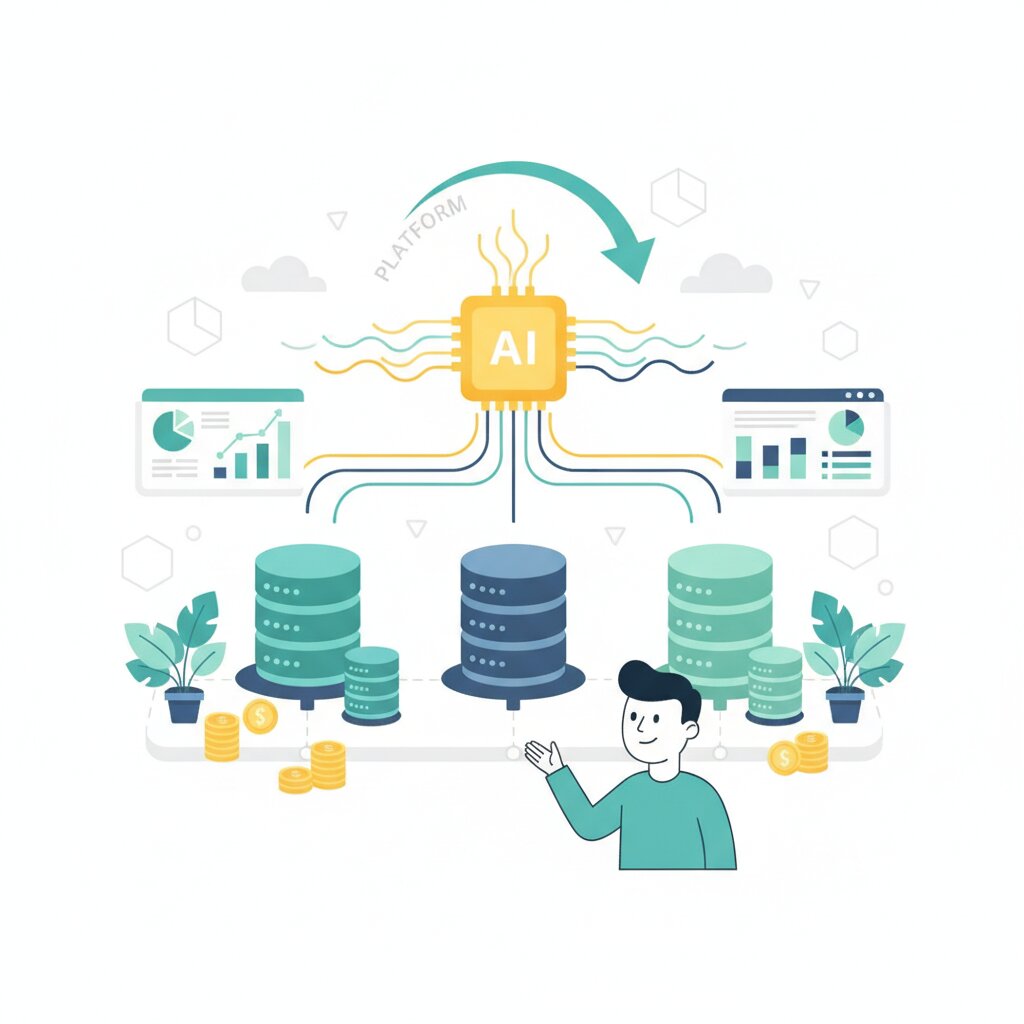
A cloud provider takes a major equity stake in an AI model lab, then becomes its primary compute supplier, then integrates the lab’s models into its managed platform. That’s three layers of entanglement: financial (equity), commercial (compute pre-commitment), and technical (governance bundling).
The thing that separates this from a simple partnership is the equity stake. Amazon now has a financial incentive to route your enterprise AI workloads toward Claude. Anthropic has a financial incentive to deepen its integration with AWS. Both are pushing toward the same outcome — and your organisation is inside the resulting architecture whether you’ve thought about it or not.
This pattern is now running across Amazon ($33B equity, 100Bcompute), Google(40B cash and compute), and the original template: Microsoft and OpenAI. “AI vendor choice” is now a structural infrastructure choice at exactly the same time.
What Amazon’s $25 billion (and up to $100 billion) investment in Anthropic actually buys
The two numbers — $33 billion in equity and $100 billion in compute — are different instruments with very different lock-in effects. The equity aligns incentives. The compute commitment is the operative lock-in mechanism.
Under the compute agreement, Anthropic has contractually committed to running its model training and inference on AWS infrastructure, specifically on Amazon’s custom Trainium chips — Trainium 2, 3, and 4, with nearly one gigawatt of capacity expected by the end of 2026. That ties Anthropic’s model architecture and training pipelines to AWS’s custom silicon roadmap for a decade.
Project Rainier makes the depth of this concrete. It’s a joint Amazon-Anthropic compute cluster running over one million Trainium2 chips — one of the largest AI training clusters in the world. This is not standard cloud tenancy. It’s a co-engineered infrastructure project where the integration runs below the API layer to the hardware itself.
The “up to” qualifiers do matter. Neither figure is a guaranteed payment schedule; both are capacity ceilings that depend on Anthropic’s growth trajectory. With $30 billion in run-rate revenue and a $350 billion valuation, this is strategic alignment between two fast-growing parties, not a rescue operation. More than 100,000 organisations are already running Claude via Amazon Bedrock.
The scale of these commitments also draws scrutiny beyond the boardroom. The financing structures the BIS flagged in its March 2026 review include investment commitments of exactly this type — equity stakes and compute pre-commitments that create off-balance-sheet exposure at hyperscaler scale.
How Google’s parallel $40 billion investment changes the picture
Google’s $40 billion commitment — $10 billion initial cash, up to $30 billion more contingent on compute milestones — is structured similarly to Amazon’s. The operative mechanism is again the compute commitment, with Broadcom co-designing custom TPU silicon: 3.5 gigawatts of capacity confirmed for Anthropic beginning in 2027. If you’re on Google Cloud Platform, the governance integration happens through Google Cloud Vertex AI, where Claude runs alongside Gemini with GCP identity management and compliance frameworks inherited automatically.
Amazon and Google both hold major Anthropic equity. Neither has exclusivity over Claude’s distribution. But “available on all three clouds” is not the same as “equally integrated on all three.” Organisations on Azure get Claude via Azure Foundry, but without the hardware-layer entanglement that characterises Bedrock and Vertex AI.
If you’re looking for a compute-layer alternative to the hyperscaler model altogether, it’s worth looking at the neocloud model that providers like CoreWeave represent.
Why Claude being on all three clouds is not the same as OpenAI being on Azure
Anthropic frames Claude as “the only frontier AI model available on all three of the world’s largest cloud platforms.” That’s a real differentiator. But it obscures an infrastructure-layer concentration that matters more for enterprise risk assessment.
The Microsoft-OpenAI comparison makes the point. OpenAI’s infrastructure is deeply integrated with Azure — GPT models are not natively available on AWS or GCP. That’s the highest-lock-in reference case: enterprises that standardised on Azure are now locked in at the model, infrastructure, and governance layers simultaneously.
Claude being accessible on all three clouds is structurally different. But when you’re moving away from the AWS or GCP integration layers, the switching costs include all the compliance infrastructure you’ve built around them — not just the model API. Access layer multi-cloud does not equal infrastructure layer neutrality. That’s the distinction worth keeping in mind.
How the lock-in works in practice: governance, governance, governance
The most important and least-discussed mechanism here is governance integration. When your organisation deploys Claude through AWS Bedrock, workloads automatically inherit your existing AWS IAM policies, data controls, compliance certifications, and regional availability settings. Anthropic calls this “same account, same controls, same billing.”
For regulated industries, that’s genuinely valuable. Bedrock carries SOC, GDPR, HIPAA, and FedRAMP High certifications. If your team has spent years building AWS compliance frameworks, those controls extend to AI workloads automatically — no need to rebuild them for a standalone Anthropic relationship.
But that same convenience is also architectural lock-in. Once you’re building AI agents inside the AWS governance layer — IAM policies, VPC configurations, compliance logging tied to Bedrock AgentCore — the switching cost is not just the model API. Agent definitions, memory, and tool integrations are stored in AWS-native services. There’s no cross-cloud portability.
Three lock-in types activate at once: API dependency, agent framework capture, and ecosystem entanglement (billing, monitoring, audit logging all in your AWS accounts). Custom silicon adds a fourth layer. Gartner projects 40% of enterprise applications will include task-specific agents by 2026. Organisations building those on AgentCore are embedding their architecture into AWS’s stack in ways that compound over time.
What enterprises standardised on AWS or GCP should do next
The vertical integration dynamic will deepen, not reverse. Accepting some lock-in in exchange for governance simplicity is a rational choice. The question is whether you’re making it deliberately, with architectural guardrails in place, or just letting it happen by default.
Here are four things you can do now:
1. Isolate AI model calls behind an internal abstraction layer. A thin API wrapper means swapping the underlying model requires configuration changes, not code rewrites. It’s the most effective architectural defence against lock-in — and you don’t have to give up any of Bedrock’s governance benefits to do it.
2. Avoid building agent orchestration logic directly into cloud-native frameworks. Bedrock Agents and Vertex AI Agent Builder are where the deepest framework capture occurs. Cloud-neutral tools like open-source LangChain and LlamaIndex offer comparable capabilities with cross-cloud portability. The orchestration layer is the highest-switching-cost component, so it’s where you want the most flexibility.
3. Negotiate data portability before signing enterprise agreements. Insist on data export in open formats — training data, fine-tuned weights, inference logs — and service continuity terms if the vendor fails. This is negotiable now, in the pre-IPO window.
4. Use that window. An Anthropic IPO is viable in 2026. Multi-year agreements negotiated now may lock in pricing stability and capacity guarantees before public market revenue pressure shifts the terms.
The outcome to avoid is the Microsoft-OpenAI model — locked in at the model, infrastructure, and governance layers at the same time. Amazon-Anthropic and Google-Anthropic are building toward an equivalent outcome. Define your agent architecture strategy before production workloads are running on AgentCore or Vertex AI Agent Builder. Enterprises that haven’t defined their agent architecture strategy are already making a lock-in decision — just not a conscious one.
For the ROI implications of this investment scale and whether the returns justify the spend, the enterprise AI payback analysis covers that in detail. For context on $725 billion in hyperscaler capex and the full scope of what these deals are part of, the arms race overview covers the complete picture.
Frequently Asked Questions
Can Amazon and Google both invest in Anthropic at the same time?
Yes. The investments are compute and equity commitments, not exclusive partnerships. Anthropic maintains model access across AWS Bedrock, Google Cloud Vertex AI, and Microsoft Azure Foundry as a deliberate differentiator from OpenAI’s near-exclusive Azure relationship. Neither investor holds exclusivity over model distribution.
What is the difference between the Amazon-Anthropic $25 billion equity investment and the $100 billion compute commitment?
The $25 billion (part of $33B total) is equity — a financial stake that gives Amazon a return if Anthropic’s valuation rises. The $100 billion compute commitment is a separate agreement where Anthropic commits to spending that amount on AWS over 10 years. The compute commitment is the operative lock-in mechanism; the equity stake aligns incentives.
What is Project Rainier and why does it matter?
Project Rainier is a jointly developed compute cluster running on AWS Trainium2 chips — over one million chips, one of the largest AI training clusters in the world. This is not standard cloud tenancy but co-engineered infrastructure: the integration goes below the API layer to the hardware itself.
What does “same account, same controls, same billing” mean in practice for enterprise governance?
When Claude is deployed through AWS Bedrock, AI workloads automatically inherit the enterprise’s existing AWS IAM policies, compliance certifications, data residency, and audit logging — no separate vendor negotiation required. For organisations with mature AWS compliance frameworks, this reduces deployment overhead significantly, and deepens dependency on the AWS governance layer.
Why does Anthropic need compute deals from Amazon, Google, and CoreWeave simultaneously?
Frontier AI training consumes compute at a scale no single vendor can guarantee. Relationships with Amazon (Trainium), Google (TPUs), and CoreWeave (Nvidia GPUs) hedge against supply disruption. Supply-side diversification coexists with the deep financial and governance integration on the demand side.
Is the Amazon-Anthropic deal a circular financing arrangement?
No. The compute commitment is a capacity pre-commitment: Anthropic secures guaranteed infrastructure supply, Amazon secures Anthropic’s training and inference traffic. The equity investment and the compute spend are separate instruments, not a recycling of the same capital.
How is the Amazon-Anthropic lock-in different from the Microsoft-OpenAI lock-in?
Microsoft’s OpenAI relationship is near-exclusive: OpenAI’s infrastructure is deeply integrated with Azure, and GPT models are not natively available on AWS or GCP. Claude remains available on all three major clouds — structurally different. But switching costs are highest on AWS Bedrock and Google Cloud Vertex AI, where custom silicon and platform-level governance are both bundled in.
What is custom silicon and why does it deepen AI vendor lock-in?
Custom silicon means chips built specifically for AI workloads: Amazon’s Trainium, Google’s TPUs, Microsoft’s Maia. Unlike Nvidia GPUs, custom silicon is optimised for a specific platform’s architecture. Anthropic’s commitment to Trainium 2-4 and Google TPU capacity means its model architecture will be tuned to those chips over time — hardware-layer dependency stacked on top of model-layer and governance-layer lock-in.
What is Anthropic’s current valuation and how does the pre-IPO timing affect enterprise contracts?
Anthropic’s valuation reached $350 billion in April 2026, with run-rate revenue surpassing $30 billion. An IPO is possible in 2026. Multi-year agreements negotiated before then may lock in terms that become less favourable once public market revenue pressure kicks in.
Should you move all AI workloads to Claude on Bedrock, or maintain a direct Anthropic API relationship?
Neither extreme is optimal. Bedrock reduces governance overhead and consolidates billing — rational if you have mature AWS compliance frameworks. A direct Anthropic API relationship preserves optionality and creates a fallback path. The sensible approach: production workloads through Bedrock where governance justifies it, direct API access maintained for others, and abstraction layers built in so switching costs stay manageable.