
Imagine upgrading to iOS 27 in Berlin or Paris or Dublin this September, watching a colleague in London demo their iPhone’s new assistant. It reads their screen, reasons across apps, remembers their context from last week’s messages. You pick up your phone, same model, same update, and your assistant is unchanged from 2024.
Who made that decision? The answer is not what either side’s press release says.
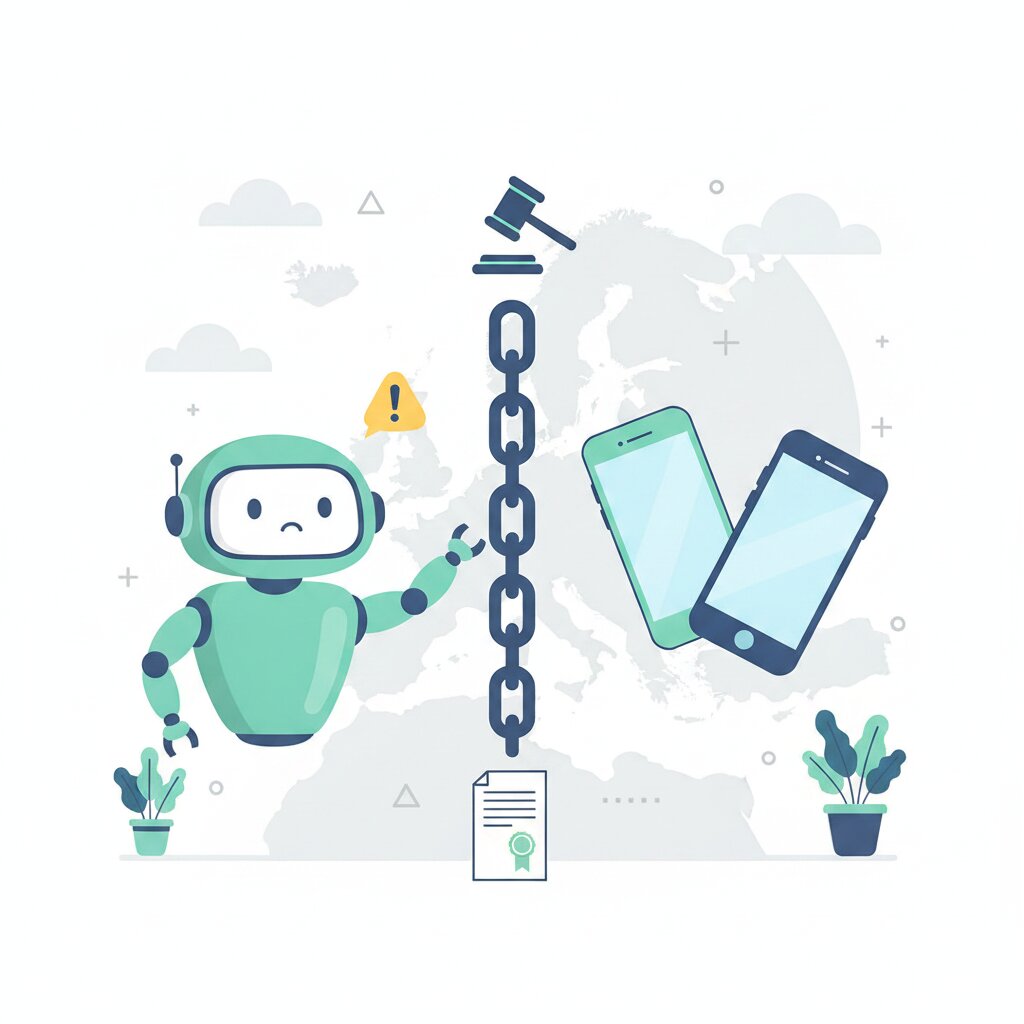
Siri AI, the 1.2-trillion-parameter assistant overhaul Apple announced at WWDC 2026, will not ship on iOS 27 or iPadOS 27 in the European Union. Apple confirmed the block in June, affecting roughly 450 million people across 27 member states. No formal prohibition order has been issued from Brussels. What exists instead is a regulatory standoff: Apple cannot launch without Digital Markets Act compliance, Apple argues DMA compliance for an AI assistant is technically impossible at current security standards, and the European Commission has rejected every proposed solution.
The DMA applies because iOS and iPadOS are designated core platform services. macOS and visionOS escape because neither has been designated, which is why EU users will get Siri AI on Mac but not iPhone. The July 2026 EU General Court upheld Apple’s gatekeeper designation, and a €500 million April 2025 DMA fine for App Store anti-steering established the Commission’s willingness to penalise. This dispute does not unfold against a blank slate.
What features will EU iPhone and iPad users miss when iOS 27 launches without Siri AI?
The feature gap turns an abstract regulatory dispute into something you would feel every day. EU users stay on legacy Siri while the rest of the world gets an assistant with capabilities that did not exist in any consumer product two years ago.
The biggest loss is contextual awareness. Siri AI can read what is on screen: an address in a text message becomes a map suggestion, an event mentioned in email becomes a calendar proposal. It executes multi-step workflows across apps through natural-language instruction. Ask it to find a photo, edit it, attach it to a message, and send it, and it chains those actions together. It also builds a semantic understanding of your communications, files, and habits, surfacing the right document when you need it and recalling preferences across interactions.
There is also no dedicated Siri AI conversation app, no Camera-mode Siri for visual queries, and no expanded Visual Intelligence. The cascade hits watchOS 27 too: Siri AI on Apple Watch requires a paired iPhone with Siri AI, so the wrist loses the feature as well. Developers in the EU cannot test or build against Siri AI capabilities on iOS, iPadOS, or watchOS, which means the block constrains the entire app ecosystem, not just end users.
Siri AI is not the first feature Apple has withheld in the EU over DMA interoperability. The pattern goes back to 2024 and has been hardening ever since.
Which Apple Intelligence features have previously been blocked or delayed in the EU because of the DMA?
The Siri AI block is the latest and most significant escalation in a multi-year pattern that reveals how the regulatory relationship has hardened. Understanding that pattern makes the current standoff more predictable than it looks in isolation.
When Apple launched its first AI suite in October 2024 (Writing Tools, notification summaries, Priority Notifications), EU iPhones and iPads were excluded from the iOS 18.1 launch. Those features eventually arrived in the EU with iOS 18.4 in April 2025 after months of negotiations, establishing a pattern of initial withholding followed by negotiated resolution. But the resolution came at a cost: EU users waited six months for features available elsewhere from day one.
iPhone Mirroring has been blocked in the EU since the iOS 18 launch in September 2024 and remains unavailable. Apple says extending secure mirroring to non-Apple devices is architecturally impossible under DMA interoperability requirements. Live Translation with AirPods is similarly delayed: conversations are processed on-device and never accessible to Apple, and making the capability available to third-party devices creates engineering challenges Apple says remain unsolved. Visited Places and Preferred Routes on Maps, both location-based features, were withheld due to DMA data-access requirements.
The Free Software Foundation Europe reported that none of 56 formal interoperability requests submitted to Apple had produced a working solution. Throughout this timeline, every blocked feature has been available on Mac in the EU from day one because macOS was never designated a gatekeeper platform. That distinction is not an anomaly. It is the mechanism.
The escalation trajectory is clear: Writing Tools (text generation) to iPhone Mirroring (device control) to Siri AI (system-wide reasoning). Each step represents deeper system integration and correspondingly harder DMA compliance problems. The Commission’s refusal to grant the 18-month exemption for Siri AI signals it will not accept the delay-then-negotiate pattern for core interoperability obligations.
Why is the European Commission blocking Siri AI from launching on EU iPhones and iPads?
The European Commission has not issued a formal prohibition order. Commission spokesperson Thomas Regnier stated that the decision not to roll out Siri AI in the EU is Apple’s and Apple’s only. The block is Apple’s choice not to ship until it can achieve DMA compliance on terms it considers workable.
What triggers the obligation is DMA Article 6(7). It requires gatekeepers to provide third-party virtual assistants with “effective interoperability with the same hardware and software features” available to the gatekeeper’s own assistant. Siri AI’s deep system integration (reading messages, making purchases, cross-app actions, screen context) means any competing assistant must receive equivalent OS-level hooks.
Apple proposed two things: a Trusted System Agent intermediary architecture and an 18-month phased rollout. The Commission rejected both in full. Regnier elaborated that Apple was unable to develop interoperability solutions meeting EU privacy and security standards, and that asking for an 18-month exemption rather than finding a suitable compliance solution was not an option.
The gatekeeper designation that triggers all of this is now legally settled. The EU General Court upheld it in July 2026.
What exactly does DMA Article 6(7) require Apple to do for competing AI assistants?
Article 6(7) is a specific, enforceable provision, and understanding what “same” means in its text is the analytical key to the entire dispute.
The core obligation: gatekeepers must provide third-party providers, including virtual assistants, with “free of charge, effective interoperability with, and access for the purposes of interoperability to, the same hardware and software features accessed or controlled via the operating system” that the gatekeeper’s own services use. If Siri AI can read your screen to answer “what is the address in that text message?”, a competing assistant must do the same through the same OS-level access, not through a reduced proxy interface. The word “same” applies to both the capabilities and the access mechanism.
The obligation extends to any third party that files a valid request through the DMA’s formal interoperability portal. Apple cannot choose which assistants get access. The specification proceedings the Commission launched in September 2024 are designed to produce binding decisions defining exactly what “effective interoperability” means for iOS and iPadOS. Draft recommendations arrived in December 2024, and the process is ongoing.
Non-compliance carries fines of up to 10% of Apple’s global annual turnover, roughly €38 billion, plus daily penalty payments. The financial architecture behind the legal language is designed to make non-compliance unaffordable.
What is Apple’s Trusted System Agent proposal and why did the EU reject it?
The Trusted System Agent was Apple’s architectural compromise: a software intermediary that would give competing AI assistants programmatic access to features on your iPhone (microphone, screen context, app intents, file system) through standardised APIs that Apple controls, rather than direct OS-level access equivalent to Siri AI’s own integration.
Apple’s rationale is straightforward. Granting direct system access to any third party that requests it through the DMA portal creates an unmanageable security surface. The Trusted System Agent was designed to provide capability access while maintaining Apple’s privacy and security guarantees, including Private Cloud Compute boundaries.
The Commission’s objection cuts to the core of what “effective interoperability” means. An Apple-controlled mediation layer creates a persistent structural advantage: Apple controls the mediation, and can therefore throttle, degrade, or deprioritise competing assistants at the API level. Under Article 6(7), competing assistants must access the same capabilities through the same mechanisms as Siri AI, not through an Apple-controlled gatekeeper.
The Free Software Foundation Europe found that none of 56 formal interoperability requests submitted to Apple had produced a working solution. That finding contextualises the Commission’s scepticism. Apple’s track record on DMA compliance does not inspire confidence that a mediated layer would deliver substantive access. Apple engineers have reportedly stopped working toward an EU iOS solution entirely, signalling how definitively the compliance dialogue has stalled.
What security risks does Apple claim the DMA’s interoperability rules would create for EU iPhone users?
Apple’s security argument hinges on a distinction. AI assistants with deep system access are a fundamentally different proposition from the data-portability and anti-steering provisions the company has already complied with.
The central concern: granting any third-party AI assistant the same OS-level access as Siri AI (the ability to read messages, execute purchases, access files, and act across applications) to any entity that requests it through the DMA portal creates an unmanageable attack surface. Siri AI’s privacy architecture extends on-device protections into Apple’s cloud infrastructure with verifiable guarantees through Private Cloud Compute. Third-party assistants would process your data on their own servers with unknown security postures and no Apple-auditable privacy guarantees.
There is also a precedent problem. If Apple must grant direct system access to one third-party AI assistant, it must grant it to any that files a valid request. There is no mechanism to distinguish between a well-resourced assistant with strong security practices and a malicious actor exploiting the portal. Apple marketing chief Greg Joswiak described the situation as the Commission asking Apple to conduct a risky experiment on tens of millions of users.
The Commission has a counter-argument worth sitting with. Regnier pointed out that Siri AI is “powered by Google” on the backend, referencing Apple’s reported $1 billion per year Gemini deal. If Apple trusts Google with EU user data for Siri AI queries, the Commission asks, why can competing assistants not receive equivalent system access? The privacy purity argument has a structural weakness Apple’s own architecture choices created.
Apple vs European Commission: who is actually responsible for the Siri AI EU lockout?
Responsibility is uncomfortably distributed across both parties.
Apple’s side: Article 6(7) as written makes secure AI assistant operation impossible. AI assistants performing multi-step reasoning across apps need unmediated system access, and granting that to any third party through the interoperability portal creates an attack surface the DMA’s drafters did not contemplate in 2022. The Trusted System Agent was a genuine architectural compromise, not a bad-faith dodge. Apple’s fiduciary duty to shareholders and its brand differentiation on privacy create real constraints. Withholding Siri AI from the EU, when the Commission has rejected every compliance pathway, is a rational business decision.
The Commission’s side: Apple had four years from DMA passage to design iOS for compliance and chose not to. The Trusted System Agent is compliance in form but defeat in substance, an Apple-controlled gatekeeper that preserves the structural advantage the DMA was designed to eliminate. Apple has made similar security arguments against every DMA obligation (sideloading would “destroy iPhone security,” alternative payment systems would “create new scam vectors”) and the predicted catastrophes have not materialised. The General Court’s July 2026 ruling upholding the gatekeeper designation is the clearest legal evidence favouring the Commission’s position, and the FSFE finding that none of 56 interoperability requests produced results suggests Apple’s existing framework has not delivered substantive compliance. The Commission is enforcing a democratically enacted law. It is not the Commission’s job to design Apple’s compliance architecture.
Both positions are defensible from within their respective institutional logics. Neither actor is behaving irrationally. The impasse reflects a genuine collision between platform security architecture and competition law, two systems built in different eras for different purposes, brought into contact by the scale of AI. It is not a product of failed negotiation or bad faith.

Resolution pathways exist: a negotiated compliance solution, a legislative amendment narrowing Article 6(7)’s scope for AI assistants, a Court of Justice ruling that interprets the provision more narrowly, or Apple capitulating to direct OS-level access. None are imminent. The Siri AI block is the first high-profile collision of this type, but it will not be the last. Google’s assistant strategy, Meta’s AI integration, and any future gatekeeper-controlled AI assistant will face the same Article 6(7) tension.
Frequently Asked Questions
Why can EU users get Siri AI on Mac but not iPhone?
The DMA applies only to designated core platform services, and while iOS and iPadOS were designated as gatekeeper platforms, macOS was not. Siri AI on Mac does not trigger Article 6(7) interoperability obligations because the operating system it runs on is not subject to those rules. The same Siri AI capability, on the same Apple account, is legal on a MacBook in Brussels but blocked on an iPhone held by the same person.
Is the Siri AI block affecting the UK as well?
No. The United Kingdom left the European Union in 2020 and is no longer subject to the Digital Markets Act. The UK has its own digital competition regime under the Digital Markets, Competition and Consumers Act 2024, administered by the Competition and Markets Authority, but iOS has not been designated under that framework. UK iPhone users will receive Siri AI with iOS 27 alongside the rest of the global launch outside the EU and China.
Can I use a VPN or change my Apple ID region to get Siri AI in the EU?
Almost certainly not. Apple determines a device’s region through multiple signals including the Apple ID billing address, GPS location, carrier network identification, and device region settings. While Apple has not published the Siri AI region-detection mechanism, the company’s existing geo-restrictions for features like iPhone Mirroring combine hardware identifiers with account metadata to prevent simple VPN or region-change workarounds. The block is architectural, not merely network-based.
Are other AI assistants like Google Gemini or ChatGPT affected by the DMA interoperability rules?
The DMA’s Article 6(7) obligations apply to gatekeeper platform operators, not to the AI assistants themselves. Google’s Gemini on Android would be subject to equivalent interoperability requirements because Android is a designated gatekeeper core platform service. ChatGPT, made by OpenAI which is not a designated gatekeeper, has no DMA interoperability obligations. The obligation falls on the platform owner, not the AI provider, meaning the access right runs in one direction only.
What does it mean that Siri AI is “powered by Google” on the backend?
Apple has a deal with Google to use Gemini models for some Siri AI backend processing, disclosed at WWDC 2026. This means certain user queries routed through Private Cloud Compute may be processed by Google’s AI infrastructure under contractual privacy terms. European Commission spokesperson Thomas Regnier has pointed to this arrangement to argue that Apple’s privacy objections to third-party AI access are inconsistent: if Apple trusts Google with EU user data for Siri AI, why can competing assistants not receive equivalent system access?
What happens if Apple simply ignores the DMA and launches Siri AI in the EU anyway?
The European Commission could open non-compliance proceedings carrying fines of up to 10% of Apple’s global annual turnover (approximately €38 billion), plus daily penalty payments of up to 5% of average turnover for continued non-compliance. The Commission demonstrated enforcement willingness with the €500 million April 2025 anti-steering fine. For systemic non-compliance, the DMA also permits structural remedies including forced divestiture of business units.
Does the Siri AI block also prevent me from using the ChatGPT app or Google Gemini on my EU iPhone?
No. The Siri AI block only affects Apple’s own deeply integrated assistant. Third-party AI apps including ChatGPT, Google Gemini, and Claude remain available through the App Store on EU iPhones and will continue to function normally on iOS 27. The difference is that these apps operate within standard iOS sandboxing and cannot access the system-level integration (screen reading, cross-app reasoning, background context awareness) that Siri AI would provide and that DMA Article 6(7) would oblige Apple to extend to them.
How long could this regulatory standoff realistically last?
There is no obvious deadline forcing resolution. Neither side has a strong incentive to capitulate quickly: Apple can absorb the reputational cost of withholding Siri AI from EU iPhones, and the Commission does not face direct political pressure over a feature that has never existed in the market. Resolution could take months through renewed negotiation, years through Court of Justice proceedings, or could remain unresolved indefinitely if neither party’s calculus changes. Apple engineers have reportedly stopped work on an EU iOS solution entirely.
Is the DMA interoperability requirement unique to the EU, or do other countries have similar laws?
The DMA is the most aggressive digital competition regime globally, but similar frameworks are emerging. The UK’s Digital Markets, Competition and Consumers Act 2024 gives the CMA comparable designation and interoperability powers. Japan’s Smartphone Software Competition Act, passed in 2025, includes platform interoperability provisions. South Korea and Australia are developing analogous frameworks. No other jurisdiction has yet imposed AI-assistant-specific interoperability requirements as concrete as DMA Article 6(7), but the EU approach is being watched as a regulatory template.
What can EU iPhone users do in the meantime to get AI assistant features?
EU users can access third-party AI assistants including ChatGPT, Google Gemini, Claude, and Perplexity through the App Store, all of which function normally on iOS 27. Some Apple Intelligence features that did reach the EU in iOS 18.4 (Writing Tools and notification summaries) remain available. For Siri AI’s cross-app reasoning and screen awareness, the only current option is to use a Mac running macOS, where Siri AI launches without DMA restrictions because macOS is not a designated gatekeeper platform.