
“Taste” is a term that has been bandied about in the AI field since the early days (2020), when image generation created aliens, and models like GPT-2 and GPT-3 created sonnets in pirate-speak.
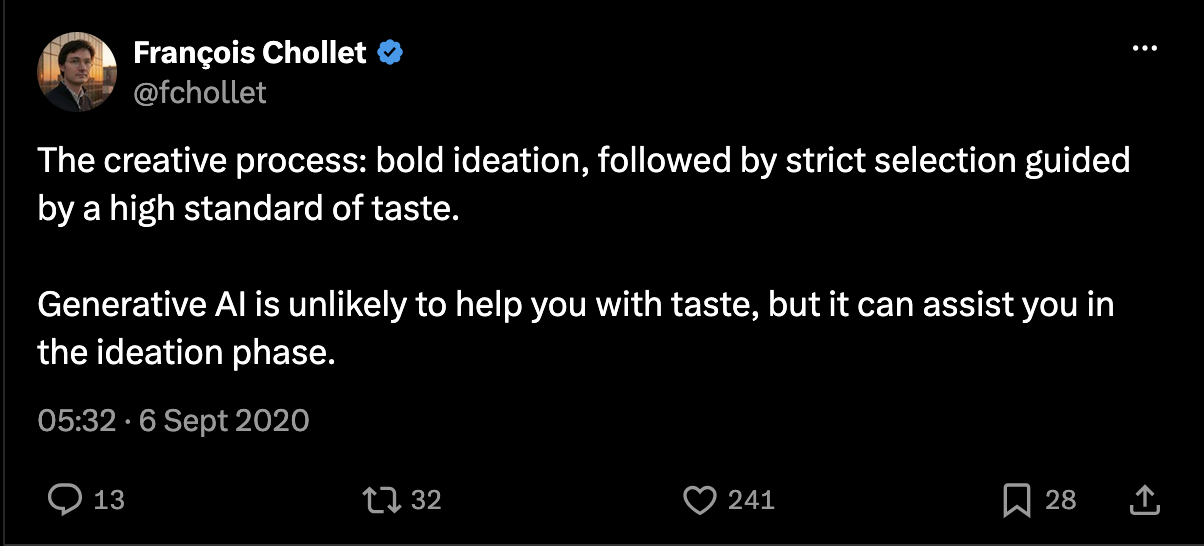
Researchers saw AI as a fountain of creativity and you only had to pick the image/sonnet/novel that you liked. And since it was a fountain, a seemingly infinite fountain of images/sonnets/novels, taste was required to pick out the generations worth keeping.
They were surprised when actual creatives – artists, writers, filmmakers – along with most of the general population, pushed back on this idea.
On the coding side, this “generate then select” evolved rapidly. Starting with Github Copilot’s release in 2022, AI could generate functions for you. Then Cursor combined with Claude 3.5 Sonnet in mid-2024 introduced AI that could generate features that required edits across multiple files. Finally, February 2025, Andrew Karpathy alerted the world to vibe coding.
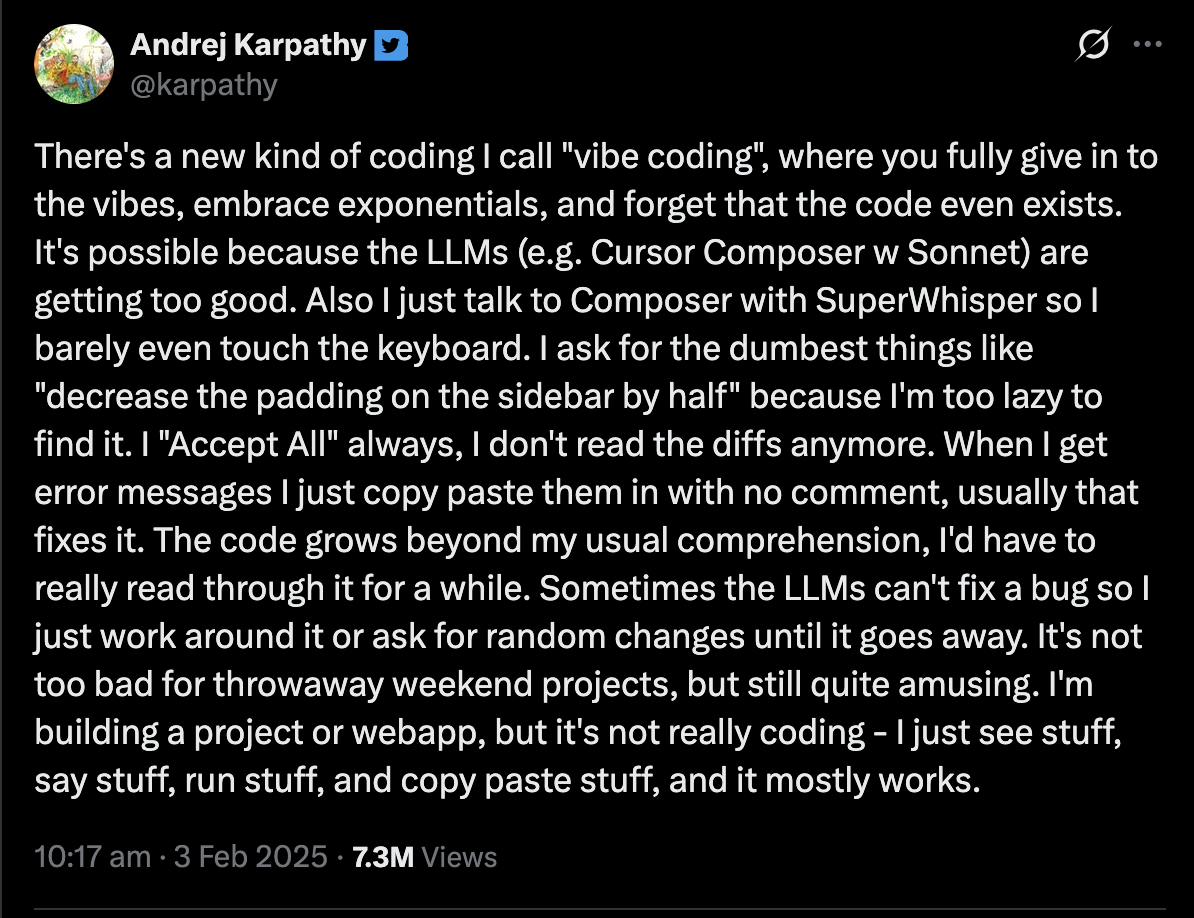
With vibe-coding you didn’t need to look at the code. You didn’t have to instruct the AI on how to build, you only had to tell it what to build. The infinite AI generation fountain had expanded to software. From February 2025 to today the complexity and quality of software it can generate has only increased.
Like the other fountains, if you can generate any app or any service you can describe, the power then is in the description, in the instructions you give to AI. In Silicon Valley, where success is measured in unicorns, taste became deciding on the right app or service you should instruct the AI to build.
Paul Graham, founder of Y Combinator:
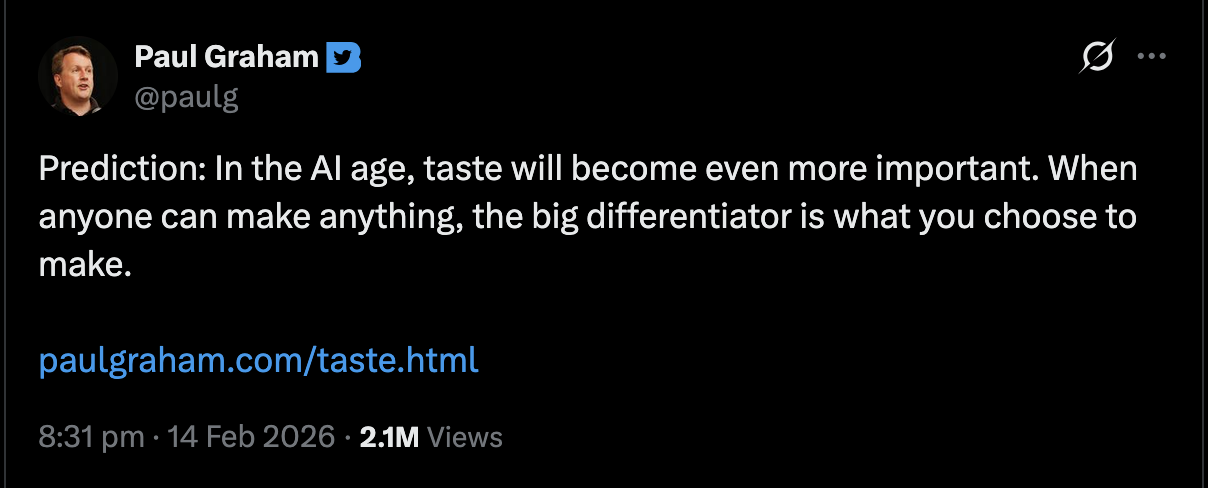
Which sounds great and all if you consider yourself an “ideas person” and believe the “anyone can make anything” messaging.
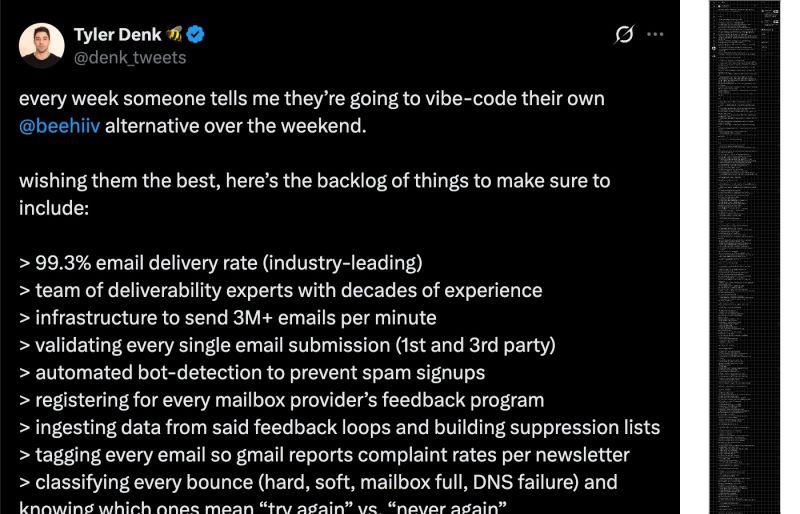
Tyler Denk, CEO of beehiiv, a newsletter platform, just one entrant in a very competitive market, shutdown this idea with a list of everything you would need to build to match beehiiv. The full list is that very scaled-down bar on the right. You can read the original here.
New competitors to beehiiv will still appear. Chances are that someone, out of a mixture spite and ignorance, has taken that list, given it to Claude or ChatGPT along with a “build all this and make no mistakes”. But that would be tasteless, according to Dane Knecht, Cloudflare’s CTO, and his definition of taste:
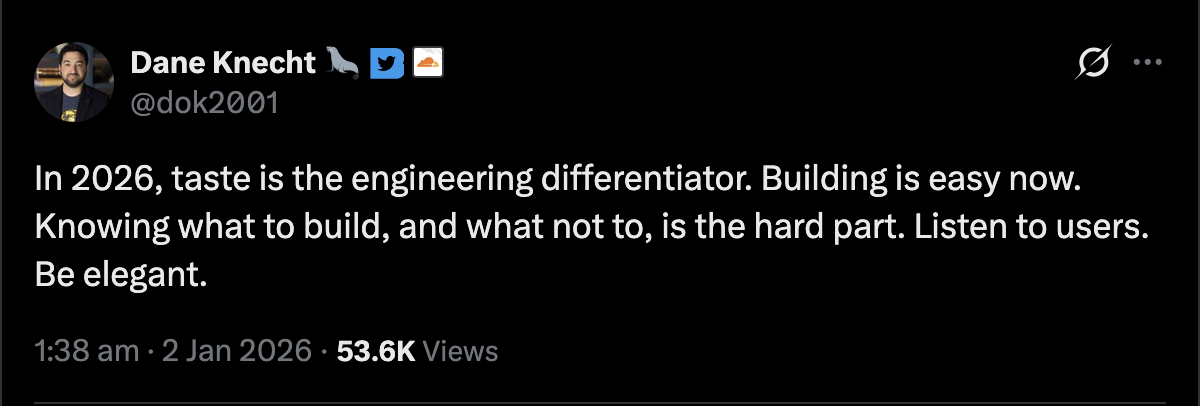
And taste in engineering is where beehiiv brings us. Taste has moved down the stack as each apparent increase in AI ability gives way to the realities of LLMs’ spiky intelligence, inability to read minds, and the level of detail that operating in the real world requires.
Building a product with paying users, rather than recreating an existing tool or converting a codebase from one language to another or telling AI “make it faster” involves the relentless application of taste across countless decisions. The only limit is your patience, experience, and, again, taste.
As Denk’s list of beehiiv features, infrastructure and processes demonstrates, a product in the marketplace has seen a team of professionals working over years, exercising their taste across design, architecture, data structures, testing, infrastructure, messaging, etc.
This will not cut it:
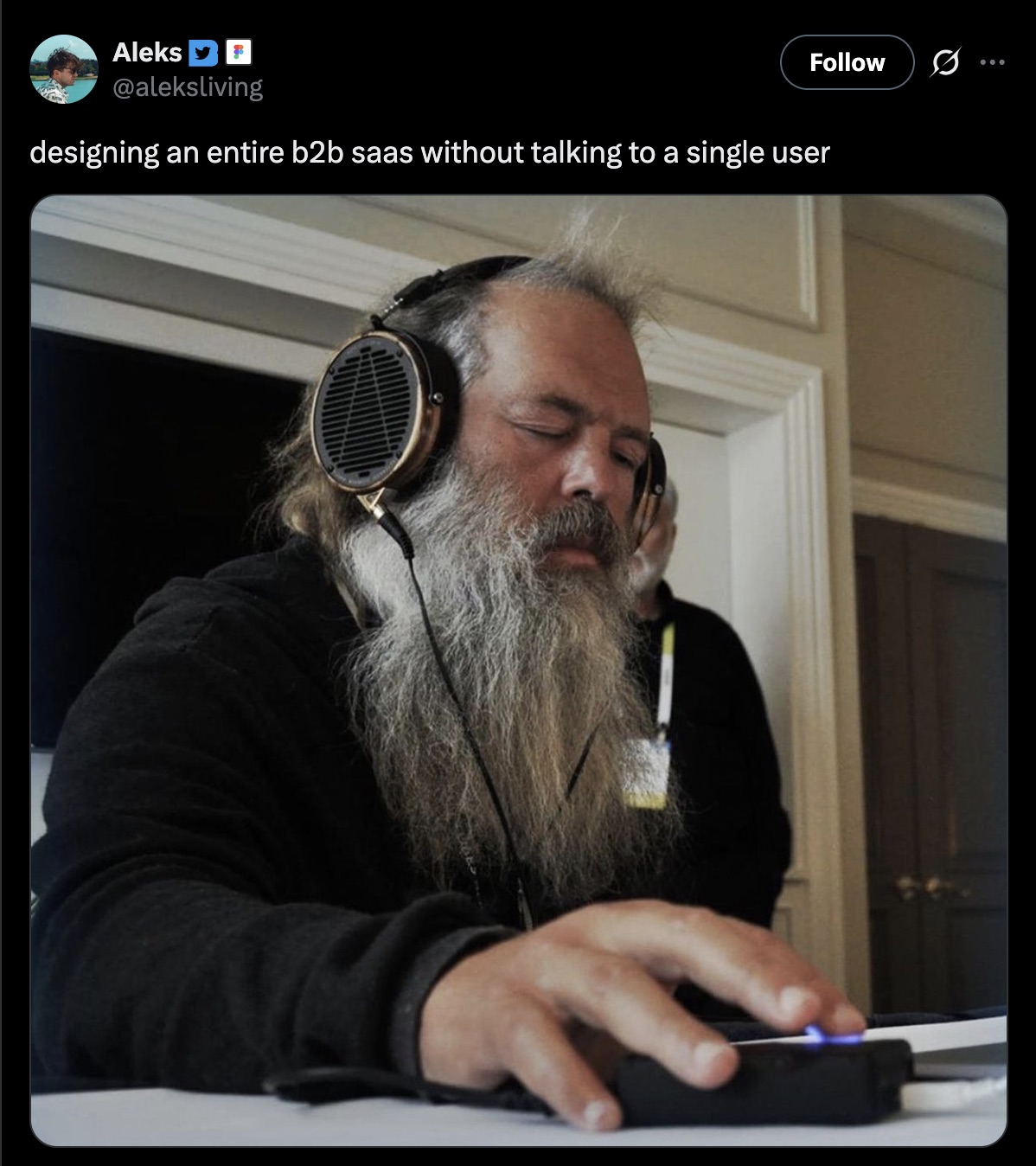
AI doesn’t save you completely from the ninety-ninety rule:
“The first 90% of the code accounts for the first 90 percent of the development time. The remaining 10% of the code accounts for the other 90% of the development time.”
Under AI that first 90% can take hours to days. But that 90% represents the broad strokes of software that AI has been trained heavily on – the database layout, the structure of your API.
You have only 10% left. Maybe you believe you just need to slap a WebUI on it. Then you discover it’s slow and the AI didn’t add indexes to the obvious tables. You tell it to fix that, but it’s still slow and you discover that it is running queries in a loop instead of using the obvious (to you) WHERE clause to get the database to handle the filtering.
Welcome to the “requirements gap” – what you didn’t specify clearly enough the model decided for itself, based on all the great and half-baked code it had been trained on. You need taste more than ever now as what your agents have built is finally brought face to face with reality.
This is why taste is built on experience. You need to be able to recognise problems, know how to diagnose their cause, and how to guide their correction. It doesn’t matter if it is design, software engineering, accounting or law or any other pursuit.
Thanks to AI, anybody can do the first 90% of the work. This has made the second 90% where the demand is, where the skill is and where all the work has been concentrated. It’s why reviews are bottlenecks. You can compress the timeline of a product’s development, but you can’t escape the decisions that need to be made.
Those decisions used to be spread across a team and across months or years. A feature might be built faster by 2 to 3 people with taste, but only the coding has been accelerated. All the same decisions still happen. With taste applied at the beginning – spending time on exploration and specification of the changes to be made – you can save some time for adding more taste at the end, but that only shifts the sequence, not the quantity.
For an entire product, a product sizable enough that building it is part of the moat, a product perhaps on beehiiv’s scale of complexity, taste is the work. The more people you have unified on taste and experience the faster you can make all the decisions needed to successfully implement all facets of your product.
AI has collapsed software development down to deciding what is right and what is wrong in the way agents follow instructions. With the ability to spin up as many agents you want, code can be written at any velocity you can handle. All it requires is clarity of decision making, taste, and the stamina to apply it across detail in your product.