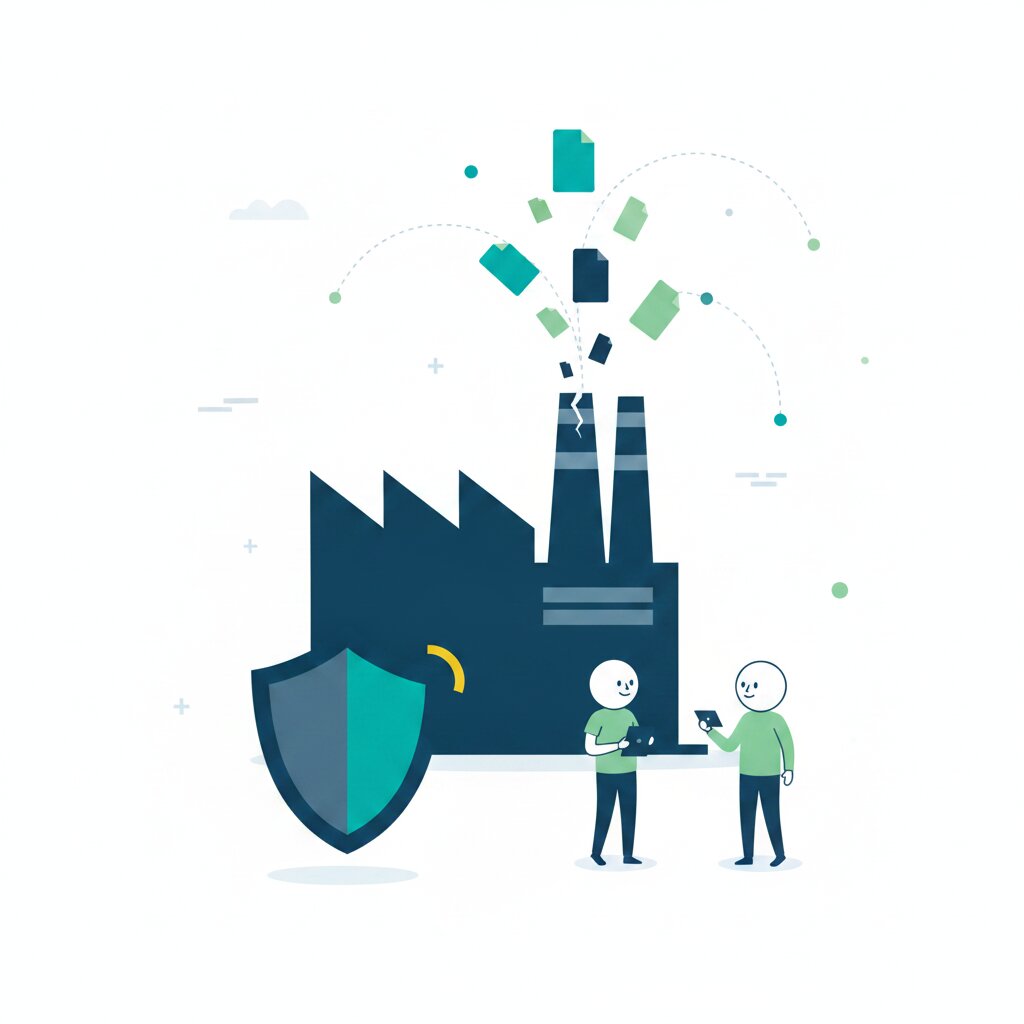

On 12 June 2026, a dark web leak site operated by the World Leaks syndicate published 630 GB of confidential data, 204,341 files, exfiltrated from Tata Electronics’ facilities in Hosur, Tamil Nadu. The dataset spanned Apple’s unreleased iPhone 18 Pro, Tesla’s Project Highland and NV36 Chargeport Controller, TSMC process-node documentation, and Qualcomm trade-secret-watermarked PMIC drawings. Within hours, the files spread from the dark web to Instagram, TikTok, YouTube, and enthusiast forums. Tata’s production lines never stopped. No ransom note ever appeared on a screen. The breach was discovered from the dark web post itself, not from internal monitoring.
By the end of this article you will understand not just what was exposed, but why the Tata breach rewrites the threat model for every company that outsources hardware manufacturing—a single event in the broader supply chain security crisis.
What exactly was exposed in the Tata Electronics breach, and why does each category of leaked data matter?
The breach did not merely reveal what the iPhone 18 Pro looks like. It exposed the engineering and commercial substrate Apple guards most closely: who makes which component, at what specification, under what dependency structure.
The exposed data falls into eight categories, each with distinct competitive consequences.
CAD renders and assembly-tolerance specifications reveal physical dimensions, chassis geometry, and manufacturing tolerances months before launch. Drop-test photographs dated early 2026 depicted a handset nearly identical to the current iPhone 17 Pro, but the renders themselves let competitors reverse-engineer design constraints.
A20 Pro 2nm chip specifications pre-empt TSMC’s process node marketing. The leaked files included motherboard blueprints and A20 Pro chip documentation, exposing Apple’s silicon roadmap before Apple could frame it at its September launch.
Variable-aperture 48MP Fusion camera system documentation exposes Apple’s computational photography roadmap, including a mechanical aperture mechanism that had not been publicly confirmed. Samsung and Google now have months of lead time to calibrate their own camera marketing against Apple’s actual capabilities. At least six files mapped iPhone 18 Pro camera module components to specific suppliers.
Samsung as image sensor supplier surfaced inside the supplier mapping. Apple had not disclosed that Samsung had broken Sony’s longstanding monopoly on iPhone image sensors. The breach stripped Apple of the ability to control when and how this supplier relationship became public. More on why this particular revelation stings in a moment.
5,000 to 5,200 mAh battery specifications reveal the power envelope and thermal design targets for the iPhone 18 Pro, letting competitors benchmark their own battery engineering against confirmed Apple specifications. Battery parts and suppliers were mapped across multiple files.
Supplier-to-component mapping is the dataset Apple guards most tightly. The records show where Apple draws a part from several suppliers and where it relies on just a few, laying bare both its bargaining leverage and its vulnerabilities. Apple treats this granular vendor data as more sensitive than product specs themselves. Section 4 examines why.
Cryptographic certificates and key files are the highest-risk category. Unlike design specifications, certificates cannot be un-leaked. They represent ongoing operational risk, including potential for signed malware, device impersonation, and trust-chain compromise that persists beyond the news cycle.
Employee PII including passport scans is the human dimension. Indian cybersecurity researcher Rajshekhar Rajaharia told Reuters he confirmed passport copies of employees including foreign nationals in the data dump. Identity documents now circulating on dark-web forums have no reset mechanism.
Tata held such a broad range of OEM IP because they manufacture iPhone enclosures and components, scale toward full device assembly, and serve multiple clients, Tesla and JLR among them, simultaneously. They are a single point of aggregation for sensitive engineering data across the automotive and consumer-electronics sectors.
The breadth of data sitting inside Tata’s environment raises the obvious question: how did attackers reach it?
How did World Leaks breach Tata Electronics’ systems?
World Leaks, widely assessed by researchers to be a rebrand of the Hunters International group, did not use a sophisticated zero-day. They used patience.
The likely attack chain, reconstructed from researcher analysis, maps cleanly to MITRE ATT&CK. Initial access probably came via an Initial Access Broker selling pre-compromised credentials, or a spear-phishing campaign targeting Tata’s administrative and engineering staff. The attackers needed credentials, not exploits.
Once inside, they used Living off the Land techniques, native Windows and Linux administrative utilities already present on the network, to move laterally from IT systems toward OT-adjacent engineering file shares, SAP ERP databases, and email servers where iPhone 18 Pro documentation was stored. World Leaks primarily performs lateral movement using valid domain accounts together with SMB and Windows administrative shares.
Over an extended dwell period, attackers mapped high-value repositories and exfiltrated 630 GB using standard protocols, mega.nz, rclone, custom SFTP, that mimicked normal outbound data flows. Leaked documents dated as late as May 2026 and event logs spanning several years suggest persistent access inside the IT active directory environment. While the exact dwell window is not publicly confirmed, the volume of exfiltrated data, over 200,000 files spanning multiple OEMs, is inconsistent with a short-duration intrusion.
World Leaks deployed zero file-encrypting ransomware. No ransom notes on screens. No halted production lines. No operational anomalies to trigger security monitoring. The dataset simply appeared on their dark web leak site as a searchable database.
Why did the breach not disrupt Tata’s factory operations despite exfiltrating 630 GB?
The security architecture was never tested. The attackers chose a different payload, one that manufacturing monitoring was not designed to detect.
World Leaks uses a pure data extortion model. The leverage comes from the threat of publication, not from holding production lines hostage. Tata Electronics confirmed: the incident had no impact on operations. No factory line stopped. No systems were encrypted.
This creates a dangerous detection asymmetry. Encryption-based ransomware triggers immediate alarms: file rewrites at scale, ransom notes on screens, production-line stoppages. Pure data exfiltration triggers none of those. In a manufacturing environment, large engineering files routinely move between partners. Data moving outbound over standard protocols during normal business is indistinguishable from legitimate activity unless you have behavioural analytics tuned to detect anomalous data aggregation.
Most manufacturing security monitoring is architected to detect operational anomalies, SCADA irregularities, line stoppages, unexpected machine-state changes, because the historical threat to manufacturing has been operational disruption. If your manufacturing partner’s SOC is watching for production-line stoppages but not for someone quietly copying your chip specifications, you have a detection gap. And if the attacker’s goal is IP monetisation through publication rather than operational disruption through encryption, that gap is the one that matters.
Modern disaster recovery, immutable cloud backups, and EDR agents make encryption-based ransomware less reliably profitable. Exfiltration was observed in 61% of cases in Q4 2025, and attackers have noticed.
Why does the iPhone 18 Pro supplier-to-component mapping matter more than the product photos?
Product photos reveal what a device looks like. Supplier-to-component maps reveal how it is made, who makes it, and where Apple has no alternative. The latter is the strategic intelligence competitors and negotiating partners value most.
The drop-test images generated the most consumer attention on Instagram and TikTok. But they depicted a conventional slab-shaped grey handset with a three-rear-camera setup, a design nearly identical to the current iPhone 17 Pro. The supplier mapping carries heavier consequence for three reasons.
First, single-source dependency exposure: the records show where Apple relies on just a few suppliers, letting competitors identify bottlenecks and target those same suppliers for capacity pre-emption.
Second, negotiation leverage erosion: suppliers who appear in the mapping now know exactly which components Apple depends on them for and whether Apple has alternatives. This shifts negotiating power from Apple to its suppliers in future pricing and capacity-allocation discussions.
Third, competitor bill-of-materials intelligence: rival manufacturers can now reconstruct Apple’s component-cost structure with unusual precision, informing their own pricing, feature-prioritisation, and supplier-selection decisions.
The Samsung-as-sensor-supplier revelation is the case in point. Apple had not disclosed that Samsung had broken Sony’s monopoly on iPhone image sensors. The breach forced that information into the public domain before Apple could manage the narrative, affecting both Sony’s market positioning and Samsung’s negotiating leverage with other smartphone OEMs.
That kind of damage, commercial rather than cosmetic, is what distinguishes this breach from the iPhone leaks that came before it.
How does the Tata Electronics breach compare to the iPhone 4 prototype left in a bar in 2010?
The iPhone 4 prototype incident, the established benchmark for iPhone leaks, involved a single physical device accidentally left at a bar near Foxconn facilities in Redwood City, California. Gizmodo purchased and published it. The device revealed the industrial design: form factor, materials, stainless-steel band, glass back. Apple successfully demanded its return, a move that allowed the company to regain narrative control. The competitive damage was bounded: one device, one product generation, one recoverable asset.
The Tata breach reveals the engineering substrate, not merely the industrial design: chip specifications, component suppliers with dependency mapping, circuit board quality inspection standards, cryptographic material. The data is irrecoverable. Once published on the dark web and propagated to consumer platforms, no legal instrument can recall it.
The breach affects multiple OEMs simultaneously: Apple, Tesla, TSMC, Qualcomm. Damages extend beyond surprise factor. Supplier negotiation leverage is compromised. Security infrastructure is compromised because cryptographic certificates cannot be un-leaked. Narrative control is lost.
Where the iPhone 4 incident was bounded, the Tata breach radiates across companies, data categories, and time. The symmetry is worth noting: the iPhone 4 prototype was lost near Foxconn’s facilities; 16 years later, the breach occurred at Apple’s other major assembly partner. The pattern is structural, not coincidental.
Why are Tier-1 manufacturing suppliers becoming the preferred target over the OEMs themselves?
Breaching a Tier-1 supplier yields the same classified blueprints as breaching the OEM directly, but with lower defensive barriers, broader multi-client access, and detection infrastructure tuned for operational disruption rather than IP exfiltration.
Tata Electronics holds Apple’s, Tesla’s, and JLR’s engineering IP in the same network environment. A single compromise yields multiple high-value datasets that would require breaching three separate hardened corporate networks to obtain individually. Apple and Tesla invest billions in corporate security. Their Tier-1 suppliers, operating on thinner margins and competing on manufacturing efficiency, cannot match that investment, yet they hold functionally equivalent IP.
The India dimension compounds this. India has expanded iPhone assembly from roughly 6% to 26% of global production in four years. That pace of industrial scaling has not been matched by equivalent investment in the security architecture that Foxconn and other Chinese manufacturers built over two decades of being targeted. The gap is one of maturity velocity, not inherent capability.
This is not new. REvil breached Quanta Computer in 2021, not Apple, and obtained unreleased M1 MacBook Pro schematics. The five years between Quanta and Tata produced no structural change to the supplier-as-weakest-link dynamic. And Quanta is not the only precedent within the Tata ecosystem: Jaguar Land Rover, another Tata Group entity, suffered a ransomware attack in 2025 that caused a six-week production halt. Two major Tata entities, two significant cyber incidents within a year. The pattern suggests systemic rather than incidental vulnerability. This is one facet of the supply chain security crisis that extends far beyond a single factory in Tamil Nadu.
Conclusion
The Tata breach is the most consequential iPhone leak because it revealed that the global hardware supply chain’s information architecture is itself the vulnerability. The threat model has shifted from disrupting operations to silently exfiltrating irrecoverable competitive infrastructure.

The cryptographic certificates and supplier dependency maps do not decay. They represent ongoing operational risk that persists indefinitely. The detection gap that World Leaks exploited, security monitoring architected for operational disruption rather than IP theft, exists at virtually every Tier-1 supplier. The five years between the Quanta breach in 2021 and the Tata breach in 2026 produced no structural change to how IP is partitioned and protected across the supply chain.
The question is not whether another breach of this magnitude will occur. It is which supplier and which OEM it will hit next.
For the full picture of the breach and its fallout—from the attacker economics to what this means for every company relying on contract manufacturers—see our complete analysis.
The group behind this attack, World Leaks, represents a change in how ransomware groups operate that makes manufacturing targets especially exposed. That pattern deserves its own examination.
Frequently Asked Questions
What can Apple actually do about the cryptographic certificates that were leaked?
Almost nothing that eliminates the risk entirely. Apple can revoke compromised certificates through its own infrastructure, which prevents them from being used to sign software for devices that check revocation status. But the certificates themselves remain in circulation on the dark web indefinitely. Any device or system that does not rigorously validate certificate revocation, including legacy enterprise provisioning systems and some supply chain testing environments, remains vulnerable to signed-malware attacks using the leaked material. The operational risk does not expire.
Was the iPhone 18 Pro the only Apple product exposed in the Tata breach?
No. While the iPhone 18 Pro and Pro Max represented the highest-profile dataset, the 204,341 files also contained documentation referencing other Apple product lines that pass through Tata’s Hosur facilities. The broader concern is that the breach exposed Apple’s engineering processes, quality-inspection standards, and supplier-management workflows, not just a single product’s specifications. These process-level documents have value across Apple’s entire hardware portfolio, not merely the iPhone 18 generation.
What does this breach mean for the iPhone 18 Pro release date and pricing?
The breach is unlikely to delay the iPhone 18 Pro launch. Tata’s production lines never stopped, assembly targets were met throughout the compromise, and the attack did not disrupt manufacturing operations. Pricing is harder to predict. The supplier-to-component mapping gives Apple’s negotiating partners visibility into single-source dependencies they did not previously have, which could harden supplier pricing positions in upcoming contract cycles. Whether that cost pressure reaches the consumer depends on Apple’s margin strategy.
How do attackers monetise stolen CAD files and engineering documents?
Through a layered dark-web economy that did not exist at this scale a decade ago. World Leaks operates what researchers describe as an Exfiltration-as-a-Service model: the group publishes stolen data on a searchable leak site, charges access fees to competing manufacturers and state-linked intelligence buyers, and monetises the threat of publication against the victim. CAD files and supplier maps sell to competitors who want to reverse-engineer design constraints. Cryptographic material sells to actors planning follow-on attacks. The dataset generates revenue from multiple buyer categories simultaneously.
Is India’s manufacturing security maturity weaker than China’s?
The question is not about weaker or stronger in absolute terms, it is about the speed of growth relative to security investment. India has expanded iPhone assembly from roughly 6 percent to 26 percent of global production in four years. That pace of industrial scaling has not been matched by equivalent investment in the security architecture that Foxconn and other Chinese manufacturers built over two decades of being targeted. The gap is one of maturity velocity, not inherent capability. China’s manufacturing ecosystem has simply had more time and more attacks to learn from.
Should consumers be worried about buying an iPhone 18 Pro after this breach?
Not about the device itself. The breach exposed design documentation, supplier records, and engineering specifications, not the security architecture of the finished product. The iPhone 18 Pro’s on-device security model, including the Secure Enclave and biometric authentication, is not compromised by the fact that its enclosure design and component suppliers were leaked. The risk the breach creates falls on Apple’s competitive positioning and supply chain relationships, not on the end user’s device security.
What is “com.apple.factorydata” and why did it appear in the leaked files?
“com.apple.factorydata” is an internal Apple data classification that appears in manufacturing and testing documentation shared with assembly partners. Its presence in the leaked files confirms that the breach reached beyond general engineering documents into Apple’s factory-floor calibration and quality-assurance datasets. These files typically contain device-specific provisioning data, testing thresholds, and production-line configuration parameters. Their exposure suggests the attackers had access to repositories that sit at the boundary between IT systems and operational technology environments inside Tata’s facilities.
Does Apple’s end-to-end encryption protect against supply chain breaches like this?
No, and that misunderstanding is itself a security risk. End-to-end encryption protects data in transit between devices. It does not protect engineering documentation sitting on a contract manufacturer’s file servers, CAD files stored in shared network folders, or email attachments moving between project managers and supplier engineers. The Tata breach targeted data at rest in a third party’s environment, a surface that Apple’s encryption architecture was never designed to cover. Supply chain security is a fundamentally different problem from communications security.
Who is World Leaks and have they targeted manufacturers before?
World Leaks is a threat actor widely assessed by researchers to be a rebrand or offshoot of the Hunters International ransomware group. They specialise in pure data extortion against the manufacturing sector, deliberately avoiding encryption-based attacks in favour of silent exfiltration followed by dark-web publication. Before the Tata breach, the group was linked to intrusions at automotive suppliers and industrial engineering firms. The Tata operation represents an escalation in both the volume of data exfiltrated and the strategic value of the targets whose IP was aggregated in a single compromise.
What happened to the Tata Electronics employees whose passport scans were leaked?
The employees, many of them foreign nationals working in Tamil Nadu, now face a risk that has no reset mechanism. Unlike a password that can be changed or a credit card that can be cancelled, passport data is permanent. The exposed identity documents are circulating on dark-web forums where they can be purchased and used for identity theft, fraudulent account creation, and credential-based social engineering. Tata Electronics has not publicly detailed what support it is providing to affected employees, and Indian data-protection law offers limited recourse for individuals whose PII is compromised in a breach of this nature.