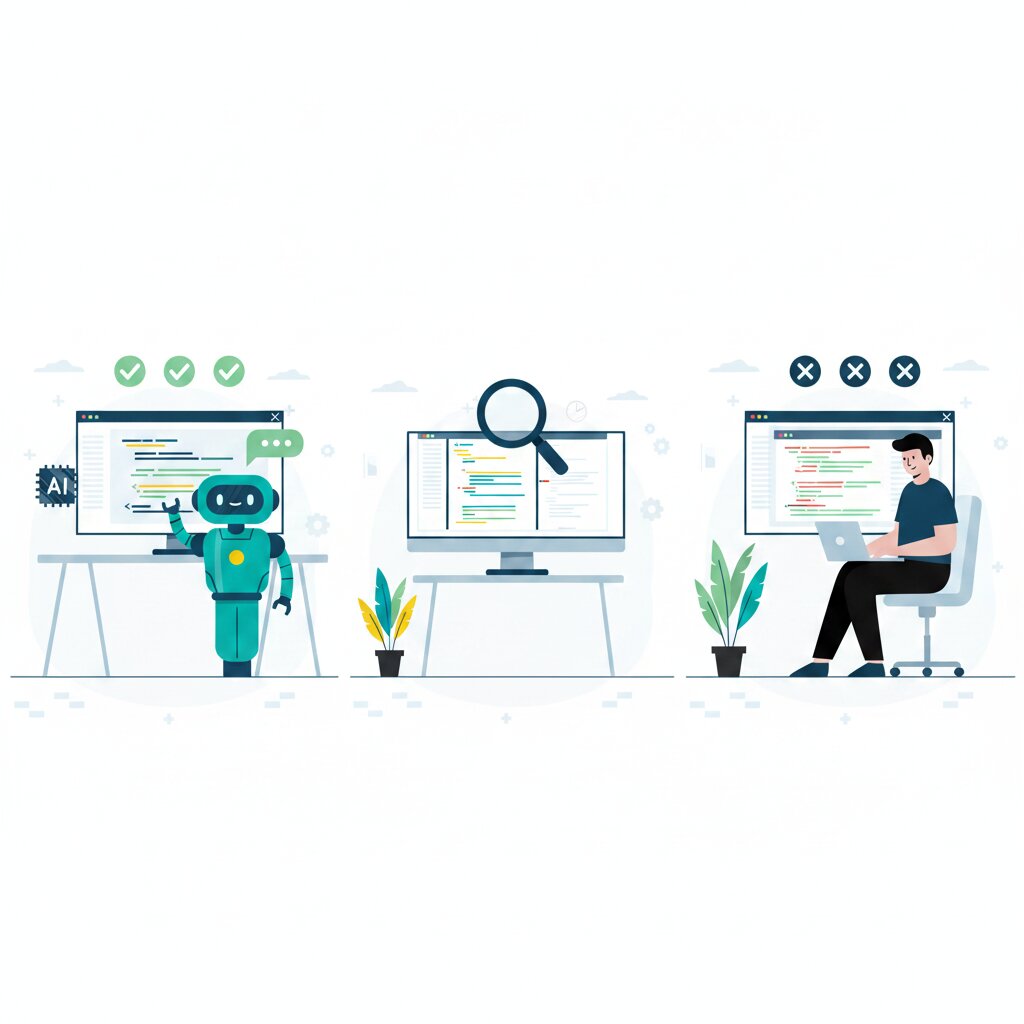

Your team has adopted an AI code review tool, or is considering one. Some developers swear by it. Others ignore every comment it makes. Nobody has data on whether it’s actually reducing production defects.
You’re not alone. Stack Overflow’s 2025 survey found 33% of developers trust AI review output while 46% distrust it. Both camps are partially right. AI catches real bugs humans miss through fatigue. AI misses real bugs humans catch through context. The question is what the boundary between them looks like, and how to build a review pipeline that respects it — a question that sits within the broader landscape of self-improving coding agents.
What Is the c-CRAB Benchmark and What Does It Tell Us About AI Code Review Quality?
The Code Review Agent Benchmark converts human review comments into executable tests. If an AI review tool can guide a coding agent to fix the code well enough to pass those tests, the review worked. It evaluates review usefulness rather than textual similarity.
The headline finding is that even the best tools collectively solve only about 40% of tasks. Claude Code leads at 32.1%, Devin Review at 24.8%, PR-Agent at 23.1%, and Codex at 20.1%. Aggregate them all and you hit that ceiling.
What the category breakdown reveals is just as instructive. AI reviews focus on robustness and testing gaps but ignore design feedback, documentation quality, and maintainability. The benchmark’s static analysis baselines confirm something worth paying attention to: SAST catches deterministic patterns (unused variables, known vulnerability signatures) AI sometimes misses, while AI catches semantic issues (logic errors, incorrect assumptions) static analysis cannot see. They’re complementary layers, not competitors.
As with any benchmark, c-CRAB inherits the representativeness and generalisability questions explored in the sibling article on why coding agent benchmarks don’t tell the full story.
AI Code Review vs. Human Code Review: How Do They Compare?
There is no direct head-to-head study measuring what human reviewers catch versus what AI misses on the same codebases. c-CRAB comes closest, but it only measures AI’s alignment with human-identified issues, not a true two-way comparison.
What humans catch that AI misses: architectural judgement (is this the right approach?), business logic correctness (does this feature implement the intended behaviour?), and tacit team conventions nobody has written down. What AI catches that humans miss: consistent enforcement of standards across every PR without fatigue, known anti-patterns (SQL injection patterns, null pointer issues, resource leaks), and gaps in test coverage on changed paths that humans overlook, especially at the volume of agent-generated PRs.
The overlap is small. The complementary coverage is large. That’s why the combination works better than either alone.
The tool landscape breaks down by architectural approach rather than feature list: PR-level review (CodeRabbit, Graphite for stacked PRs), IDE-integrated review (Augment Code with deep language server integration), security-scanning emphasis (Cycode), and agent-native review (Codegen as part of the coding agent workflow). When evaluating which fits your team, start with three questions: PR size compatibility (does it handle your typical volume without truncating context?), language coverage (more than lint-level analysis for your stack?), and CI integration depth (PR level, pre-commit hook, or IDE level?). Feature matrices beyond that are premature.
Why Does AI Code Review Miss Roughly Half of All Bugs?
The answer begins with a category distinction that predates AI code review by nearly two decades.
Gary McGraw’s 2006 taxonomy established that roughly half of software defects are implementation bugs (buffer overflows, SQL injection, null pointer issues, detectable by pattern matching) and half are design flaws (missing authorisation checks, incorrect business logic, absent trust boundaries, requiring intent knowledge to detect). Two decades of NIST SATE evaluations have confirmed this, with static analysis tools plateauing at 50 to 60% detection rates.
Andrew Stellman’s term “intent ceiling” describes exactly this boundary: structural analysis examines what code does (pattern matching, syntax checking, code smell detection, known vulnerability signatures), while intent-based analysis examines whether code does what it was meant to do, which requires a specification. AI review tools operate entirely in the structural domain.
Better models will not close this gap. It is a category boundary, not a quality problem. AI catches implementation bugs the way it catches them today, and it misses design flaws the same way it will miss them in five years.
Three predictable failure modes follow from this. Context collapse: reviewing 50 lines in isolation misses how they interact with 200 lines outside the prompt window. Assumption errors: the model shares the same blind spots that produced the bug. Novel categories: the model cannot recognise a bug pattern it was never trained on.
Does AI Code Review Actually Improve Delivery Stability?
The DORA 2025 report found something uncomfortable: a 7.2% decline in delivery stability for every 25% increase in AI adoption. Not because AI review is ineffective, but because teams install tools without restructuring their review processes.
DORA calls this the verification tax. Time saved in AI-accelerated code creation gets re-allocated to auditing and verifying AI-generated output. The METR randomised controlled trial corroborates this: experienced developers took 19% longer on tasks with AI tools despite believing they were 20% faster. The perception of speed masks the re-allocation of effort. This re-allocation pattern is one of several dynamics explored in how self-improving agents fit into the development workflow.
Most teams install AI review tools without establishing baselines, making it impossible to tell whether the tool reduces production defects or just shifts detection downstream. The metrics that matter are defect escape rate, review cycle time, and false positive rate. If defect escape rate is flat or climbing after three months, the tool is producing noise that developers have learned to filter out.
DORA recommends forcing AI-generated changes into reviewable, testable units, pushing against the natural tendency of coding agents to produce large, monolithic changesets.
Agent Self-Verification vs. Human-in-the-Loop Review
The verification tax exists because most teams have not restructured the reviewer relationship itself. The question is not whether agents can review, it’s what role they should play.
Agent self-verification catches deterministic issues: does the code compile? Do tests pass? Are there known anti-patterns? It misses novel bug patterns and assumption errors because it shares the same reasoning framework that produced the bug.
Human-in-the-loop review catches novel issues, architectural concerns, and security signals outside automated review scope. It misses volume. No human team can review every change at the pace of agent-generated code.
The synthesis is the auditor-worker architecture: a separate auditor agent reviews worker output before it reaches a human. The auditor flags exceptions based on encoded rules and learned patterns. The human reviews only those exceptions and tracks system-wide trends: false positive rate, defect escape rate, categories the auditor consistently misses. This operationalises “check the system that checks the code.”
The human role restructures from line-by-line reviewer to system auditor, monitoring the auditor’s performance and handling the exceptions automated review cannot resolve. This is an organisational change that requires deliberate process redesign, not just tool installation.
How Do You Configure AI Code Review to Reduce False Positives?
False positives are more effectively addressed through configuration than through tool selection. A healthy false positive rate sits under 20%. Above 30%, the tool creates more work than it saves. Developers stop reading AI comments entirely, including the valid ones.
The configuration levers are simple. First, scope: review only changed lines, not full files. Second, severity: suppress style nits and surface logic and security issues. Third, granularity: prefer hunk-level inline comments over PR-level summaries. The feedback loop matters more than the initial settings. Track which comment categories get dismissed most often and recalibrate monthly. The tuning takes two to three weeks of adjusting; after that the noise drops and the signal stays.
Can AI enforce team-specific conventions? Yes, but it requires prompt engineering effort: encoding team rules into the review prompt and maintaining that prompt as conventions evolve. Unwritten conventions remain invisible.
What Security Vulnerabilities Does AI Code Review Still Miss?
AI reliably catches known vulnerability signatures: SQL injection patterns, hardcoded credentials, unsafe deserialisation. Detection rates reach 89 to 96% in controlled evaluations across commercial models. These are implementation bugs in McGraw’s taxonomy.
The half of security defects that are design flaws are invisible to structural analysis. Missing authorisation checks (CWE-862), incorrect trust boundaries, privilege escalation paths, TOCTOU race conditions. You cannot detect a missing security control if you don’t know what security controls were meant to be in place.
The adversarial robustness concern is real but misunderstood. Across 14,012 evaluations, adversarial comments produced small, statistically non-significant effects on detection rates. AI reviewers are harder to fool than AI generators. The real threat is inherent model blindness to complex authorisation chains and timing attacks.
The most effective defence is SAST cross-referencing: running static analysis tools before LLM review and injecting SAST findings as verification targets into the prompt. This achieves 96.9% detection with 47% recovery of baseline misses.
Code review catches logic bugs and known vulnerability signatures, but the vulnerabilities that securing the self-improving coding agent covers (prompt injection, package namesquatting, credential leakage through agent tool use) are categories neither AI review nor traditional human review systematically address.
Where the Machine Stops and the Human Begins
The intent ceiling is not a temporary limitation. It’s the permanent boundary between what structural analysis can detect and what requires knowing what the code was meant to do. Accepting this boundary is the prerequisite to making AI code review work within the emerging practice of agent-assisted development.
The 33% who trust AI review and the 46% who distrust it are both responding to the same reality from different angles. AI catches real bugs. AI misses categories only humans can see. The resolution is not to pick a side but to build a system where each does what it can and the human audits the boundary.
The single action that matters most: establish baselines before adoption and track them monthly. Without baselines, no team can tell whether AI review is reducing production defects or just shifting noise around.
The code review pipeline is the gate where agent-generated code meets human judgement. The sibling articles on agent architecture, benchmark limitations, and security each explore a dimension of the same problem: where does the machine stop and the human begin?
Frequently Asked Questions
Can AI code review replace a senior developer review?
No. AI code review catches roughly 40% of human-identified issues, and the 60% it misses includes architectural judgement, business logic correctness, and tacit team knowledge that only an experienced developer who understands the system can evaluate. Think of AI as a mechanical filter that handles consistency enforcement and known anti-patterns before the PR reaches a human, not as a substitute for the senior reviewer who decides whether the approach is sound.
How do I get started with AI code review on my team?
Start by measuring your current baselines: defect escape rate, review cycle time, and false positive rate over a two-week period. Then configure a tool on a single repository with severity thresholds tuned to surface logic and security issues while suppressing style comments. Review the first 20 PRs manually alongside the AI output to calibrate trust before expanding to more repositories. Track dismissal patterns monthly and adjust rules accordingly.
What programming languages does AI code review work best with?
AI code review performs strongest on languages with large public training corpora (Python, JavaScript, TypeScript, Java, Go) where anti-patterns and vulnerability signatures are well represented. It performs weaker on niche or proprietary languages where training data is sparse, and on languages like C and C++ where undefined behaviour and memory safety issues require deep contextual analysis that structural review cannot fully capture. Expect lint-level coverage at minimum for any supported language.
How much does AI code review cost compared to the time it saves?
Most AI review tools price per seat or per repository, typically between $15 and $50 per developer monthly, which is a fraction of the cost of a single production incident. The real cost is the verification tax: if the tool generates a false positive rate above 30%, developers spend more time dismissing noise than they save on review. The return on investment comes from catching bugs earlier in the pipeline, where fixes cost roughly 10x less than in production.
Do AI code review tools learn from my team’s specific feedback over time?
Most tools allow you to configure rules, severity thresholds, and suppression patterns, but they do not “learn” in the sense of building a bespoke model from your team’s feedback. Unwritten conventions that nobody has documented will remain invisible to AI review regardless of how long the tool is installed. The practical approach is to encode team-specific rules into the review prompt and maintain that prompt as conventions evolve, accepting that tacit knowledge stays in the human reviewer’s domain.
Is AI code review suitable for regulated industries like finance or healthcare?
Yes, but with specific constraints. AI review works best as a first-pass filter for deterministic issues (known vulnerability signatures, compliance-relevant patterns like hardcoded credentials) with human review gating every PR. Regulated environments should also run static analysis tools alongside AI review, since SAST catches deterministic patterns that AI sometimes misses. Do not use AI review as the sole gate for compliance-critical code paths, and maintain audit trails showing human sign-off on every change.
What is the difference between a linter and an AI code reviewer?
A linter applies deterministic rules to code structure (unused variables, formatting violations, syntax errors) and produces results that are consistent and predictable. An AI code reviewer applies pattern recognition trained on large code corpora to catch semantic issues (logic errors, incorrect assumptions, missing edge cases) that linters cannot see. The two tools are complementary: linters for mechanically enforceable rules, AI review for issues requiring judgement about what the code is meant to do within its structural limits.
What happens if I disagree with an AI review comment?
Dismiss it and move on. A single dismissal is expected; a pattern of dismissals in the same category signals a configuration problem. Track which comment categories your team dismisses most often and recalibrate monthly by suppressing or reweighting those categories. The goal is not zero false positives (that would mean the tool is not surfacing enough real issues) but a dismissal rate under 20%, where most AI comments are actionable and developers trust the system enough to read them.
How do AI code review tools handle large legacy codebases?
Poorly, by default. Context window limits mean AI review on large files or PRs touching many files will miss interactions between changed and unchanged code. The most effective approach is not to feed the entire legacy codebase into the tool but to work in small batches: split large refactors into reviewable units, review only changed lines rather than full files, and accept that the tool will not understand decade-old architectural decisions that were never documented. Legacy codebases make the human reviewer’s tacit knowledge more important, not less.
Can I run multiple AI code review tools together, and should I?
You can, but it usually creates more noise than value. The c-CRAB benchmark found that even aggregating all review agents only reaches ~40% task coverage, meaning different tools flag overlapping issues rather than complementary ones. Running two tools doubles the comments a human must triage without meaningfully expanding what gets caught. The better approach is to pick one AI review tool, configure it well, and pair it with a static analysis tool rather than stacking multiple AI reviewers.