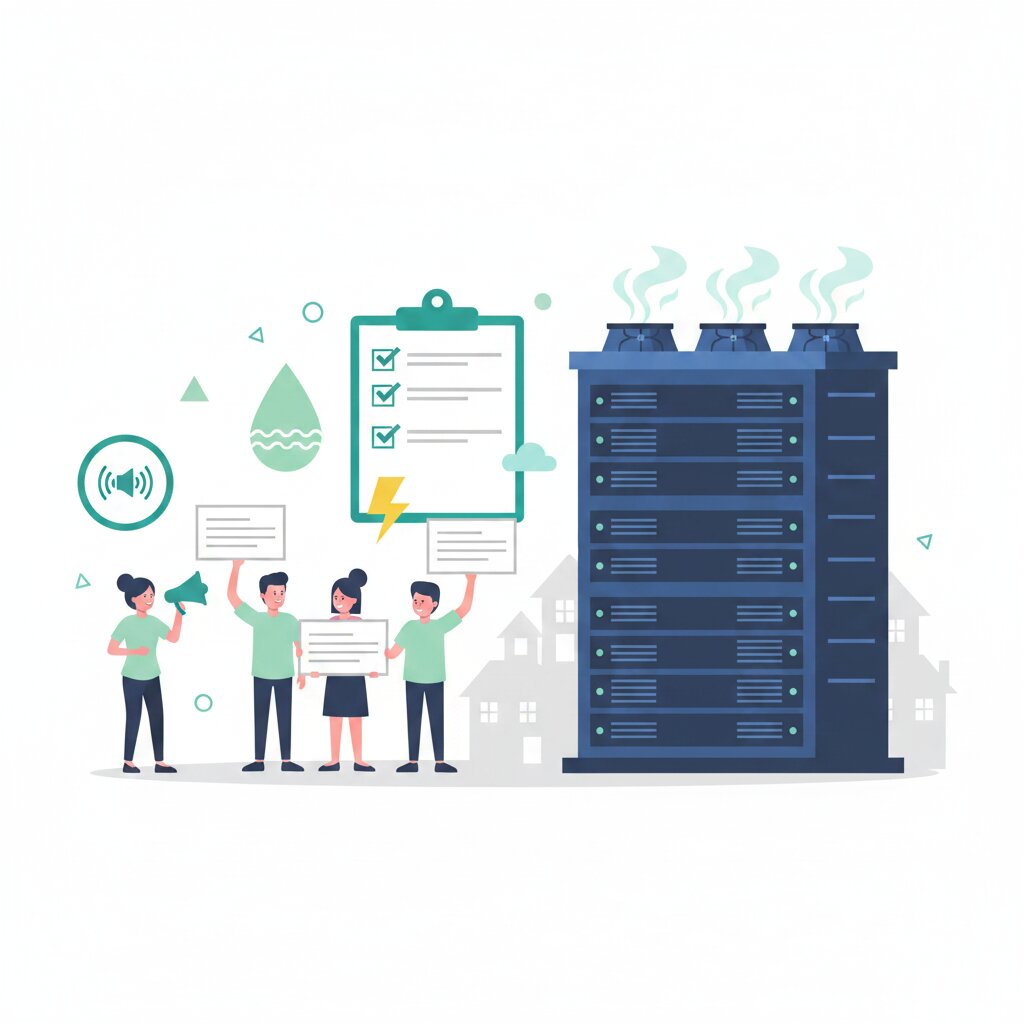

A large hyperscale data centre draws up to five million gallons of water per day — the same daily consumption as a town of 50,000 people. Its cooling systems run non-stop and emit up to 70 dB at 400 feet. When it hooks up to the regional grid, the transmission upgrades it needs get spread across every household in the same zone — whether those households see any benefit or not.
Water draw volumes, decibel readings, and grid load calculations. Those three things are the quantified grievances behind Nixon Peabody‘s documented count of 140+ community opposition groups and $60 billion in blocked investment since early 2025. This article is part of the data center community revolt reshaping infrastructure planning, and it documents those impacts with source-verified numbers.
Why Are These Three Grievances at the Core of Community Opposition?
Water depletion, continuous noise, and rising electricity bills are what turn passive concern into organised legal action. They’re measurable, they’re continuous, and they affect residents who get nothing in return. They also generate bipartisan opposition — water depletion alarms rural conservatives, noise disrupts suburban homeowners, and ratepayer cost-shifting has triggered Republican- and Democrat-sponsored legislation in the same state sessions.
Between April and June 2025 alone, Data Center Watch counted 20 proposals worth $98 billion blocked or delayed by local opposition — two-thirds of all projects tracked in that period. That marks the end of the “energy-first” era across the data center community revolt. The Power-Plus-Permission model (Nixon Peabody, 2026) replaces it: power access is necessary, but it’s no longer enough.
💡 Social licence to operate is the combination of community trust, transparent operations, and legislative durability that a facility must maintain alongside its formal permits — without it, approved projects face injunctions, moratoriums, and ballot measures even after construction begins.
How Much Water Does a Hyperscale Data Centre Actually Use?
A typical mid-sized data centre uses around 300,000 gallons of water per day — roughly equivalent to 1,000 households. A large hyperscale facility can draw up to five million gallons per day. That gap comes down to cooling technology choice more than anything else.
In Northern Virginia alone, data centre water consumption hit close to two billion gallons in 2023 — a 63% increase from 2019 — with Loudoun County accounting for around 900 million of those gallons. Approximately 80% of the water withdrawn evaporates through cooling towers rather than being recycled. The standard efficiency metric is Water Usage Effectiveness (WUE) — litres of water consumed per kilowatt-hour of IT energy. The industry average sits at 1.9 L/kWh.
Two-thirds of all US data centres under development since 2022 are in water-stressed areas (World Resources Institute). In western states under prior appropriation water law — Colorado, Nevada, and Arizona — the newest users face curtailment during drought. Florida has moved most directly: demonstrated water access is now a gating prerequisite for new projects there.
What Cooling Technology Choices Determine How Much Water a Data Centre Uses?
The cooling system a facility uses is the single most important variable in determining its water footprint. It should be the first question you ask any vendor.
Evaporative (open-loop) cooling is the most common type. Around 80% of withdrawn water evaporates, and cooling towers emit up to 70 dBA within 400 feet — the highest-water and highest-noise option of the lot. Closed-loop cooling recirculates water internally, cutting freshwater use by up to 70%. Immersion cooling submerges servers in synthetic dielectric fluid, reducing water consumption by 90% or more and eliminating cooling towers entirely. Air cooling uses near-zero water but only works in cooler, drier climates.
The Lancaster, Pennsylvania CBA caps water use at 20,000 gallons per day. The El Paso, Texas Meta CBA specifies closed-loop cooling starting at 750,000 gallons per day. When you’re evaluating co-location providers, ask for the WUE figure upfront — it’s the most direct proxy for cooling technology choice.
How Loud Are Data Centres — and What Do Neighbouring Communities Actually Hear?
Cooling systems generate up to 70 dBA within 400 feet, continuously, every day of the year. Backup diesel generators hit up to 105 dB during testing or emergencies. Residents in Prince William County, Virginia routinely report noise exceeding 60 dB.
Three sources explain that range:
1. HVAC and cooling systems produce a continuous 24/7 hum — consistently the primary community complaint, not because it’s the loudest source, but because it never stops.
2. Backup diesel generators are tested monthly and can run without a federally enforced time limit during emergencies. Larger industrial units approach 105 dB.
3. Behind-the-meter (BTM) gas turbines are a growing category that deserves its own attention.
💡 Behind-the-meter (BTM) generation means a data centre generates its own power on-site — through diesel generators, gas turbines, or batteries — independently of the utility grid. Unlike backup generators, BTM turbines run 24 hours a day.
Forty-six planned or permitted US data centres will use off-grid gas turbines. xAI‘s Memphis Colossus operates 30+ natural gas turbines daily; local residents and the NAACP filed a Clean Air Act notice of intent to sue. Virginia JLARC’s 2024 report found nearly one-third of Virginia’s data centres sit within 200 feet of residentially zoned properties. And because the EPA defunded its Office of Noise Abatement and Control in 1981, federal noise standards for data centres simply don’t exist.
Are Data Centres Raising Local Electricity Bills?
Yes — in regions where large loads connect without bearing the full cost of the infrastructure upgrades they require. In 2025, Americans paid approximately $60 billion more in electricity costs nationwide compared to 2024 (WRI), with data centre load growth a documented contributor in the Mid-Atlantic region.
When a facility drawing 20 megawatts or more connects to the grid, transmission lines, substations, and capacity reserves need upgrading. By default, those costs get distributed across all existing ratepayers.
💡 PJM Interconnection is the regional transmission organisation that coordinates wholesale electricity across 13 Mid-Atlantic and Midwest states — it determines whether a new large load pays for its own infrastructure upgrades or distributes those costs across existing customers.
US summer peak demand is expected to rise 24% in the next 10 years, with data centres accounting for the majority of that increase (NERC Level 3 Alert, May 4, 2026). By 2030, data centre demand could hit 90 GW — nine times New York City’s peak summer demand.
AEP Ohio now requires data centres to pay for at least 85% of subscribed energy capacity regardless of actual use. FERC‘s docket RM26-4-000 is expected to finalise uniform rules for large electrical loads (≥20 MW) by end of June 2026. The White House Ratepayer Protection Pledge (March 4, 2026) commits Amazon, Google, Meta, Microsoft, OpenAI, Oracle, and xAI to build or buy their own generation and pay for delivery upgrades — voluntary today, but the same language is now showing up in 18+ state bills.
What Is a Social Licence to Operate and Why Does It Now Matter for Data Centre Projects?
Social licence to operate is Nixon Peabody’s term for the community approval now required alongside grid access as a practical prerequisite for permitting. It’s not a legal document — it’s a combination of five commitments:
- Legislative durability: Approvals won’t be reversed by the next council or session.
- Ratepayer-protection commitments: The facility isn’t shifting grid costs to residential customers.
- Transparent operations: The community can verify what the facility is doing — relevant when NDAs prevent communities from evaluating these impacts.
- Reliable utility relationships: The grid operator and developer are aligned.
- Earned community acceptance: Active opposition groups aren’t organising or litigating.
The consequences of getting this wrong: 300+ bills in 30+ states; 12+ moratorium proposals; 140+ local groups blocking approximately $60 billion. In Menomonie, Wisconsin, community opposition led the city council to block a $1.6 billion project outright. As Nixon Peabody puts it — “Don’t mistake silence for safety.”
What Is a Community Benefit Agreement and What Does It Actually Contain?
A Community Benefit Agreement (CBA) is a formal, legally binding contract between a data centre developer and a host community. Unlike NDAs, CBAs must be publicly available. Nixon Peabody describes them as “permitting prerequisites” in jurisdictions with active opposition — not optional goodwill gestures.
Standard CBA coverage includes job creation targets with wage floors, water usage caps, noise limits, clean energy commitments, a public dashboard, and exit fees. Proposed fines run up to $50,000 per day for wilful violations.
Four verified examples: Lancaster, Pennsylvania (Chirisa / CoreWeave) caps water at 20,000 gallons per day with $20 million in community commitments. Cedar Rapids, Iowa (Google + QTS) delivers a 70% tax exemption tied to job thresholds. West Des Moines, Iowa (Microsoft) commits to 100% renewable energy and $2 billion-plus in projected tax revenues. El Paso, Texas (Meta) specifies closed-loop cooling and 80% property tax abatement over 35 years.
Some CBAs are, as Brookings puts it, “heavily redacted such that key sections are hidden.” That changes after September 30, 2026, when the EIA mandatory survey makes energy, cooling, and BTM generation data public for the first time.
What Does This Mean for Evaluating a Cloud Provider’s Regional Credibility?
The three footprints documented in this article — water, noise, and grid cost-shifting — determine whether a hyperscaler’s regional capacity plans will actually proceed on schedule. Ask about each of them directly before signing any long-term contracts.
Vendor Evaluation Checklist (10 Questions)
- Does the facility use evaporative, closed-loop, or immersion cooling?
- What is the facility’s daily water consumption in gallons, and from what source? Is the source water-stressed?
- What is the facility’s Water Usage Effectiveness (WUE) score? (Industry average: 1.9 L/kWh.)
- Does the facility have a drought contingency plan that triggers operational changes before community conflict arises?
- What is the facility’s measured noise level at the fence line in dBA? Is it within 200 feet of residential zoning?
- Does the facility use behind-the-meter gas turbines? (If yes: continuous 24/7 noise, not emergency-only.)
- Has the operator signed a Community Benefit Agreement? Is it publicly available and unredacted?
- Is the facility in a state with active moratorium legislation or known opposition group activity?
- Has the operator signed the White House Ratepayer Protection Pledge (March 4, 2026)?
- Is the facility prepared for EIA mandatory reporting requirements effective after September 30, 2026?
Nixon Peabody maps all 50 states into four risk tiers — moratoria/bans, regulated growth, tax incentives under fire, and pro-growth — with Virginia, Michigan, Minnesota, and Wisconsin in the highest-risk tier.
Until September 30, 2026, direct questions are the only proxy for facility-level data. After that date, the EIA mandatory survey makes water consumption, BTM generation, and cooling efficiency metrics matters of public record. For the due diligence questions to ask cloud providers about site operations, continue to the CTO Guide.
Frequently Asked Questions
What is the average water usage of a data centre per day?
A typical mid-sized facility uses around 300,000 gallons per day. A large hyperscale facility can draw up to five million gallons per day. The industry average WUE is 1.9 litres per kWh; facilities using closed-loop or immersion cooling score significantly lower.
How much electricity does a hyperscale data centre use?
Data centres could represent up to 12% of all US electricity consumption by 2028 (Lawrence Berkeley National Laboratory). By 2030, data centre demand may reach 90 GW — nine times New York City’s peak summer demand.
Why can’t data centre noise be simply regulated away?
The EPA defunded its Office of Noise Abatement and Control in 1981, and federal noise standards for data centres don’t exist. Local zoning designed for occasional industrial activity is poorly suited to continuous 24/7 low-frequency hum, and multi-frequency noise makes standard decibel-meter enforcement difficult.
What is a Water Usage Effectiveness (WUE) score and how do I evaluate it?
WUE measures litres of water consumed per kilowatt-hour of IT energy. The industry average is 1.9 L/kWh; the ideal score is 0 (fully air-cooled systems). Request the facility WUE from co-location providers as standard due diligence before committing to a contract.
What is behind-the-meter (BTM) generation and how does it affect communities?
BTM generation means a data centre generates its own power on-site, independently of the utility grid. Generators and turbines that run continuously produce 24/7 noise rather than occasional emergency operation. The EIA mandatory survey will capture BTM generation data for the first time after September 2026.
Are data centres in water-stressed areas at operational risk?
Yes. Two-thirds of US data centres under development since 2022 are in water-stressed areas (WRI). In western states under prior appropriation water law — Colorado, Nevada, and Arizona — the newest users face curtailment during drought and cannot guarantee long-term access.
What happened in Virginia with data centre noise complaints?
Nearly one-third of Virginia’s data centres sit within 200 feet of residentially zoned properties (Virginia JLARC 2024 report); some are within 50 feet of homes. Prince William County residents routinely report noise above 60 dB, and Amazon has been retrofitting acoustical shrouds at some Northern Virginia facilities in response.
What is the NERC Level 3 Alert and what does it mean for cloud infrastructure reliability?
NERC issued a Level 3 Essential Action Alert on May 4, 2026 — its highest designation — in response to data centres dropping load or oscillating demand rapidly, creating grid reliability risks. Seven mandatory actions are required by August 3, 2026, with NERC CLE Compliance expected to become enforceable for in-scope data centres by 2027.
What will the EIA mandatory energy survey require data centres to disclose?
After September 30, 2026, the EIA’s mandatory nationwide survey will require data centres to report grid-supplied electricity, behind-the-meter generation, cooling efficiency metrics, and IT specifications — making previously proprietary operational data matters of public record for the first time.
How does the White House Ratepayer Protection Pledge affect my cloud provider?
Amazon, Google, Meta, Microsoft, OpenAI, Oracle, and xAI signed the voluntary pledge on March 4, 2026, committing to build or buy their own generation, pay for delivery upgrades, and negotiate separate rate structures. Voluntary today — but its vocabulary now appears in 18+ state bills.
Can a community legally stop a data centre from being built?
Yes: through local zoning denials (upheld by the Virginia Court of Appeals in the QTS Digital Gateway case); moratoriums (adopted by 12+ jurisdictions); ballot measures (Ohio residents are pursuing a permanent ban); and community litigation. In Menomonie, Wisconsin, the city council blocked a $1.6 billion project outright.
What is the difference between rural and suburban data centre opposition?
Rural opposition is often more intense — loss of farmland, groundwater depletion, a fundamental change in community character, and less organisational capacity to negotiate CBA terms. Suburban communities have more resources to mount legal challenges but face greater pressure to accept economic development arguments.