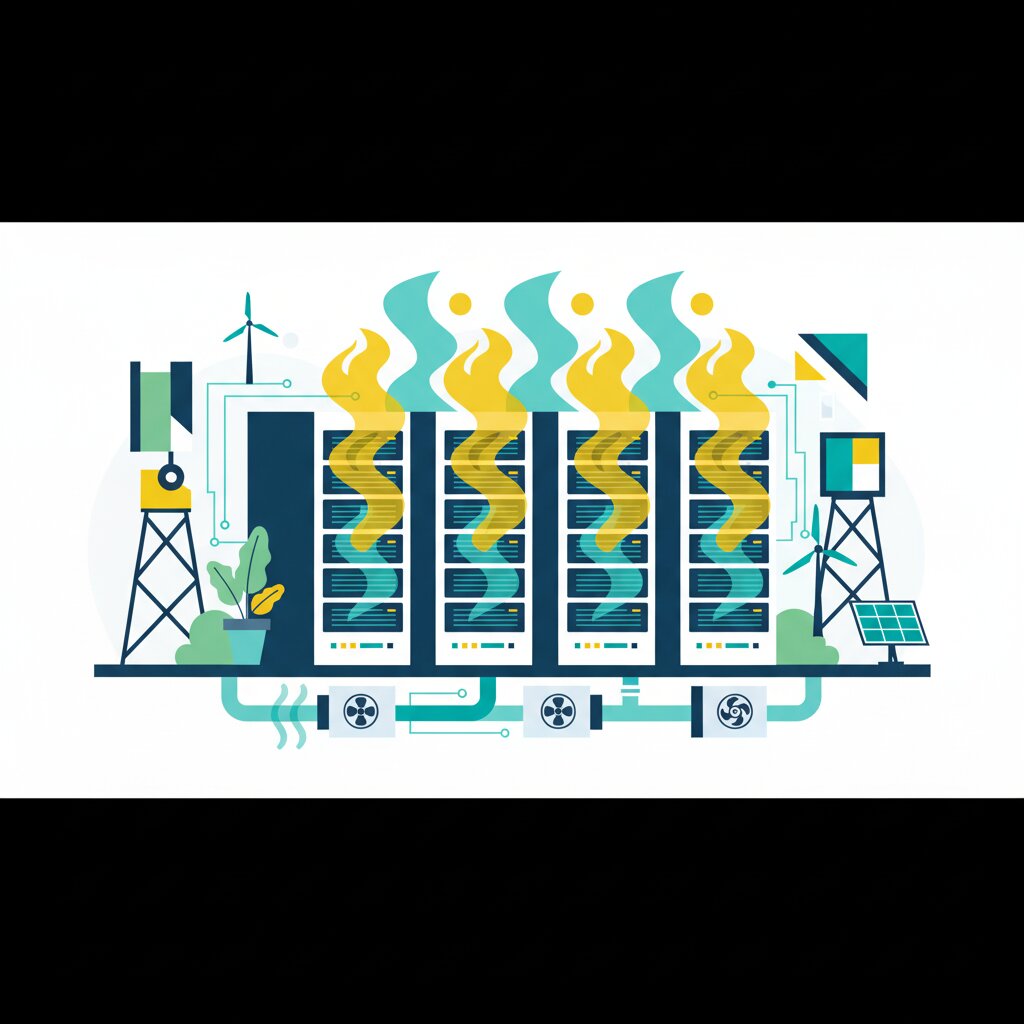
AI infrastructure is transforming our electrical grid and environmental landscape rapidly. Understanding these changes matters if you’re making infrastructure decisions that balance innovation with sustainability.
This hub provides comprehensive context on AI data centre energy consumption, water usage, carbon emissions, and the solutions being pursued by industry leaders. Whether you’re evaluating cloud providers, planning AI workloads, or responding to stakeholder pressure on sustainability, this guide equips you with the framework, metrics, and strategic context needed for informed decisions.
Explore eight key questions covering the scale of energy consumption, environmental impacts, infrastructure constraints, and emerging solutions. Each section links to detailed cluster articles for deeper technical analysis:
- How AI Data Centres Are Stressing Power Grids and Creating Infrastructure Bottlenecks – Regional grid impacts and capacity constraints
- The Hidden Environmental Footprint of AI Including Water Consumption and Carbon Emissions – Water demands and cooling technologies
- How Tech Giants Are Pursuing Nuclear and Renewable Energy to Power AI Infrastructure – Energy solutions and industry response
- Reducing AI Infrastructure Energy Consumption Through Cloud Optimisation and Efficiency Strategies – Practical implementation guidance
How Much Energy Do AI Data Centres Actually Consume?
U.S. data centres consumed 183 terawatt-hours (TWh) of electricity in 2024, representing 4.4% of total U.S. electricity consumption. The International Energy Agency projects this could grow to 426 TWh by 2030—a 133% increase driven primarily by AI workload expansion. To put this in perspective, a single large hyperscale AI data centre consumes enough electricity to power approximately 100,000 households, with the largest facilities approaching the energy demands of entire cities.
AI workloads consume 10-20 times more energy per square foot than traditional data centres due to GPU-intensive computing requirements. Training large language models like GPT-4 can require petaflop-days of computation, consuming megawatt-hours of electricity for a single training run. Most of the electricity used by data centres—about 60% on average—powers the servers that process and store digital information, with cooling systems accounting for 7% at efficient hyperscalers to over 30% at less efficient enterprise facilities.
The growth trajectory varies significantly by projection methodology. The IEA’s base case forecasts 426 TWh by 2030, while more aggressive scenarios accounting for rapid AI adoption suggest consumption could reach 9% of U.S. electricity by decade’s end.
Geographic concentration amplifies regional impacts. Northern Virginia, the world’s largest data centre market with 643 facilities, now dedicates 26% of regional electricity to data centre operations according to the Electric Power Research Institute—creating significant strain on local power infrastructure. Over the past year, residential power prices increased more than the national average in 8 of the 9 top data centre markets, showing how concentrated demand affects local economies.
Detailed regional impact analysis: How AI Data Centres Are Stressing Power Grids and Creating Infrastructure Bottlenecks
Why Are AI Workloads So Energy-Intensive Compared to Traditional Computing?
AI workloads are fundamentally more energy-intensive because they rely on graphics processing units (GPUs) that consume two to four times more power than traditional CPUs while running at near-constant 100% utilisation. Unlike traditional applications with variable compute patterns and idle periods, AI model training and inference operations maintain continuous high-intensity processing, transforming data centres into facilities requiring power densities exceeding 125 kilowatts per server rack compared to 6-10 kW for conventional enterprise workloads.
GPU architecture prioritises parallel processing over energy efficiency. Advanced servers at AI-optimised hyperscale data centres are equipped with GPUs that can perform trillions of mathematical calculations per second. Training large language models involves thousands of GPUs running continuously for months, leading to massive electricity consumption. Each training session can take weeks or months consuming enormous amounts of power.
AI workloads have two distinct energy profiles: training (one-time but extremely intensive) and inference (lower per-query but scales with usage). A single training run for a large language model might consume 1,000 megawatt-hours, while inference operations for deployed models collectively represent the growing share of operational energy consumption as AI adoption increases.
Doubling the amount of energy used by the GPU gives an approximate estimate of the entire operation’s energy demands when accounting for CPUs, fans, and other equipment. This rough estimate, while useful for planning, may underestimate modern AI facilities where cooling can represent 30-40% of total load for dense GPU clusters, or overestimate for highly efficient liquid-cooled deployments. The smallest Llama model (Llama 3.1 8B with 8 billion parameters) required about 57 joules per response, or an estimated 114 joules when accounting for cooling, other computations, and other demands. Comprehensive methodology estimates show a median Gemini text prompt uses 0.24 Wh of energy, 0.03 gCO2e, and 0.26 mL of water when accounting for all critical elements.
High-bandwidth memory and advanced interconnects required for AI accelerators introduce additional power overhead. Memory systems, networking, and thermal management collectively contribute 40-50% of total system power beyond the GPUs themselves. Only a handful of organisations such as Google, Microsoft, and Amazon can afford to train large-scale models due to the immense costs associated with hardware, electricity, cooling, and maintenance.
Deep dive into technical infrastructure: Understanding GPU energy requirements and data centre design implications
What Is the Environmental Footprint Beyond Electricity Consumption?
Beyond electricity, AI data centres have substantial water and carbon footprints often overlooked in sustainability discussions. A typical mid-sized data centre consumes approximately 300,000 gallons of water daily for cooling—equivalent to 1,000 households—while large AI facilities can require up to 5 million gallons daily (equivalent to a 50,000-person town). The carbon footprint extends beyond operational emissions to include embodied carbon from manufacturing GPUs and constructing facilities, which can represent 30-50% of total lifecycle emissions.
Hyperscale data centres alone are expected to consume between 16 billion and 33 billion gallons of water annually by 2028. Projections show water used for cooling may increase by 870% in the coming years as more facilities come online.
Water consumption has two components: direct onsite use for evaporative cooling systems and indirect consumption by power plants generating electricity for data centres. Berkeley Lab research indicates indirect water use from electricity generation typically accounts for 80% or more of total water footprint—roughly 1.2 gallons consumed per kilowatt-hour generated. Approximately 80% of the water (typically freshwater) withdrawn by data centres evaporates, with the remaining water discharged to municipal wastewater facilities.
Bloomberg research reveals that two-thirds of U.S. data centres built since 2022 are located in high water-stress regions, creating tension with residential water supplies during peak summer demand. Arizona data centres, for example, use nearly double their average water consumption during summer months when cooling demands peak and local water supplies are most constrained. The World Resources Institute forecasts that about one-third of data centres globally are now located in areas with high or extremely high levels of water stress.
By 2030, the current rate of AI growth would annually put 24 to 44 million metric tons of carbon dioxide into the atmosphere, the emissions equivalent of adding 5 to 10 million cars to U.S. roadways. AI expansion would drain 731 to 1,125 million cubic metres of water per year by 2030, equal to the annual household water usage of 6 to 10 million Americans. Carbon emissions from AI infrastructure include operational emissions (electricity generation), embodied carbon (GPU manufacturing, rare earth element mining), and end-of-life impacts (e-waste from 3-5 year server lifecycles).
Comprehensive environmental analysis: The Hidden Environmental Footprint of AI Including Water Consumption and Carbon Emissions
How Are Data Centres Stressing Regional Power Grids?
Data centre concentration in specific regions is creating substantial strain on local power grids. AI data centres uniquely challenge grid operations because they can create large, concentrated clusters of 24/7 power demand. Grid stress was the leading challenge for data centre infrastructure development, with 79% of respondents saying that AI will increase power demand through 2035 due to widespread adoption. There’s currently a seven-year wait on some requests for connection to the grid.
Geographic clustering creates localised grid stress disproportionate to national averages. Northern Virginia’s “Data Centre Alley” in Loudoun County hosts the world’s highest concentration of data centre capacity, requiring utilities to expedite substation upgrades, transmission line reinforcement, and new interconnection points at accelerating pace and increasing cost. The concentration of data centres primarily in Loudoun County represents a complex challenge where current power constraints often arise due to transmission and distribution limitations rather than a lack of power generation capabilities.
Last summer, Northern Virginia narrowly avoided widespread blackouts when 60 data centres simultaneously switched to backup power in response to a grid equipment fault. Electric transmission constraints are creating significant delays for grid connections. In Ireland (the second largest data centre market in Europe), data centres account for about 21 percent of electricity demand, with EirGrid having a de facto moratorium on new data centres since 2022.
Grid capacity constraints are emerging as genuine bottlenecks to AI expansion. Industry leaders including SK Group have publicly warned that physical infrastructure limitations—not chip availability or capital—may become the binding constraint on AI scaling by 2026-2027. Utilities report 5-7 year lead times for major transmission upgrades, creating planning challenges for companies needing capacity within 18-24 months.
Peak demand is spiking as base load generation capacity contracts, while new generation projects are stuck in increasingly long interconnection queues, 95% of which consist of renewables and storage. The forecast ranges for AI data centre demand vary widely, complicating efforts to build new generation while insulating residential customers from rate increases.
Detailed grid impact analysis: How AI Data Centres Are Stressing Power Grids and Creating Infrastructure Bottlenecks
What Cooling Technologies Do Data Centres Use and How Do They Compare?
Data centres employ three primary cooling approaches—air cooling (traditional), liquid cooling (direct-to-chip), and immersion cooling (component submersion)—each representing different trade-offs between capital cost, energy efficiency, and water consumption. Air cooling with evaporative systems consumes the most water (45-60% of withdrawn water evaporated) but has lowest upfront cost. Liquid cooling improves energy efficiency by 50-70% and enables higher rack densities required for AI workloads, while immersion cooling eliminates water consumption entirely but carries the highest initial investment and operational complexity.
Air cooling remains the most common method, though its water-intensive evaporative approach is giving way to liquid cooling for AI workloads.
The shift from air to liquid cooling is being driven by AI workload density requirements, not just efficiency gains. When server racks exceed 40-50 kilowatts of power density, air cooling becomes physically impractical—airflow cannot remove heat fast enough without excessive fan power and facility design compromises. Most AI-specific data centres now deploy hybrid approaches: air cooling for general infrastructure, liquid cooling for GPU clusters.
Direct-to-chip liquid cooling and immersive liquid cooling are two standard server liquid cooling technologies that dissipate heat while significantly reducing water consumption. Liquid cooling systems utilise a coolant which absorbs heat more efficiently than air and is especially prevalent in high-performance computing. Water-cooled data centres consume less electricity than air-cooled data centres.
Immersion cooling involves bathing servers, chips, and other components in a specialised dielectric (non-conductive) fluid. This approach can eliminate 100% of direct water consumption while enabling rack densities exceeding 125 kilowatts—more than double what liquid cooling achieves. However, immersion cooling entails higher upfront costs than conventional direct liquid cooling but provides significant energy savings and space-optimisation benefits for data centre developers.
Closed-loop water systems represent an intermediate solution, recirculating coolant to reduce freshwater consumption by up to 70% compared to traditional evaporative cooling. Closed-loop cooling systems enable the reuse of both recycled wastewater and freshwater, allowing water supplies to be used multiple times. Google, Microsoft, and Amazon have committed to closed-loop designs for new facilities, though retrofitting existing infrastructure remains challenging and expensive.
In water-stressed regions, the priority should be low- to zero-water cooling systems to reduce direct use, while investing to add renewable energy to local grids to curb indirect water use. In wetter regions with carbon-intensive grids, priority should be given to reducing power use to lower overall water consumption, even if that means continued use of evaporative cooling with its higher onsite water consumption.
While cooling innovations address operational efficiency, they don’t solve the fundamental challenge of energy sourcing—which is where tech giants are making their most dramatic strategic shifts.
Technology comparison and selection guidance: The Hidden Environmental Footprint of AI Including Water Consumption and Carbon Emissions
Implementation strategies: Reducing AI Infrastructure Energy Consumption Through Cloud Optimisation and Efficiency Strategies
What Energy Solutions Are Tech Companies Pursuing?
Tech giants are pursuing three parallel energy strategies: nuclear power agreements (both existing plant restarts and Small Modular Reactor development), massive renewable energy Power Purchase Agreements, and emerging technologies like power-flexible AI factories that adjust computing workloads based on grid conditions. These investments reflect recognition that sustainable AI scaling requires dedicated clean energy sources beyond grid-supplied electricity, with nuclear providing baseload reliability that intermittent renewables alone cannot deliver.
Amazon, Microsoft, Meta, and Google are the four largest purchasers of corporate renewable energy power purchase agreements (PPAs), having contracted over 50GW, equal to the generation capacity of Sweden. As of 2024, natural gas supplied over 40% of electricity for U.S. data centres. Renewables such as wind and solar supplied about 24% of electricity at data centres, while nuclear power supplied around 20% and coal around 15%.
Nuclear power is gaining renewed attention as a reliable, low-carbon source of always-on electricity that could help balance intermittent renewables. Data centre operators are exploring the potential to site facilities near existing nuclear plants. Tech companies’ insatiable power demands, net-zero commitments by 2030-2040, and grid infrastructure limitations create a perfect storm favouring nuclear solutions.
Small Modular Reactors (SMRs) offering 50-300 megawatts of dedicated generation are attracting significant investment despite unproven commercial viability. These units promise faster deployment (36-48 months versus 10+ years for traditional nuclear), lower capital costs through factory production, and the ability to co-locate directly with data centres, eliminating transmission losses and enabling waste heat utilisation. Government support exceeding $5.5 billion in the United States alone, matched by billions in private investment, provides the capital needed to overcome initial deployment hurdles for Small Modular Reactors.
The sheer scale of electricity demand accelerated by AI infrastructure exceeds what any single generation type can provide within required timeframes, requiring bringing more energy online, optimising how we use it, and advancing innovative energy solutions. Power Purchase Agreements for renewable energy have become standard procurement mechanisms, but physical electricity delivery remains constrained by grid interconnection. Companies increasingly acknowledge that contracted renewable energy often cannot flow directly to data centres, raising questions about the accuracy of carbon-neutrality claims when facilities draw from grids still heavily reliant on fossil generation during peak periods or when renewable sources are unavailable.
Alphabet is developing demand response methods which allow reduced data centre power demand during periods of grid stress by shifting non-urgent computing tasks to an alternative time and location. The emergence of DeepSeek, a highly efficient AI model, highlights a new path forward: prioritising software and system-level optimisations to reduce energy consumption, achieving competitive performance with a fraction of the energy use. AI tools now predict cooling needs, optimise workload scheduling, and identify efficiency opportunities across infrastructure.
Complete solution landscape: How Tech Giants Are Pursuing Nuclear and Renewable Energy to Power AI Infrastructure
How Can Organisations Evaluate and Reduce Their AI Energy Footprint?
Organisations can evaluate their AI energy footprint by measuring three dimensions—infrastructure efficiency (Power Usage Effectiveness/PUE), workload efficiency (energy per inference or training task), and carbon intensity (emissions per kilowatt-hour based on energy sourcing). Reduction strategies span infrastructure selection (choosing cloud providers with low PUE and clean energy), workload optimisation (model efficiency techniques like quantisation and pruning, carbon-aware scheduling), and architectural decisions (edge computing for latency-sensitive inference, batch processing for non-urgent training). Effective approaches balance sustainability goals with performance requirements and cost constraints.
Infrastructure efficiency measurement begins with Power Usage Effectiveness (PUE), the ratio of total facility energy to IT equipment energy. While industry-leading hyperscale facilities achieve PUE values of 1.1-1.2 (meaning only 10-20% overhead), traditional enterprise data centres often operate at 1.6-1.8. However, PUE alone is insufficient for AI workloads—measuring energy per inference or per training epoch provides more relevant efficiency signals for algorithmic and architectural optimisation.
Traditional metrics for data centre efficiency like power usage effectiveness (PUE) are insufficient for measuring AI workloads as they do not account for energy efficiency at the intersection of the software, hardware, and system levels. New AI-specific metrics such as energy per AI task and grid-aware computing must be developed to ensure that AI data centres optimise energy consumption across all levels of operation.
Workload optimisation offers the highest leverage for most organisations. Model efficiency techniques including quantisation (reducing numerical precision), pruning (removing unnecessary parameters), and distillation (training smaller models from larger ones) can reduce energy consumption by 40-70% with minimal accuracy degradation. DeepSeek‘s recent demonstration of achieving competitive performance with a fraction of typical energy consumption illustrates the potential of software optimisation over hardware scaling.
Leveraging energy-efficient cloud computing generally improves datacentre energy efficiency compared to on-premise solutions due to custom warehouses designed for better PUE and carbon-free energy (CFE). Cloud platforms such as Google Cloud Platform (GCP) and Amazon Web Services (AWS) enable sustainability in AI workloads by offering tools to minimise carbon footprints. GCP allows users to select low-carbon regions based on metrics like CFE percentage and grid carbon intensity, with regions like Montréal and Finland achieving near 100% CFE.
AWS reduces the carbon footprint of AI workloads by optimising infrastructure, transitioning to renewable energy, and leveraging purpose-built silicon chips, achieving up to 99% carbon reductions compared to on-premises setups. Many engineers and organisations overlook the CFE or PUE metrics cloud platforms provide while choosing regions, often prioritising performance, cost, and meeting business metrics over sustainability.
Carbon-aware computing, which shifts workloads geographically or temporally to periods of cleaner grid energy, provides environmental benefits without efficiency compromises. This approach requires flexible workload scheduling—feasible for training jobs and batch inference, less practical for real-time customer-facing applications. Cloud providers increasingly offer carbon-aware scheduling tools, though adoption requires engineering integration and acceptance of potential delays. Non-urgent tasks can be scheduled during periods of renewable energy abundance or lower utility rates, reducing both costs and emissions.
AI tools like MLCarbon address the gap in preemptive evaluation of environmental impact during the ML model selection phase by allowing engineers to estimate the carbon footprint of different model architectures and hardware configurations before model development. To further reduce emissions and enhance sustainability in machine learning, a holistic approach that combines thoughtful model selection, continuous model optimisation, and the strategic use of energy-efficient cloud computing is crucial.
Decision framework and implementation guide: Reducing AI Infrastructure Energy Consumption Through Cloud Optimisation and Efficiency Strategies
Measurement methodologies: The Hidden Environmental Footprint of AI Including Water Consumption and Carbon Emissions
What Metrics Should Technology Leaders Track for AI Infrastructure Sustainability?
You should track five critical metrics: Power Usage Effectiveness (PUE) for facility efficiency, Water Usage Effectiveness (WUE) for cooling impact, carbon intensity of electricity sources (grams CO2 per kWh), energy per AI task for workload efficiency, and total cost of ownership including energy expenses. These metrics collectively provide visibility into operational efficiency, environmental impact, and economic sustainability. Effective tracking requires establishing baselines, setting improvement targets, and integrating sustainability metrics into infrastructure selection and vendor evaluation processes alongside traditional performance and cost criteria.
Power Usage Effectiveness (PUE) is a metric used to determine data centre energy efficiency, calculated as Total Facility Energy divided by IT Equipment Energy. A PUE value closer to 1 indicates higher efficiency.
PUE measurement, while standardised by The Green Grid, requires careful interpretation. A facility in a cool climate with abundant renewable energy and 1.4 PUE may have lower environmental impact than a facility in a hot climate with 1.2 PUE powered by fossil fuels. Context matters—geographic location, energy sourcing, and workload characteristics all influence the meaningfulness of efficiency metrics. Beyond PUE, data centres also monitor other energy metrics to provide a comprehensive view of efficiency and to identify areas for improvement.
Energy per AI task represents an emerging metric more relevant than facility-level PUE for comparing model architectures and deployment approaches. Measuring kilowatt-hours per thousand inferences, per training epoch, or per user session enables apples-to-apples comparisons across different infrastructure choices. The CTO Advisor research on hidden GPU operational costs highlights that energy expenses often exceed hardware depreciation for continuously-operated AI infrastructure.
Carbon accounting methodology significantly affects reported sustainability performance. Scope 2 emissions (purchased electricity) are straightforward but incomplete. Scope 3 accounting for embodied carbon in manufacturing, construction, and end-of-life disposal typically adds 30-50% to total carbon footprint. Location-based versus market-based carbon accounting (renewable energy credits) can show dramatically different results for the same physical infrastructure and energy consumption.
Procuring and saving carbon footprint information needs to be automated so engineers can have easy access to this data to gain insights before training or inference phases. Tools like MLCarbon allow engineers to estimate the carbon footprint of different model architectures and hardware configurations before model development and resource-intensive training.
Green data centre practices include adoption of renewable energy, implementing energy-efficient equipment, and utilisation of hot aisle/cold aisle configurations to optimise airflow and improve cooling efficiency. A holistic approach combining thoughtful model selection, continuous model optimisation, and strategic use of energy-efficient cloud computing is crucial for reducing emissions and enhancing sustainability.
Metric selection and benchmarking: Reducing AI Infrastructure Energy Consumption Through Cloud Optimisation and Efficiency Strategies
Comprehensive footprint measurement: The Hidden Environmental Footprint of AI Including Water Consumption and Carbon Emissions
AI Data Centre Energy and Sustainability Resource Library
Infrastructure Constraints and Regional Impacts
How AI Data Centres Are Stressing Power Grids and Creating Infrastructure Bottlenecks
Detailed analysis of regional grid stress, capacity market impacts, and infrastructure limitations constraining AI expansion. Learn how Northern Virginia’s concentration of data centres is affecting electricity costs, why there are seven-year waits for grid connections, and what industry leaders like SK Group are warning about future bottlenecks.
Read time: 8-10 minutes | Type: Investigative analysis | Best for: Understanding physical constraints on AI infrastructure development
Environmental Footprint Analysis
The Hidden Environmental Footprint of AI Including Water Consumption and Carbon Emissions
Comprehensive examination of water consumption, cooling technologies, carbon accounting, and training versus inference environmental impacts. Discover why data centres consume 300,000 to 5 million gallons of water daily, how different cooling approaches compare, and how to measure your organisation’s complete environmental footprint.
Read time: 8-9 minutes | Type: Educational deep-dive | Best for: Understanding total environmental impact beyond electricity
Energy Solutions and Industry Response
How Tech Giants Are Pursuing Nuclear and Renewable Energy to Power AI Infrastructure
Strategic analysis of nuclear power agreements, renewable energy investments, Small Modular Reactors, and emerging technologies addressing AI energy demands. Explore Microsoft’s Three Mile Island restart, Google’s partnership with NextEra, and why hyperscalers have contracted over 50 gigawatts of renewable capacity.
Read time: 8-10 minutes | Type: Strategic analysis | Best for: Understanding industry solutions and energy strategy
Practical Implementation and Decision Support
Reducing AI Infrastructure Energy Consumption Through Cloud Optimisation and Efficiency Strategies
Actionable guidance on cloud provider selection, workload optimisation, carbon-aware computing, model efficiency, and sustainability measurement. Learn how to evaluate cloud providers on sustainability metrics, implement carbon-aware scheduling, and reduce energy consumption by 40-70% through software optimisation.
Read time: 10-12 minutes | Type: How-to guide | Best for: Making infrastructure decisions and implementing efficiency strategies
FAQ Section
What percentage of global electricity do data centres consume?
Data centres currently consume approximately 2% of global electricity, though this varies significantly by region. In the United States, the figure reached 4.4% in 2024 (183 TWh), with projections suggesting growth to 7-9% by 2030 depending on AI adoption rates. Some regions with high data centre concentration, such as Northern Virginia, already dedicate over 25% of electricity to data centre operations, illustrating that global averages mask significant local impacts.
Is AI energy consumption worse than cryptocurrency mining?
AI and cryptocurrency mining have different energy profiles making direct comparison complex. Bitcoin mining consumed an estimated 120-150 TWh globally in 2024, while AI-related data centre consumption approached similar levels. However, a single training run of GPT-4 class models consumes what Bitcoin’s network uses in approximately 3-4 hours, illustrating AI’s concentrated intensity versus crypto’s distributed consumption. AI consumption is growing much faster (projected 133% increase by 2030) while cryptocurrency mining has stabilised. Additionally, AI workloads serve broader economic purposes beyond speculative value transfer, though this distinction reflects utility preferences rather than physical energy efficiency differences.
Will renewable energy be sufficient to power AI expansion?
Renewable energy supply growth is unlikely to keep pace with AI data centre demand growth without significant grid modernisation and energy storage deployment. While hyperscalers have contracted over 50 gigawatts of renewable capacity through Power Purchase Agreements, the intermittent nature of wind and solar creates reliability challenges for 24/7 data centre operations. This reality drives the parallel pursuit of nuclear baseload power, with companies viewing renewables and nuclear as complementary rather than alternative strategies. Learn more: How Tech Giants Are Pursuing Nuclear and Renewable Energy to Power AI Infrastructure
How much does AI infrastructure increase electricity costs?
The impact varies dramatically by region. In areas with high data centre concentration like Northern Virginia, the PJM Interconnection capacity market price increase (attributed primarily to data centres) translates to residential bill increases of $16-18 monthly. Over the past year, residential power prices increased more than the national average in 8 of the 9 top data centre markets. For organisations deploying AI infrastructure, energy costs typically represent 20-30% of total infrastructure costs when accounting for both direct consumption and cooling requirements. Detailed regional analysis: How AI Data Centres Are Stressing Power Grids and Creating Infrastructure Bottlenecks
What is Power Usage Effectiveness (PUE) and why does it matter?
Power Usage Effectiveness (PUE) is the ratio of total facility energy consumption to IT equipment energy consumption, providing a standardised measure of data centre efficiency. A PUE of 1.0 (theoretically perfect) would mean zero energy overhead for cooling, lighting, and auxiliary systems. Modern hyperscale facilities achieve 1.1-1.2, while typical enterprise data centres operate at 1.6-1.8. For AI infrastructure decisions, PUE indicates how much energy overhead your workloads incur—a facility with 1.5 PUE means your AI training job consumes 50% additional energy for facility operations beyond the GPU computation itself.
Can edge computing reduce AI energy consumption?
Edge computing can reduce total system energy consumption for inference workloads by processing data locally rather than transmitting to centralised data centres, though the effect varies by application. Latency-sensitive applications (autonomous vehicles, industrial automation) benefit most from edge deployment, where local processing eliminates network transmission energy and enables smaller, specialised models. However, edge infrastructure typically operates at lower efficiency (higher PUE) than hyperscale facilities, and distributed edge deployments complicate renewable energy sourcing. Edge computing is most effective as a complementary architecture for specific use cases rather than a wholesale replacement for centralised AI infrastructure.
How do I calculate my organisation’s AI carbon footprint?
Calculate your AI carbon footprint across three scopes: Scope 1 (direct emissions from owned generation, typically none for most organisations), Scope 2 (electricity consumption multiplied by grid carbon intensity), and Scope 3 (embodied emissions from hardware manufacturing and end-of-life disposal). For cloud-deployed AI, request carbon reporting from your provider, noting whether they use location-based (actual grid emissions) or market-based (accounting for renewable energy credits) methodology. For on-premises infrastructure, measure kilowatt-hours consumed by AI workloads and multiply by your electricity provider’s carbon intensity (typically 400-900 grams CO2 per kWh depending on regional generation mix). Tools like MLCarbon allow engineers to estimate the carbon footprint before model development. Comprehensive measurement guidance: The Hidden Environmental Footprint of AI Including Water Consumption and Carbon Emissions
Are tech companies’ renewable energy claims accurate?
Tech companies’ renewable energy claims require careful interpretation. Many companies claim “100% renewable energy” based on Power Purchase Agreements (PPAs) that contract for renewable generation equivalent to their consumption, but the contracted renewable electricity often cannot physically flow to their data centres due to grid constraints. This market-based carbon accounting approach differs significantly from location-based accounting that measures actual emissions from electricity consumed. While PPAs do fund renewable generation that displaces fossil fuels elsewhere on the grid, the geographic and temporal mismatch between contracted renewable generation and actual facility consumption means data centres frequently draw fossil-generated electricity when renewable sources are unavailable. While hyperscalers have contracted over 50GW of renewable capacity, evaluate provider sustainability claims by examining both location-based and market-based carbon reporting methodologies.
What This Means for Your Infrastructure Decisions
The AI infrastructure landscape is evolving rapidly, with energy and environmental considerations moving from nice-to-have considerations to genuine constraints on deployment strategies. Understanding the scale of energy consumption, recognising the full environmental footprint including water and carbon, and evaluating the solutions being pursued by industry leaders gives you the context needed to make informed decisions.
Smart siting, faster grid decarbonisation and operational efficiency could cut environmental impacts by approximately 73% (carbon dioxide) and 86% (water) compared with worst-case scenarios. The choices you make about cloud providers, cooling technologies, workload scheduling, and model efficiency directly affect both your environmental footprint and your operational costs. For example, if you’re evaluating AWS versus Google Cloud for AI workloads, the 30-40 percentage point difference in Carbon-Free Energy between their regions can translate to hundreds of tonnes of CO2 difference for large-scale deployments.
The cluster articles linked throughout this guide provide the detailed technical analysis, implementation strategies, and decision frameworks you need to navigate these challenges. Whether you’re concerned about grid constraints limiting your expansion plans, water usage in drought-prone regions, or simply want to reduce your energy bills while meeting sustainability commitments, the solutions exist—but they require informed decision-making.
Start with understanding the constraints your region faces, evaluate your current and projected AI workloads against sustainability metrics, and explore both infrastructure and software optimisation strategies. The technology landscape will continue to evolve, but the fundamental trade-offs between performance, cost, and environmental impact will persist.