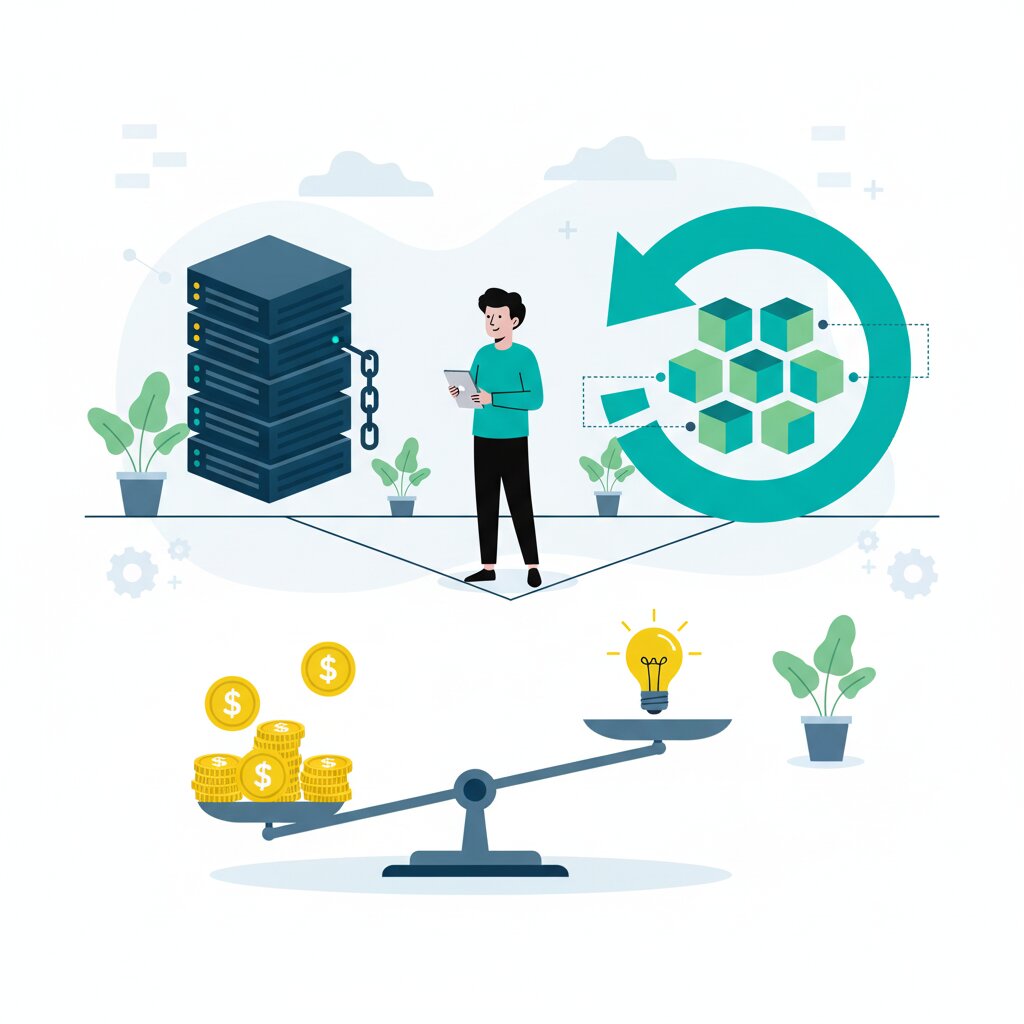

SAP’s messaging on ECC end-of-mainstream-support is pretty clear: migrate to S/4HANA via RISE with SAP, or else. What SAP doesn’t go out of its way to tell you is that two other commercially structured paths exist — third-party support and composable ERP. And 83% of SAP ECC customers are not fully aware of either.
This article covers both. The cost savings from third-party support are real. So are the risks that alternative vendors typically gloss over. Kingfisher — the £13 billion retail group behind B&Q and Screwfix — moved SAP ECC to Google Cloud under Rimini Street support and built AI capabilities on ECC data without touching S/4HANA. That case study is the clearest evidence we have that the alternatives actually work at enterprise scale.
For the full landscape of options, see our complete guide to SAP ECC end of support and what comes next.
What are the real alternatives to migrating to SAP S/4HANA?
There are three paths for SAP ECC customers facing the 2027 deadline. Migrate to S/4HANA via RISE or direct upgrade. Stay on ECC under a third-party support contract with someone like Rimini Street or Spinnaker Support. Or go composable — keep ECC as the stable core and modularise around it.
SAP has been pushing migration since S/4HANA launched in 2015. But as of Q4 2024, only 39% of ECC customers had adopted S/4HANA. Gartner projects around 13,000 organisations will still be on ECC in 2030. Gartner’s Fabio Di Capua put it bluntly: ” You convinced less than half of your clients to migrate in 15 years. How can you think you will migrate the next 50% in five years?”
The two alternatives aren’t mutually exclusive. Many organisations combine third-party support as the cost-reduction lever with composable ERP as the innovation strategy. That’s exactly what the Kingfisher case study demonstrates, and it’s what independent research suggests delivers above-average performance outcomes.
What does third-party SAP support actually provide and how does it work?
Third-party support replaces SAP Enterprise Support with an independent contract that covers bug fixes, security updates, interoperability patches, regulatory compliance updates, and custom code support — which SAP’s standard offering treats as your problem. SAP Enterprise Support fees typically run at 18–22% of net licence value per year. Third-party support providers charge roughly half that at a fixed rate.
Rimini Street, the largest independent provider of third-party support for SAP and Oracle enterprise software across 45+ countries, has committed to supporting SAP ECC through 2040. Spinnaker Support is the other established option, operating in 25+ countries with a more boutique service model.
The financial picture is pretty straightforward. One documented case: a global retailer paying $3.1M annually to SAP on $14M in ECC licences switched to Rimini Street and dropped support costs to $1.55M annually. Over four years that’s $6.2M in direct savings plus $1.8M in avoided SAP fee increases — $8M total.
TPS providers use virtual patching — a security technique where protective controls are implemented at the operating environment or network layer to address known vulnerabilities, without needing access to SAP’s source code. This is the technically important difference from SAP’s approach, and it’s the source of the most significant TPS risk.
What are the risks of third-party SAP support that vendors do not mention?
TPS vendors market cost savings hard. They have less incentive to spell out what you give up. Here’s the full picture.
Security patch coverage. SAP issues patches for all newly discovered vulnerabilities in its software. TPS providers issue virtual patches for vulnerabilities they have catalogued, which may lag or miss SAP’s full vulnerability surface. For regulated industries — financial services, healthcare, utilities — with specific patch compliance obligations, this gap requires a formal security risk assessment, not just a cost comparison. Gartner’s Dixie John has noted that while strategies like third-party support and edge innovation have merit, she believes core system upgrades ultimately remain necessary for advanced capabilities. Worth taking seriously.
System freeze. Third-party support means no access to SAP software updates, new functionality releases, or SAP roadmap features including S/4HANA AI capabilities. If your ECC implementation depends on SAP-native capabilities you expect to need updated, TPS locks you out of them.
Reinstatement costs. If you later return to SAP Enterprise Support or migrate to S/4HANA, SAP charges back-maintenance fees for the entire period off support plus approximately a 20% reinstatement surcharge. One documented case: a $2M/year contract off SAP for three years results in a $6M+ reinstatement bill. Model this scenario before you commit.
SAP relationship consequences. Michael Bloch of the German SAP user group DSAG was direct: “SAP will not grant you any incentives if you want to move to the SAP Cloud solutions” after switching to third-party support.
Custom code complexity. TPS providers support your existing custom code, but the S/4HANA codebase diverges while you are on ECC. A future migration becomes more complex the longer you stay on TPS — a technical debt dimension that does not appear in the cost savings calculations.
What is composable ERP and why is it gaining traction among SAP customers?
Composable ERP is a Gartner-coined architectural strategy: keep ECC for stable, foundational processes — finance, procurement, HR — and build modular, best-of-breed applications around it via APIs. The contrast is with monolithic replacement of the whole ERP stack at once, which is what RISE with SAP’s migration path involves.
The Rimini Street survey found 83% of SAP customers see composable approaches as providing faster access to AI, and 94% highlight the freedom to choose best-fit solutions for each business need. Worth noting: 29% of organisations still on ECC are no longer looking to SAP for innovation at all. Given that 92% of SAP customers cite rising and unpredictable subscription costs as a significant problem, the ability to choose tools independently has obvious commercial appeal.
Joe Locandro, Rimini Street’s global CIO, describes the implementation pattern clearly: “You can have an Oracle, an SAP, or whatever underneath and put new screens developed through ServiceNow or Microsoft and new workflows on top. It’s headless. All the innovation, workflows, and screens look nothing like the old green screens.” ECC as the data and transaction core, an API integration layer connecting it to modular applications, best-of-breed tooling on top.
The technical prerequisite is an API integration layer. The composable model only works if ECC data is accessible to modular applications. Data cleanliness and integration orchestration are where composable ERP transitions most commonly stall — and they are not optional extras.
How did Kingfisher move SAP ECC to Google Cloud without migrating to S/4HANA?
Kingfisher plc — £13 billion turnover, parent of B&Q and Screwfix — is the most prominent enterprise case study of this model. The scale matters. This is not a workaround used by a small business.
What Kingfisher did: moved SAP ECC from on-premise infrastructure to Google Cloud — an infrastructure migration, not a platform migration to S/4HANA. They moved SAP ECC support from SAP Enterprise Support to Rimini Street. Then they built AI and personalisation capabilities directly on ECC data using Google Cloud services and Databricks — personalisation engines, product recommendation systems, flexible pricing models — without waiting for S/4HANA’s AI capabilities.
Kingfisher’s group CTO Chris Blatchford presented this strategy at the Gartner Symposium/ITxpo in Barcelona in November 2025. He explained that Kingfisher had attempted negotiations with SAP to establish clear business value in upgrading and ultimately wasn’t persuaded by SAP’s case. Kingfisher’s approach directly contradicts SAP’s 2023 claim that “newest innovations and capabilities will only be delivered in SAP public cloud and SAP private cloud.”
Cloud infrastructure elasticity, AI capability on existing ECC data, and support cost reduction — all without the disruption, cost, and lock-in risk of a RISE migration. For organisations asking whether AI access requires S/4HANA migration, see our article on what AI is actually achievable without migrating.
Why does perpetual licence preservation matter and what happens if you give it up?
ECC perpetual licences are owned outright — an asset, not a subscription. RISE with SAP converts that asset into a subscription, and once that conversion is made, the perpetual licence is permanently surrendered. It cannot be recovered.
Joe Locandro puts it plainly: “You’ve got an asset on your books that you can keep running till 2040 or beyond, but if you give up perpetual licenses, there’s no going back. Sweat the asset and build outside of it.” Preserving the perpetual licence keeps all three paths open — migration, third-party support, and composable ERP — along with the negotiating leverage to push back on RISE pricing.
The lock-in chain in RISE is specific. The subscription bundles SAP BTP consumption-based pricing (variable, often unpredictable), SAP Signavio for process management, and SAP LeanIX for enterprise architecture — additional cost layers that come with the model. Exiting any component is difficult because software usage, operations, and support are contractually inseparable.
Kingfisher preserved its perpetual licence position by moving to Rimini Street and Google Cloud without converting to RISE. For the total cost of ownership comparison across all three strategic paths, see our business case analysis. For the failure statistics that make the financial case for staying on ECC, see the cost of SAP migration budget overruns.
How do you evaluate whether third-party support or composable ERP is right for your organisation?
Cost comparison is one input. Several others matter more in specific contexts.
For third-party support, the key variables:
Regulated industry and compliance posture. Does your organisation operate under compliance frameworks requiring SAP’s official patch coverage? If yes, virtual patching requires a formal gap assessment — not a standard RFP question.
Strategic dependency on SAP roadmap. Is your ECC implementation built around SAP-native capabilities you expect to need updated? If yes, system freeze risk is higher and TPS may be a bridge rather than a long-term position.
SAP relationship value. Active co-innovation agreements and preferred pricing may be jeopardised by moving off Enterprise Support. Quantify what you would be giving up.
Reinstatement scenario. Model the cost of returning to SAP support. If the reinstatement bill at the likely scale is unacceptable, TPS is effectively a one-way door.
Provider evaluation. Both Rimini Street and Spinnaker Support should go through a detailed RFP — coverage breadth for your modules and versions, security response SLAs, regulatory update timeliness for your jurisdictions. Headline cost comparisons are not sufficient.
For composable ERP, the key prerequisites:
Integration layer readiness. John Burns, senior director of financial systems at Summit BHC, put it plainly: “If your data is messy or your processes are inconsistent, splitting the layers will not fix that. The core still has to be clean, and the front end still has to be governed.” The API integration layer is a real technical prerequisite.
Process modularity. Finance and core procurement are deeply integrated with ECC’s transaction engine — they’re the last processes to modularise. E-commerce, analytics, and customer-facing processes are typically first.
The combined approach — third-party support for cost reduction while building composable ERP capability incrementally — is the Kingfisher pattern and what Freeform Dynamics data suggests delivers above-average performance.
Where do you start with a composable ERP transition alongside existing SAP ECC?
Composable ERP is incremental by design. You add capabilities around a stable core over time, not in one move. Here’s how it typically plays out.
Analytics and reporting are the lowest-disruption starting point. Connecting a modern data platform — Databricks, Snowflake, Power BI — to ECC data via API does not touch transactional systems. Most organisations start here.
Customer-facing processes come next. E-commerce, personalisation, and customer service tooling change faster than monolithic ERP can keep up with. Kingfisher’s personalisation and recommendation engines via Google Cloud and Databricks are the case study example.
Workflow and service management is where ServiceNow enters. Replace SAP-native workflow management while leaving ECC’s transactional backbone untouched. Agentic AI fits naturally here — “Agentic workflows thrive in architectures with open data access and strong APIs.”
The API integration layer choice has long-term implications. iPaaS platforms like MuleSoft, Boomi, or Azure Integration Services each have different trade-offs. Base the decision on your cloud provider relationship and integration team capability.
What to avoid starting with: finance and core procurement. The switching cost is high, integration complexity is substantial, and you are probably not ready. Start with processes that are genuinely modular and where you have the internal capability to manage the integration.
For deeper analysis of composable ERP as a next-generation architecture signal and whether monolithic ERP is obsolete, see our strategic capstone analysis. This article is part of our complete guide to SAP ECC end of support and what comes next, which maps all strategic paths from the 2027 deadline through migration choices, alternatives, and the AI variable.
Whichever path you choose, someone still has to execute it before the 2027 deadline arrives. A hiring round is rarely fast enough for that timeline, so SoftwareSeni’s extended development teams put engineers on the work immediately, without waiting on a search to fill the role.
see how extended development teams get engineers working without a hiring round →
“SoftwareSeni are and have been our primary development and design partner for a number of years. We have scaled with them as our business has continued to grow and we will continue to do so. The team are reliable , efficient and just get what is required. Onboarding new people and scaling is a breeze, with new resources coming online and being productive at speeds other providers dream of. With Software Seni it is not just singular resources, you are getting the whole team behind that with years of expertise in all domains and they become an extension of your team. Couldn’t recommend Software Seni any higher for any of your development, design or project needs.”
 Eddie PetersenHead of Engineering, Funraisin
Frequently asked questions
Can I get third-party support for SAP ECC after 2027?
Yes. Rimini Street has announced it will support SAP ECC through 2040. Spinnaker Support similarly offers post-2027 coverage. This is a commercially structured alternative — you enter a formal support contract with the TPS provider. SAP’s extended support through 2030 is also available at a 2% surcharge if you need a bridge period.
Is Rimini Street a legitimate alternative to SAP’s own support?
Rimini Street is the largest independent provider of third-party support for SAP and Oracle enterprise software, with the Kingfisher case study demonstrating it operating at enterprise scale. It’s a legitimate commercial alternative, but it’s not equivalent to SAP Enterprise Support in all respects — notably in security patch coverage, where virtual patching is used instead of SAP’s official code patches. Organisations in regulated industries should conduct a formal security risk assessment before switching.
What is composable ERP in plain terms?
Keep your existing ERP for stable back-office processes and add specialist software around it for everything else, connected via APIs. Instead of replacing the entire ERP stack with a new monolithic system, you add best-of-breed tools for analytics, customer experience, AI, or HR alongside the core. Faster innovation without touching the transactional backbone.
Is composable ERP real or just hype?
Composable ERP is a genuine architectural strategy. The Kingfisher case study demonstrates it at enterprise scale — see the dedicated section above. Freeform Dynamics research supports the approach: 83% of organisations combining composable architectures with third-party support achieved above-average business performance. The API integration layer is a real technical prerequisite and implementation complexity is non-trivial.
What is the cost of returning to SAP support after using third-party support?
SAP charges back-maintenance fees for the entire period off support, plus approximately a 20% reinstatement surcharge. One documented case puts this at approximately $6 million for an organisation on a $2M/year contract off SAP for three years. Model this scenario as part of the initial TPS decision.
How does virtual patching work and is it secure enough?
Virtual patching is a configuration-level security technique. TPS providers implement protective controls around known vulnerabilities at the operating environment or network layer, without applying SAP’s official code patches. The limitation is coverage: SAP patches all vulnerabilities it discovers; TPS providers patch the vulnerabilities they have catalogued, which may lag or not cover SAP’s full vulnerability surface. For organisations with strict patch compliance requirements, a formal gap assessment is necessary before switching.
What is RISE with SAP and what does it include?
RISE with SAP is SAP’s bundled cloud migration offering that converts ECC perpetual licences to subscriptions and moves customers to SAP S/4HANA. The bundle includes SAP S/4HANA (cloud edition), SAP BTP with consumption-based pricing, SAP Signavio (process management), and SAP LeanIX (enterprise architecture). The conversion of perpetual licences to subscriptions is permanent.
Can I stay on SAP ECC and still access AI capabilities?
Yes. The Kingfisher case study demonstrates this directly — see the dedicated section above for the full picture. The approach requires a composable architecture: ECC data exposed via APIs to a modern data platform, which then feeds AI applications. SAP’s S/4HANA offers native AI through SAP BTP, but that requires the RISE subscription model.
Rimini Street vs Spinnaker Support — how do I choose?
Rimini Street covers ECC, S/4HANA, HANA, BW, and CRM across 45+ countries — publicly traded, at roughly 50% of SAP fees. Spinnaker Support covers ECC, S/4HANA, and HANA across 25+ countries with a boutique service model at 50–60% of SAP fees. Both should go through a detailed RFP with specific coverage scope requirements — coverage breadth for your modules, security response SLAs, regulatory update timeliness, and customer references in your industry.
If 2027 is fixed, is a hiring round really the fastest way to have people ready? Talk to us about extended development teams