
If you’ve been through the microservices transformation, you’re going to recognise what’s happening with AI right now. Monolithic applications gave way to microservices, and it unlocked scalability, specialisation, and independent deployment across the industry. AI systems are following the exact same path, moving from monolithic LLMs through single-agent tools to coordinated multi-agent AI orchestration.
And this isn’t theoretical hand-waving. 57% of organisations already have AI agents in production. The autonomous agent market is projected to reach $35 billion by 2030. If you’ve worked with microservices, you already understand the core patterns behind multi-agent orchestration—it’s distributed systems thinking applied to AI. By the end of this article, you’ll have a clear framework for deciding whether and when multi-agent orchestration is relevant to what you’re doing.
What Is Multi-Agent AI Orchestration and Why Is Everyone Talking About It?
Multi-agent AI orchestration is the structured coordination of multiple autonomous AI agents working together to achieve complex, shared objectives. Single-agent systems consolidate all logic, context, and capability into one system. Multi-agent distributes specialised responsibilities across coordinated agents.
Each agent operates with its own reasoning loop. This enables independent decision-making and learning from outcomes. It’s different from traditional automation because agents are proactive rather than reactive. They adapt to changing conditions without you having to reprogram them.
The mechanism is called the TAO cycle: Think-Act-Observe. The agent analyses context and plans (Think), executes using available tools (Act), then evaluates outcomes and updates its understanding (Observe). This continuous loop enables agents to learn and improve without manual retraining.
The conversation has intensified because three enabling conditions have converged. LLM reasoning capability has matured, communication protocols are standardising, and orchestration frameworks have reached production readiness.
Use cases already in production? Customer service accounts for 26.5% of deployments, research and analysis represents 24.4%, and internal knowledge management is gaining traction.
Why Is This the Microservices Moment for Artificial Intelligence?
The term “microservices moment” captures a specific pattern: the point where a distributed architecture becomes clearly superior to monolithic approaches for complex systems.
In software, the microservices moment arrived when containerisation (Docker), orchestration (Kubernetes), and API standardisation made it practical to decompose monoliths. For AI, an equivalent convergence is happening now. Advanced LLM reasoning provides the cognitive foundation. Protocol standards provide the communication layer. Frameworks provide the orchestration tooling.
Just as microservices didn’t replace all monoliths overnight, multi-agent will not replace all single-agent systems. The shift is towards using the right architecture for the right complexity level.
The “moment” is defined by market signals. Deloitte projects $35 billion by 2030, growing from $8.5 billion by 2026. Gartner predicts 40% of enterprise applications will incorporate agentic AI by 2026, up from less than 5% in 2025. And 93% of IT leaders report intentions to introduce autonomous agents within the next 2 years.
What Parallels Exist Between Microservices Architecture and Multi-Agent Systems?
Both architectures evolved from the same pressure: complexity outgrows what a single unit can efficiently handle. Monolithic application to microservices mirrors monolithic LLM to single-agent to multi-agent. In both cases, the driver is specialisation, independent scaling, and fault isolation.
The analogy maps like this. Monolithic application maps to monolithic LLM. Service decomposition maps to agent specialisation. API contracts map to agent communication protocols. Service mesh maps to orchestration layer.
In microservices, services communicate through well-defined APIs with rigid contracts. In multi-agent systems, agents communicate through dynamic protocols that allow negotiation and adaptation. Instead of predefined API calls, agents exchange goals, capabilities, and results.
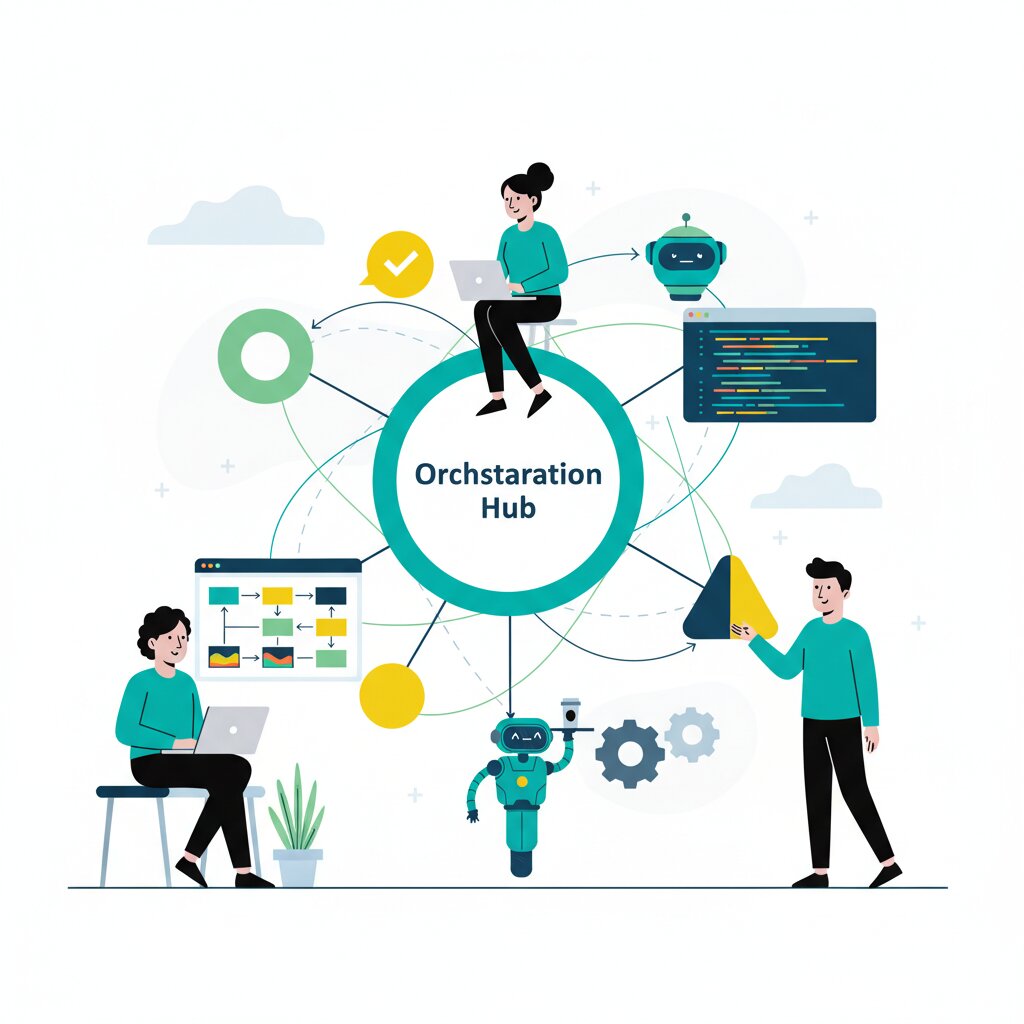
Microservices use centralised orchestration like service mesh or API gateway. Multi-agent systems offer three patterns: centralised (supervisor agent), decentralised (peer-to-peer negotiation), and hierarchical (nested delegation).
The key difference? Microservices are stateless and execute predefined logic. Agents maintain state, learn from outcomes, and can modify their behaviour through the TAO cycle.
The emerging trend is hybrid systems, where microservices handle stable transactional workloads while agents handle reasoning and orchestration. Think of microservices as a collection of tools and agentic AI as something that knows when and why to use each one.
Shared challenges? Both face complexity in debugging distributed interactions, require robust observability, and demand new operational skills from teams.
What Technological Changes Are Enabling Multi-Agent Adoption Now?
Three categories of enabling technology have matured simultaneously. This convergence mirrors the Docker-Kubernetes-REST moment for microservices. Each technology alone was insufficient, but together they made the pattern practical.
First, LLM capability maturity. Models can now reason, plan, use tools, and maintain context across extended interactions. This provides the cognitive foundation each agent needs to operate autonomously.
Second, protocol standardisation. Anthropic’s Model Context Protocol (MCP) standardises how agents access tools and contextual data. Google’s Agent2Agent (A2A) protocol governs peer coordination and delegation. Cisco’s AGNTCY provides agent coordination standards for enterprise deployments. The industry is converging toward 2-3 dominant standards.
Third, framework proliferation. LangGraph, CrewAI, and AutoGen have reached production-grade maturity. They provide abstractions that simplify defining agent roles, goals, and communication patterns.
The protocol standardisation race determines whether the ecosystem will be open and interoperable or locked into vendor-specific walled gardens. Excessive competition across protocols could risk “walled gardens”, where companies are locked into one protocol and agent ecosystem.
AWS Bedrock and IBM Watsonx Orchestrate are embedding multi-agent capabilities. This reduces the engineering effort required for organisations without dedicated AI teams.
How Big Is the Market Opportunity and What Is Driving Growth?
The autonomous AI agent market is projected to reach $35 billion by 2030, growing from $8.5 billion by 2026. IDC projects overall AI spending growth of 31.9% annually through 2029, reaching $1.3 trillion, with agentic AI as a primary growth driver.
The shift is already underway. 57% of organisations have AI agents in production. Gartner predicts 40% of enterprise applications will incorporate agentic AI by 2026, and by 2028, 33% of enterprise software will include agentic AI, enabling 15% of day-to-day work decisions to be made autonomously.
Guardian agents, focused on risk management and compliance, are expected to capture 10-15% of the agentic AI market by 2030. This signals institutional maturity—governance as an architectural component rather than an afterthought.
Now for the reality check. Gartner estimates more than 40% of agentic AI projects could be cancelled by 2027, due to unanticipated cost, complexity, or unexpected risks. Market growth does not guarantee organisational success. Careful assessment and realistic expectations are essential. Understanding why multi-agent projects fail and how to avoid the same mistakes is critical before committing resources.
Is Multi-Agent Orchestration Right for Your Organisation?
Multi-agent orchestration isn’t universally the right choice. Specific problem characteristics determine whether it adds value or adds unnecessary complexity.
Problems that benefit from multi-agent? Context overflow, where a single agent can’t hold all relevant information. Specialisation conflicts, where one agent can’t be expert in all required domains. Parallel processing needs, where tasks can be decomposed and executed concurrently. And security boundary requirements, where different agents operate at different trust levels.
Problems better served by single-agent? Well-defined tasks with clear inputs and outputs. Low complexity requiring no domain specialisation. Cost-sensitive deployments where orchestration overhead is unjustified. And environments where simplicity of debugging outweighs coordination benefits.
Use Microsoft’s Azure Cloud Adoption Framework to evaluate security boundaries, team structure, growth trajectory, role complexity, time-to-market needs, and cost priorities. Build multiple agents when regulations mandate strict data isolation, when distinct teams manage separate knowledge areas, or when your solution roadmap spans more than three to five distinct functions.
Don’t assume role separation requires multiple agents. Often a single agent using persona switching and conditional prompting can satisfy role-based behaviour without added orchestration.
Organisational readiness matters. Does your team have distributed systems experience? Is there existing infrastructure for monitoring and observability? Is leadership prepared for the shift from deterministic processes to probabilistic outcomes?
A practical decision tree. If your use case involves fewer than three distinct domain specialisations, a single agent is likely sufficient. If it requires parallel processing across security boundaries with multiple knowledge domains, multi-agent becomes compelling. For a detailed framework on deciding between single-agent and multi-agent architectures, including specific problem categories and anti-patterns, comprehensive guidance is available.
Start with honest assessment of current maturity rather than aspiration. A strong single-agent implementation is better than a poorly governed multi-agent system.
What Are the Realistic Expectations for Adoption Timelines and ROI?
ROI from multi-agent systems is real but not instant. 88% of US executives report seeing ROI from AI investments, yet Gartner’s 40% cancellation rate indicates that poor planning accounts for most failures. Organisations are seeing 5x-10x returns in successful implementations.
Typical adoption follows a crawl-walk-run pattern. Start with a single well-scoped agent, validate ROI, then progressively add agents as competence and infrastructure mature. Expect 6-12 months to achieve meaningful single-agent ROI before expanding to multi-agent.
ROI calculation should combine tangible savings (cost reduction, productivity gains, revenue growth) with intangible value (improved agility, faster time-to-market, employee satisfaction). Use the formula: ROI = (Net Benefit / Total Investment) x 100%, where costs include infrastructure, frameworks, team training, governance tooling, and ongoing observability.
Measurable benefits? Cost reduction of $1-$4 saved per $1 spent, with 80% lower Tier-1 support costs documented. Productivity gains of 20-30% more output for same spend. Revenue growth of 10-30% increase in sales and conversions.
The hybrid systems approach is recommended. Microservices handle stable transactional workloads while agents progressively take over reasoning and orchestration. This approach forms a core principle of effective multi-agent AI orchestration strategies.
Human-in-the-loop patterns are necessary during early adoption. The autonomy spectrum moves from continuous human oversight to periodic review to monitored autonomy as trust matures.
Common failure patterns? Over-scoping initial implementations, underinvesting in observability, neglecting governance frameworks, and treating multi-agent as a technology project rather than an organisational change initiative.
What Questions Should You Be Asking as You Evaluate This Technology?
Before evaluating tools or frameworks, ask “What specific problem would multi-agent solve that our current approach cannot?” If the answer is vague, the timing is wrong.
Assess architectural fit. Does your current workload involve multiple distinct domains that require specialised knowledge? Do you need parallel processing across trust boundaries? Is context overflow limiting your single-agent effectiveness?
Evaluate team readiness. Does your engineering team have experience with distributed systems, event-driven architectures, or microservices patterns? If not, invest in foundational skills before multi-agent adoption.
Consider governance requirements. How will you monitor agent decisions? What compliance requirements apply? Where do human approval gates need to exist in your workflows?
Map the ecosystem. Which orchestration frameworks (LangGraph, CrewAI, AutoGen) align with your existing technology stack? Which communication protocols (MCP, A2A) does your tooling ecosystem support?
Challenge vendor narratives. Every platform vendor is positioning multi-agent capabilities. Distinguish between genuine orchestration and rebranded workflow automation.

Plan the exit. If multi-agent doesn’t deliver expected outcomes, what’s your fallback? A well-designed single-agent system should remain viable as a graceful degradation path.
Identify who in your C-suite will own your organisation’s AI agent vision and strategy with aligned incentives and accountability. Stress-test orchestrations rigorously before scaling. Simulate with real complexities—incomplete data, conflicting goals, or adversarial scenarios.
For organisations ready to proceed, getting started with multi-agent implementation requires a structured three-phase approach with pilot project selection and realistic ROI expectations.
FAQ Section
What is the difference between multi-agent AI and traditional workflow automation?
Traditional workflow automation follows pre-defined, deterministic sequences where each step is explicitly programmed. Multi-agent AI uses autonomous agents that can reason, adapt, and make independent decisions through the TAO cycle (Think-Act-Observe). Agents can negotiate with each other, handle unexpected inputs, and learn from outcomes. This makes them suited to complex, dynamic tasks that workflow automation can’t handle.
How does the microservices analogy break down when applied to AI agents?
The analogy is imprecise in two key areas. First, microservices are stateless and execute pre-defined logic, while agents maintain state, learn from outcomes, and modify their behaviour over time. Second, microservices communicate through rigid API contracts, while agents can negotiate dynamically through evolving protocols. The analogy is strongest for understanding decomposition, specialisation, and independent scaling.
What is the TAO cycle and why does it matter for multi-agent systems?
The TAO cycle (Think-Act-Observe) is the reasoning loop that makes agents autonomous. In the Think phase, the agent analyses its current context and plans actions. In the Act phase, it executes those actions using available tools. In the Observe phase, it evaluates outcomes and updates its understanding. This continuous loop enables agents to learn and improve without manual retraining. It’s what differentiates them from static automation.
Can a small company (under 100 employees) benefit from multi-agent orchestration?
Most small companies are better served by well-implemented single-agent systems. Multi-agent orchestration adds coordination overhead, observability requirements, and governance complexity that typically only pays off when workloads involve multiple distinct knowledge domains, security boundaries, or parallel processing needs. Start with a single agent, validate ROI, and only expand when specific limitations of the single-agent approach become evident.
What communication protocols do multi-agent systems use?
Three major protocols are emerging. Anthropic’s Model Context Protocol (MCP) for standardising how agents access tools and contextual data. Google’s Agent2Agent (A2A) for inter-agent communication. And Cisco’s AGNTCY for agent coordination standards. The industry is converging toward 2-3 dominant standards, similar to how REST and gRPC became dominant in the microservices era.
How do I calculate ROI for multi-agent AI implementations?
Use the formula: ROI = (Net Benefit / Total Investment) x 100%, where Net Benefit combines tangible savings (cost reduction, productivity gains, revenue growth) with intangible value (improved agility, time-to-market, satisfaction). Include costs for infrastructure, frameworks, team training, governance tooling, and ongoing observability. Most organisations should expect 6-12 months to achieve meaningful single-agent ROI before expanding to multi-agent.
What is a guardian agent and why are they important?
Guardian agents are specialised agents focused on risk management, compliance validation, and governing the behaviour of other agents. They monitor agent decisions, enforce policy constraints, and prevent unsafe actions. Gartner expects guardian agents to capture 10-15% of the agentic AI market by 2030. This indicates that governance is becoming an architectural component rather than an afterthought.
What percentage of multi-agent AI projects fail?
Gartner estimates a 40% cancellation rate for agentic AI projects. The main reasons? Over-scoping, unrealistic expectations, insufficient governance, and treating the initiative as a technology project rather than an organisational change effort. Success rates improve substantially when organisations adopt a phased approach, starting with well-scoped single-agent implementations before expanding to multi-agent coordination.
How does multi-agent orchestration differ from running multiple chatbots?
Running multiple chatbots means operating several independent, disconnected systems that don’t communicate or coordinate. Multi-agent orchestration means those agents share context, delegate tasks to each other, negotiate approaches, and work toward shared objectives through defined patterns (centralised, decentralised, or hierarchical). The orchestration layer is what transforms independent agents into a coordinated system.
What skills does my engineering team need for multi-agent systems?
Teams need distributed systems expertise (similar to microservices experience), understanding of event-driven architectures, familiarity with at least one orchestration framework (LangGraph, CrewAI, or AutoGen), comfort with probabilistic rather than deterministic outcomes, and skills in observability and monitoring for non-linear agent interactions. If your team has microservices experience, the transition is more natural.
Is multi-agent AI just hype or a genuine architectural shift?
Market evidence supports a genuine shift. 57% of organisations have agents in production, the market is projected to reach $35 billion by 2030, and major technology platforms are embedding native multi-agent capabilities. However, not every organisation needs multi-agent architecture, and the 40% project cancellation rate indicates that hype-driven adoption without clear use-case fit is a real risk.
What is the relationship between the agent layer and existing microservices infrastructure?
The agent layer sits above microservices infrastructure. It uses existing services for stable transactional workloads while adding autonomous decision-making and dynamic coordination. This hybrid approach means organisations don’t need to replace their microservices. Agents consume and orchestrate existing services while handling the reasoning, planning, and adaptive coordination that static service orchestration can’t provide.