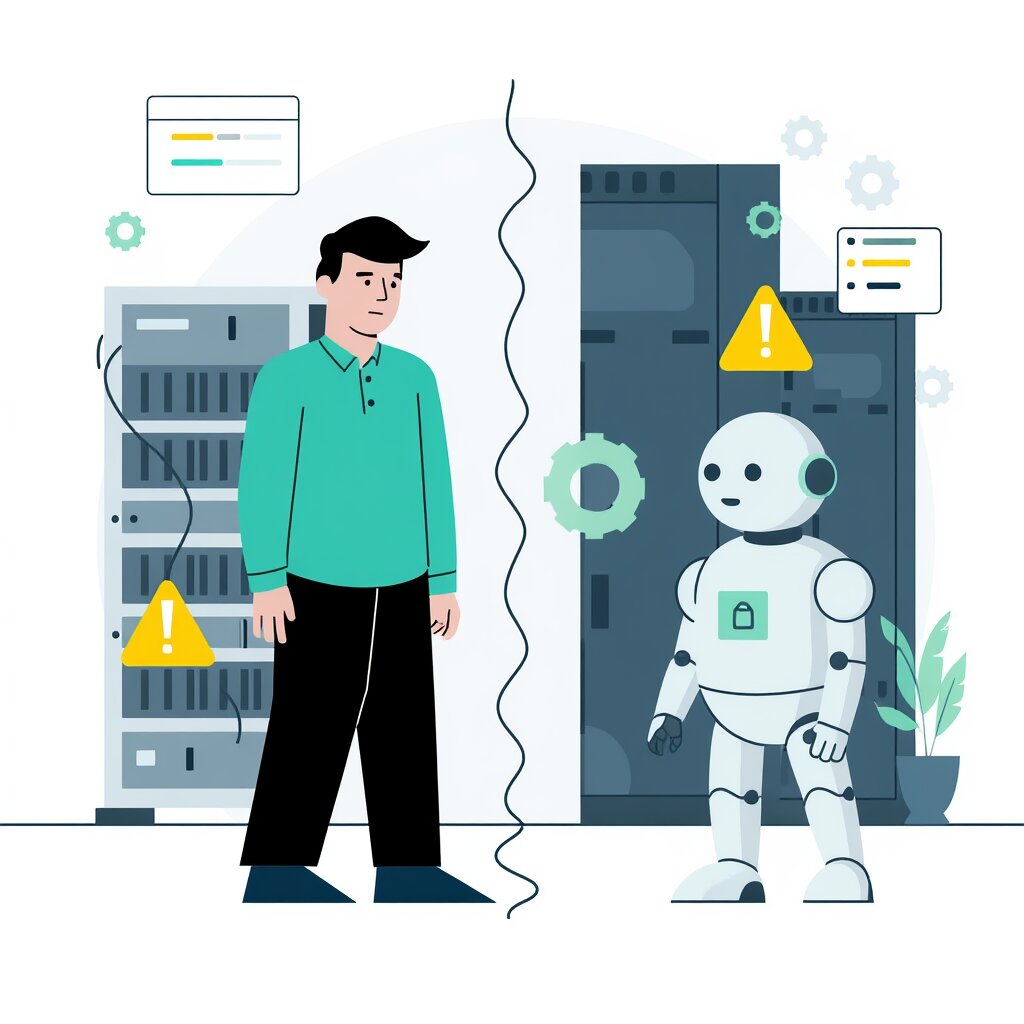
Here’s the reality: you need AI to modernise your legacy systems efficiently, but those same legacy systems are preventing you from deploying AI. Deloitte research confirms 60% of AI leaders are dealing with this right now.
This paradox sits at the heart of the AI legacy modernisation imperative. While AI-assisted code comprehension promises to accelerate modernisation efforts, the architectural constraints of legacy systems create a chicken-and-egg problem that blocks progress.
Gartner predicts that 40% of agentic AI projects will be cancelled by the end of 2027. Why? Infrastructure constraints. Your legacy systems can’t handle the real-time data access, API orchestration, and event-driven architecture that autonomous agents need.
This creates a circular problem. You need AI-assisted reverse engineering to modernise your legacy infrastructure efficiently—manually analysing decades of COBOL just leads to analysis paralysis. But you can’t deploy agentic AI without the modern integration patterns that only modernisation delivers.
But there’s good news. Evolutionary modernisation lets you use AI where integration is already possible, then reinvest those gains to build infrastructure that enables deeper AI adoption. Research shows enterprises have roughly two years to demonstrate meaningful AI value. That window determines whether you’re building competitive advantage or explaining to the board why you’re in Gartner’s 40% failure statistic.
What is the 60% Barrier and Why Does It Matter for AI Adoption?
Deloitte Tech Trends 2026 research shows 60% of AI leaders identify legacy system integration as their primary barrier to agentic AI implementation. Not skills. Not budget. Integration.
When we say legacy systems we mean any infrastructure that lacks APIs, real-time data access, and modern integration patterns. That includes your Oracle ERP from 2015 if it only exposes batch interfaces.
The barrier is structural. These systems were designed for stability and isolation—exactly the opposite of what agentic AI requires. Autonomous agents need constant interaction with business systems. Without modern integration, they can’t function.
Agentic AI represents the next competitive frontier. The market is splitting between AI-native companies that move fast and legacy-burdened enterprises that can’t deploy agents. Nearly half of organisations cite data searchability (48%) and reusability (47%) as challenges.
What Do Legacy Systems Lack That Agentic AI Requires?
Legacy infrastructure runs on batch processing—nightly jobs, scheduled updates. Autonomous agents need to make decisions now, based on current state.
Traditional systems don’t expose RESTful APIs for programmatic access. They were built for human interfaces: screens, forms, workflows. Not machine-to-machine communication where an agent queries inventory levels 50 times per second.
Current enterprise data systems are built around ETL processes. Extract, transform, load, wait. Agents need enterprise search and indexing—making data discoverable the way Google made the web discoverable.
Event-driven architecture is missing. Agentic AI needs to react to business events as they happen. Legacy systems update databases silently—nothing downstream knows anything changed until the next batch job runs.
Traditional IT governance models don’t account for AI systems that make independent decisions without human checkpoints. The skills gap makes this worse. The COBOL developer community is declining—we’re looking at a shortfall close to 100,000 workers.
Why Will 40% of Agentic AI Projects Fail by 2027?
Gartner’s prediction is pattern recognition. They’re seeing the infrastructure and integration challenges organisations are already hitting.
The failure pattern is predictable. Your pilot succeeds in an isolated environment with clean test data. Then production deployment requires connecting to 15 legacy systems that don’t have APIs, can’t provide real-time data, and weren’t designed for the query patterns agents generate.
Only one in five companies has a mature model for governance of autonomous AI agents. 60% of AI leaders are concerned about risk frameworks for autonomous decision-making. When governance, integration, and infrastructure all require fundamental rework, most organisations cancel rather than commit to multi-year foundation rebuilding.
The root cause? Underestimation. Enterprises think agentic AI is software they deploy, like installing a CRM. They discover it’s infrastructure they build on top of, and their foundation can’t support the load.
78% of enterprises are struggling to integrate AI with existing systems. Close to a third of enterprise leaders (29%) see integrating AI with existing systems as a top barrier to AI adoption—ranking alongside AI skill gaps (35%), data quality issues (29%), and IT infrastructure bottlenecks (27%).
What is the Chicken-and-Egg Problem Between AI Adoption and Modernisation?
The paradox is simple to state, hard to resolve. You need AI to modernise legacy systems efficiently, but legacy systems prevent AI adoption.
Reverse engineering decades of COBOL manually creates analysis paralysis. Documentation is either missing or hopelessly out of sync with reality. These systems become “black boxes”—vital to operations but opaque and risky to touch.
AI-assisted reverse engineering can reduce modernisation time and cost by 30%. Tools that parse COBOL syntax, infer business logic, and generate natural language documentation turn months of manual analysis into weeks. You need that capability.
But you can’t deploy AI-assisted modernisation tools if those tools require the modern integration patterns you don’t have yet. They need API access to analyse system behaviour. They need real-time data streams to understand workflows.
Traditional big-bang modernisation takes too long and costs too much. Your business can’t afford 5-year replacement projects—by the time the new system launches, business requirements have shifted and the whole thing is out of date.
93% of respondents said AI will help overhaul legacy infrastructure. AI has two major roles here: creating documentation for older systems, and greatly reducing development work required to recreate a system.
But you can’t use AI for modernisation if you can’t deploy AI systems, and you can’t deploy AI systems without modern infrastructure. That’s the deadlock.
Should You Modernise Before Adopting AI or Use AI to Help Modernise?
Neither pure approach works. Modernising before AI adoption means manual analysis, slow progress, and high costs. Using AI to help modernise assumes you already have the modern infrastructure AI requires.
The answer is a sequenced approach that does both incrementally. The approach involves three phases: operational gains, tech debt reduction, and new markets.
Phase 1 focuses on freeing up operational dollars. Deploy AI in domains that don’t require deep legacy integration. Customer onboarding workflows, supplier qualification processes, content generation for marketing. Quick wins that generate budget for deeper work.
Phase 2 moves AI into a more integral role—integrating AI organisation-wide and systematically eliminating tech debt. AI tools help you analyse legacy systems, generate documentation, create API wrappers. Those wrappers enable more AI deployment. More AI deployment generates savings that fund deeper modernisation.
Phase 3 delivers the ambitious outcomes—engaging with customers in new ways, enabling new competitive capabilities, pursuing new business opportunities.
Organisations are poised to halve the budget allocated to maintaining existing systems from 61% today to just 27% by 2030. That shift requires both AI acceleration and strategic sequencing.
Every turn of the flywheel increases velocity. The first cycle delivers small operational gains. The second cycle delivers bigger gains because you have better tools and more integration points. Compound effects matter.
How Does Evolutionary Modernisation Break the Deadlock?
Evolutionary modernisation breaks the circular dependency by starting where integration is already possible and building momentum from there. This sequencing AI and modernisation through incremental phases delivers the deadlock-breaking approach enterprises need.
Step 1: Use AI for legacy analysis without requiring full integration. Tools that read code, generate documentation, and reverse engineer business logic can work with codebase access alone. No APIs required. No real-time data streams. Just the ability to scan files and infer patterns.
ThoughtWorks’ CodeConcise combines large language models with knowledge graphs derived from abstract syntax trees. It doesn’t just parse syntax—it understands structure, identifies dependencies, and maps business logic to code implementations.
Step 2: Apply AI insights to create a minimal integration layer. Use the documentation and business logic maps to build API wrappers around legacy systems. Implement change data capture to turn database updates into event streams.
This is where strangler fig pattern thinking starts. Wrap the legacy system with modern services. Gradually migrate functionality. Eventually retire the legacy core.
Step 3: Deploy agents in newly accessible domains. Now that procurement data is available via APIs and inventory changes publish as events, you can deploy agents that optimise purchasing decisions, trigger reorder workflows, and flag supply chain anomalies.
Step 4: Reinvest savings in deeper modernisation. The procurement agents reduced manual work by 40%. That budget saving funds the next round of integration work—wrapping your finance systems, modernising your customer data platform, replacing the most problematic legacy components entirely.
Initial API wrapping typically completes in 3-6 months, enabling first agent deployments. Meaningful tech debt reduction and expanded agent capabilities take 12-18 months. Full modernisation runs 24-36 months, but you’re deploying agents and generating value throughout that timeline.
Evolutionary modernisation delivers incremental value continuously rather than all at once. Big bang modernisation is all or nothing—if it fails, you lose years of investment. The evolutionary approach validates each step before committing to the next.
What Happens If You Don’t Resolve This Paradox in the Next Two Years?
Cognizant research shows enterprises feel pressure to demonstrate AI value within two years. That’s your window. After that, the board wants results, not roadmaps.
Organisations that don’t break the deadlock become part of Gartner’s 40% cancelled projects statistic.
The tech debt crisis accelerates while you’re stuck. Legacy systems age further. The COBOL developer shortage worsens—already a 100,000 worker shortfall and growing. Costs escalate as the talent pool shrinks.
81% of companies feel peer pressure from competitors to speed up AI adoption. 41% of leaders say slow AI rollouts have made them fall behind their competition. 39% claim they’ve missed out on productivity gains.
The impacts compound: delayed ROIs (37%), customer experience gaps (36%), and missed market opportunities (34%). Each quarter of delay makes modernisation more expensive and AI adoption more difficult. The cost curve isn’t linear—it accelerates.
By 2030, AI-powered consumers could drive up to 55% of spending. If your systems can’t support AI-powered customer experiences by then, you’re locked out of the majority of consumer spending.
The window to act is approximately two years. Those who move with purpose will thrive. Those who wait for perfect clarity will miss the window entirely.
Can You Deploy Agentic AI While Legacy Systems Remain?
Yes, with tactical bridging approaches. You don’t need complete modernisation to begin agent deployment—you need sufficient integration in the specific domains where agents will operate.
API gateway pattern creates RESTful wrappers around legacy system interfaces. Modern API calls get translated to legacy protocols—SOAP, mainframe transactions, whatever your core systems speak. The translation adds latency and complexity, but it works.
Event sourcing bridges capture changes in legacy databases through change data capture. Whenever a record updates, the bridge publishes an event to a modern event stream. Agents subscribe to those streams and react to changes as they happen.
Toyota deployed agentic supply chain tools while their mainframe remains operational. Teams use an agentic tool to gain better visibility into estimated arrival times for vehicles at dealerships.
The process used to involve 50 to 100 mainframe screens and hours of manual work. The agent handles all of it before people arrive in the morning.
This approach provides tactical bridging while you work toward a strategic solution. API wrappers add maintenance burden. Event bridges create dependencies that complicate both systems. The integration layer is technical debt you’re taking on deliberately to enable progress now.
The alternative is waiting for complete modernisation before deploying any agents. That means years without competitive advantage, no AI-driven productivity gains, and falling further behind competitors who chose tactical bridging.
Parallel deployment works for workflows that don’t require deep legacy integration. Customer onboarding, supplier qualification, content operations—these can run on modern infrastructure without touching mainframe systems.
But tactical bridging breaks the immediate deadlock. It lets you deploy agents, demonstrate value, build organisational confidence, and fund deeper modernisation with proven ROI rather than theoretical projections.
For a complete implementation roadmap showing how to sequence these steps in practice, see our 90-day execution plan. The playbook addresses how to assess your systems, prioritise modernisation targets, and execute the evolutionary approach that breaks the barrier while maintaining business operations.
Is the 60% barrier just enterprise-specific or does it affect SMBs too?
The 60% barrier affects organisations of all sizes, often hitting SMBs harder. While they may lack mainframes, they often depend on ageing ERP, CRM, or custom applications that similarly lack APIs and modern integration patterns. SMBs face the same circular problem—need AI to compete, need modernisation to adopt AI—but with tighter budgets and smaller technical teams to resolve it.
Can I deploy agentic AI without modernising legacy systems?
Partially. You can deploy agents for new workflows that don’t require deep legacy integration—customer service chatbots, content generation, or market analysis. However, you cannot deploy agents that need to orchestrate across legacy backends (supply chain agents, financial close agents, operational automation) without APIs and integration capabilities. Most high-value agentic AI use cases require multi-system orchestration, which legacy constraints block. Tactical bridging through API wrappers provides temporary access but isn’t a substitute for modernisation.
How long does it take to break the deadlock using evolutionary modernisation?
Evolutionary modernisation delivers incremental value continuously rather than all at once. Initial API wrapping and basic integration layers typically complete in 3-6 months, enabling first agent deployments. Meaningful tech debt reduction and expanded agent capabilities take 12-18 months. Full modernisation of complex legacy environments runs 24-36 months, but you’re deploying agents and generating value throughout rather than waiting for completion. Each phase funds the next through operational savings.
What happens if I try big-bang modernisation instead of evolutionary?
Big-bang modernisation attempts to replace entire legacy systems before deploying agentic AI. This approach typically takes 3-5 years, requires massive upfront capital, and carries high failure risk. During this period, you generate no AI value while competitors deploy agents incrementally and pull ahead. The analysis paralysis problem worsens—trying to document all legacy behaviour before replacement creates project gridlock. Most importantly, you can’t use AI to accelerate modernisation because you’re trying to modernise before adopting AI. Big-bang puts you on the wrong side of the two-year timeline.
Does evolutionary modernisation work for mainframe systems?
Yes, though mainframes present specific challenges. Start with API wrapping using modern integration layers that translate between mainframe protocols (CICS, IMS) and RESTful APIs. Deploy AI for COBOL code analysis and documentation generation—this addresses the skills gap and creates your modernisation roadmap. Use change data capture to stream mainframe database changes to modern event systems. This enables agent deployment in domains where mainframe data is needed but direct mainframe modification isn’t. Toyota’s supply chain agent deployment demonstrates mainframe systems can coexist with agentic AI through thoughtful integration architecture.
How do I know which legacy systems to modernise first?
Prioritise by agent deployment value and modernisation feasibility. Identify high-value agentic AI use cases (supply chain optimisation, financial close, customer experience) then assess which legacy systems block those use cases. Systems that are less complex, better documented, and serving single business domains are easier modernisation targets. Start where you can generate operational savings quickly—those savings fund modernisation of more complex systems later. Use AI-assisted reverse engineering to assess modernisation complexity before committing resources.
What role do system integrators play in breaking the deadlock?
System integrators play an important role. Cognizant research finds 98% of organisations plan to use system integrators for legacy modernisation projects. SIs bring experience with transformation patterns, access to AI-assisted modernisation tools, and technical resources to supplement internal teams. However, vendor selection matters—seek SIs with evolutionary modernisation expertise, not just big-bang replacement experience. Look for partners who use AI for reverse engineering and code translation, understand strangler fig patterns, and can create API bridging layers while modernisation proceeds. The right SI accelerates both modernisation and agent deployment.
Can AI really understand 30-year-old COBOL or mainframe code?
Yes, with appropriate techniques. Modern LLMs can parse COBOL syntax, infer business logic, and generate natural language documentation. AI-assisted reverse engineering achieves significant reductions in modernisation time and cost through automated code translation and business rule extraction. However, AI doesn’t replace human expertise—it accelerates human work. Developers still need to validate AI-generated documentation, test translated code, and make architectural decisions. The multi-lens approach combines AI code analysis with UI inspection, data lineage tracing, and change data capture to reconstruct complete system understanding.
What’s the minimum infrastructure needed to deploy first agentic AI agents?
At minimum you need RESTful APIs for important data sources, event-driven notifications for key business events, a modern authentication and authorisation framework, and a containerised deployment environment. You don’t need complete modernisation—tactical API wrappers around legacy systems can provide initial access. Start with agents that require limited system integration: procurement bots querying inventory APIs, approval workflow agents, or document processing agents. These deliver value while you build more comprehensive integration layers. The key is choosing agent use cases that match your current infrastructure capabilities rather than waiting for perfect infrastructure.
How do I measure progress breaking the deadlock?
Track both modernisation and agent deployment metrics. Modernisation progress includes APIs exposed, systems with event streams, tech debt reduction (measured by maintenance cost savings), and documentation coverage of legacy systems. Agent deployment progress includes workflows automated, operational cost savings, processes optimised, and decision speed improvements. The key indicator is whether agent-generated savings are funding modernisation efforts. Quarterly reviews should show expanding agent deployment domains as modernisation creates integration points. Organisations report operational cost reductions can fund a significant portion of modernisation costs.
What are the biggest risks in evolutionary modernisation?
Primary risks include tactical bridging becoming permanent architecture rather than a transition phase, underestimating organisational change management needs, inconsistent architectural vision leading to fragmented modernisation, and inadequate governance for autonomous agents. Mitigation approaches include establishing a clear modernisation roadmap before starting (bridging is temporary), investing in change management and AI literacy programmes, maintaining architectural standards across incremental changes, and implementing robust governance frameworks early. The 40% agentic AI project failure rate shows infrastructure alone isn’t sufficient—governance, trust, and organisational readiness matter equally.
Does using AI to modernise legacy create new security vulnerabilities?
It creates both risks and opportunities. Risks include AI code generation potentially introducing vulnerabilities if not properly tested, API wrappers may expose legacy systems to new attack vectors, and agentic AI requires expanded authentication surfaces. Opportunities include AI-assisted security audits that identify existing vulnerabilities in legacy code, modern authentication frameworks that improve access control, and agent orchestration that enables consistent security policy enforcement. The mitigation approach involves implementing security-by-design in modernisation efforts, using AI for vulnerability detection during code translation, maintaining zero-trust architecture for agent access, and ensuring governance frameworks include security review gates.
The 60% barrier is real, but it’s not insurmountable. The key is recognising that neither “AI first” nor “modernisation first” works in isolation. The answer lies in understanding market urgency driving adoption and applying evolutionary approaches that start the flywheel turning today.