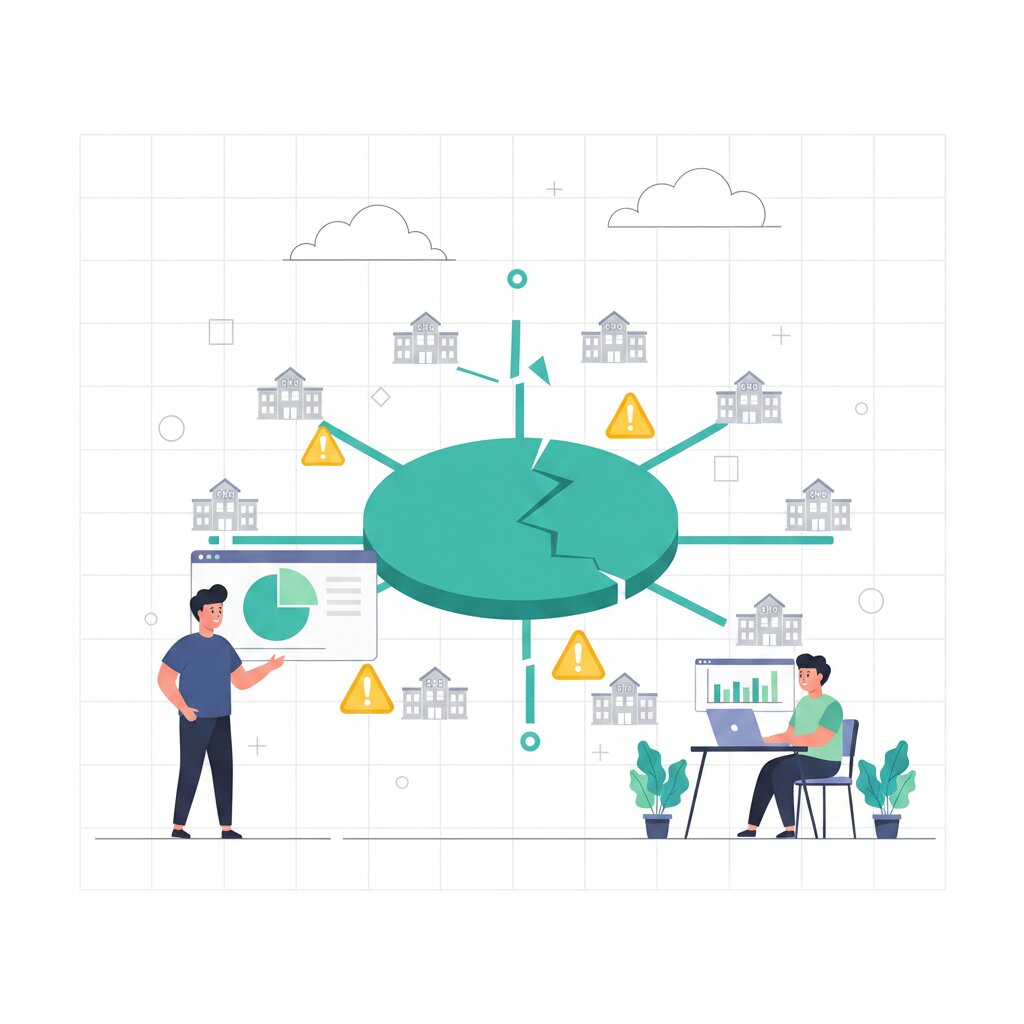

When the Canvas breach hit in May 2026, no school had been individually targeted. None had failed on their own. They had all shared one platform — and that platform held 41% of North American higher education by institution count, and roughly 50% by enrolment.
That is not just a market statistic worth noting. It is a structural condition. The breach was a predictable consequence of concentration — and if you manage any critical SaaS dependency, in education or anywhere else, the pattern will be very familiar.
What Is Canvas’s Market Share in Higher Education — and Why Does the Number Matter?
Canvas, developed by Utah-based Instructure, holds 41% of North American higher education institutions by institution count as a primary LMS, according to Phil Hill’s “State of Higher Ed LMS Market for US and Canada: Year-End 2024 Edition” (OneEdTech). Weighted by student enrolment, that share climbs to around 50% — the gap exists because large flagship universities and state systems are disproportionately Canvas customers.
That 41% translates to a global footprint of 8,809 institutions — all simultaneously disrupted in May 2026. Phil Hill’s “squid diagram,” which maps fifteen years of LMS market history, shows a market that has contracted rather than diversified.
And that is the problem. When 41% of institutions share one platform for coursework, grades, and communications, a security failure at the platform level is not an isolated event. Every institution in that cohort inherits the consequences at the same moment — not because each was individually attacked, but because they share infrastructure.
Is There a Safe Alternative to Canvas — or Does the Duopoly Remove That Option?
The instinctive response to a breach affecting a dominant vendor is to ask about switching. In the Canvas case, that means Blackboard, now operated by Anthology. That argument fails structurally.
Canvas and Blackboard together account for approximately 85% of the US higher education LMS market, derived from Phil Hill’s institutional data. By enrolment: Canvas approximately 50%, D2L Brightspace approximately 20%, Anthology Blackboard approximately 12% (OneEdTech/Phil Hill Year-End 2024). Switching from Canvas to Blackboard relocates concentration rather than resolving it. A Blackboard breach would be structurally identical.
The question “is Canvas more secure than Blackboard?” misframes the risk. Both platforms are multi-tenant SaaS. Both hold records for tens of millions of students. Both are attractive targets for exactly the same reason Canvas was targeted: one intrusion reaches an enormous number of records at once. The structural vulnerability belongs to the architecture of a concentrated market, not to any single vendor’s security posture.
Moodle is the architectural exception — each institution runs its own instance, so there is no shared infrastructure to breach at sector scale. But Moodle requires server infrastructure, technical expertise, and ongoing maintenance investment that most institutions simply do not have. The University of British Columbia‘s post-breach migration to Moodle and SharePoint is the most prominent switching case. It is exceptional precisely because it requires resources most institutions cannot match.
How Does Multi-Tenant SaaS Architecture Turn Concentration into Catastrophe?
Cloud deployments held 72.36% of the higher education LMS market in 2025 (Mordor Intelligence). For Canvas, multi-tenant cloud deployment is the architecture. When an institution signs a Canvas contract, it is not getting a dedicated instance — it is joining a shared platform where thousands of tenants coexist on common infrastructure, with data separation enforced through application-layer controls rather than physical separation.
💡 Multi-tenant SaaS: A deployment model where a single platform serves multiple customers simultaneously, with logical rather than physical data separation. A vulnerability in shared infrastructure can propagate across all tenants at once.
Canvas’s Free-For-Teacher (FFT) programme let educators create accounts without institutional verification — lower-friction onboarding on the same production platform as paid institutional tenants. Instructure confirmed the exploit originated from FFT account issues — a trust boundary failure between the FFT tier and institutional data. The full technical detail is in the breach itself. Remediation included permanent FFT shutdown and rotation of privileged credentials and API keys, indicating the attacker may have reached service-level authentication tokens across thousands of institutions in a single operation.
The pattern is not unique to education. The June 2022 Cloudflare outage brought down Discord, Shopify, and Fitbit simultaneously. WannaCry in 2017 exploited a single Windows vulnerability across 150 countries. Shared infrastructure converts one point of failure into a simultaneous multi-organisation event. Market concentration determines the blast radius.
Is Edtech More Concentrated Than Other Enterprise SaaS — or Is This Normal?
Salesforce holds approximately 23–24% of the global CRM market. Canvas holds 41% of its market — nearly double. No single CRM vendor failure would propagate to 41% of CRM users at once. The global CRM landscape — Salesforce, Microsoft Dynamics, Oracle, SAP, HubSpot — is fragmented enough that a single failure would be severe but not sector-defining.
The Herfindahl-Hirschman Index (HHI) gives you an objective comparison. It sums the squares of each competitor’s market share — markets above 2,500 score as highly concentrated. The LMS market sits substantially above that threshold. Apply the same calculation to your own SaaS stack; any critical-function platform with 40%+ share signals elevated systemic risk. The vendor concentration scoring framework covers the methodology.
ShinyHunters has breached Canvas, PowerSchool, and Infinite Campus in sequence — 62 million student records from PowerSchool, 275 million claimed from Canvas. Doug Thompson of Tanium frames the attacker logic: “It’s the math of a bank robber who just figured out where the armored truck stops. Why hold up a hundred branches when the truck visits all of them?” Anton Dahbura of Johns Hopkins adds: “Educational platforms are particularly rich targets given the concentration of personal, financial and international student data.” High concentration, high data sensitivity, historically limited cybersecurity investment. That is the attacker’s calculus.
Why Can’t Institutions Solve a Systemic Problem Through Their Own Procurement Decisions?
The risk is systemic, but the procurement decisions that created it were made one institution at a time. No individual institution decided to create a sector-wide vulnerability — each made a reasonable, locally optimal decision. The aggregate cannot be undone through individual action.
Standard third-party risk management (TPRM) evaluates vendors individually: security posture, compliance certifications, contract terms. A thorough Canvas assessment can return a clean result and still not reveal that 41% of peer institutions share the same dependency — a sector-level correlated risk no individual institution’s controls can address.
RiskLedger‘s concentration risk taxonomy classifies the Canvas case as a textbook dual failure: technological concentration (thousands of institutions sharing a single platform and infrastructure) combined with supplier/fourth-party concentration (Instructure sits in every dependent institution’s academic operations as a critical fourth party). Traditional TPRM maps institution-to-vendor. Concentration risk requires mapping the network and identifying the hubs.
Switching costs lock the whole thing in place: curriculum migration, faculty retraining, integration rebuilding, contractual lock-in. Canvas-to-alternative migration is a multi-year, multi-million-dollar undertaking. A vendor controlling 41% of its market knows customers cannot realistically threaten to leave. Institutional procurement leverage is structurally constrained — and vendors operate accordingly.
If your CRM holds 40%+ of its market, if your payroll platform dominates its sector, if your communications infrastructure runs through one provider — the logic is identical. Vendor concentration scoring starts with identifying which platforms in your critical-function categories would, if breached, expose you alongside thousands of peer organisations simultaneously.
What Are the Downstream Effects of Concentration — Regulation, Litigation, and Academic Continuity?
Concentration does not just determine who is affected. It determines the scale of every downstream consequence. The same structural feature — 41% market share — that made the breach possible multiplies its effects across every dimension at once.
Regulatory exposure (FERPA): FERPA applies to schools, not vendors. Instructure operates as a “school official” through its service agreements — but the institution bears responsibility for ensuring student data is used for authorised purposes only. When one vendor breach affects 41% of North American higher education simultaneously, thousands of institutions face FERPA notification obligations for a breach they did not cause. State-level laws — New York Education Law 2-d, California’s SOPIPA, approximately 130 analogous statutes — add further obligations. Full regulatory treatment is in FERPA at scale.
Academic continuity: Canvas went offline twice during the week of 5 May 2026 — end of spring semester, when grade submission, finals, and transcript completion are all simultaneously in play. Hundreds of institutions lost access to coursework and grade systems at the same moment. The full operational account is in the academic continuity failure.
Litigation scope: A vendor breach affecting 8,809 institutions and 275 million claimed records creates class-action potential that a single-institution breach simply cannot. The PowerSchool precedent — 62 million records, USD 17.25 million settlement, class actions in eleven states — is the closest comparable. Canvas would dwarf it. Detail in the class-action wave.
The pay-or-leak extortion mechanism: ShinyHunters instructed individual schools to negotiate directly before 12 May 2026, or watch data published. Institutions are not party to the negotiation between Instructure and the extortion group — yet they bear the FERPA obligation. When 8,809 institutions share one platform, all 8,809 face potential regulatory liability from a negotiation they cannot participate in.
These are predictable consequences of concentration. A breach affecting a 3% market-share LMS would generate a fraction of the regulatory, litigation, and continuity exposure. The multiplier is concentration itself. The broader Canvas breach analysis maps all seven dimensions of this event and what they mean for any organisation with a mission-critical SaaS dependency.
Frequently Asked Questions
What is LMS vendor concentration risk?
LMS vendor concentration risk is the systemic exposure created when a large proportion of institutions depend on a single learning management system. When a failure hits at the vendor layer, it cascades simultaneously across all dependent institutions — affecting academic operations, regulatory obligations, and data security at sector scale rather than at individual-institution scale.
What is Canvas’s market share in higher education?
Canvas holds 41% of North American higher education institutions by institution count and approximately 50% by enrolment, according to OneEdTech and Phil Hill’s “State of Higher Ed LMS Market for US and Canada: Year-End 2024 Edition.” That makes it the most widely adopted LMS in North American higher education by a significant margin.
Would switching from Canvas to Blackboard have protected institutions from the breach?
No. Switching from Canvas to Blackboard relocates concentration rather than resolving it. Canvas and Blackboard together control approximately 85% of the US higher education LMS market. A Blackboard breach would produce a structurally identical outcome — thousands of institutions simultaneously affected through a shared platform failure.
What is multi-tenant SaaS architecture?
Multi-tenant SaaS is a deployment model where a single platform instance serves multiple independent customers (tenants) with logical but not physical separation between their data. It is the dominant architecture for cloud-based LMS — 72.36% of higher education LMS deployments are cloud-based, per Mordor Intelligence. When trust boundaries between tenant tiers weaken, a single vulnerability can propagate across all tenants simultaneously.
What is a trust boundary failure in a SaaS platform?
A trust boundary failure occurs when the logical isolation between different privilege tiers or tenant segments in a multi-tenant platform breaks down — either through a vulnerability in shared infrastructure or through a compromised account tier that has unintended data access paths to other tiers. In the Canvas breach, the Free-For-Teacher (FFT) account architecture is the confirmed example: FFT accounts were production tenants with lower-friction onboarding that shared infrastructure with paid institutional tenants.
How does the LMS market compare to other enterprise SaaS markets in terms of concentration?
Canvas’s 41% share of the North American higher education LMS market is approximately double Salesforce’s 23–24% share of the global CRM market. The Herfindahl-Hirschman Index (HHI), which scores markets above 2,500 as highly concentrated, places the LMS market at the high-concentration end relative to most enterprise SaaS categories. The LMS duopoly is anomalously concentrated, not typical.
What is the Herfindahl-Hirschman Index and how is it used for vendor concentration risk?
The Herfindahl-Hirschman Index (HHI) is an economic measure of market concentration calculated by summing the squares of each competitor’s market share percentage. Values above 2,500 indicate high concentration. You can apply HHI to your own SaaS stack to quantify dependency concentration — a single platform with 40%+ share in a critical function scores as highly concentrated and signals elevated systemic risk.
Why is edtech specifically targeted for concentration-based attacks?
Edtech platforms combine three attacker-attractive features: high concentration (few platforms hold most of the market), high data sensitivity (student records, FERPA-protected personal data, financial aid information, private communications), and historically limited institutional cybersecurity investment. ShinyHunters’ sequential targeting of Canvas, PowerSchool, and Infinite Campus demonstrates this as a deliberate, systematic strategy — high concentration maximises breach yield from a single intrusion.
Why can’t institutions simply negotiate better security terms with Canvas?
Institutional procurement leverage is limited when a vendor controls 41% of the market and switching costs are prohibitive. Institutions cannot realistically threaten to migrate — Canvas knows this. Collective leverage through consortia or regulatory pressure via FERPA compliance audits are partial mechanisms, but individual institution negotiation has limited effect on a vendor with near-monopoly market position in its sector.
How does the pay-or-leak extortion model create specific problems for institutions dependent on a breached vendor?
The pay-or-leak model — used by ShinyHunters in the Canvas breach — sets a public ransom deadline for the vendor. If the vendor does not pay, student data is released publicly. Institutions are not party to the negotiation, yet they bear the FERPA obligation if student data is exposed. Concentration amplifies this: when 8,809 institutions share one platform, every one of them faces potential regulatory liability from a negotiation they cannot participate in.
What happened during the Canvas outage in May 2026, and why did it affect finals?
The Canvas breach and resulting outage occurred at the end of the spring semester — the period of the academic calendar for grade submission, final examinations, and transcript completion. Canvas went offline twice during the week of 5 May 2026. Institutions simultaneously lost access to coursework, assignments, and grade submission systems. The concentration of dependent institutions meant this was not an isolated disruption; it was a coordinated academic continuity failure across hundreds of institutions at once.
Does Moodle or open-source LMS solve the concentration problem?
Moodle provides architectural diversity — each institution runs its own instance, so there is no shared infrastructure to breach at scale. However, Moodle requires institutional server infrastructure, technical expertise, and ongoing maintenance investment that most higher education institutions lack. Moodle reported 420 million users across 245,000 sites in 2024. Open-source alternatives reduce concentration at sector level only if adoption is widespread enough to displace the duopoly — a transition that most institutions lack the resources to lead.