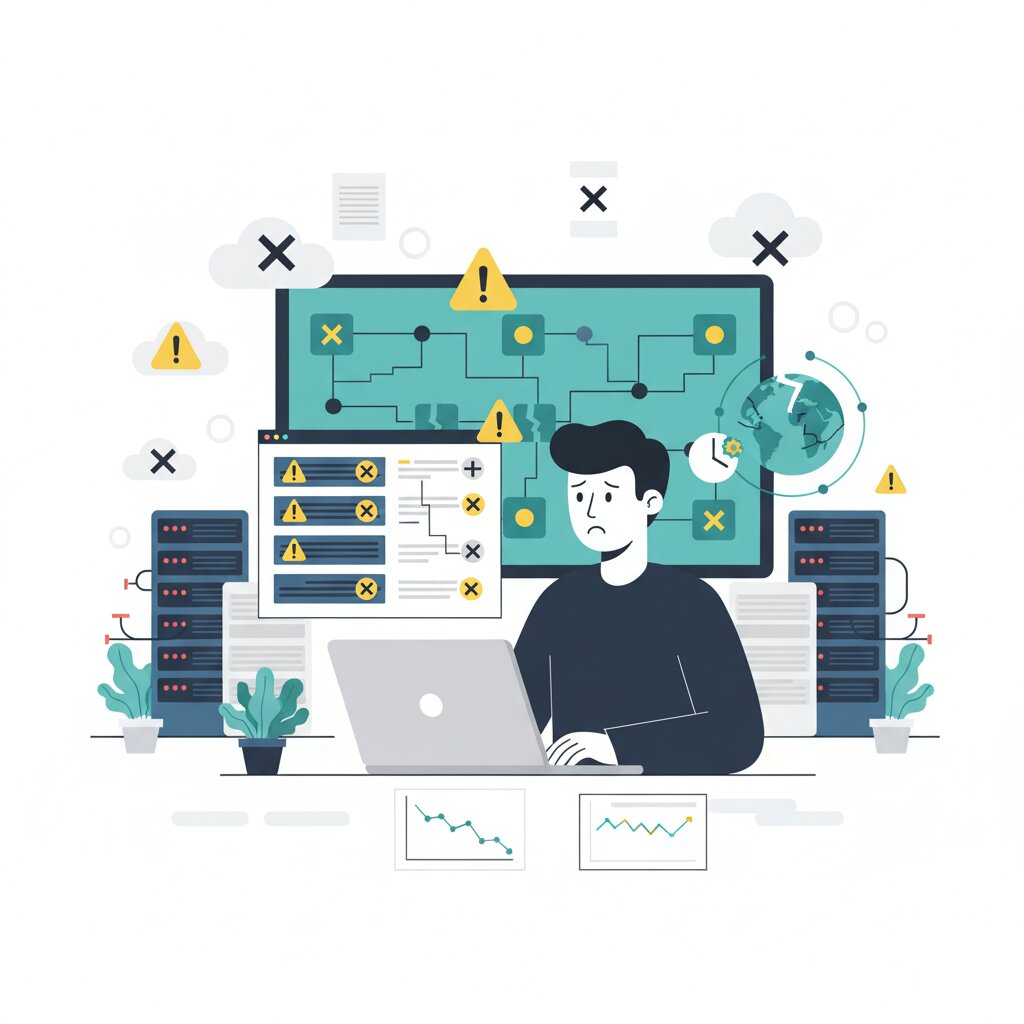

Cloudflare’s CTO had to apologise after an error took a huge chunk of the internet offline in late November 2025. They acknowledged “we failed our customers and the broader internet.” A month later, AWS had its own multi-hour outage affecting millions globally.
These incidents exposed something many technical leaders already suspected—standard SLA credits don’t cover actual business losses. Delta Airlines lost $500 million from a vendor outage but received only $60 million in credits. That’s an 88% gap between real damage and compensation.
The problem is you’re probably facing this vendor concentration risk without the procurement expertise to negotiate contracts that protect you. Engineering expertise doesn’t automatically translate to contract negotiation skills. As we explore in our comprehensive guide on infrastructure outages and cloud reliability in 2025, understanding vendor management is a critical component of modern cloud resilience strategies.
This guide provides practical tactics for negotiating better cloud contracts, tiering vendors by risk, establishing audit rights, and building vendor management programs that reduce third-party risk exposure.
How to negotiate cloud vendor contracts with better SLA terms?
Standard cloud SLAs offer 10% service credits when availability drops below 99.99%. These numbers sound reasonable until you calculate actual impact. Say you’re paying $50,000 monthly and experience a 14-hour outage that costs $150,000 in lost revenue. Your 25% credit gives you $12,500—covering about 8% of real damage.
You need custom SLA terms tied to your revenue loss, not just discounted service costs.
Start by calculating what vendor outages actually cost you. Include direct revenue losses, contractual penalties to your customers, incident response costs, and productivity losses. Use this data to justify custom terms. For a detailed methodology on calculating the true cost of cloud outages, see our comprehensive guide that includes frameworks for quantifying both direct and indirect impacts.
Demand right-to-audit clauses allowing independent verification of vendor security controls and compliance status. Standard contracts avoid this because vendors don’t want oversight. The introduction of data breach notification requirements has driven many organisations to require detailed contractual obligations with third-party suppliers.
Establish clear escalation paths with dedicated support contacts. Not ticketing systems—actual people you can reach when things break.
Include specific response time commitments for different severity levels with enforceable penalties. P0 incidents need responses in minutes, not hours.
Negotiate termination provisions with data portability guarantees. Specify export formats, timelines, and deletion processes. Failure to comprehend termination elements can result in unplanned service disruptions, data loss, or extended downtime.
Request transparent post-mortem reporting after outages. Cloudflare published detailed technical analyses of their November and December outages—that level of transparency should be contractual, not voluntary.
Never reveal your budget during early negotiations. Let vendors quote first. Clearly defined SLAs focusing on termination and renewal clauses provide transparent clauses regarding performance, support, and maintenance. Involve finance and procurement teams early.
What contractual clauses should you demand in cloud service agreements?
Right-to-audit clauses are non-negotiable for high-risk vendors. Continuous monitoring and vendor-provided reports may not reveal emerging vulnerabilities. You need independent verification of security controls for vendors handling sensitive data.
Custom liability caps exceeding standard limitations are the second priority. Standard contracts limit vendor liability to your monthly fees. That doesn’t cover actual business impact. Push for liability caps that reflect real exposure.
Vendors will say “this is our standard contract.” Counter with your business impact data. If they want your business, they’ll negotiate. Negotiated terms between enterprise and vendor are not merely a commercial discussion but a risk management exercise.
Data portability provisions guarantee export in standard formats during contract termination. Best practices include encrypted transfers and clear exit protocols to prevent data loss or corruption. Specify formats—JSON, CSV, or database dumps. Define timelines—usually 30 to 90 days.
Business continuity requirements obligate vendors to maintain documented disaster recovery procedures. Ask for copies. Verify they test them regularly.
Breach notification timelines specify maximum time vendors have to disclose security incidents. Many jurisdictions mandate notification within 72 hours. Your contracts should meet or exceed that.
Subcontractor disclosure requirements ensure transparency about third-party dependencies. The Target breach—40 million records exposed through an HVAC vendor—shows how subcontractor vulnerabilities cascade.
Regulatory compliance commitments protect you from liability. Healthcare needs HIPAA. Financial services need PCI-DSS. Everyone needs SOC 2. Rights to audit or receive SOC 2 reports should be specified in security measures aligned with ISO/IEC 27001 or NIST CSF.
How to build a vendor risk management program for SaaS companies?
Vendor risk management follows a seven-stage lifecycle: needs definition, vendor search and assessment, contract negotiation, onboarding, continuous monitoring, remediation, and offboarding or renewal.
Continuous monitoring is where most programs fail. Conduct thorough cybersecurity assessments addressing compliance requirements and vulnerabilities specific to each vendor type during onboarding. Deploy monitoring cadences based on vendor risk: quarterly for Tier 1 vendors, biannually for important vendors, annually for routine vendors. 61% of companies experienced a third-party data breach or cybersecurity incident in the past year—that’s why ongoing oversight matters.
Establish vendor tiering using a two-dimensional matrix: data sensitivity and business criticality. Data sensitivity measures what information vendors access. Business criticality assesses operational impact if vendors fail. Understanding third-party concentration risk and shared responsibility gaps provides the conceptual foundation for effective vendor classification and governance frameworks.
Develop incident response playbooks for vendor-caused outages. When Cloudflare goes down, what’s your immediate response? Document it.
Early-stage companies can manage vendor risk in spreadsheets. As you grow, use a vendor risk management solution to track cybersecurity and financial health over time.
How to tier vendors by risk level and business criticality?
The two-dimensional risk matrix combines data sensitivity and business criticality.
Data sensitivity has three levels. High means vendors access customer PII, payment data, or health records. Medium covers business data and analytics. Low involves public information.
Business criticality has three levels. Mission-critical means immediate revenue impact if vendor fails. Important means significant disruption but workarounds exist. Routine means minimal business impact.
Tier 1 vendors have high sensitivity and mission-critical impact. These require quarterly assessments, dedicated monitoring, custom SLA terms, and formal incident response procedures.
Tier 2 vendors represent medium risk combinations. These receive biannual assessments, standard monitoring, and enhanced SLA requirements.
Tier 3 vendors have low sensitivity and low criticality. Annual assessments and basic contract reviews suffice.
Example tier assignments: AWS or Azure hosting production infrastructure is Tier 1. Marketing automation platforms are Tier 2. Office supplies vendors are Tier 3.
Review classifications annually or when business context changes. Conducting thorough dependency mapping to understand all cloud and third-party service interconnections provides transparency needed for identifying single points of failure. Map which vendors your Tier 1 vendors depend on—indirect dependencies matter too.
What is vendor concentration risk in cloud infrastructure?
Vendor concentration risk occurs when organisations depend excessively on limited providers, creating systemic vulnerability to individual vendor failures.
The cloud market demonstrates significant concentration. AWS holds approximately 32% market share, Microsoft Azure approximately 23%, and Google Cloud approximately 10%—three providers control nearly two-thirds of the market.
CDN concentration is worse. Since June 2021, the Herfindahl-Hirschman Index for the top 10,000 most-visited websites jumped from 2,448 to 3,410. That crosses the 2,500 threshold indicating high concentration and oligopoly conditions.
Cloudflare and Amazon alone host over 30% of popular domains for DNS and web hosting. Add Google, Akamai, and Fastly, and five providers host 60% of index pages in the Tranco Top-10K.
This concentration creates cascading failure potential. When Cloudflare experienced outages on November 18 and December 5, 2025, they disrupted services globally.
When a single provider hosts most of an organisation’s workloads, that provider’s availability becomes the ceiling for the organisation’s overall availability. The October 20, 2025 AWS outage lasted several hours, affecting millions globally and costing the economy more than $1 billion.
Companies that went dark without even using AWS discovered just how entangled today’s software supply chains are. Indirect dependencies through SaaS vendors, APIs, or authentication systems can bring you down even when you’re not a direct customer.
Concentration risk differs from vendor lock-in. Concentration is market-level systemic issue. Lock-in is organisation-specific dependency making switching costly. For a deeper exploration of these distinctions and their implications for governance discussions, see our guide on understanding cloud concentration risk and vendor lock-in.
Regulatory frameworks like the Digital Operational Resilience Act now require firms to demonstrate resilience of their critical suppliers, not just assume it.
Mitigating concentration requires multi-cloud resilience and strategic vendor diversification. Don’t just move from one single provider to another—distribute dependencies.
How to implement multi-cloud resilience without massive cost increases?
Multi-cloud resilience distributes workloads across providers to eliminate single points of failure.
Workload partitioning runs different applications on providers optimised for specific requirements. You run compute on AWS, databases on Google Cloud, and CDN through Cloudflare. This leverages each provider’s strengths without duplicating infrastructure.
Active-passive failover maintains standby capacity at a secondary provider activated during primary outages. Your production runs on primary. The secondary stays warm or cold. When primary fails, you fail over to secondary.
Active-passive costs less than active-active because secondary uses minimal standby resources. You accept brief downtime during failover—typically 5 to 30 minutes.
Start with mission-critical workloads. Implement multi-cloud for Tier 1 services first. Don’t try to make everything multi-cloud on day one.
Leverage Kubernetes for workload portability—container orchestration enables cross-cloud deployment without vendor lock-in. Every SaaS solution should deliver one additional nine of availability beyond underlying infrastructure. If cloud vendors provide 99.9% uptime, multi-cloud should exceed 99.99% reliability.
Calculate expected outage losses. If AWS outages cost you $200,000 annually, spending $100,000 on multi-cloud has a two-year payback.
What is the difference between active-active and active-passive multi-cloud architectures?
Active-active runs identical workloads simultaneously across providers with real-time data synchronisation. If primary fails, secondary already handles production traffic with zero failover delay. In active-active design if one node fails, others are still running and take over that node’s tasks providing near-instantaneous failover.
Active-active costs more—full capacity across providers, continuous replication, complex synchronisation. You’re running two production environments continuously.
Active-passive maintains primary handling all traffic while secondary stays on standby. You accept brief downtime during failover. Detection, health checks, DNS updates, and traffic redirection typically require 5-30 minutes.
Active-passive costs less. Minimal standby resources. No continuous synchronisation overhead. Simpler operational model.
Architecture choice depends on business requirements. Financial services and e-commerce may justify active-active costs when downtime means immediate transaction losses. Many B2B SaaS applications work with active-passive—a 10-minute outage beats hours-long outage if your single provider fails.
Hybrid approaches work well. Run active-active for critical services like authentication. Use active-passive for fault-tolerant workloads. Keep low-criticality services on single cloud.
All nodes in active-active are hot and contribute to workload at all times resulting in better overall performance. You utilise resources across both providers continuously. Active-passive leaves secondary capacity mostly idle.
How do cloud provider outages impact business operations and costs?
The October 20, 2025 AWS outage cost the global economy more than $1 billion.
Direct revenue impact hits immediately. E-commerce sites lose sales. SaaS providers face service credit obligations. Financial services experience transaction failures.
Shopify lost just over $4 million during the 3.5-hour Cloudflare outage. Downstream merchant losses topped $170 million when aggregating Cloudflare impacts. Conservative estimates land north of $250 million across all affected businesses.
Operational disruption costs compound the damage. Engineering teams get diverted to incident response. Customer support volume spikes.
Healthcare system downtime costs medium to large hospitals between $5,300 and $9,000 per minute translating to $300,000-$500,000 hourly.
Cascading failures amplify impact. DynamoDB outage triggers failures across Lambda, ECS, and EKS, multiplying business disruption.
Contractual exposure creates liability without compensation. You missed SLAs to your customers because your vendor failed. But your vendor’s standard credits don’t cover your penalties.
Delta Airlines demonstrates this gap. They suffered $500 million in losses from the CrowdStrike incident but received roughly $60 million in vendor credits—covering only 12% of actual damages. These financial realities provide powerful leverage when negotiating SLA terms and demonstrate why standard agreements require customisation to reflect actual business impact.
Calculate this for your business. A consulting firm with 40 billable professionals at $250 per hour loses $10,000 per hour. Retailers face up to $4.5 million per hour.
When a four-hour outage costs $200,000, spending $50,000 annually on redundancy makes business sense. This calculation forms the foundation of building negotiation leverage through outage cost data.
For comprehensive guidance on navigating the broader landscape of vendor management strategies and cloud resilience governance, explore our pillar resource covering all aspects of infrastructure reliability and risk management.
FAQ Section
What caused the Cloudflare outages in November and December 2025?
The November 18 outage started with a ClickHouse database permissions change. The modification allowed users to view metadata for tables without adding a necessary database name filter. An unfiltered SQL query doubled the Bot Management system’s feature file from 60 to 200+ features. Cloudflare’s proxy had a hard-coded 200-feature ceiling. When exceeded, the system panicked triggering HTTP 5xx errors. The December 5 incident involved changes to body parsing logic aimed at protecting React Server Components against CVE-2025-55182 triggering a Lua exception.
What are the biggest cloud outages of 2025?
AWS October 20 was the largest, receiving over 17 million Downdetector reports lasting over 15 hours. The issue traced to DNS management problems for DynamoDB in US-EAST-1. Cloudflare November 18, 2025 registered over 3.3 million reports due to global disruption within core cloud infrastructure lasting nearly five hours. Google Cloud experienced a three-hour incident on June 12 affecting over 70 services, stemming from a new feature added to Service Control that overloaded infrastructure.
Should I be worried about depending on a single cloud provider?
Yes. Single-provider dependency creates single points of failure exposing you to complete service disruption when that vendor experiences outages. The October AWS outage and November Cloudflare incidents demonstrate that even dominant “reliable” providers fail. Forrester estimated the three-hour Cloudflare disruption cost businesses $250-300 million. Implement vendor risk management, negotiate strong SLA terms, and consider multi-cloud resilience for mission-critical workloads.
How to conduct vendor security assessments before onboarding?
Evaluate security controls through SOC 2 and ISO 27001 certifications. Verify financial solvency using credit reports. Check compliance status for industry requirements like HIPAA, PCI-DSS, or GDPR. Contact client references. Review liability insurance coverage. Examine incident response procedures and business continuity plans.
Where to find vendor risk management frameworks and checklists?
UpGuard provides authoritative VRM frameworks and continuous monitoring best practices. Industry standards include NIST Cybersecurity Framework vendor guidance, ISO 28000 supply chain security, and ENISA cloud security guidelines. Start with the seven-stage vendor lifecycle framework: needs definition, assessment, contract negotiation, onboarding, continuous monitoring, remediation, and offboarding.
Which cloud providers offer the best SLA guarantees?
Standard SLAs are similar across providers—AWS, Azure, and Google Cloud typically guarantee 99.9%-99.99% uptime with 10% service credits for breaches. SLA quality depends on negotiated custom terms. Focus on response time commitments, financial penalties beyond credits, audit rights, and business continuity requirements.
What is the real cost of a cloud outage for my business?
Calculate direct revenue losses during downtime, contractual penalties from SLA breaches to your customers, operational costs for incident response, productivity losses, and customer churn impact. Standard vendor credits typically cover only 10-15% of actual business impact.
How does vendor lock-in differ from vendor concentration risk?
Vendor lock-in is organisation-specific—your business becomes dependent on single vendor’s technology through proprietary APIs or data formats, making switching costly. Vendor concentration risk is market-level systemic issue where few dominant providers control infrastructure market, creating cascading failure potential. Lock-in increases your exposure to concentration risk by preventing diversification.
Can you explain why cloud outages are getting worse in 2025?
Infrastructure complexity increases failure modes. Interconnected services create cascading failure potential. Vendor concentration means more customers affected per incident. Rapid feature deployment introduces configuration errors. Dependency on automated systems can amplify human errors.
What’s the difference between Tier 1, Tier 2, and Tier 3 vendors?
Tier 1 vendors combine high data sensitivity with mission-critical business impact, requiring quarterly assessments, dedicated monitoring, and custom SLA terms. Tier 2 vendors represent medium risk combinations receiving biannual assessments and enhanced SLA requirements. Tier 3 vendors have low sensitivity and low criticality needing annual assessments and basic contract reviews.
How often should I reassess vendor risk classifications?
Use continuous monitoring for Tier 1 vendors with quarterly formal assessments. Review Tier 2 vendors biannually. Assess Tier 3 vendors annually. Trigger immediate reassessment when vendors experience security breaches or major outages, your usage changes, vendors undergo acquisition, or regulatory requirements change.
What are right-to-audit clauses and why do they matter?
Contractual provisions allowing independent verification of vendor security controls and operational practices through on-site audits or third-party assessments. They matter because vendor-provided reports may not reveal emerging vulnerabilities. Right-to-audit enables verification of contractual commitments and identification of security gaps before they cause incidents. Important for Tier 1 vendors handling sensitive data.