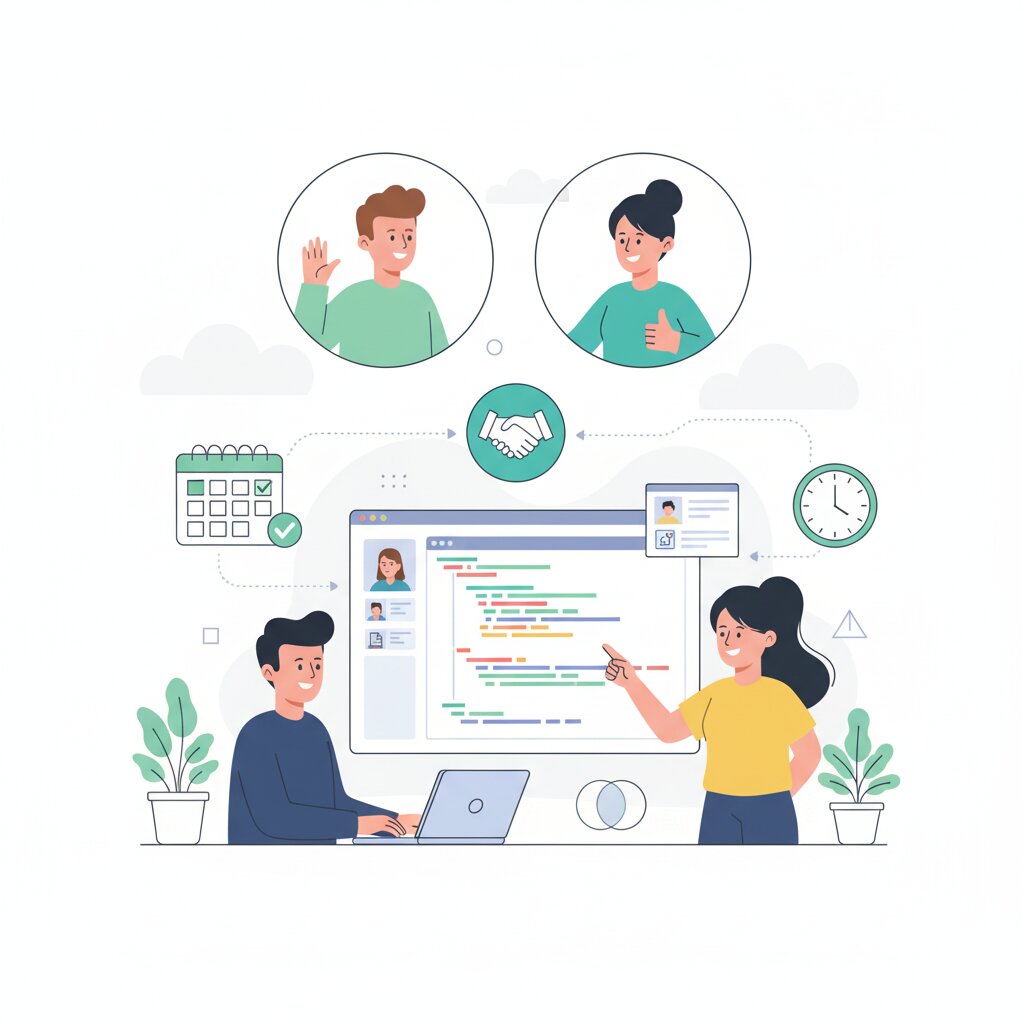

Hybrid work is the new standard for engineering teams. Some people work from home, others are in the office, and everyone’s trying to figure out how to make it all work. As part of the broader return-to-office landscape in 2025, technical leaders face unique challenges in keeping distributed development teams productive and aligned.
The challenge is real. How do you keep productivity up when your team is scattered? How do you make sure remote engineers don’t get passed over for promotions just because they’re not visible? How do you avoid burning everyone out with constant video calls?
Here’s the good news. Research shows that specific practices can increase trust by 30% and achieve 91% fairness ratings in hybrid teams. These aren’t generic “have more meetings” suggestions. They’re engineering-specific practices that address code reviews, pair programming, async communication, and making your limited office time actually count.
In this article we’ll walk through what you need to know: team-determined schedules that prevent proximity bias, trust-building systems that work for distributed teams, and the documentation and communication practices that make hybrid engineering teams productive.
What is proximity bias and how does it affect hybrid engineering teams?
Proximity bias is when you unconsciously favour the people who are physically present in the office. It creates inequitable recognition and advancement opportunities, even when the quality of work is identical. This is one of the key challenges in navigating the office return context that many technical leaders face today.
96% of executives report noticing in-office contributions more than remote work. Think about what that means. You’ve got an engineer who ships solid features, writes clean code, and mentors juniors through thoughtful pull request reviews. But they work remotely. Meanwhile, someone else is in the office, visible at lunch conversations, present when architectural decisions get discussed informally. Guess who gets remembered at performance review time?
For engineering teams, proximity bias shows up predictably. Architectural decisions get made during office lunch conversations, excluding remote engineers. Technical leadership opportunities go to whoever was in the room. Code contributions from remote engineers get less attention during performance reviews.
The damage compounds. Initial bias in visibility leads to fewer opportunities, which reduces future visibility, creating a self-reinforcing loop. Not great.
The solution is implementing outcome-based evaluation and team-determined schedules. These approaches shift focus from physical presence to actual results.
How do team-determined schedules prevent proximity bias and build trust?
Team-determined schedules mean your team collectively decides when members come to the office. Not individuals choosing for themselves. Not managers mandating attendance. The team decides together.
Research from Gallup shows this approach achieves a 91% fairness rating compared to just 73% when managers determine the schedule.
When the team decides together, no one gets penalised for location choices they didn’t control individually. The consistency in attendance patterns makes remote members’ schedules predictable, eliminating coordination headaches. And when everyone agreed to the schedule, you can’t claim someone is “not committed” for working remotely on agreed remote days.
Here’s how to implement it. Convene a team discussion about hybrid needs and preferences. Identify what collaborative work genuinely requires in-office time. Establish a trial schedule for 4-6 weeks. Review and iterate based on what you learn.
Self-determined schedules come with trade-offs. Employees with self-determined schedules are 76% more likely to report burnout as their greatest challenge and 57% more likely to report reduced work-life balance. Individual autonomy sounds great until coordination breaks down and everyone’s stressed.
Why is asynchronous communication necessary for hybrid engineering teams?
Asynchronous communication is any method that doesn’t require simultaneous participation. Written code reviews. Design documents. Recorded demos. Slack messages that don’t expect immediate replies.
Shopify Engineering describes it as the glue holding distributed workforces together. It’s inclusive across time zones, creates an audit trail, and gives everyone the same window into what’s happening.
In physical offices, context gets gathered through osmosis. You overhear conversations. You see what people are working on. That doesn’t happen remotely. Async communication replaces osmosis with explicit, documented information sharing.
The shift to async means a shift to permanence. Conversations leave searchable records. Decisions get documented instead of lost. Future team members can understand why choices were made because the reasoning is written down. That’s a good thing.
For engineering workflows, async is a natural fit. Code review comments, pull request discussions, and technical RFC documents produce better outcomes than verbal approvals. The written format forces clarity.
GitLab’s approach is instructive. Optimise for high synchronous collaboration within teams and asynchronous communication between teams. Engineers on the same team should have overlap hours for discussions and pair programming. But communication with other teams can be async by default.
Common async tools include Slack for threaded discussions, GitHub or GitLab for code review, Notion or Confluence for documentation. The key is establishing team norms around response time expectations and where information lives.
What are the four trust-building practices that increase trust by 30%?
Gallup research identifies four practices that together increase employee trust by nearly 30 percentage points.
Transparency in decision-making. Document why decisions were made, not just what was decided. Share decision criteria before decisions happen. Explain trade-offs considered, especially for architecture and technical direction.
Consistent communication cadence. Regular written updates at predictable intervals. No information surprises where remote team members find out about changes after the fact. The same information available to everyone regardless of location.
Equitable treatment. Outcome-based evaluation, not face-time assessment. Rotate tasks fairly across the team. Ensure remote members get the same opportunities for conference attendance, leadership roles, and high-visibility projects. When employees receive the same opportunities whether they’re remote or on-site, they feel more trusted.
Follow-through on commitments. Do what you say you’ll do. Respond to messages within stated timeframes. Implement agreed policies. Deliver promised resources. Broken commitments erode trust faster than any other factor.
All four together create a foundation of psychological safety. Run regular anonymous surveys asking about fairness perceptions, decision transparency, and manager reliability. If scores decline, you’ve got an early warning that trust is eroding.
How should engineering teams optimise in-office days for collaborative work?
Office time is limited in hybrid models. Use it for high-bandwidth collaborative activities that genuinely benefit from physical presence.
High-value in-office activities: architecture planning sessions that need whiteboarding, pair programming for complex problems, onboarding new engineers with hands-on mentoring, resolving complex technical conflicts.
Poor uses of office time: individual coding (better at home without interruptions), routine status meetings (more efficient async), administrative tasks.
When your team determines the schedule, explicitly identify what collaborative work happens on office days. Don’t just say “everyone in on Tuesday.” Say “Tuesday is for architecture planning and pair programming sessions.”
Avoid forced attendance without purpose. If you mandate office time but there’s no genuine collaborative value planned, you undermine trust. That breeds cynicism. For more guidance on implementing fair RTO policies that maintain team morale, consider how schedule decisions align with your broader workplace policy.
Research suggests 2-3 days per week provides balance for most hybrid teams. Prioritise quality over quantity.
Even on office days, accommodate remote members. Record whiteboard sessions. Document decisions in writing.
How do you adapt code review processes for distributed engineering teams?
Code review is naturally an async activity. Embrace it.
The foundation is rich context in pull requests. Write detailed PR descriptions explaining why you made the changes, not just what changed. Include visual aids like screenshots and architecture diagrams. Give reviewers everything they need to understand the change without having to ask you questions.
Code reviews are valuable for spreading knowledge across the team. When one developer reviews another’s code, they learn about that feature area.
Set clear expectations. Define response time SLAs, like first response within 24 hours. Establish review thoroughness standards. Make these norms explicit so everyone knows what’s expected.
Distribute review load to avoid bottlenecks. Use GitHub or GitLab features for automatic reviewer assignment.
Keep review guidelines lightweight. Focus on design and logic issues, not nitpicking formatting. The goal is collaborative improvement, not gatekeeping.
What communication tools and infrastructure do hybrid engineering teams need?
You need five core categories. An async communication platform like Slack or Microsoft Teams. Code collaboration via GitHub or GitLab. A documentation wiki using Notion or Confluence. Video conferencing with Zoom. Project tracking through Linear or Jira.
For engineering teams specifically, you need code integration so Slack connects to GitHub. Search functionality for retrieving past discussions. Threading for technical conversations. High-quality screen sharing for pair programming.
Integration matters more than individual tool features. Notifications from GitHub appearing in Slack. Project updates linked to documentation. When tools work together, workflows are seamless.
Common mistakes: using too many tools, creating fragmented communication. Poor adoption because tools are too complex. Missing integrations that force manual work.
GitLab’s principle is instructive. Choose a single system for communicating project progress. If it’s not in an epic, issue, or merge request, it doesn’t exist.
How do you measure productivity in hybrid engineering teams without creating surveillance culture?
Focus on outcomes, not activity. Features shipped, bugs resolved, incidents prevented. Results matter. Presence doesn’t.
Avoid surveillance entirely. No keystroke logging. No screen monitoring. No time tracking. These tools erode trust faster than any metric improves performance.
The DORA framework provides validated metrics: deployment frequency, lead time for changes, change failure rate, and mean time to recovery. These measure team effectiveness without individual surveillance.
The DX Core 4 consolidates DORA, SPACE, and DevEx frameworks into four balanced dimensions: speed, effectiveness, quality, and impact. Companies like Booking.com quantified a 16% productivity lift from AI adoption using these metrics.
Don’t measure lines of code or raw ticket counts. These are easily gamed. An engineer who refactors a complex module might delete more lines than they add while creating significant value.
Teams that feel trusted are more productive. Measurement should inform improvement, not create fear.
How do you onboard new engineers in a hybrid work environment?
You can’t rely on over-shoulder learning in hybrid teams. Documentation and structure become critical.
Start with comprehensive documentation covering architecture, development setup, deployment processes, and team norms.
Assign an explicit buddy. Make one person responsible for daily check-ins, code review learning, and answering questions.
Schedule overlap time for the first 2-4 weeks. Early-career engineers especially struggle with fully remote onboarding. They need synchronous time to ask questions and get immediate feedback.
Use progressive integration. Start with well-scoped starter tasks that let new hires contribute without needing to understand the entire system.
Have new hires document the setup process as they go through it. They’ll identify gaps in your documentation that you’ve become blind to.
Knowledge transfer should be ongoing, not a one-time dump. The smoother your process, the faster new hires become productive.
What documentation practices support effective hybrid engineering team collaboration?
Architecture Decision Records (ADRs) are the foundation. An ADR documents why technical decisions were made, the context at the time, and alternatives considered. This replaces verbal tribal knowledge that disappears when people leave.
Each ADR should include: title, status, context, decision, and consequences. Store ADRs with the codebase or in a searchable wiki.
Runbooks and playbooks document operational procedures, incident response, and deployment processes. These enable self-service without asking teammates who might be asleep in a different time zone.
Every meeting should produce documented outcomes, decisions, and action items. No verbal-only decisions. GitLab’s rule is strict. Any side conversation gets documented in the agenda, and useful elements get ported to relevant issues or merge requests.
Code comments and README files provide context in the repository itself. Document team norms and processes. Make implicit expectations explicit.
Organise your knowledge base with searchable structure. Prune outdated content regularly. Outdated docs are worse than no docs because they mislead people.
The effort-value balance matters. Not everything needs documentation. But anything architecturally significant should be documented. Ask yourself: will someone six months from now need to understand why we made this choice? If yes, document it.
FAQ
How do I prevent burnout in hybrid engineering teams?
Set clear work-hour boundaries. No expectation of 24/7 availability. Async-first communication reduces pressure to respond immediately.
Model work-life balance by not sending messages outside work hours. If you’re working late, schedule messages to send during business hours so you’re not creating pressure for your team.
Monitor workload distribution. Watch for overwork signals like late-night commits and weekend work. Address it in 1:1s before burnout happens.
What should I do when team members disagree on office schedules?
Return to team-determined schedule principles. Identify what collaborative work genuinely requires in-office time.
Find overlapping days that work for the majority. Respect genuine conflicts like childcare and long commutes.
Trial the schedule for 4-6 weeks then iterate. Treat it as an experiment, not a permanent decree.
How often should hybrid engineering teams meet in person?
Generally 2-3 days per week provides balance. Some teams succeed with 1 day weekly.
Prioritise quality over quantity. One well-planned office day beats three days of people working individually at desks.
Can pair programming work effectively in remote or hybrid settings?
Yes. You need proper tools and practices, but remote pairing works.
High-quality screen sharing with low latency is necessary. IDE plugins for collaborative editing like VS Code Live Share help.
Rotate pairs to spread knowledge. Some pairs find remote pairing more focused than in-office because there are fewer distractions.
How do I ensure remote team members don’t miss important information?
Document all decisions in writing. No verbal-only decisions.
Use threaded Slack or Teams conversations for team-relevant discussions instead of DMs.
Record meetings and share notes. Use explicit @mentions for important updates. Centralise reference information in a wiki so people can find it when they need it.
What’s the difference between team-determined and self-determined hybrid schedules?
Self-determined: individuals choose their own office days. This maximises personal flexibility but creates coordination challenges.
Team-determined: the team collectively decides the schedule. This achieves 91% fairness ratings versus 73% for manager-determined schedules.
Self-determined schedules are 76% more likely to report burnout as the greatest challenge and 57% more likely to report reduced work-life balance.
How do I handle time zone differences in distributed engineering teams?
Async-first communication reduces real-time dependency. Distributed teams rely heavily on detailed design documents and recorded meetings.
Identify overlap hours for time-sensitive discussions. Use those hours strategically.
Rotate meeting times to share inconvenience fairly. Use recorded demos instead of live presentations.
Establish response time expectations of 24-48 hours rather than immediate replies.
What metrics indicate a hybrid team is struggling versus thriving?
Thriving signals: consistent deployment frequency, low change failure rate, improving cycle times, high code review engagement, positive retrospective feedback.
Struggling signals: increasing deployment intervals, quality issues rising, missed deadlines, low pull request activity, declining attendance, turnover increasing, fairness scores dropping.
Track DORA metrics at the team level: deployment frequency, lead time, change failure rate, and mean time to recovery.
How do I transition an existing co-located team to hybrid work?
Start with a team discussion of hybrid vision and concerns.
Audit and improve documentation. Co-located teams often have poor documentation because they rely on verbal communication.
Establish a team-determined schedule through collaborative planning. Select async communication tools.
Run a trial period of 8-12 weeks with regular retrospectives. Resist reverting to office-first habits like verbal decisions.
Should engineering managers work the same hybrid schedule as their team?
Generally yes, especially aligning with team-determined office days.
Asymmetric schedules create proximity bias risk. If you’re more accessible to office workers than remote workers, remote team members are at a disadvantage.
Communicate your schedule explicitly. Ensure remote accessibility during your remote days.
How do I build team culture and social connections in hybrid environments?
Plan intentional social time during office days. Team lunches, coffee breaks.
Virtual social activities for remote days, but make them optional. Forced fun creates resentment.
Celebrate wins in public channels. Set up social channels to spotlight interests and talents. The stronger the community, the stronger the collaboration.
Team retrospectives build trust through process improvement.
What should be in a hybrid work policy for engineering teams?
Team-determined schedule framework and process. Communication response time SLAs. Meeting guidelines: video on, recordings shared, notes documented.
Outcome-based evaluation criteria making it clear you assess results, not presence. Documentation requirements for decisions.
Work-hour boundaries and availability expectations. Office space booking process if needed. Expense policies for home office equipment.
Trial period and review process for policy iteration. Create clear expectations for remote work quality. For comprehensive guidance on fair enforcement and communication strategies, ensure your policy addresses both technical requirements and team morale considerations.