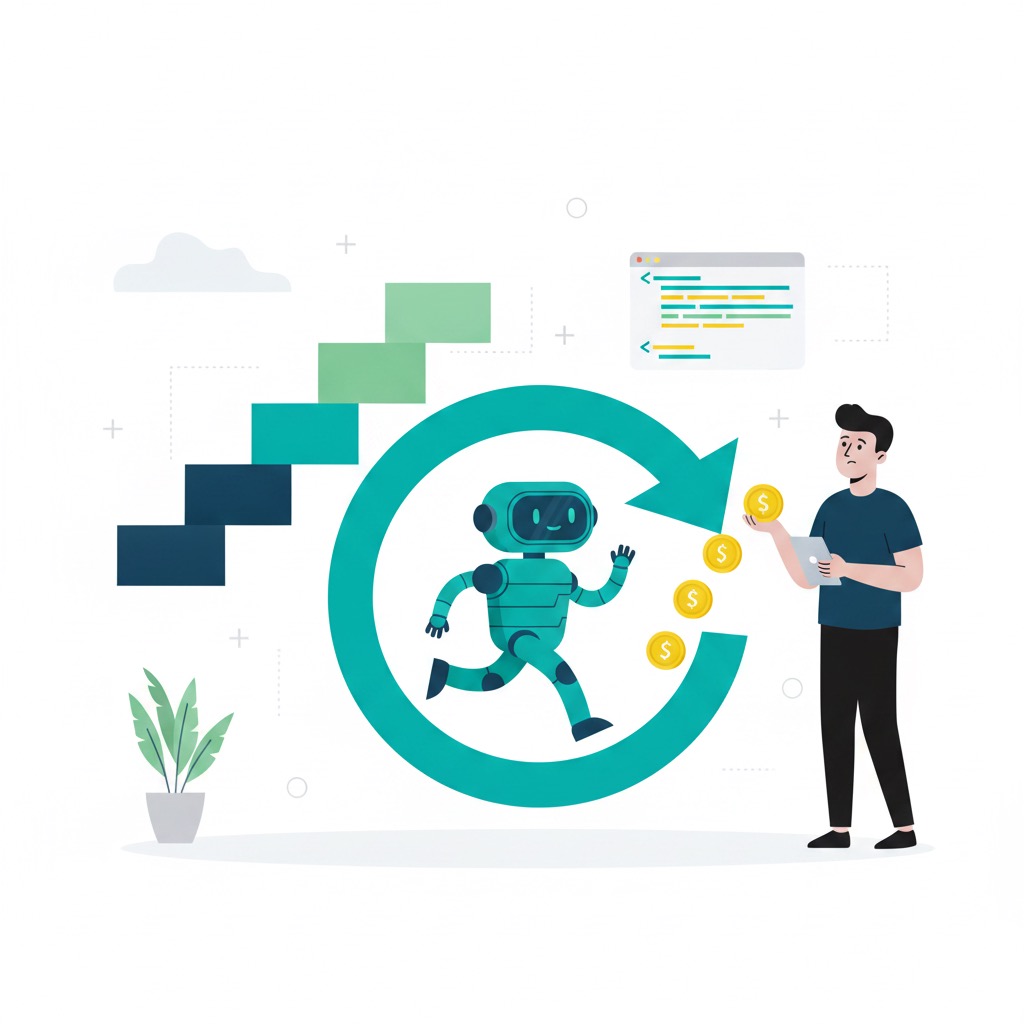

When Fortune reported that GPT-5.4 was designed to target Anthropic’s enterprise coding stronghold, that wasn’t a general product announcement. It was a market attack. The category at stake: enterprise coding workloads, where Claude holds an estimated 42–54% of spend versus OpenAI’s 21%. Every time a model like GPT-5.4 ships, the teams responsible for AI infrastructure face the same question: do we upgrade now and absorb the engineering cost, or do we hold the line and risk falling behind?
The honest answer is that costs sit on both sides. Upgrading means prompt re-tuning, regression testing, and evaluation overhead. Not upgrading means capability lag and, eventually, a forced migration when deprecation arrives. Most organisations have strong opinions about this but no framework for making the decision deliberately — and no language to take it to the board. In this article we’ll cover both, connecting the operational evidence from the model release treadmill to a strategic decision framework your board can actually engage with.
What does “lock in” actually mean — and what does “keep up” actually cost?
The lock-in posture means pinning a specific model version and building stability around it. You invest in deep prompt optimisation, your engineers aren’t context-switching for migrations, and costs are predictable. What you’re trading away is capability currency — the locked model ages while competitors upgrade, and the forced migration eventually arrives all at once.
The keep-up posture means continuously upgrading to the latest available model. You stay at peak capability. What you’re trading away is stability. The more time you invest optimising prompts for a specific model, the higher the risk of degraded results when you upgrade. Every optimisation that improves today’s performance is a potential regression when tomorrow’s model arrives.
Neither posture is obviously correct. That’s the point.
The failure mode between them is the upgrade trap: an organisation commits deeply to a model, invests in prompt optimisation and workflow integration, then faces a forced migration when that model is deprecated. It paid the cost of specialisation without the stability of deliberate lock-in, and faces migration without model-agnostic architecture. On the model release treadmill, this failure mode is increasingly easy to fall into because the upgrade cycle is faster than most evaluation timelines.
Why is provider lock-in different from model lock-in — and why does the distinction matter?
Most content conflates these two risks. They’re different problems with different remedies.
Provider lock-in is commercial and technical dependency on a single AI vendor — API contracts, pricing exposure, deployment infrastructure. The remedy is an API abstraction layer (like LiteLLM) or a multi-cloud deployment model.
Model lock-in — sometimes called behavioural lock-in — is tight coupling to a specific model’s output characteristics: prompt compatibility, reasoning patterns, structured output schemas. These accumulate regardless of which vendor delivers the model. Switching from OpenAI to Anthropic doesn’t solve model lock-in. The remedy is model-agnostic prompt design and a continuous evaluation harness — architectural choices, not vendor choices.
The distinction matters because the $315,000 average cost of a platform migration bundles both types of cost together. A multi-provider architecture solves provider lock-in without touching model lock-in.
There’s a third form worth understanding: agentic lock-in. When AI agent orchestration layers become tightly coupled to a specific model’s runtime behaviour, lock-in accumulates at multiple layers simultaneously — foundation model, orchestration framework, runtime environment, developer patterns. A single abstraction layer can’t resolve it. The Model Context Protocol (MCP) — an open standard developed by Anthropic and adopted by OpenAI and Google DeepMind — provides structural counterforce at the tool-integration layer.
“Enterprises that have not defined their agent architecture strategy are already making a lock-in decision, just not a conscious one.” — Kai Waehner
What is the competitive pressure actually driving the keep-up argument?
When a competitor deploys a purpose-built model to target your incumbent provider’s stronghold, a performance gap can translate directly to customer retention and product differentiation. The argument for upgrading stops being theoretical.
But here’s the thing: GPT-5.5 shipped approximately six weeks after GPT-5.4. At that cadence, some organisations are still completing one migration when the next is announced. The competitive advantage from any single upgrade has a shrinking half-life — which changes the cost-benefit calculus considerably.
This is also where benchmark claims become unreliable. GPT-5.5’s safety card compared it to Claude Opus 4.5, which had already been superseded by Opus 4.7 before publication. For the full treatment of the benchmark inflation problem, that article has everything you need.
What are the hidden costs of chasing the latest model?
The keep-up posture’s real costs are a stack that compounds over time. And it’s worth going through each one.
Prompt engineering debt is the cost least visible until migration. Prompt optimisation is model-specific — the phrasing that produces excellent output from Claude may produce mediocre results from GPT-5.4. Every upgrade cycle partially invalidates your prior investment.
Regression overhead comes next. Every upgrade requires testing your production workflows against the candidate model. Without a continuous evaluation harness, that testing is manual and often incomplete — 85% of organisations misestimate AI project costs by more than 10%, with model maintenance accounting for 15–30% of overhead.
Developer distraction is the most diffuse cost. Engineers context-switching between feature work and migration work lose velocity on both. It shows up as slower product delivery, not as a line item in your budget.
Each keep-up cycle starts from a less stable base because the previous upgrade’s debt hasn’t fully cleared. Even a lock-in posture eventually faces forced migration — but it defers and concentrates that cost. For the operational detail on migration burden and deprecation shelf life, the deprecation article covers the evidence.
What are the hidden costs of committing to a stable version?
The lock-in posture has its own accumulating risks. Treating it as a safe default misreads the profile.
Competitive disadvantage accumulates when your locked model ages while competitors upgrade. Anthropic held an 18-month lead in coding benchmarks, but GPT-5.4 was built to close that gap. The risk accretes regardless of your use case.
Technical debt accumulates the longer you’re pinned to a specific version. GPT-4o was retired in March 2026, auto-upgraded to GPT-5.1, and the resulting migration checklist — audit systems, test alternatives, update code, deploy to staging, run integration tests, brief the team — represents weeks of engineering work. The longer the lock-in, the longer that checklist gets.
The lock-in posture is only low-cost if it’s paired with architecture that makes future upgrades reversible. A prompt graph and agent configuration tuned against one model version may not behave equivalently against its successor. Lock-in without an exit plan is technical debt with a deferred payment date.
How should organisations frame model churn risk at the board level?
The framing that works is vendor management and capital planning, not tooling preference.
Model churn is a vendor management risk. Your organisation depends on a vendor whose product roadmap is not governed by your release cycle. Boards recognise this pattern from ERP decisions — the ERP analogy is accurate: a core system dependency whose roadmap a third party controls.
Model churn is a capital planning exposure. The recurring cost of migration — engineering hours, regression testing, prompt re-tuning, downtime risk — is foreseeable and budgetable. Migration typically costs twice as much as the initial investment. It belongs as a recurring line in your AI infrastructure budget, not an unplanned engineering request.
Model churn is a risk reserve requirement. Forced migrations from deprecation are unscheduled capital expenditure. A risk reserve proportional to migration cost and likelihood is defensible and auditable.
Model selection decisions that cross a cost or risk threshold should require board-level sign-off, not a sprint planning decision. For organisations with EU operations, the EU AI Act (effective 2025) makes this governance, not preference.
The Kai Waehner Trust vs. Lock-In Matrix is a useful board-presentable framework. Anthropic’s “Trusted and Flexible” positioning — Constitutional AI, AWS Bedrock deployment, MCP adoption — is a concrete input to vendor risk assessment for compliance-sensitive boards.
The deliverable that converts this from engineering concern to boardroom agenda item: a documented AI vendor risk position covering switching cost estimates, migration timelines, mitigation architecture, and a defined risk reserve.
What signals should trigger an upgrade decision?
A new model release starts an evaluation process, not a migration. Upgrade decisions driven by release announcements, benchmark scores, or press coverage hand control of your migration calendar to the provider.
Here are the signals that justify upgrading:
A capability gap confirmed on production tasks. The candidate model demonstrably outperforms the incumbent on your own canonical task set — not vendor benchmarks, but representative production workloads. Benchmarks are frequently saturated, contaminated, or stale before publication. A 13-point Terminal-Bench 2.0 gap may produce zero benefit in your production pipeline.
A deprecation notice. Migration is no longer optional — the question is timing and whether you have the abstraction layer to make it cheap. Organisations that haven’t built abstraction architecture face forced migration at the worst possible time.
A confirmed competitive performance threshold. A competitor has shipped a product feature your model cannot match, and the gap is attributable to model capability rather than product or engineering differences.
Abstraction architecture is in place. Without this, even a clear capability signal should be weighed against migration cost.
Signals that should not trigger an upgrade: a vendor benchmark showing the new model scores higher; press coverage of a competitor switching; the engineering team’s preference for the latest model.
Before any migration: run your existing prompt library against the candidate model; benchmark on production-representative tasks; quantify regression scope; estimate total migration cost against the capability gain. If the gain is transient — the next release is six weeks away — the cost-benefit may not close.
The architectural resolution to the lock-in vs. keep-up dilemma is not a posture choice. Building architecture that makes upgrades reversible removes the dilemma entirely — the upgrade question becomes a cost-benefit calculation rather than a strategic commitment. The implementation patterns are in the model-agnostic AI architecture article. For the full context on model churn risk across every layer of the enterprise AI stack, see the pillar.
That resolution still has to be built, and building it is a staffing question before it’s an architecture one: who does the work and how soon they can start. A hiring round is the slowest way to answer that when a competitor’s release has already set the clock running. SoftwareSeni’s extended development teams put engineers on it now, without the recruiting delay.
see how extended development teams get engineers in place without a hiring round →
“I’ve worked with SoftwareSeni for many years now across different CTO roles. Davo and his team are such a pleasure to work with and they have always provided the best and most capable resources when I needed them. They run a well oiled process to ensure they find and present the best candidates, plus they ensure smooth onboarding process. I highly recommend SoftwareSeni to any company that is wanted to expand their team and keen to explore an embedded team model.”
— Simon Farrell, VP of Engineering, Forage
FAQ
What is the difference between the “lock in” strategy and the “keep up” strategy for enterprise AI model selection?
Lock-in means pinning a specific model version for operational stability and predictable costs — at the risk of capability lag. Keep-up means continuously upgrading to maximise capability — at the cost of recurring migration overhead, regression testing, and prompt re-tuning debt. The right choice depends on capability sensitivity, engineering capacity, and whether abstraction architecture is in place.
What is the difference between model churn risk and provider lock-in risk?
Provider lock-in is commercial dependency on a single vendor; the remedy is an API abstraction layer. Model churn risk is operational instability from frequent AI model upgrades — regression testing, prompt re-tuning, evaluation burden — and exists regardless of vendor. A multi-provider architecture solves provider lock-in without touching model churn risk.
How do I convince my board or VP Engineering that model churn is a structural infrastructure risk, not a tooling preference?
Reframe the cost: migration overhead is a vendor management exposure and capital planning item, not discretionary tooling spend. Use the ERP analogy: model selection is a core system dependency whose roadmap a third party controls. Quantify the reserve: estimate migration cost and present it as a recurring budget line.
How does OpenAI’s six-week release cadence compare to Anthropic’s cadence in 2026?
GPT-5.4 to GPT-5.5 was approximately six weeks; Claude Opus 4.7 landed in mid-April 2026 with GPT-5.5 in production within ten days. The cadences are competitive. The more useful comparison is deprecation policy: evaluate providers on notice period reliability and migration support, not release frequency.
Which AI providers have the most stable, predictable deprecation and migration policies?
OpenAI’s Microsoft Azure Foundry GA model retirement policy requires at least 60 days’ notice; preview models get 30 days. Anthropic puts most production versions on a 12-month observable horizon. Key signals: minimum notice period, migration guide quality, API versioning commitments, and whether stable versions are distinguished from preview versions.
Should I upgrade to the newest AI model or stick with what’s working?
Hold the current model unless: a capability gap is confirmed on your own production tasks, a deprecation notice has been received, or a competitor has shipped a feature your model cannot match. Do not upgrade because a benchmark scores higher or press coverage is positive. Before upgrading: run your prompt library against the candidate, quantify regression scope, and estimate re-tuning cost against the gain.
How do I stop having to rewrite my AI prompts every time a new model comes out?
The root cause is model lock-in: prompts calibrated to a specific model’s behaviour must be re-tuned when that model changes. The architectural solution is model-agnostic prompt design — prompts written to stable task specifications rather than model-specific output patterns. The strategic solution is deciding deliberately between a keep-up posture (accept re-tuning as a recurring cost) or a lock-in posture (pin the model and build abstraction architecture).
What is “the upgrade trap” in enterprise AI strategy?
The upgrade trap is the failure mode of a half-committed keep-up posture: deep prompt investment in a specific model, then a forced migration when it is deprecated — losing both the stability of lock-in and the flexibility of model-agnostic architecture. High migration cost plus competitive lag.
What is “agentic lock-in” and why is it harder to manage than API-level lock-in?
Agentic lock-in occurs when AI agent orchestration layers become tightly coupled to a specific model’s or vendor’s ecosystem. It accumulates at multiple layers simultaneously — API schema, reasoning patterns, tool-use conventions, memory structures — and cannot be resolved by a single abstraction layer. The Model Context Protocol (MCP), developed by Anthropic and adopted by OpenAI and Google DeepMind, provides structural counterforce at the tool-integration layer.
Why does Fortune’s reporting on GPT-5.4 matter for enterprise AI strategy decisions?
Fortune reported GPT-5.4 was designed to target Anthropic’s enterprise coding stronghold — confirming the keep-up pressure is directed competitive targeting, not coincidental cadence. MindStudio and Menlo Ventures data put the stakes in context: Claude holds 42–54% of enterprise coding spend versus OpenAI’s 21%, the gap GPT-5.4 was engineered to close.
Is multi-provider AI architecture the answer to the lock-in vs. keep-up dilemma?
A multi-provider architecture solves provider lock-in but does not solve model lock-in — prompts tuned to one model’s behaviour still require re-tuning when that model changes. Multi-provider architecture must be combined with model-agnostic prompt design and continuous evaluation infrastructure.
What is the Kai Waehner trust vs. lock-in matrix and how does it apply here?
A two-dimensional framework positioning AI vendors across enterprise trust (safety, governance, data sovereignty, regulatory compliance) and vendor lock-in exposure (API dependency, ecosystem entanglement, data gravity). Anthropic positions in the “Trusted and Flexible” quadrant — Constitutional AI, AWS Bedrock deployment, MCP adoption. Useful for board-level vendor evaluation in a governance context that boards and CFOs recognise from other vendor categories.
When the next model release forces the question, do you have engineers ready, or a hiring round ahead of you? Talk to SoftwareSeni about extended development teams