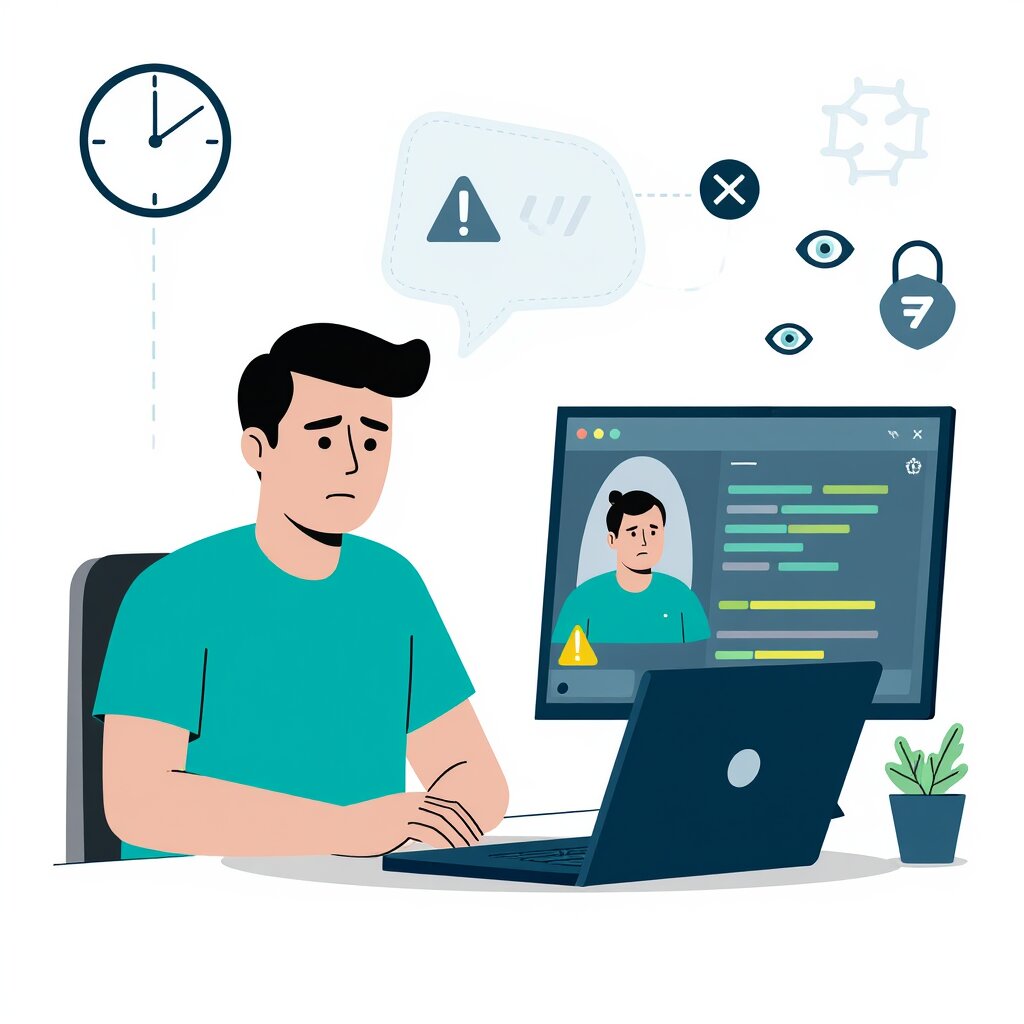

Picture this: A candidate is confidently walking through a complex binary search tree problem during a video interview. Their explanations sound polished. Their code looks perfect. There’s just one problem – they’re reading everything from an invisible AI-powered overlay that the interviewer can’t see on the shared screen.
AI interview assistance tools have broken remote technical hiring. The numbers tell the story: 80% of candidates use LLMs on code tests despite explicit prohibition, and 81% of FAANG interviewers suspect AI cheating. The data shows systemic adoption across the industry.
This article walks through the technical mechanics of these cheating tools, the quantitative evidence of how widespread the problem is, and what it costs organisations when false positive hires make it through the process. Understanding what you’re up against is the first step toward figuring out how to respond. This analysis is part of our comprehensive strategic framework for responding to AI interview challenges.
What Are AI Interview Assistance Tools and How Do They Work?
AI interview assistance tools are software applications that capture interview content in real-time and generate suggested responses using large language models. They come in three main flavours: invisible desktop overlays like Interview Coder, browser-based tabs like FinalRound AI, and secondary device apps like Interview Hammer.
The core function is straightforward. The tool captures the interview question – either by screenshotting the coding environment or transcribing the interviewer’s audio – sends it to an LLM, and displays the AI-generated answer back to the candidate. All of this happens without the interviewer seeing anything suspicious.
Vendors market these as “real-time coaching” but hiring teams call it what it is: cheating. Using AI to practise beforehand is studying. Using AI during the interview is fraud.
The technical sophistication varies. Invisible overlays exploit how operating systems render application layers. Browser-based tools disguise themselves as innocent documentation tabs. Secondary device strategies keep the entire cheating apparatus physically separate from the monitored interview machine.
But the outcome is the same – candidates who can’t actually code are passing technical screens and getting offers.
How Do Invisible Overlay Tools Like Interview Coder Work?
Invisible overlay technology creates a transparent application layer that sits above your screen content. It captures the interview material, sends it to an LLM, and displays suggested code and explanations in that invisible layer. The key exploit: it renders below the capture level of screen sharing in video conferencing apps.
When you share your screen in Zoom or Teams, those apps capture content at a specific rendering layer in the operating system. Interview Coder’s overlay renders at a layer that screen sharing can’t see. So the interviewer’s view shows a clean coding interface, while the candidate sees AI-generated solutions displayed transparently over the shared content.
The tool stays active but never shows an icon in the dock or taskbar. It runs silently without appearing in Activity Monitor. The overlay is click-through – your cursor passes right through it. Even if the session is recorded, the overlay leaves no visible trace.
Interview Coder was created by Columbia University student Chungin “Roy” Lee. He was expelled for using it to cheat on his own technical interviews, allegedly including obtaining an Amazon internship through fraud. After the expulsion, he rebranded the tool as Cluely and raised $5.3M in funding.
The tool works across all major video platforms: Microsoft Teams, Zoom, Google Meet, Amazon Chime, Cisco Webex. It supports the major coding platforms too: HackerRank, CoderPad, Codility. The vendor claims “zero documented cases of users being detected” when using it properly, though that’s marketing copy, not verified fact.
Two Columbia students, Antonio Li and Patrick Shen, responded by creating Truely, detection software specifically designed to counter Cluely. This detection-evasion cycle continues to evolve as both sides develop new capabilities.
How Widespread Is AI Cheating in Technical Interviews?
The data from multiple independent sources tells a consistent story. Karat’s co-founder reports that 80% of candidates use LLMs on code tests even when explicitly prohibited. The interviewing.io survey of 67 FAANG interviewers found that 81% suspect AI cheating and 33% have actually caught someone.
This isn’t isolated incidents. It’s the new baseline. The majority of remote interview candidates use some form of AI assistance.
75% of FAANG interviewers believe AI assistance lets weaker candidates pass. Interview Coder’s testimonials page is full of candidates claiming offers at Meta, Google, Amazon, Apple, Netflix, Tesla, TikTok, Cisco, Uber, and Microsoft. One anonymous testimonial boasts: “Got Meta and Google offers even though I failed all my CS classes!”
The motivation is understandable. Hiring processes are often broken. Candidates face disconnected academic questions that have nothing to do with actual work. As HireVue’s chief data scientist notes, “a lot of the efforts to cheat come from the fact that hiring is so broken”. Candidates are asking themselves how to get assessed fairly when the process itself is fundamentally unfair.
But understanding the motivation doesn’t change the outcome. When AI helps candidates pass interviews they shouldn’t pass, organisations end up with false positive hires who can’t do the job.
58% of FAANG companies have adjusted the types of algorithmic questions they ask in response to AI cheating. The industry recognises the problem. The question is whether adjusting questions is enough.
Why Are LeetCode-Style Interviews So Vulnerable to AI Cheating?
LeetCode-style algorithmic problems have well-documented solutions. Binary search trees, Huffman encoding, graph traversal, dynamic programming – these are academic problems that have been discussed, dissected, and solved across GitHub, Stack Overflow, Reddit communities like r/leetcode, textbooks, and academic papers. LLMs are extensively trained on all of that content.
David Haney’s analytical framework identifies three enabling conditions that must all be present for undetected cheating: academic questions with public solutions, automated screening with no human interaction, and no follow-up questions to verify understanding. Break any one of these conditions and you disrupt the cheating pathway.
The problem is structural. 90% of tech companies use LeetCode-style questions while only 10% actually need this expertise daily in their jobs. The questions test pattern recognition rather than problem-solving ability. LLMs excel at pattern recognition – they’ve effectively memorised the entire LeetCode solution space.
Without probing follow-up questions, AI-generated solutions look identical to genuine candidate work. The typing happens at the same speed. The code follows the same patterns a real candidate would use. There’s no tell.
Google CEO Sundar Pichai has suggested returning to in-person interviews specifically to eliminate remote cheating vectors. Zero FAANG companies have abandoned algorithmic questions despite the cheating concerns, but Meta interviewers report shifting to “more open-ended questions which probe thinking, rather than applying a known pattern”.
The simplest detection method remains human judgment: asking candidates to explain their solutions line-by-line reveals whether they truly understand the code.
What Are the Business Costs of Undetected AI Cheating?
False positive hires are candidates who pass interviews using AI but lack actual competence. They’re discovered post-hire during probation or when they hit their first real project. The costs compound quickly.
Direct financial cost: You waste a six-figure salary on an engineer who cannot perform basic tasks. Add recruiting expenses, onboarding costs, and re-hiring expenses when you inevitably need to replace them. You’re looking at 3-6 months of wasted investment before the probation failure.
Team poisoning is the bigger problem. Low-quality code, poor architectural decisions, and an inability to debug problems grind your product roadmap to a halt. Your senior engineers – your most valuable asset – are forced to stop innovating and start babysitting. They’re cleaning up buggy code, rewriting entire features, and hand-holding the unqualified new hire.
That leads to burnout and frustration. Your best people start looking elsewhere because they’re tired of carrying dead weight.
The data suggests this is widespread: “More people pass interviews than get exited during their probation period”. An LLM can help you pass an interview but it can’t help you be good at your job. Dealing with incidents, technical designs, and consistent communication is a whole different thing that AI can’t assist with once you’re employed.
Remote hiring credibility takes a hit too. When false positive rates spike, companies lose confidence in remote processes and revert to expensive in-person interviews. That limits access to the global talent pool and creates geographic hiring constraints that put you at a competitive disadvantage. The long-term workforce implications of false positive hires extend far beyond individual hiring mistakes.
How Do Browser-Based Tools Like FinalRound AI Evade Detection?
FinalRound AI takes a different technical approach. Instead of invisible overlays, it runs as a seemingly innocent browser tab during video interviews, blending in with legitimate documentation tabs that many candidates have open.
The tool employs real-time audio monitoring to capture interviewer questions, converts speech to text, sends it to an LLM for processing, and displays polished responses via on-screen overlays. The candidate just recites what they’re reading.
Browser tabs appear normal in screen sharing. There are no suspicious processes running that would trigger detection software. The browser integration disguise is effective because it exploits legitimate behaviour – who doesn’t have documentation open during a coding interview?
The adaptive response adjustment is clever. The tool modifies answers mid-interview to mask candidate knowledge gaps. If a candidate struggles to understand the AI’s first suggestion, the tool rephrases it in simpler terms.
Talview has developed a specific detection platform targeting FinalRound AI through behavioural analysis. Their approach includes audio intelligence systems to detect abnormal AI-generated prompts and monitoring behavioural patterns to flag scripted or unnatural responses.
Detection software continues evolving alongside cheating tools, creating an ongoing technical arms race.
What About Secondary Device Strategies?
The secondary device method keeps things simple. You run software on a second computer or even a phone that listens to interview questions in real-time, feeds them to an AI, and displays perfect answers.
The advantage: physical separation. The cheating apparatus is completely separate from the monitored interview device. No suspicious processes, no overlays, no browser integration that might get detected. Your screen-sharing or proctoring software is completely blind to it.
The disadvantage: physical tells. The candidate needs to glance away from the screen to read the secondary device. That creates detection opportunities through gaze tracking and eye-tracking technology that monitors where candidates look during responses.
Environmental camera scanning can detect hidden phones, notes, extra monitors, or reflections of second screens. Some platforms require candidates to pan their webcam to confirm they’re alone in a distraction-free space.
Audio detection can identify whispered coaching from secondary devices too. Live gaze and face tracking flags frequent downward glances, sideways looks, or off-camera behaviour suggesting note-reading.
Secondary device strategies are less sophisticated than overlays but they’re still effective against organisations without proper environmental monitoring.
How Are Companies Responding to the Crisis?
Companies are deploying multiple strategies: detection tools like Truely and Talview, redesigning questions to be AI-resistant, and in some cases reverting to in-person interviews for final rounds.
11% of FAANG companies use cheating detection software, mostly Meta. Meta requires full-screen sharing enforcement and background filter disabling, staying “pretty front-and-center” on detection prevention. For organisations considering the detection path, our comprehensive guide to detecting AI cheating provides detailed implementation frameworks.
58% of companies have adjusted interview questions to company-specific problems not documented online. Companies are moving away from standard LeetCode problems toward more complex, custom questions. About one-third of interviewers changed how they ask questions, emphasising deeper understanding through follow-ups. Technical leaders exploring the redesign approach can reference our guide on AI-resistant interview question design for practical alternatives to algorithmic tests.
Detection software is getting sophisticated. Truely monitors open windows, screen access, microphone usage, and network requests, generating cumulative likelihood scores. It works across Zoom and Google Meet platforms.
Talview claims 95% accuracy in identifying cheating incidents with detection rates 8x higher than traditional methods. They employ dual-camera monitoring and LLM-powered AI agents operating 24/7 for violation detection.
EvoHire uses speech pattern and lexical analysis to identify the subtle but distinct patterns of a candidate who is reading a script.
67% of startups report meaningful AI-driven process changes including eliminating algorithmic take-homes entirely. CoderPad CEO Amanda Richardson emphasised that AI-assisted interviews using 1000-2000 line codebases are making interviews harder and impossible to do without AI.
Industry responses suggest that AI changes evaluation methods but doesn’t lower hiring standards.
Wrapping This Up
AI tools have broken remote technical interviews. Invisible overlays, browser disguises, and secondary devices all bypass traditional proctoring. The 80-81% quantitative evidence confirms systemic adoption across the industry.
Probation failures and project delays across the industry demonstrate these costs: wasted salaries, team poisoning, lost productivity, and erosion of remote hiring credibility.
There’s no single solution. Companies need to choose strategic pathways that match their hiring context: invest in detection software, redesign their interview process around AI-resistant formats, or accept the costs of returning to in-person interviews for some roles.
Understanding the mechanics and scale is the foundation. The next step is figuring out your response strategy – for guidance on evaluating detection, redesign, and embrace approaches, see our strategic framework for responding to AI interview challenges.
FAQ
Is using AI during a coding interview considered cheating?
Yes. Using AI assistance during a live interview without disclosure is universally considered cheating by employers. It violates the fundamental premise that interviews assess your abilities, not an AI’s capabilities. Even when tools market themselves as “coaching,” hiring teams classify real-time AI assistance as fraudulent misrepresentation of skills.
Can AI really help candidates pass FAANG interviews without coding skills?
Yes, with caveats. 75% of FAANG interviewers believe AI assistance allows weaker candidates to pass. These false positive hires typically fail during probation when required to perform actual work. AI provides algorithmic solutions but doesn’t transfer genuine problem-solving ability, debugging skills, or system design thinking needed for job performance.
Are companies going back to in-person interviews because of AI cheating?
Partially. Google CEO Sundar Pichai suggested returning to in-person interviews specifically to eliminate remote cheating vectors. However, zero FAANG companies have completely abandoned remote interviews. Most companies pursue multi-pronged strategies: deploying detection software, redesigning questions to be AI-resistant, and reserving in-person interviews for final rounds rather than complete reversion.
How do invisible overlays bypass screen sharing detection?
Invisible overlays exploit how operating systems render application layers. The overlay renders below the capture level of video conferencing tools like Zoom and Teams. The shared screen feed shows only the legitimate interview interface while you see AI-generated responses displayed transparently over the shared content. It’s an architectural exploit, not a configuration error.
What percentage of candidates actually use AI to cheat on technical interviews?
Two corroborating sources: Karat reports 80% of candidates use LLMs on code tests despite explicit prohibition, and interviewing.io surveyed 67 FAANG interviewers finding 81% suspect AI cheating with 33% having caught someone. These figures indicate systemic prevalence – the majority of remote interview candidates use some form of AI assistance.
Why are LeetCode-style questions so vulnerable to AI assistance?
LeetCode-style algorithmic questions are vulnerable because: LLMs are trained on GitHub, Stack Overflow, and textbooks containing these solutions; they test pattern recognition rather than novel problem-solving; and LLMs have essentially memorised the entire LeetCode problem space and solution patterns.
What is the “Three Conditions Framework” for interview cheating?
David Haney’s framework identifies three enabling conditions that must all be present for undetected cheating: academic questions with documented solutions, automated screening without human engagement, and no verification through line-by-line explanation. Breaking any single condition disrupts the cheating pathway. See “Why Are LeetCode-Style Interviews So Vulnerable to AI Cheating?” for full analysis.
What are the business consequences of false positive hires?
False positive hires create compounding costs including wasted salary (3-6 months before termination), team productivity decline, re-hiring expenses, and damage to remote hiring credibility. See “What Are the Business Costs of Undetected AI Cheating?” section for detailed breakdown.
How can interviewers detect if a candidate is using AI assistance?
Primary detection methods: follow-up questions requiring line-by-line code explanation reveal genuine understanding; behavioural pattern analysis identifies unnatural pauses and response copying patterns; environmental scanning catches secondary devices or suspicious eye movement; and custom questions with no documented solutions prevent AI reference.
What is Interview Coder and why is it controversial?
Interview Coder is an invisible overlay application that exploits screen-sharing vulnerabilities. See “How Do Invisible Overlay Tools Like Interview Coder Work?” section for complete technical details and backstory.
Do detection tools like Truely actually work?
Detection effectiveness data remains limited. Truely monitors open windows, screen access, microphone usage, and network requests. Talview claims 95% accuracy with detection rates 8x higher than traditional methods. They increase detection rates compared to no countermeasures, but sophisticated cheaters using secondary device strategies can still evade technical detection, making human interviewer follow-up questions essential.
Is AI interview assistance legal?
Legal status varies by jurisdiction. Using AI assistance isn’t illegal in a criminal sense but typically violates: employment application fraud statutes for misrepresenting qualifications; company policy agreements candidates sign before interviews; and academic integrity codes if used for school-related assessments. Legal risk is primarily civil (contract breach, termination for cause, offer rescission) rather than criminal.