
Over 80% of professional developers now use AI tools in daily work, up from 27% in 2022. But the transformation this represents isn’t just about tools. It’s reshaping professional identity, competency frameworks, productivity expectations, career progression, quality standards, daily workflows, and organisational structures simultaneously.
If you’re leading an engineering team through this shift, you’re navigating something more complex than simple tool adoption. Developers who once found professional satisfaction in hands-on coding are questioning what it means to be a developer when AI generates implementations. Teams report feeling faster while velocity metrics stay flat. Junior hiring has declined 25% year-over-year as AI automates traditional entry-level tasks. Trust in AI output dropped from 42% to 33% in a single year, even as adoption climbed to 84%.
This comprehensive guide helps you understand the full landscape of developer transformation. You’ll find evidence-based insights synthesised from GitHub, Anthropic, METR, Faros AI, and Stack Overflow research. Each section provides overview-level understanding of a transformation dimension, then connects you to deep-dive articles addressing your specific priorities—whether that’s navigating team psychology, restructuring career paths, setting realistic productivity expectations, establishing quality governance, or leading organisational change.
What you’ll find in this guide:
- From Coder to Orchestrator: Understanding the psychological dimension of role transformation and the four stages of AI adoption
- The Four Essential Skills: New competencies defining AI-era developers and frameworks for assessment and training
- The Productivity Paradox: Research evidence explaining why developers feel faster while measuring slower
- The Broken Rung: Career disruption, hiring evolution, and strategies for developing talent in the AI era
- Almost Right But Not Quite: Trust decline, security vulnerabilities, and systematic validation frameworks
- When to Delegate: Tactical decision criteria for daily delegation choices while preserving expertise
- Scaling Organisational Gains: Why 21% individual gains become 0% organisationally and how to capture benefits
This hub serves as your navigation centre—providing comprehensive overview while connecting you to focused guidance for immediate needs.
How is AI Redefining What It Means to Be a Developer?
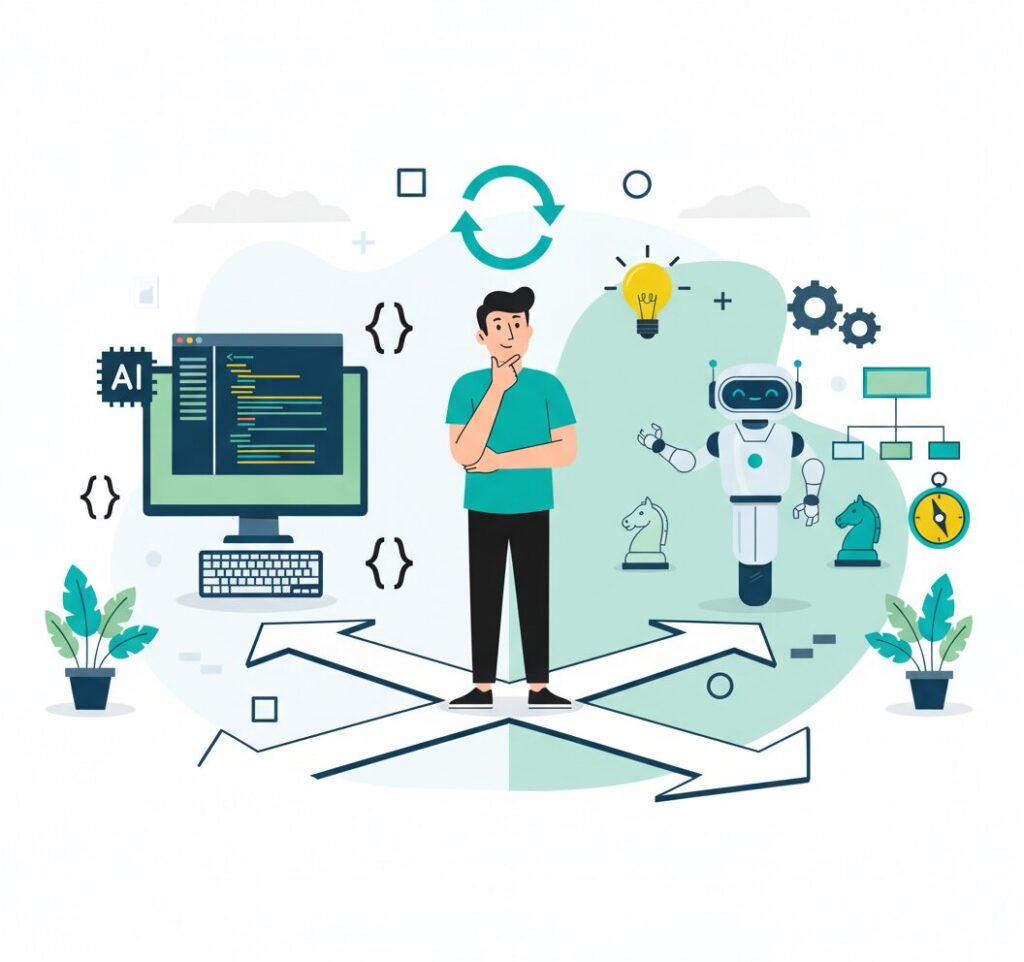
AI coding assistants are transforming developers from hands-on code writers to orchestrators who articulate intent, delegate implementation, and validate correctness. This shift separates solution design from code implementation. Developers still create solutions that solve problems, but increasingly delegate the typing to AI tools. Many developers experience identity anxiety as their core activities change, but the transformation parallels familiar transitions like moving from individual contributor to technical leadership. Uncomfortable, certainly. But navigable with frameworks and mindset adjustments.
The role transformation is substantial. Developers increasingly act as what research calls “creative directors of code”—defining architecture, specifying requirements in natural language, and rigorously reviewing AI-generated implementations rather than writing every line themselves. Advanced AI users no longer primarily write code but focus on “defining intent, guiding agents, resolving ambiguity, and validating correctness.”
This creates psychological complexity. For developers who find professional satisfaction in hands-on coding, the shift feels like losing what makes the work meaningful. The anxiety reflects change in what defines competence and value in the profession—moving from individual coding prowess to orchestration effectiveness. “If I’m not writing the code, what am I doing?” asked one developer in 2023. By 2025, the answer emerged: setting direction, establishing architecture and standards, while delegating implementation to AI.
Research identifies four adoption stages developers move through: AI Skeptic (low tolerance for errors, minimal usage) → AI Explorer (building trust through quick wins and cautious experimentation) → AI Collaborator (frequent iteration and co-creation with AI) → AI Strategist (multi-agent orchestration and strategic delegation). Understanding where your team members sit on this progression helps you support their development and normalise the discomfort.
The transformation also surfaces in emerging interaction patterns. “Vibe coding”—Andrej Karpathy’s term for developers who “fully give in to the vibes,” expressing high-level intent in natural language and trusting AI to handle implementation—represents an extreme delegation style. GitHub data shows 72% of developers reject this approach, preferring iterative collaboration where they maintain control and validate outputs. The tension between speed and understanding, automation and skill preservation, runs through the entire transformation.
Understanding this psychological dimension matters for managing team morale, structuring training programmes, and communicating transformation vision. Developers aren’t resisting change out of stubbornness—they’re experiencing professional identity disruption that needs acknowledgment and frameworks.
For deep exploration of the emotional and conceptual dimensions of this transformation, including parallels to leadership transitions you’ve personally experienced and frameworks for normalising discomfort while embracing opportunity, see From Coder to Orchestrator—Navigating the Psychological Shift in Developer Identity. This guide provides empathetic framing for understanding developer identity evolution and practical strategies for supporting your team through this transition.
What Skills Matter Most for Developers in the AI Era?
Four new skill categories emerge: context articulation (translating requirements into AI-executable instructions), pattern recognition (identifying what to automate versus code manually), strategic review (efficient validation without bottlenecks), and system orchestration (designing human-AI workflows). These complement—not replace—durable fundamentals like problem decomposition, system design, and debugging methodology. The paradox: you need coding skills to supervise AI effectively, yet AI usage can erode those same skills if delegation isn’t balanced thoughtfully.
“The ability to clearly express project requirements, architectural constraints, and code standards” determines how well AI understands your intent. If you can’t specify what you need, AI struggles to deliver it. This requires product thinking, requirements clarity, and system understanding—ironically, the same skills that make you a strong hands-on developer.
Pattern recognition enables identifying repetitive workflows suitable for delegation to autonomous agents, allowing engineers to dramatically multiply effectiveness. Not all tasks benefit equally from AI assistance. Boilerplate generation, refactoring well-understood code, writing tests for defined behaviour, and creating scaffolding are ideal candidates. Novel algorithm design, security-critical logic, complex business rules, and unfamiliar domains require hands-on coding to build mental models.
Strategic review focuses on efficiently reviewing AI-generated changes and providing targeted feedback, including spotting edge cases the AI missed. This competency prevents validation from becoming the bottleneck by developing pattern-matching abilities that identify likely problem areas quickly, establishing checkpoints that balance thoroughness with speed, and creating feedback loops that improve AI output quality over time. The 91% increase in PR review time on high-AI-adoption teams demonstrates what happens when strategic review skills aren’t developed.
System orchestration involves designing workflows where humans and AI each contribute what they do best. Developers bring creativity, strategic thinking, and novel problem-solving; AI brings tireless execution, pattern matching across vast codebases, and consistency in routine tasks. Effective orchestration maximises both.
These new competencies sit alongside durable skills that remain valuable regardless of automation. Andrew Ng emphasises that the most productive programmers combine deep computer science understanding, software architecture expertise, and cutting-edge AI tool familiarity. Approximately 30% of computer science knowledge may become outdated, but the remaining 70% remains foundational.
Overreliance on AI tools can cause decline in fundamental skills, abstracting away technical details that developers need for debugging, optimisation, and holistic system design. This creates the “paradox of supervision”—you need technical depth to validate AI output, but delegating too much can erode that depth over time. Balancing automation benefits with skill preservation requires deliberate strategies.
Technical skills now last only about 2.5 years, making continuous learning essential. Organisations require developers who can leverage AI assistance for rapid software system engineering, apply AI techniques including prompting and retrieval-augmented generation, and execute swift prototyping and iteration cycles. AI fluency becomes a meta-competency underpinning everything else.
For detailed frameworks, assessment criteria, training curricula, and strategies for developing these competencies while preventing skill atrophy, see The Four Essential Skills Every Developer Needs in the AI Era. This article provides actionable guidance for building AI-era developer competencies and evaluating them in your team.
What Does the Productivity Evidence Actually Show?
Research reveals a striking productivity paradox: developers complete 21% more individual tasks and feel faster, but organisations see no measurable delivery improvement. METR found developers were 19% slower with AI despite believing they were 20% faster. The gap stems from review bottlenecks (91% increase in PR review time), the “70% problem” (AI excels at scaffolding but struggles with production refinement), context rot in long sessions, and a productivity placebo from instant code generation creating subjective speed feelings disconnected from measured outcomes.
Research across 1,255 teams documents how individual gains evaporate at organisational scale. Developers on teams with high AI adoption complete 21% more tasks and merge 98% more pull requests. But PR review time increases 91%, revealing the bottleneck. The individual speed gains get consumed by slower reviews, coordination overhead, and cross-functional dependencies. Amdahl’s Law applies to software delivery: systems move only as fast as their slowest component.
The 70% problem explains part of the gap. AI generates scaffolding and boilerplate brilliantly but produces code that’s “almost right but not quite” when complexity increases. The final 30% refinement often takes longer than expected, eroding initial speed gains. This pattern shows up in developer frustration data: 66% cite code that appears correct but contains subtle bugs as their top complaint.
Context rot represents time-dependent degradation where AI performance declines over long sessions as conversation history grows and the model loses track of earlier context. The same prompt that worked well early in a session produces worse results later. Developers experience this as “the AI was great for the first hour but then started making weird mistakes.”
The productivity placebo deserves particular attention. Instant code generation creates an illusion of progress—the subjective feeling of productivity disconnected from actual output. Marcus Hutchins observed: “LLMs give the same feeling of achievement one would get from doing the work themselves, but without any of the heavy lifting.” The extra time comes from checking, debugging, and fixing AI-generated code, making total work time longer than expected despite the subjective speed feeling.
Stack Overflow data reinforces the perception gap. Only 16.3% of developers reported AI made them significantly more productive, while 41.4% said it had little to no effect. Yet 90% report high usage and over 80% believe AI increased their productivity. This disconnect highlights the challenge of evaluating true productivity effects—and why organisations struggle to capture promised benefits.
This evidence matters for setting stakeholder expectations. Promising velocity improvements without acknowledging review bottlenecks, quality issues, and organisational friction sets you up for credibility problems when metrics don’t improve. The data provides realistic framing: individual developers may complete coding tasks faster, but organisational delivery depends on end-to-end workflow optimisation.
For comprehensive analysis synthesising nine research sources, measurement frameworks for tracking actual impact, and guidance for communicating realistic expectations to stakeholders, see The AI Productivity Paradox in Software Development—Why Developers Feel Faster But Measure Slower. This deep-dive explains why AI productivity gains don’t translate to organisational speed and what to measure instead.
How Are Career Paths and Hiring Changing?
AI creates a “broken rung” in developer career progression—junior employment declined 13% as AI automates traditionally entry-level tasks, eliminating learning-through-doing opportunities. Hiring criteria evolve to prioritise AI fluency combined with deep computer science fundamentals, not algorithmic speed tests. Skill assessment must evaluate context articulation, validation competency, and strategic review capabilities. Career ladders require restructuring to define advancement in orchestration terms, and AI fluency commands a 17.7% salary premium.
The broken rung phenomenon disrupts traditional career paths that assumed juniors would learn through scaffolding tasks—writing boilerplate, refactoring code, fixing simple bugs. AI now handles these, removing the experiential ladder rungs juniors used to climb toward expertise. Employment for software developers aged 22-25 declined nearly 20% from late 2022 to July 2025, while hiring for workers aged 35-49 increased 9%. Entry-level tech hiring decreased 25% year-over-year in 2024. New graduates now comprise just 7% of new hires at large tech firms, down 25% from 2023.
The challenge extends beyond current hiring difficulties. If juniors can’t develop fundamentals through practice, where will future senior developers come from? As Camille Fournier asks: “How do people ever become ‘senior engineers’ if they don’t start out as junior ones?” This creates a sustainability crisis in talent development that requires strategic attention. Without addressing the broken rung, organisations face a long-term pipeline problem where today’s efficiency gains create tomorrow’s expertise shortage.
Hiring criteria necessarily evolve. Coding tests measuring algorithmic speed become less predictive of AI-era success. Evaluating context articulation—can candidates specify requirements clearly?—matters more. So does strategic review competency: can they validate efficiently? System orchestration capability: can they design workflows? Traditional assessments miss these dimensions entirely.
Organisations must update approaches. Look for adaptability and growth mindset, evidence of self-learning including AI tool usage. Shift from senior-only hiring strategies that ignore pipeline sustainability. Update onboarding and training programmes to incorporate AI literacy, ensuring juniors get guidance on using sanctioned AI tools effectively and responsibly. Require juniors to explain any AI-generated code during code reviews to build understanding and verification mindsets.
Career path restructuring follows naturally. Advancement criteria must shift from “lines of code written” and “implementation speed” to “orchestration effectiveness,” “validation accuracy,” “architectural decision quality,” and “AI fluency maturity.” The question becomes “how effectively did you leverage available tools, including AI, to deliver business value?” rather than “how much code did you write?”
Compensation strategy adjusts accordingly. Engineers involved in designing or implementing AI solutions earn 17.7% higher salaries than non-AI peers. This premium reflects market recognition that AI fluency represents valuable capability, not just trendy skill adoption.
For early-career developers, AI can become a “silent mentor” providing judgment-free support, particularly benefiting underrepresented groups who may lack traditional support networks. But this only works when organisations intentionally structure learning opportunities and maintain fundamentals training even when AI could do work faster.
For comprehensive hiring frameworks, interview questions beyond traditional coding tests, career ladder restructuring templates, and strategies for developing junior talent without traditional apprenticeship models, see The Broken Rung in Developer Career Progression—How AI is Disrupting Junior Talent Pipelines and What to Do About It. This strategic guide addresses junior developer pipeline challenges and provides actionable talent development strategies.
Why Does Trust and Validation Matter More Than Ever?
Despite 84% AI adoption, only 33% of developers trust the output, down from 42% in 2024, and 46% actively distrust accuracy. The top frustration—66% of developers—is code that appears correct but contains subtle bugs: the “almost right but not quite” problem. Security research found 322% increases in privilege escalation vulnerabilities and 2.5 times more critical CVEs in AI-generated code. This trust gap drives verification overhead that consumes individual productivity gains, creating review bottlenecks that prevent organisational scaling.
Trust decline statistics show the challenge. Stack Overflow data shows eroding confidence despite rising adoption—a dangerous combination where teams use tools they don’t trust, creating verification burden without corresponding benefits. The decline from 42% trust to 33% in a single year signals that experience with AI tools reduces rather than increases confidence.
Code that appears correct but contains subtle bugs is more dangerous than obviously broken code because it appears production-ready. AI-generated code often looks syntactically correct and passes basic tests but contains logical errors, edge case failures, or security vulnerabilities that surface later. Developers report spending significant time debugging AI-generated output, with 45.2% highlighting this as a major time sink.
Security research documents serious implications. Research documenting 322% more privilege escalation vulnerabilities and 2.5 times more critical CVEs in AI-generated code versus human-written code establishes that quality concerns aren’t theoretical. Common patterns include insecure defaults, injection flaws, authentication bypasses, improper access controls, and failure to validate inputs. The “AI-generated code crisis” stems from difficulty verifying correctness and safety of code that wasn’t written by a human with full context and understanding.
Context gaps compound the problem. 65% of developers say AI misses context during refactoring, 60% report similar issues during test generation and review, and 44% of those reporting quality degradation blame context gaps. Modern AI tools struggle to understand historical decisions, team constraints, and architectural subtleties that humans implicitly maintain.
Review bottlenecks emerge as organisational friction. PR review time increased 91% on high-AI-adoption teams according to research. Larger pull requests (AI generates more code), unfamiliar patterns (AI uses different idioms), and necessary scrutiny (can’t trust output implicitly) create organisational delays that negate individual gains. Without systematic validation processes, review becomes the constraint preventing productivity capture.
Strategic review—efficient validation that maintains quality without becoming a bottleneck—emerges as one of the four essential AI-era skills. This requires systematic methodologies: strategic prompting and code review, functional and unit testing, security auditing, performance profiling, integration and system testing, and standards adherence. Treating AI-generated code like junior developer output—rigorous scrutiny required—establishes appropriate baseline.
Trust calibration matters for progressive adoption. Anthropic’s research suggests gradually expanding delegation as you validate AI’s capabilities in your specific domain. This builds confidence through experience rather than requiring upfront trust in uncertain capabilities.
Only 3.8% of developers report both low hallucination rates and high confidence in shipping AI code without human review. This statistic validates the cautious approach: trust in AI output ties directly to how accurate, contextual, and reviewable generated code is. Lack of trust undermines promised productivity gains as teams recheck, discard, or rewrite code, seeing limited return on investment.
For systematic validation methodologies, security frameworks addressing the 322% vulnerability problem, trust calibration models for progressive delegation, and review process optimisation strategies that prevent bottlenecks, see Almost Right But Not Quite—Building Trust, Validation Processes, and Quality Control for AI-Generated Code. This guide provides comprehensive frameworks for establishing trust in AI-generated code and building quality control processes.
When and How Should Developers Delegate to AI?
Two simple heuristics kickstart effective delegation: (1) try to delegate every coding task you possibly can to AI, (2) accept upfront that it will take longer than doing it yourself initially. Effective delegation requires strong context articulation skills—translating requirements into prompts AI can execute. The tension: delegation accelerates delivery but can erode the deep mental models (Peter Naur’s theory of programming) needed for system understanding. Balancing automation benefits with skill preservation requires deliberate workflow design.
Selecting tasks to delegate requires judgment, intuition, and iteration that develops through practice. While heuristics provide starting frameworks, effective delegation depends on contextual understanding that evolves with experience. Early on, the goal of broad delegation isn’t speed, it’s exploration to discover what AI is capable of, where it struggles, and how to improve prompts. Delegating broadly helps discover capabilities while accepting the slower pace frees you from frustration and reframes the process as skill-building.
Underdefined tasks like building new UI components or prototyping fresh applications are often great candidates for AI delegation. For example, asking AI to “create a user profile page with edit capabilities” leverages AI’s ability to fill in plausible defaults, while “implement OAuth2 authentication with strict security requirements” demands hands-on expertise to handle security-critical logic correctly. Modern large language models excel at filling in the blanks with plausible, high-quality defaults. Don’t hesitate to delegate even very simple or overly clear-cut tasks—they’re low-risk, likely to be completed flawlessly, and the AI acts as an extra set of eyes catching similar issues elsewhere.
Context articulation determines delegation success. The 26% of improvement requests focused on “improved contextual understanding” narrowly edge out “reduced hallucinations” at 24%, revealing that context and contextual relevance remain primary drivers of perceived quality, not just code generation capability. Developers must learn to express project requirements, architectural constraints, and code standards clearly enough for AI to understand intent.
Mental model preservation deserves conscious attention. Peter Naur’s theory of programming emphasises that code is the formalisation of mental models—deep understanding of how systems work. Delegating too much can prevent developing these models, making future architectural decisions harder and validation less effective. Strategies for balance include coding for mental models while delegating for production (write first version yourself, let AI generate production-quality version), delegating boilerplate while coding complexity (hybrid approach), and trust calibration (gradually expand delegation as you validate AI capabilities in your domain).
Instead of asking AI to analyse tasks one by one, delegate creation of automation scripts or workflows, shifting the AI’s role from labourer to toolsmith. This amplifies the benefit—you get reusable automation rather than one-off outputs.
Pattern recognition enables identifying automation opportunities systematically. Tasks suitable for delegation share characteristics: low context requirements, low complexity, easily verifiable outputs, well-defined success criteria, and low stakes if imperfect. Tasks requiring hands-on coding include those needing mental model development, involving security-critical logic, touching unfamiliar domains, or demanding deep system understanding.
Trust calibration happens through systematic experimentation. Models can control their own internal representations when instructed to do so, and this ability works with both explicit instructions and incentives. But developers still need to validate outputs rather than assuming correctness. Progressive delegation—starting with low-risk tasks and expanding as confidence grows—builds appropriate trust levels.
For comprehensive decision frameworks including delegation heuristics, prompt engineering patterns with examples, mental model maintenance strategies preserving deep understanding despite automation, and workflow templates balancing speed with skill preservation, see When to Delegate Development Tasks to AI and When to Code Yourself—A Practical Decision Framework. This tactical guide provides practical delegation decision criteria for daily workflow optimisation.
How Do Organisations Scale Individual Productivity Gains?
Faros AI found 21% individual productivity gains disappear at organisational scale (0% improvement). Causative factors: review bottlenecks consuming benefits, uneven adoption across teams creating coordination mismatches, collaboration degradation (AI as “first stop” reduces peer interaction and mentorship), and cross-functional dependencies meaning one fast team doesn’t speed integrated delivery. Capturing gains requires lifecycle-wide modernisation—optimising review processes, managing teams at different adoption stages, preserving mentorship, and restructuring workflows to support AI-augmented patterns organisation-wide.
Software delivery is a system with interdependencies. Accelerating one part—coding—doesn’t speed the whole when reviews, testing, deployment, and cross-team coordination remain unchanged. The 91% increase in PR review time acts as organisational speed limit. Larger PRs (AI generates more code), unfamiliar patterns (different idioms than human developers typically use), and necessary scrutiny create delays that erase coding speed gains.
Without end-to-end visibility, teams optimise locally—making code generation faster—while the actual constraint shifts to review, integration, and deployment. Value Stream Management provides diagnostic frameworks to identify true constraints in the value stream, enabling organisations to invest AI resources where they create most impact.
Uneven adoption creates particular challenges. When some teams use AI heavily and others don’t, coordination suffers. Different code styles, varying quality expectations, and mismatched velocities create integration friction. Managing teams at different maturity levels—AI Skeptic through AI Strategist stages—requires tailored approaches rather than one-size-fits-all mandates.
Collaboration and mentorship preservation demands intentional design. When developers turn to AI first instead of teammates, informal knowledge transfer declines, team cohesion weakens, and junior developers lose learning opportunities. This degrades long-term organisational capability even if short-term tasks complete faster. Preservation strategies include maintaining pair programming practices (human-human, not just human-AI), requiring collaborative design sessions before implementation, creating knowledge-sharing rituals (architecture reviews, brown bags, incident retrospectives), pairing juniors with seniors explicitly for mentorship, encouraging “social debugging” where teammates discuss problems together before consulting AI, and designing workflows that require cross-team collaboration.
AI-assisted teams ship ten times more security findings while PR volume actually falls by nearly a third. This means more emergency hotfixes and higher probability that issues slip into production. The pattern reveals a quality crisis: when validation processes don’t scale with increased output velocity, defects multiply. Teams generate code faster but lack the review capacity to catch problems, creating technical debt and production incidents rather than business value. Without quality governance, speed creates technical debt and production incidents rather than business value.
Research shows seven key organisational capabilities determine whether individual productivity gains translate to organisational performance improvements: user-centred design, streamlined change approval, visibility into work streams, continuous integration and delivery, loosely coupled architecture, empowered product teams, and quality internal platforms. Organisations lacking these foundations see AI gains absorbed by downstream bottlenecks and systemic dysfunction.
Change management requirements extend beyond tool rollout. Successful scaling requires workflow redesign (review processes, testing automation, release pipelines), training programmes (moving teams from Skeptic to Collaborator/Strategist stages), career path restructuring (redefining advancement criteria), and governance frameworks (quality standards, security policies, accountability models). The complexity isn’t just technical—it’s organisational, triggering cascading changes across business processes, decision-making frameworks, and structures.
Measurement matters for managing transformation. Track both immediate gains and long-term impact, mapping “deep productivity zones” to measure success accurately based on role complexity and employee experience levels. The question is no longer “Can it generate code?” but “Is the code good, and do developers trust it enough to use it?”
For comprehensive change management playbooks, workflow redesign frameworks capturing benefits without creating bottlenecks, collaboration preservation strategies maintaining team dynamics, phased transformation roadmaps managing uneven adoption, and systematic approaches to scaling tactical patterns across teams, see Why Individual AI Productivity Gains Fail at Organisational Scale and How to Fix It. This strategic guide explains how to capture AI productivity gains organisationally through systematic transformation.
What Should CTOs Do Now?
Start with psychology: acknowledge the identity transformation your developers experience and create space for the transition. Invest in skills development around the four new competencies (context articulation, pattern recognition, strategic review, system orchestration) while maintaining fundamentals. Set realistic expectations with stakeholders using productivity evidence. Restructure hiring and career paths to reflect new value drivers. Establish validation and governance frameworks before quality issues compound. Design workflows that preserve collaboration and mentorship. Approach transformation as organisational change management, not just tool adoption.
Understanding the transformation holistically matters. This isn’t just about productivity tools—it’s identity disruption, skills evolution, career restructuring, quality governance, and organisational change simultaneously. Treating it as simple tool rollout guarantees poor outcomes. AI has replaced digital transformation as the top CEO priority, yet only 1% of enterprises have achieved full AI integration despite 92% investing in AI.
Leading with empathy provides foundation. The psychological dimension is real and significant. Developers experiencing identity anxiety aren’t being difficult—they’re navigating professional transformation. Acknowledging this creates trust and engagement rather than resistance. Remember your own transition from individual contributor to leadership. The discomfort of shifting from hands-on coding to setting direction and reviewing others’ work felt uncomfortable initially but became your primary value delivery mechanism. Your team experiences similar transition now.
Focus on capabilities, not just tools. Which AI coding assistant matters less than whether your team has context articulation, strategic review, and orchestration skills. Invest in training and assessment frameworks. Technical skills last only about 2.5 years now, making continuous learning essential. Engineers need to leverage AI assistance for rapid software system engineering, apply AI techniques including prompting and retrieval-augmented generation, and execute swift prototyping and iteration cycles.
Redesigning systems matters more than optimising coding. Review processes, testing automation, release pipelines, collaboration patterns, and career frameworks must all evolve. Individual gains fail without systemic support. The seven organisational capabilities determining whether individual productivity translates to organisational performance—user-centred design, streamlined change approval, visibility into work streams, continuous integration and delivery, loosely coupled architecture, empowered product teams, and quality internal platforms—require deliberate development.
Measure what matters rather than vanity metrics. Track review bottlenecks, trust progression, skill development, collaboration health, and quality metrics—not just task completion velocity. Set key performance indicators for adoption success, track system usage, gather user feedback, and share success stories from teams seeing positive results.

Establish phased adoption plans. Start with pilot participants representing diverse experience levels (20-25 developers), build measurement infrastructure, and create governance frameworks for appropriate use and quality standards. Shift from technology-first to value-first thinking, starting small with bounded use cases and measuring impact rigorously.
Implementing new standards is as much cultural challenge as technical one, requiring buy-in, training, and consistent enforcement. AI implementations often affect multiple departments simultaneously without clear boundaries, requiring enterprise thinking and broad stakeholder impact assessments. Define roles, responsibilities, workflows, and decision-making structures to support scaled and governed AI adoption.
Navigate the journey stages systematically using the seven deep-dive articles addressing your specific priorities:
For awareness and psychological understanding: Start with developer identity transformation to understand the psychological landscape your team navigates.
For skills frameworks and training priorities: Read four essential AI-era skills for competency frameworks and assessment criteria.
For evidence supporting stakeholder conversations: Use productivity paradox analysis to set realistic expectations grounded in research rather than hype.
For talent strategy and hiring decisions: Consult broken rung career progression for hiring criteria, interview questions, and advancement frameworks.
For quality governance and risk management: Implement validation processes for security, trust calibration, and systematic review.
For tactical workflows and daily operations: Apply delegation decision frameworks for balancing automation with skill preservation.
For strategic transformation and scaling: Execute organisational scaling strategies for capturing benefits systematically.
FAQ Section
What is “vibe coding” and should I be concerned?
Vibe coding represents an extreme AI delegation style where developers “fully give in to the vibes”—expressing high-level intent in natural language and trusting AI to handle implementation without detailed scrutiny. It’s effective for rapid prototyping, throwaway code, and exploration but risky for production code without rigorous validation. GitHub data shows 72% of developers reject this approach, preferring iterative collaboration where they maintain control and validate outputs. The concern isn’t vibe coding itself but using it inappropriately in contexts requiring reliability and security. See developer identity transformation for conceptual framing and delegation decision framework for when to use different delegation styles.
Are AI coding assistants actually making developers faster or slower?
It depends on what you measure. Developers feel faster (METR found they believe they’re 20% faster) and complete more individual tasks (Faros AI documented 21% increases). However, measured productivity at organisational level shows no improvement—the gains evaporate in review bottlenecks, coordination overhead, and quality issues. METR’s research even found developers were actually 19% slower on complex tasks despite believing they were faster—a “productivity placebo” from instant code generation creating subjective speed feelings disconnected from measured outcomes. For full analysis, see the productivity paradox article.
How do I know if my developers are ready to use AI tools effectively?
GitHub’s research on the four AI fluency stages provides assessment framework: (1) AI Skeptics have low error tolerance and minimal usage—they need trust-building through quick wins, (2) AI Explorers experiment cautiously and build confidence gradually, (3) AI Collaborators engage in frequent iteration and co-creation with AI, and (4) AI Strategists orchestrate multi-agent workflows and delegate strategically. Readiness depends less on technical skill than on trust development, willingness to experiment, and ability to validate outputs critically. The four essential skills—context articulation, pattern recognition, strategic review, and system orchestration—are better predictors of effective usage than coding speed or experience level. See the AI-era skills frameworks article for assessment criteria.
Is it still worth hiring junior developers if AI can handle entry-level tasks?
Yes, but the junior role must be reimagined. Traditional models assumed juniors would learn through scaffolding tasks (writing boilerplate, fixing simple bugs, refactoring)—exactly what AI now automates. This creates the “broken rung” problem: no experiential ladder to climb. However, juniors still provide value through fresh perspectives, willingness to learn new tools including AI, and lower cost relative to seniors. The key is restructuring onboarding to focus on validation competency, AI fluency, fundamentals depth (so they can supervise AI), and deliberate skill-building exercises even when AI could do work faster. Without juniors, you lose your future senior developer pipeline—a long-term sustainability crisis. See broken rung career progression for hiring strategies and training frameworks.
What security risks should I be aware of with AI-generated code?
Research found AI-generated code has 322% more privilege escalation vulnerabilities and 2.5 times more critical CVEs than human-written code. Common patterns include insecure defaults, injection flaws (SQL, command, cross-site scripting), authentication bypasses, improper access controls, and failure to validate inputs. The “almost right but not quite” problem (66% top frustration) is especially dangerous for security—code appears functional and passes basic tests but contains subtle logical flaws or edge case failures that surface under adversarial conditions. Stack Overflow data shows 46% of developers actively distrust AI output accuracy, which drives verification overhead but is healthy instinct. Mitigation requires systematic validation processes, security-focused code review checklists, automated static analysis, human ownership and accountability, and treating AI-generated code like junior developer output requiring rigorous scrutiny. See trust and validation processes for security frameworks.
How do I prevent my team’s collaboration from degrading as they rely more on AI?
Faros AI research documented this concern: when AI becomes developers’ “first stop” for answers, peer interaction declines, informal knowledge sharing decreases, and mentorship opportunities vanish. This weakens team cohesion and reduces collective capability even if individual task completion speeds up. Preservation strategies include: (1) maintaining pair programming practices (human-human, not just human-AI), (2) requiring collaborative design sessions before implementation, (3) creating knowledge-sharing rituals (architecture reviews, brown bags, incident retrospectives), (4) pairing juniors with seniors explicitly for mentorship, (5) encouraging “social debugging” where teammates discuss problems together before consulting AI, and (6) designing workflows that require cross-team collaboration. The goal is balancing AI’s efficiency benefits with collective intelligence advantages emerging from human interaction. See organisational scaling strategies for collaboration preservation frameworks.
What’s the difference between “context rot” and regular code quality issues?
Context rot is specific phenomenon in AI coding assistants where model performance degrades over long interaction sessions. As conversation history grows, the AI loses track of earlier context, makes assumptions contradicting previous decisions, introduces inconsistencies, and produces lower-quality outputs. It’s distinct from regular quality issues because it’s time-dependent—the same prompt that worked well early in session produces worse results later. Developers experience this as “the AI was great for the first hour but then started making weird mistakes.” Mitigation strategies include: restarting sessions periodically, explicitly re-stating critical context in later prompts, using newer models with larger context windows, and being particularly vigilant in validation during long sessions. Unlike regular bugs that can occur anytime, context rot is predictable based on session length, making it manageable with awareness and workflow adjustments. See productivity paradox analysis for research on context degradation patterns.
How should I structure career advancement criteria now that AI handles implementation?
Career ladders must shift from measuring coding volume and speed to evaluating orchestration effectiveness, architectural decision quality, validation accuracy, AI fluency maturity, and systems thinking depth. Specific criteria might include: (Junior) Can articulate requirements clearly for AI delegation, validates outputs systematically, builds mental models through hands-on coding in critical areas. (Mid) Designs effective human-AI workflows, recognises automation opportunities versus manual coding needs, reviews code efficiently without bottlenecks, demonstrates deep computer science fundamentals enabling AI supervision. (Senior) Architects systems considering AI capabilities, mentors others on AI-era practices, makes strategic delegation decisions, contributes to governance and quality frameworks. (Staff+) Defines organisational AI strategy, redesigns workflows for scaling, establishes training curricula, measures and optimises AI impact. The shift is from “how much code did you write?” to “how effectively did you leverage available tools, including AI, to deliver business value?” Measuring orchestration effectiveness requires assessing workflow design quality, team velocity improvements attributed to process optimisation, and architectural decisions that enable both human and AI contributions. See broken rung career progression for comprehensive career restructuring frameworks.
Conclusion
AI coding assistants represent more than productivity tools. They’re catalysts for professional transformation affecting identity, skills, productivity expectations, career paths, quality standards, workflows, and organisational structures simultaneously. The developers you lead experience this as shift in what it means to be a developer—from hands-on implementation to orchestration, from writing every line to articulating intent and validating correctness.
The evidence shows transformation is neither as simple as vendors promise nor as catastrophic as sceptics fear. Individual developers complete more coding tasks but organisational delivery doesn’t automatically improve. New skills emerge as essential while durable fundamentals remain valuable. Junior career paths break down while AI fluency commands salary premiums. Trust declines despite adoption climbing. Individual gains evaporate without systematic workflow redesign.
Your path forward requires approaching this as organisational change management, not tool adoption. Acknowledge the psychological dimension your team experiences. Invest in developing the four essential competencies while maintaining fundamentals. Set realistic expectations using research evidence rather than hype. Restructure hiring criteria and career paths to reflect new value drivers. Establish validation and governance frameworks before quality issues compound. Design workflows preserving collaboration and mentorship. Implement systematic transformation strategies for capturing benefits organisationally.
The seven deep-dive articles in this hub provide focused guidance for your specific priorities—whether that’s understanding team psychology, developing skills frameworks, setting stakeholder expectations, restructuring hiring and careers, establishing quality governance, optimising daily workflows, or leading systematic transformation.
AI is redefining what it means to be a developer. How you lead your team through this transition determines whether the transformation creates sustainable capability or just churn and frustration. Choose your starting point in the navigation above and begin building the frameworks your organisation needs.