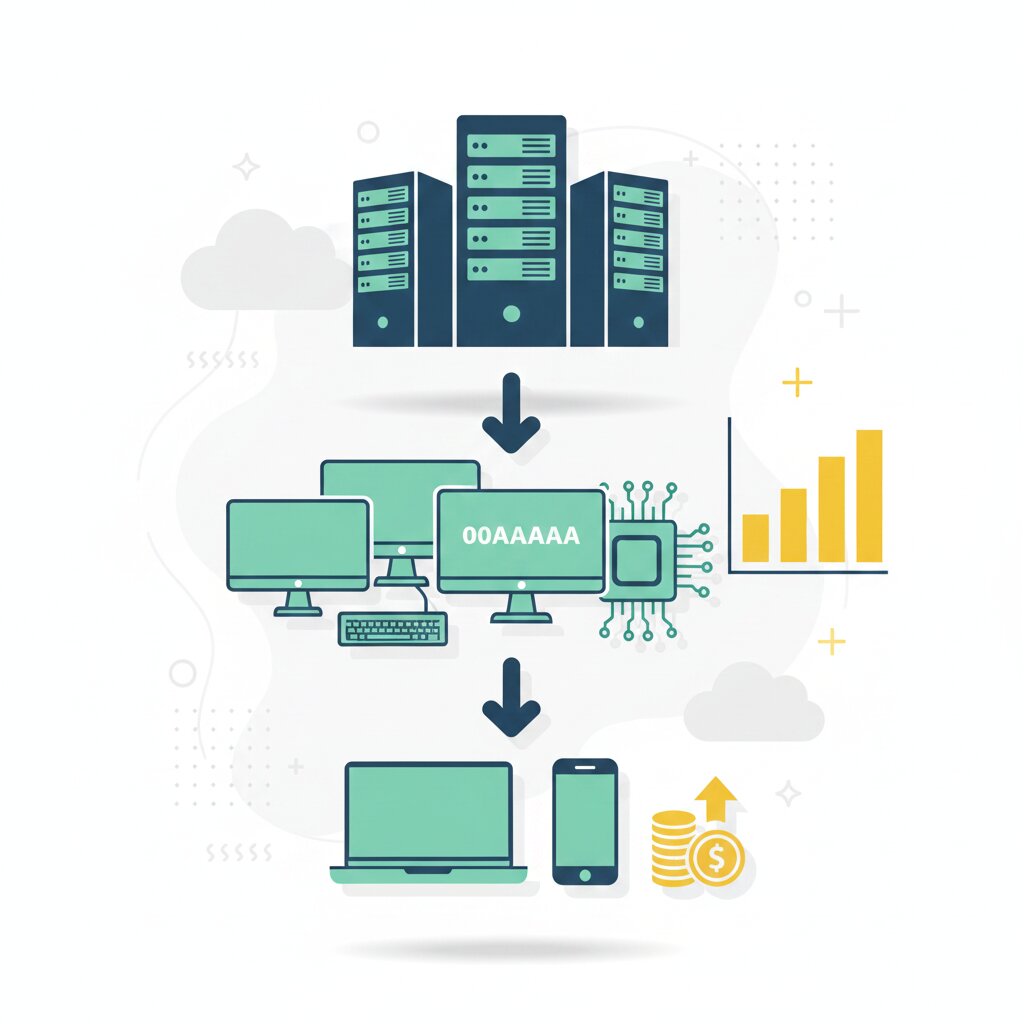

A mid-range laptop that cost $1,100 in mid-2025 now starts at $1,300 — and you’re getting 8 GB of RAM instead of 16 GB. The sticker went up and the spec went down. This is not a post-pandemic supply blip. It is a direct consequence of the global AI infrastructure build-out.
This article is part of our comprehensive AI memory crunch series on how the shortage that started in hyperscale GPU clusters has worked its way down through the full consumer device stack. This article traces the causal chain step by step, with specific price figures at each stage — DDR5 RAM, LPDDR5 in phones, consumer SSDs, the TurboQuant episode, and the CXMT subplot. And it answers the question everyone actually wants answered: will things get better before they get worse?
How Does AI Data Centre Demand Cause Consumer Memory Prices to Rise?
The mechanism is wafer reallocation — fabs redirecting their production lines away from regular consumer RAM toward AI-grade memory. Semiconductor fabs have fixed silicon-wafer capacity. Producing more HBM for AI accelerators means producing less DDR5 for consumers. Zero-sum, baked into fab economics. For a full technical breakdown, see HBM wafer reallocation — the root cause tracing back to AI chip demand.
HBM (High Bandwidth Memory) is the stacked, high-speed DRAM inside every Nvidia and AMD AI accelerator. Producing one bit of HBM consumes approximately three times the wafer capacity of one bit of DDR5, due to complex packaging and lower yields. For SK Hynix, Samsung, and Micron — the Big 3 memory suppliers — the margin maths heavily favour HBM. Think of a bakery that switches its ovens from bread to luxury pastries. Same ovens. Less bread.
AI will consume roughly 20% of total DRAM production in 2026, with HBM absorbing approximately 23% of all global DRAM wafer capacity. IDC describes it as a zero-sum trade: every wafer allocated to an HBM stack for an Nvidia GPU is a wafer denied to the LPDDR5X module of a mid-range smartphone. The result: PC DRAM prices rose 105–110% quarter-over-quarter in Q1 2026.
What Are Dell, HP, and Lenovo Actually Charging Now?
Dell’s numbers are specific enough to put in a board presentation. Dell announced 15–20% price increases from mid-December 2025 — 130–230 more for 32 GB notebook configurations, 520–765 more for 128 GB configurations. Dell’s COO said he had “never seen memory-chip costs rise this fast.” And then Dell raised prices a further 17% on March 30, 2026. The December numbers were not the ceiling.
Memory now represents 35% of the cost to build a PC at HP, up from 15–18% the prior quarter. HP’s CEO has warned that the second half of 2026 could be challenging. That is a polite way of saying things are going to get worse before they get better.
Lenovo, the world’s largest PC vendor, had previously absorbed cost increases by burning through stockpiled DRAM inventory. That buffer ran out. In late 2025, Lenovo sent formal repricing notices citing “intensifying memory shortage and rapid integration of AI technologies,” effective January 1, 2026. When Lenovo stops buffering, the buffer is gone.
Framework and MAINGEAR also raised prices — the shortage reaches OEMs of every size. MAINGEAR CEO Wallace Santos advised consumers to consider shopping now before further increases hit. OEMs are also restructuring their bills of materials: shipping 8 GB as the mid-range baseline instead of 16 GB. Memory’s share of PC BOM rose from 16% to 23% in 2026 according to Gartner. Buyers are paying more and getting less.
For enterprise procurement teams dealing with the same pressures on the server side, the analysis is in what these price increases mean for enterprise hardware budgets.
Beyond RAM: Have Consumer SSD Prices Doubled Too?
Yes. A 1 TB consumer SSD cost approximately $45 in mid-2025 and now retails for approximately $90 — a 100% price increase running in parallel with the DRAM shortage.
NAND Flash is the non-volatile memory that retains data when the power is off — what makes SSDs fast. DRAM is the volatile working memory your CPU uses while running. Different manufacturing processes, same structural supply pressure from AI demand. NAND contract prices are climbing 70–75% in Q1 2026. Storage Switzerland put it bluntly: “These are not adjustments. They are repricings.”
Are Smartphone Prices Going Up Because of the Memory Shortage?
Yes. Smartphones use LPDDR5 — the low-power version of DDR5 designed for phones and tablets. LPDDR5 is sourced from the same supply pool being reallocated toward AI memory. As Counterpoint Research Director Tarun Pathak put it, memory companies are “asking smartphone vendors to stand in line behind the hyperscalers.”
Apple has reported margin compression from memory costs, and 2026 iPhone pricing reflects that upstream pressure. Larger players absorb the hit differently — but they’re not immune.
Counterpoint projects a 12% year-on-year fall in global smartphone shipments in 2026 — the sharpest decline on record, with volumes at their lowest since 2013. IDC projects 13%. The decade-long trend of bringing flagship specs to affordable smartphones is reversing.
Thin laptops are caught in the same squeeze — ultrabooks use LPDDR5 rather than standard DDR5 SODIMMs, so the supply crunch extends into premium notebook categories as well.
Why Did the PC Market Fall — and What Does That Tell Us?
IDC’s initial estimate put the 2026 PC shipment decline at 4.9% due to memory price increases. By February 2026, Gartner had revised that to 10.4% and IDC’s own updated forecast reached 11.3%. IDC noted: “The current situation is now more negative than even our most pessimistic scenarios suggested just a few months ago.”
That is tens of millions of devices not sold. Higher prices push buyers to defer, downgrade, or exit. Enterprise buyers are already extending PC refresh cycles by 15% during 2026, and vendors are no longer guaranteeing prices beyond two to three weeks.
For context: the COVID-era semiconductor shortage peaked at 20–30% GPU and RAM premiums. The 2026 DDR5 increase is 110–130%. The COVID shortage was a demand spike that normalised. This is a structural reallocation — a different kind of event, on a different timeline.
💡 A DRAM supercycle is an extended period of sustained demand outpacing supply, driving price inflation across all DRAM categories. Unlike shorter cyclical price swings, supercycles tend to reset price floors rather than spike and recover.
What Was the TurboQuant Episode — and Why Didn’t It Fix the Shortage?
On 24 March 2026, Google published TurboQuant at ICLR 2026. It compresses the KV cache — the scratch-pad memory an AI model uses during a conversation — by 6x, with no accuracy loss and no retraining required. For a moment, it looked like this might change things.
The market reacted within hours. SK Hynix and Samsung stocks fell. Corsair’s 32 GB DDR5 kit fell from $439.99 to $379.99. Then prices recovered within days.
The reason is Jevons Paradox — greater efficiency in using a resource tends to increase total consumption, because lower cost per use expands the market. SK Hynix CFO Kim Woo-hyun said it plainly: “memory-efficiency technologies are evolving in a direction that maximises the amount of context that can be processed per unit of memory, creating a virtuous cycle that expands the overall AI services market and, in turn, drives memory demand.”
A genuine efficiency breakthrough enables broader deployment. It does not reduce demand.
Will the Consumer Memory Crunch Get Worse Before It Gets Better?
Yes, and the primary driver is agentic AI — AI systems that loop through multi-step tasks (browsing, coding, scheduling, verifying), reloading context memory at each step. Each loop is a new inference call with a full KV cache load. A single chatbot query loads context once; an agentic task may make 10–50 inference calls.
On the supply side, the timeline is clear. SK Hynix had its HBM, DRAM, and NAND capacity sold out through 2026 as of October 2025. Micron’s Idaho fab expansion will not provide meaningful supply relief before 2028, and that capacity arrives already committed. Intel CEO Lip-Bu Tan at the Cisco AI Summit in February 2026 was blunt: “There’s no relief until 2028.”
Getting back to anything resembling normal pricing looks more like 2028–2029. Storage Switzerland calls this a permanent floor reset — not a spike. What it means for enterprise hardware budgets specifically is in our guide to what these price increases mean for enterprise hardware budgets — the enterprise procurement implications that sit above the consumer cascade. For the full picture of how this structural shortage reaches every level of the stack, see our complete AI memory crunch overview.
Can PC Makers Route Around Big 3 Pricing With CXMT?
HP, Dell, Acer, and ASUS are all qualifying CXMT DDR5 and LPDDR5X as a secondary supply source. CXMT — ChangXin Memory Technologies — is a Chinese state-backed DDR5 manufacturer scaling output to fill the consumer demand gap left by the Big 3’s pivot to HBM.
“Qualifying” means running tests and certification processes that typically take 6–12 months. HP and Dell are qualifying CXMT to give themselves alternative sourcing options — negotiating leverage against the Big 3, not an imminent product change. Acer is directing Chinese partners to source locally; ASUS is doing the same.
CXMT appears on the US DoD list of companies suspected of aiding the Chinese military but is not banned from sale. HP is routing CXMT-equipped devices to non-US markets. For US consumers, CXMT-equipped devices are not currently available at retail and performance parity with Big 3 DDR5 is unconfirmed. This is an OEM procurement story, not a near-term consumer option.
One line in the budget is now impossible to forecast: the cost of components outside your control. Engineering capacity doesn’t need to move the same way: SoftwareSeni’s extended development teams are priced per developer against a plan agreed upfront, a cost you can hold steady while everything built from silicon keeps resetting.
see how extended development teams keep engineering costs predictable →
“I worked with Software Seni for several years at Agentpoint and Reapit. They provide strong, cost-effective technical staff and excellent service to their customers. Being able to bring in high-level expertise on a temporary basis (e.g. architecture) was also very useful. What I found unique about Software Seni was their investment in their people with training, career development and performance management all part of the service they offer. Highly recommend.”
— Neil Wilkinson, Chief Technology Officer, Reapit
Frequently Asked Questions
Why is RAM so expensive right now in 2026? AI data centres are buying massive volumes of HBM on the same fabs that produce consumer DDR5. Producing one bit of HBM consumes roughly three times the wafer capacity of one bit of DDR5. SK Hynix — roughly 70% of all HBM — had its DRAM capacity sold out through 2026 as of October 2025. Consumer allocations are whatever remains after AI contracts are filled. DDR5 rose approximately 130% year-on-year in 2026.
Are smartphone prices going up because of the AI memory shortage? Yes. Smartphones use LPDDR5, sourced from the same supply pool being reallocated toward AI memory. Counterpoint projects a 12% year-on-year fall in global smartphone shipments in 2026 — the sharpest decline on record. IDC projects 13%.
Is the 2026 memory shortage worse than the COVID-era semiconductor shortage? Yes. The COVID-era shortage caused roughly 20–30% premiums on GPUs and RAM. The 2026 DDR5 price increase is 110–130%. The COVID shortage was a demand spike that normalised. This shortage is a structural reallocation analysts project persisting through 2027 and beyond.
Does the AI memory shortage affect gaming RAM prices? Yes. Gaming PCs use DDR5 and DDR5 SODIMM — the same categories most affected. There is no separate gaming-specific supply pool. Sony also announced MSRP increases on the PS5 and PS5 Pro as downstream effects.
Should I buy a laptop now or wait for memory prices to come down? Buy now if you need it. Analysts advise not waiting. Gartner’s take: “buy now, or wait until prices stabilise again, because whatever you’re getting at the moment is going to be the best price.” No supply relief is expected before late 2027.
Is it worth upgrading my PC’s RAM right now? Only if it is a genuine performance bottleneck. If the upgrade is discretionary, defer — prices are unlikely to fall in 2026 but may start moderating in late 2027. DDR4 used-market prices offer a partial alternative for older systems.
What is wafer reallocation and why does it affect me? Wafer reallocation is when fabs redirect production from one memory type to another based on profitability. Those are the same factories that produce the RAM in your laptop — and they are switching from consumer DDR5 to AI-grade HBM because HBM pays better.
What is CXMT and should I be concerned if my laptop uses it? CXMT (ChangXin Memory Technologies) is a Chinese state-backed DDR5 manufacturer being evaluated by HP, Dell, Acer, and ASUS as an alternative to Big 3 pricing. It appears on the US DoD list but is not banned from sale. HP is routing CXMT-equipped devices to non-US markets. US consumers are unlikely to encounter CXMT memory in retail devices in the near term.
When will DDR5 prices go back to normal? They won’t — not to 2024 levels. The earliest scenario for meaningful supply relief is late 2027, with a realistic timeline of 2028–2029. Storage Switzerland calls the current price floor a permanent reset. Build your 2026 budgets accordingly.
Did Google’s TurboQuant algorithm fix the memory shortage? No. TurboQuant compresses KV cache by 6x, causing a brief price drop and stock sell-off in March 2026. But Jevons Paradox applies: cheaper-per-session AI inference expands total AI deployment, leaving total memory demand unchanged or higher. Prices recovered within days.
What is Jevons Paradox and why does it matter for the memory shortage? Jevons Paradox: increased efficiency in resource use leads to greater total consumption, because lower cost per use expands the market. Efficiency improvements like TurboQuant reduce the memory cost per AI session, making inference cheaper and therefore more broadly deployed — more total demand, not less.
How does the memory shortage affect enterprise IT budgets? Dell and HP have raised server prices alongside PC prices. Dell announced 15% server price increases in late 2025 and raised hardware prices an additional 17% on March 30, 2026. For detailed enterprise procurement analysis, see DRAM Up 70–110%: What It Means for Enterprise Hardware Budgets.
With component costs already outside your control, why leave the cost of extra engineering capacity to chance too? Talk to SoftwareSeni about extended development teams