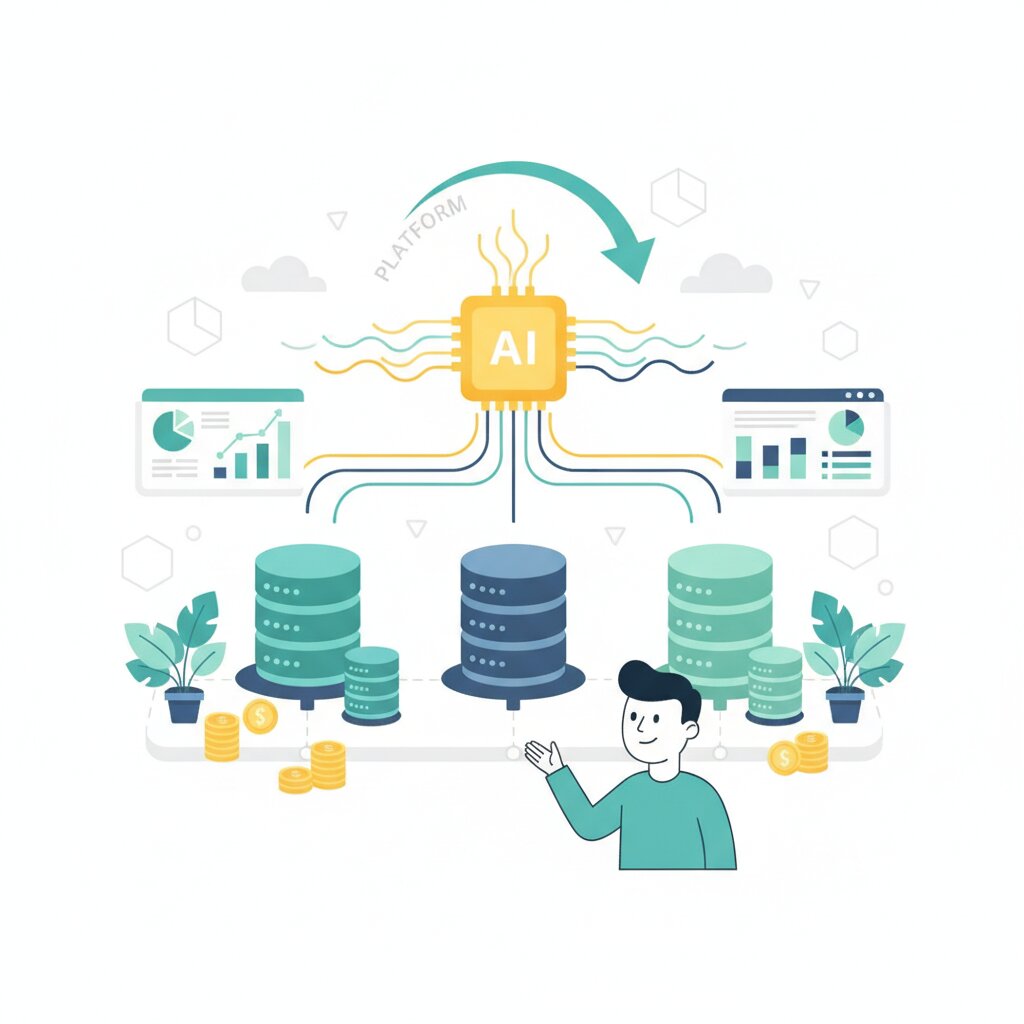

The enterprise data platform market is not consolidating. It is fragmenting around an AI execution question none of the incumbents can answer the same way. Databricks is growing at 65% year-over-year and closing in on $5.4 billion in annual recurring revenue, driven by AI workloads that consume compute at rates traditional analytics never did. Snowflake is committing $6 billion to AWS over five years while positioning itself as the model-agnostic agentic enterprise control plane. BigQuery is collapsing the boundary between data and models, embedding Gemini inference directly into SQL. And IBM’s Confluent acquisition, completed in March 2026, has added a streaming-first fourth claim to a market that was already a three-way fight.
This is a structural realignment of how data platforms compete, and of what they compete on. The storage format wars have given way to a catalog war over governance and AI context. Consumption-based pricing has turned AI workload growth into a direct revenue multiplier. And multi-cloud neutrality has collided with the economic reality of hyperscaler dependency.
This page maps the competitive landscape and connects you to four deep-dive articles, each exploring a dimension of the platform wars your enterprise cannot afford to ignore.
In This Series:
- How AI Has Transformed the Databricks Snowflake and BigQuery Platform Wars — The structural reset AI consumption has triggered across platform economics and competitive positioning
- Why Open Table Formats Are the Real Battlefield in the Data Platform Wars — How Iceberg and Delta Lake became strategic weapons, and why the catalog war now matters more than the format war
- Snowflakes Six Billion Dollar AWS Bet and the True Cost of Multi-Cloud Data Platform Neutrality — The economic tension between multi-cloud ambition and single-cloud dependency
- Evaluating Databricks Snowflake and BigQuery for Enterprise AI and Analytics Workloads — A structured framework for comparing the three platforms across AI capability, cost architecture, and governance
What Is Really Happening in the Data Platform Market in 2026?
The data platform market has entered a phase of AI-driven structural realignment rather than conventional competitive consolidation. Databricks ($5.4B ARR, 65% YoY growth), Snowflake ($4.7B FY2026 revenue, 34% product growth), and BigQuery are all growing, but growing from three distinct architectural philosophies: lakehouse-first AI, warehouse-first agentic enterprise, and serverless data-to-AI integration. The fourth question, whether IBM-Confluent‘s streaming-first claim is credible, adds another dimension to an already complex competitive picture.
The counterintuitive reality is that all three major platforms are growing simultaneously despite competing directly. Databricks’ 65% growth rate and $1.4 billion AI product run-rate suggest an expanding market, not a zero-sum one. Snowflake’s product revenue reacceleration from 28-30% to 34% YoY confirms that AI demand is lifting all boats. AI consumption is creating net-new spend that exceeds the FinOps optimisation drag that previously threatened to flatten platform revenue curves. More than 60% of Fortune 500 companies now use Databricks, up from roughly 40% in 2022, while Snowflake counts 733 customers spending more than $1 million annually and 790 Forbes Global 2000 customers.
The most practical takeaway is the multi-platform reality. Enterprises are not choosing one platform; they are routing workloads to the platform best suited for each. Databricks captures ML training and data engineering; Snowflake captures governed BI and data sharing; BigQuery captures GCP-native bursty analytics. Open table formats (Apache Iceberg, Delta Lake) make this technically viable by allowing the same data to be queried by multiple engines without duplication. This reality makes the evaluation question more nuanced than “which platform wins?” It becomes “which platform anchors your architecture, and which supplement it?”
And then there is IBM-Confluent. IBM’s acquisition of Confluent in March 2026 adds a streaming-first claim to a market dominated by batch-and-SQL architectures. Confluent’s Kafka is the de facto streaming standard, and its enterprise installed base cannot be dismissed. But the question is whether IBM can integrate Confluent without suffocating the multi-platform neutrality that made Kafka valuable in the first place. This is the unresolved variable in the 2026 platform wars.
For a deeper look at how this competitive dynamic is playing out, read how AI has transformed the Databricks, Snowflake, and BigQuery platform wars.
Why Has AI Become the Inflection Point for Data Platform Competition?
AI has become the inflection point because it changes what data platforms charge for, how much they charge, and who they compete against. Traditional SQL analytics consume compute predictably: a query runs, returns results, and stops. AI workloads — retrieval-augmented generation, vector search, agentic chains — consume compute continuously and at GPU-accelerated rates that make SQL analytics look negligible. This structural difference turns AI adoption into a consumption multiplier: every AI workload layered onto a data platform increases revenue without requiring a new customer acquisition. The platform that provisions GPU efficiently and governs AI access comprehensively wins on both margin and lock-in.
Three AI consumption multipliers sit behind this shift. First, RAG workloads perform vector search on every prompt: retrieval operations that consume compute every time an AI model needs enterprise context. Second, GPU-attached inference consumes credits, DBUs, or slots at premium rates. An AI query can cost 10 to 100 times more than an equivalent SQL query. Third, agentic AI creates fan-out: a single user request triggers chains of model calls, each consuming compute independently. Agentic AI models require 5 to 30 times more tokens per task than standard chatbots. These three multipliers compound, explaining why Databricks’ AI products crossed $1.4 billion run-rate and why Snowflake’s Cortex Code (CoCo) became the largest driver of its FY2027 guidance increase within a quarter of launch.
The governance surface has shifted too. Databricks’ Unity AI Gateway governs AI agents, Model Context Protocols (MCPs), and frontier models across AWS, Azure, and GCP with unified access controls inheriting from Unity Catalog. Snowflake Intelligence positions as model-agnostic but cloud-bound: governance is only as portable as the Snowflake deployment. BigQuery Gemini collapses governance into SQL, with no separate AI governance layer, but also no cross-platform portability. The MCP standard gives Databricks an architectural advantage: it is the only layer that governs models and agents the same way it governs data. This governance question is where the AI inflection and the open-format question intersect. The catalog that governs your tables increasingly governs your AI models too.
The durability question hangs over all of this. Is AI-driven growth structural or temporary? Structural signals include NRR expanding as existing customers add AI workloads, agentic consumption compounding per-account, and GPU-attached DBU growth outrunning SQL DBU growth. Databricks’ sustained 65% YoY growth and $5.4 billion ARR serve as the durability benchmark. Databricks has turned free-cash-flow positive while Snowflake posted a GAAP net loss near $1.43 billion for FY2026. If AI consumption is structural, Databricks’ $134 billion private valuation reflects a growth premium that justifies the multiple. If it is temporary, Snowflake’s public-market discipline looks smarter. The answer determines whether current platform valuations reflect structural advantage or temporary AI enthusiasm.
For the full AI governance comparison and the signals that distinguish durable growth from hype, start with the AI transformation article.
How Does AI Consumption Structurally Reset Data Platform Economics?
AI consumption resets platform economics by turning usage growth from a linear function into a compounding one. Traditional analytics revenue grows with query volume: more users, more queries, more consumption. AI revenue grows with query complexity: each AI interaction burns more compute than the last as models get larger, context windows expand, and agentic chains lengthen. This changes the revenue model from per-query to per-capability, meaning platforms can exceed 140% net revenue retention without adding new customers. For buyers, it means platform costs become less predictable as AI adoption deepens.
The three pricing architectures are worth understanding at a structural level. Databricks DBUs are consumed across all workloads (SQL, ETL, ML training, and AI inference) with GPU-attached compute consuming DBUs at accelerated rates. Snowflake credits are consumed per second of virtual warehouse runtime, with warehouse size as a multiplier. An AI query on a large warehouse consumes credits faster than a SQL query on a small one. BigQuery slots are reserved compute capacity with flat-rate commitments and on-demand overflow. AI inference through Gemini is charged on Vertex AI usage plus BigQuery slot consumption. The structural difference: DBU and credit models make AI cost growth automatic and unbounded; slot models create a cost ceiling that AI consumption can hit. Neither model is inherently better, but they produce different cost predictability profiles your procurement team needs to understand before committing.
The FinOps tension is real. Consumption-based pricing means vendors benefit when you use more. AI workloads that compound consumption are exactly what vendors want. But your FinOps team exists to push spending down, not up. Snowflake at 126% NRR and Databricks above 140% NRR are growing largely because existing customers are consuming more, not because they are acquiring new customers at the same rate. The practical question: can you forecast your AI-driven platform costs with enough accuracy to satisfy your CFO? dbt’s Fusion engine, claiming 60 to 65% warehouse cost reduction, is a tool explicitly selling cost optimisation against the platforms whose revenue depends on consumption growth. That tension is not going away.
When you compare platforms, list-price comparisons miss the point. The real TCO question is how AI workloads compound over a three-year commitment. A platform with lower per-query costs but higher AI consumption growth may cost more than a platform with higher per-query costs but more predictable AI pricing. Cost architecture and AI capability are not separate dimensions. They compound.
For the full economic analysis, including the credit vs. slot pricing comparison, dive into the multi-cloud economics article.
How Do Databricks, Snowflake, and BigQuery Differ in Their AI Strategies?
The three platforms diverge on a fundamental architectural question: should AI be model-optimised and cross-cloud portable (Databricks), model-agnostic and platform-bound (Snowflake), or infrastructure-integrated with the model baked into SQL (BigQuery)? Databricks’ Mosaic AI provides the deepest toolchain — model training, GPU-backed serving, vector search — governed through Unity AI Gateway across all three clouds. Snowflake’s Cortex AI is model-agnostic by design but binds governance to Snowflake-managed storage. BigQuery Gemini collapses the data-model boundary entirely, with AI inference through SQL and no separate governance layer. The choice turns on whether your AI workload’s data gravity justifies the lock-in trade each platform requires.
Databricks’ Mosaic AI is the broadest AI toolchain: model training, fine-tuning, GPU-backed serving, vector search, feature store, and agentic AI tooling, all governed through Unity Catalog and served through Unity AI Gateway. The strategic advantage is cross-cloud governance. Unity AI Gateway enforces the same access controls on AI models and agents as it does on data, across AWS, Azure, and GCP. The MCP standard, operationalised through Unity AI Gateway, is an architectural advantage neither Snowflake nor BigQuery can replicate: it governs AI agents with the same permissions model as data access. Over 100,000 agents have been built on the platform, processing over one quadrillion tokens annually. The trade-off: Databricks’ AI depth comes with platform complexity. SQL-only BI workloads cost more on Databricks than on Snowflake or BigQuery, and the AI toolchain requires data engineering skills that Snowflake’s SQL-native approach does not.
Snowflake’s Cortex AI is the model-agnostic counterpoint. Cortex AI serves any model on top of Snowflake-managed storage, with Cortex Analyst for NL-to-SQL, Cortex Search for vector retrieval, Cortex Code (CoCo) for AI-assisted development, and Snowflake Intelligence for business-facing agents. The strategic pitch: you are not locked into a model vendor. Use Anthropic, OpenAI, Meta, or your own fine-tuned models. The architectural reality: you are locked into Snowflake’s storage and governance layer, because Cortex AI serves models against Snowflake-managed data. The two-stage Cortex Sense architecture (Horizon Context feeding Cortex Sense) is Snowflake’s attempt to make the lock-in worth it, claiming 3.5x better agent performance than standalone tools. But Cortex Sense is still in private preview, and the claim is unproven against genuinely messy enterprise data estates.
BigQuery Gemini takes a different approach. AI is a capability embedded directly in SQL, not a separate layer to manage. Gemini translates natural language to SQL, generates queries, and provides inference results directly within the BigQuery environment, governed by existing BigQuery access controls. The structural advantage: no separate AI governance layer to manage, no model-agnostic vs. platform-native decision to make, no GPU provisioning to worry about. Google manages the infrastructure transparently. The limitation: BigQuery is single-cloud (GCP), and Gemini’s AI capabilities are only as portable as your GCP deployment. BigQuery’s AI strategy makes the most sense for organisations already committed to GCP that want AI without adding architectural complexity. It is the least flexible option for multi-cloud enterprises.
To understand how these AI strategies reshape the competitive dynamics, the AI transformation article has the full three-way comparison.
Why Have Open Table Formats Become a Strategic Weapon in the Platform Wars?
Open table formats — Apache Iceberg and Delta Lake — have become strategic weapons because they solve storage lock-in while creating a new lock-in surface at the catalog layer. Before open formats, migrating between platforms meant rewriting data into a new proprietary format, a multi-month, multi-million-dollar barrier to exit. With open formats, your data lives in cloud object storage in a format any compatible engine can read, making migration a configuration change, not a data rewrite. But vendors did not open-source their formats out of altruism. Databricks open-sourced Delta Lake to make Snowflake’s proprietary storage a liability. Snowflake adopted Iceberg and launched Polaris to make Databricks’ governance layer the only remaining lock-in surface.
Open formats (Iceberg, created at Netflix, now Apache-governed; Delta Lake, created by Databricks, open-sourced under the Linux Foundation) separate metadata from data so that any compatible engine can read the same data files. This eliminated the most expensive dimension of vendor lock-in. But it also revealed where lock-in had migrated. The catalog, your governance layer, contains the permissions, lineage, and rules that make your data usable within your organisation’s compliance framework. If you built that governance in Unity Catalog, migrating to Polaris means recreating every access policy, every lineage trace, and every semantic definition. That is a multi-quarter project with compliance risk, a lock-in barrier comparable to what proprietary storage formats created a decade ago.
Databricks’ acquisition of Tabular is the clearest signal of the strategic stakes. Tabular was founded by Iceberg’s creators and acquired by Databricks for a reported $2 billion against $1 million in ARR. That is 2,000 times revenue, not for talent, but to neutralise the risk of an independent Iceberg company becoming the neutral format standard. If Tabular had succeeded independently, enterprises could have run Iceberg tables on any platform with a vendor-neutral management layer, undermining Databricks’ format stewardship advantage. The acquisition was defensive: Databricks brought Iceberg’s creators in-house to accelerate Delta-Iceberg interoperability while ensuring no independent Iceberg company could challenge Databricks’ format governance.
The catalog war is now more important than the format war. Unity Catalog (Databricks, open-sourced 2024) and Polaris (Snowflake-contributed to Apache, open-sourced 2024) are racing to become the default governance standard for all lakehouse deployments. The catalog’s AI governance capability, governing models and agents the same way as tables, is the next lock-in frontier. Your format choice is secondary to your catalog choice, and your catalog choice should be independent of your compute platform.
The open table formats explainer has the full story, including the Tabular acquisition analysis and the Iceberg vs. Delta Lake standardisation guidance.
What Is the Catalog War and Why Should You Care About It?
The catalog war is the competition between Unity Catalog (Databricks) and Polaris/Horizon Catalog (Snowflake) to become the default governance layer for all lakehouse data — and the outcome determines whose platform becomes the control plane for your data access, regardless of which engine you query it with. A catalog is the metadata layer that governs table access, enforces permissions, tracks lineage, stores semantic definitions, and — critically in 2026 — governs AI models and agents with the same controls it applies to data. The catalog is the new lock-in surface because data portability through open formats means nothing if your governance layer is proprietary.
Unity Catalog (Databricks) governs both Delta and Iceberg tables with Databricks-native access controls. It also governs AI models, MLflow experiments, and AI agents through the same permission model. Polaris (Snowflake-contributed, promoted to Apache Top-Level Project in February 2026) governs Iceberg tables with Snowflake-native access controls, and through Horizon Catalog, extends governance to external engines, semantic definitions, and AI governance monitoring. The architectural distinction: Unity Catalog is Databricks-native but governs across clouds; Polaris is Iceberg-native but designed for Snowflake’s ecosystem. Unity Catalog is the only major data catalog with an open governance model: Snowflake, BigQuery, Trino, DuckDB, and Apache Spark can all read Unity-governed Iceberg tables. With Horizon, policies stop at the Snowflake boundary.
Both vendors are open-sourcing their catalogs to win the standard, but the standard that wins determines whose platform becomes the default governance plane. Your job as a buyer is to ensure your catalog is not the same vendor as your primary compute engine. Format independence plus catalog independence equals genuine platform portability.
The AI governance dimension raises the stakes further. Unity AI Gateway governs AI agents and models through the same Unity Catalog permissions that govern tables. A model accessing a table inherits that table’s access controls. Snowflake Horizon Context stores semantic definitions that Cortex Sense uses to give AI agents governed enterprise context. The catalog becomes the AI context layer. Both vendors are betting that the catalog that governs your AI models will be the catalog you cannot leave. This is one of the most important competitive dynamics in the 2026 data platform market, and the one most enterprise buyers have not yet internalised.
For the full Polaris vs. Unity Catalog comparison and the buyer due diligence checklist, the open table formats article covers the catalog war in detail.
Does Multi-Cloud Neutrality Deliver Enough Value to Justify Its Premium?
Multi-cloud neutrality — the ability to run the same data platform on multiple clouds — is worth its premium only when your data gravity is genuinely multi-cloud. Snowflake charges for this optionality through consumption-based pricing that lacks the flat-rate predictability of single-cloud alternatives. For organisations with data on AWS, Azure, and GCP, having a consistent platform interface, governance model, and pricing structure across clouds simplifies operations and strengthens cloud negotiation leverage. But Snowflake’s own $6 billion AWS commitment exposes the gap between multi-cloud marketing and single-cloud reality: most Snowflake deployments are on AWS, the same hyperscaler whose Redshift competes directly.
Snowflake’s landlord-competitor paradox is the central tension. Snowflake is simultaneously AWS’s best data platform customer and Redshift’s closest competitor. AWS captures margin either way, through Snowflake’s infrastructure spend or through Redshift adoption. Snowflake’s $6 billion five-year commitment is more than double its prior contract, a curve that went from $1.2 billion at IPO to $2.5 billion in 2023 to $6 billion in 2026. Roughly 70% of Snowflake deployments are on AWS. This dependency complicates the multi-cloud neutrality pitch: the platform that sells cross-cloud optionality is disproportionately dependent on one cloud’s infrastructure. The practical question for buyers: does your organisation have enough multi-cloud data gravity to justify the premium, or are you paying for optionality you will never exercise?
The choice between multi-cloud neutrality and hyperscaler bundling depends on your cloud strategy, not just your data platform requirements. Multi-cloud neutrality (Snowflake) is worth the premium when you have existing multi-cloud deployments, regulatory requirements demanding cloud-diversified data residency, or enough scale to negotiate across cloud providers. Hyperscaler bundling (BigQuery + GCP, Redshift + AWS, Fabric + Azure) wins when you are single-cloud, when bundled AI/BI/analytics integration matters more than cross-cloud optionality, or when predictable flat-rate costs matter more than deployment flexibility. Microsoft Fabric is the extreme version of the bundling argument: a single Azure-native service integrating data platform, AI, and BI.
But it is worth being clear about what multi-cloud actually delivers. It means you can deploy Snowflake on AWS, Azure, or GCP with the same interface and governance model. It does not mean your data is automatically portable between clouds; replication requires separate configuration. It does not mean your workloads can seamlessly shift between clouds; each deployment is independent. Open-format portability is the escape hatch that makes multi-cloud viable. Without Iceberg tables, the data migration cost of switching clouds would make multi-cloud optionality irrelevant.
For the full economic breakdown of the landlord-competitor paradox and when multi-cloud neutrality earns its keep, the platform economics article has you covered.
How Should You Think About Data Platform Pricing and Cost Predictability?
Data platform pricing comes in three models — consumption-based credits (Snowflake), consumption-based DBUs (Databricks), and slot-based flat-rate (BigQuery) — and they produce fundamentally different cost predictability profiles. Credit and DBU models scale with usage: the more you consume, the more you pay, with no built-in ceiling. This makes costs harder to forecast as AI workloads escalate consumption, but it aligns cost directly with value. Slot-based pricing creates a cost ceiling through reserved capacity commitments, with on-demand overflow pricing for bursts. The right model depends on your workload predictability: stable, forecastable workloads benefit from slot-based pricing; variable, AI-driven workloads may find consumption pricing more efficient despite the forecasting challenge.
The structural differences matter. Snowflake credits are consumed per second of virtual warehouse runtime, multiplied by warehouse size. An XS warehouse consumes 1 credit per hour; a 6XL consumes 512 credits per hour. AI queries on large warehouses consume credits rapidly; idle warehouses still consume credits if not suspended. Databricks DBUs are consumed across all compute (SQL, ETL, ML training, AI inference) with GPU-attached DBUs consuming at accelerated rates. DBU pricing is workload-agnostic: a DBU is a DBU regardless of what consumed it. BigQuery slots are reserved compute capacity. You commit to a certain number of slots at a flat rate, and queries consume slots as they run. On-demand pricing covers overflow beyond your reservation. The structural trade: credits and DBUs scale automatically with usage (good for growth, bad for predictability); slots create a ceiling (good for predictability, requires sizing expertise).
AI makes cost forecasting harder. Traditional SQL analytics produce predictable consumption patterns: query volume correlates roughly with user count and reporting cycles. AI workloads — RAG vector searches on every prompt, GPU-accelerated inference, agentic chains that spawn multiple model calls per user request — produce consumption that is harder to model. A single AI feature rollout can spike platform costs sharply. The procurement question is whether you can negotiate AI-specific pricing tiers that separate AI consumption from SQL consumption, giving you visibility into what is driving cost growth. The FinOps discipline for AI workloads means separating batch from serving workloads, assigning ownership per endpoint, tracking unit costs (cost per retrieval, per agent run), and using per-agent cost limits.
Exit costs compound with usage too. Consumption-based pricing means your exit cost grows with usage: the more DBUs or credits you have consumed, the more data you have stored, the more expensive it becomes to migrate to another platform. Slot-based pricing makes exit more predictable. You have already paid for capacity, and migration costs are dominated by egress and engineering time rather than consumption arrears. When evaluating platforms, model the three-year TCO including exit costs, not just year-one list prices. The platform with the lowest year-one cost may have the highest year-three exit cost.
For the detailed pricing model comparison and procurement guidance, the platform economics article covers consumption-based pricing in depth.
What Is the Difference Between a Data Warehouse and a Lakehouse in 2026?
In 2026, the warehouse vs. lakehouse distinction is collapsing — but the architectural philosophy behind each still shapes what each platform does best. A data warehouse (Snowflake, BigQuery) is optimised for SQL analytics on structured data, with AI as a serving layer on top. A lakehouse (Databricks) unifies data lake storage with warehouse SQL performance, treating AI/ML as a first-class workload with native training and serving on the same governed data. The practical difference: warehouses are SQL-first, with AI capabilities added as a consumption layer; lakehouses are AI-first, with SQL as one of several query modalities. Both architectures can now handle both workload types.
Where the architectures have converged is worth acknowledging. Both warehouse and lakehouse architectures now support open table formats (Iceberg, Delta Lake) on cloud object storage with ACID transactions, schema evolution, and time travel. Both support SQL analytics, Python-based data science, and AI model serving. Both offer governance catalogs (Unity Catalog, Horizon Catalog/Polaris) that manage access, lineage, and semantics. The 2020-vintage distinction (warehouses use proprietary storage formats, lakehouses use open formats) is no longer accurate. Snowflake supports Iceberg tables natively; Databricks supports SQL analytics with performance competitive with warehouses. The convergence means the architectural label matters less than the workload fit.
Where the architectures still diverge is in the compute model. Warehouse platforms (Snowflake, BigQuery) separate storage and compute with virtual warehouse elasticity (Snowflake) or serverless autoscaling (BigQuery). You provision compute independently of storage, optimising for SQL concurrency and query isolation. Lakehouse platforms (Databricks) co-locate compute and data on the same infrastructure, optimising for data-intensive AI/ML workloads where moving data between storage and compute creates a bottleneck. This architectural difference produces different cost profiles: warehouses are typically cheaper for SQL-only BI workloads; lakehouses are typically more efficient for AI/ML workloads that require data-proximate compute. The difference also shapes governance: warehouse catalogs govern SQL access primarily; lakehouse catalogs govern SQL, Python, ML models, and AI agents through a unified permission model.
What this means for your evaluation is straightforward. The warehouse vs. lakehouse question is a proxy for a more practical question: is your dominant workload SQL analytics with AI features, or AI/ML with SQL analytics as a supporting capability? If BI and governed reporting drive your platform consumption, a warehouse-first platform will likely be more cost-effective. If ML training, AI inference, and data engineering drive your consumption, a lakehouse-first platform will likely perform better. But the convergence means you should not over-index on the label. Evaluate the specific AI and analytics capabilities against your workload profile, not the architectural category.
For the full architectural comparison and how to match platform philosophy to your workload profile, the evaluation framework article walks you through it.
How Should You Evaluate Platforms for AI and Analytics Workloads?
Platform evaluation must integrate five dimensions: AI capability depth (training, serving, governance), cost architecture (consumption model, AI workload pricing, exit cost), format and catalog independence (can you leave without rebuilding governance?), workload fit (does the platform optimise for your dominant workload type?), and ecosystem compatibility (does it work with your existing tools?). The evaluation is a structured trade-off analysis that weights each dimension against your organisation’s specific workload profile, cloud strategy, and team capability. No platform wins all five dimensions. Your job is to determine which trade-offs your organisation can absorb and which are dealbreakers.
The five dimensions break down like this. AI capability: can the platform handle your AI workload profile (training vs. serving, RAG, agentic AI, GPU requirements)? Cost architecture: what is the three-year TCO including AI consumption growth and exit costs? Format and catalog independence: if you need to leave, can you migrate data and governance without a multi-quarter rebuild? Workload fit: does the platform optimise for your dominant workload (SQL BI vs. ML training vs. streaming vs. ad-hoc analytics)? Ecosystem compatibility: does the platform integrate with your existing ingestion (Fivetran), transformation (dbt), BI, and streaming tools? The Fivetran-dbt merger, completed June 2026 at roughly $9.8 billion with $600 million combined ARR, marginally reduces pipeline lock-in across all three platforms, making ecosystem compatibility less of a differentiator than it was. They pitch themselves as “the data infrastructure for trusted AI agents,” a platform-agnostic ingestion and transformation layer.
The trade-off reality means no platform wins outright. Databricks: strongest on AI capability (MLflow, GPU clusters, Agent Bricks with 100,000-plus agents built), but weaker on SQL-only BI costs. Snowflake: strongest on SQL performance, multi-cloud deployment, and data sharing (790 Forbes Global 2000 customers), but weaker on AI training toolchain depth. BigQuery: strongest on serverless simplicity and cost predictability, but weakest on multi-cloud flexibility and AI training depth. The IBM-Confluent streaming-first alternative adds a sixth dimension (streaming capability) but introduces integration complexity that may offset the streaming advantage. Confluent’s Kafka is the de facto streaming standard with sub-second latency, used by customers of all three platforms. Under IBM, the question is whether Confluent can sustain multi-platform neutrality while layering watsonx AI on top.
Moving from evaluation to commitment means running time-boxed proofs of concept on real production data, not vendor-provided datasets. Establish credit/slot/DBU baselines from POC workloads before negotiating commitments. Include catalog portability and format independence clauses in contracts. Demand contractual confirmation that your data remains readable by open-source engines and that your governance metadata is exportable. Model exit costs for year three before signing year one. And recognise that the multi-platform reality means your evaluation is not “which single platform?” but “which platform anchors the architecture, and which supplement it for specific workloads?”
For the complete five-dimension evaluation framework with workload-routing decision matrices, the platform evaluation article is the synthesis piece.
What Should Enterprise Decision-Makers Watch Next in the Platform Wars?
The next 12 months will be shaped by three questions. First, whether the AI consumption growth rate is accelerating or stabilising — watch for NRR updates, GPU-attached DBU/credit growth rates, and any change in AI product revenue run-rate disclosures. Second, the AI governance question: can Snowflake’s Cortex Sense and Horizon Catalog close the governance gap with Unity AI Gateway, and will BigQuery Gemini develop a standalone AI governance layer or remain SQL-bound? Third, the IBM-Confluent integration: can IBM demonstrate that Confluent + watsonx is a credible fourth platform without eroding Confluent’s multi-platform neutrality? If IBM sustains Confluent’s independence while layering watsonx AI on top, it reshapes the competitive landscape. If IBM absorbs Confluent into its ecosystem, the streaming layer fragments and the three incumbents benefit.
The June 2026 summit cycle has already revealed that agentic AI is moving from prototype to production at scale. Databricks Summit drew 30,000-plus attendees with Agent Bricks going GA and Unity AI Gateway as the governance centerpiece. Snowflake Summit drew approximately 20,000 attendees with CEO Sridhar Ramaswamy declaring “the era of the agentic enterprise”. Databricks is reportedly in IPO talks at a $165 to 175 billion valuation, and the pricing of that IPO will be the market’s verdict on whether AI-driven platform growth is structural or cyclical.
The governance question remains open. Can Snowflake’s Cortex Sense and Horizon Catalog close the governance gap with Unity AI Gateway? Cortex Sense’s 3.5x performance claim is impressive but unproven at production scale against genuinely messy enterprise data. Will BigQuery Gemini develop a standalone AI governance layer or remain SQL-bound? The governance question matters because the catalog that governs your AI models is the catalog you cannot leave.
The IBM-Confluent integration is the wildcard. IBM is pairing Confluent’s Real-Time Context Engine with watsonx.data’s context layer for AI. The credible-fourth-position test is whether IBM can add AI value on top of Confluent without subtracting neutrality value from Confluent’s existing integrations. If IBM sustains Confluent’s independence while layering watsonx AI on top, it reshapes the competitive landscape. If IBM absorbs Confluent into its ecosystem, the streaming layer fragments and the three incumbents benefit. Snowflake’s Datastream, a native streaming product, is already challenging Confluent’s Kafka position, but Kafka clusters are deeply embedded and migration inertia is real.
The platform that wins over the next three years is not necessarily the one with the best AI, the best format, or the best pricing in isolation. It is the one that best integrates AI capability, format portability, cost predictability, and workload fit for the specific profile of each enterprise. The platform wars are a structural realignment driven by AI consumption, fought across four dimensions. The outcome is determined by which dimension each enterprise weights most heavily, not by a single victor in a single battle.
For the strategic synthesis that turns analysis into your evaluation framework, start with how AI has transformed the platform wars and finish with the structured evaluation framework.
Resource Hub: Data Platform Wars Deep Dives
Understanding the Competitive Dynamics
- How AI Has Transformed the Databricks Snowflake and BigQuery Platform Wars — How AI consumption structurally resets platform economics, the three-way AI governance comparison, and the signals that distinguish durable AI growth from temporary hype
- Why Open Table Formats Are the Real Battlefield in the Data Platform Wars — Why Iceberg and Delta Lake became strategic weapons, the $2 billion Tabular acquisition as a clear signal, and why the catalog war now matters more than the format war
The Economics of Platform Choice
- Snowflakes Six Billion Dollar AWS Bet and the True Cost of Multi-Cloud Data Platform Neutrality — The landlord-competitor paradox, credit vs. slot pricing for cost predictability, and when multi-cloud neutrality is worth its premium over hyperscaler bundling
Making Your Platform Decision
- Evaluating Databricks Snowflake and BigQuery for Enterprise AI and Analytics Workloads — A structured five-dimension evaluation framework, the warehouse vs. lakehouse distinction in 2026, and whether IBM-Confluent has a credible fourth position
Suggested reading order: Start with “Why Open Table Formats Are the Real Battlefield” to understand the substrate all platform competition rests on. Then read “Snowflakes Six Billion Dollar AWS Bet” to internalise the economic stakes. Follow with “How AI Has Transformed the Platform Wars” to see how AI consumption changes the competitive dynamics. Finish with “Evaluating Databricks Snowflake and BigQuery” to turn analysis into your organisation’s evaluation framework.
Frequently Asked Questions
Is Databricks Really Worth $134 Billion When Snowflake Is Public at a Fraction of That?
The valuation gap reflects different growth rates and market structures, not necessarily overvaluation. Databricks at 65% YoY growth and $5.4 billion ARR is growing more than twice as fast as Snowflake at 34% product growth. Databricks has achieved positive free cash flow while Snowflake operates at a GAAP net loss near $1.43 billion for FY2026. If AI consumption is structural, Databricks’ growth premium justifies a higher multiple. If AI growth proves temporary, Snowflake’s public-market discipline looks smarter. Snowflake’s $9.77 billion RPO growing at 42% YoY also shows it remains a formidable competitor with strong customer commitment. The answer depends on the durability question explored in How AI Has Transformed the Platform Wars.
Does Adopting Apache Iceberg Mean I Can Leave Snowflake Without Data Migration?
Technically, yes — Iceberg tables in Snowflake can be read by any Iceberg-compatible engine. But your governance layer (permissions, lineage, semantic definitions) is not automatically portable. If you built your governance in Snowflake’s Horizon Catalog, migrating to Unity Catalog means rebuilding access controls and lineage, a governance migration that can take months. Data portability through open formats is necessary but not sufficient for platform independence. The catalog portability question is covered in Why Open Table Formats Are the Real Battlefield.
Does Multi-Cloud Neutrality Mean My Data Is Automatically Portable Between Clouds?
No. Multi-cloud neutrality means you can deploy Snowflake on AWS, Azure, or GCP with the same interface. It does not mean data replicates automatically between cloud deployments. Cross-cloud replication requires separate configuration and incurs egress costs. Multi-cloud neutrality is deployment optionality, not workload mobility. This distinction, and when deployment optionality is worth the premium, is analysed in Snowflakes Six Billion Dollar AWS Bet.
What Happened With the Fivetran-dbt Merger and Why Does It Matter?
Fivetran (data ingestion) and dbt Labs (data transformation) merged, completing in June 2026 at roughly $9.8 billion with approximately $600 million combined ARR. They position as “the data infrastructure for trusted AI agents,” a platform-agnostic ingestion and transformation layer that works with Databricks, Snowflake, and BigQuery. A strong independent pipeline layer reduces switching costs between platforms, making platform lock-in marginally weaker. dbt’s Fusion engine, which claims 60 to 65% warehouse cost reduction, also creates a counterweight to consumption-based pricing. This dynamic is addressed in Evaluating Databricks Snowflake and BigQuery.
Does IBM Owning Confluent Mean Confluent Will Stop Working Well With Databricks and Snowflake?
Not immediately. Confluent’s Kafka is deeply embedded across all three platforms’ ecosystems, and IBM would destroy significant value by degrading those integrations. The risk is gradual: IBM may prioritise watsonx integration and IBM Cloud optimisations over maintaining feature parity with Databricks and Snowflake. The credible-fourth-position test is whether IBM can add AI value on top of Confluent without subtracting neutrality value from Confluent’s existing integrations. This question is explored in Evaluating Databricks Snowflake and BigQuery.
Which Platform Has the Lowest Total Cost of Ownership for SQL-Heavy BI Workloads?
Snowflake and BigQuery are typically more cost-effective than Databricks for SQL-only BI workloads, because their architectures are optimised for SQL concurrency and query isolation. Databricks’ SQL Serverless has closed much of the gap, but the platform’s pricing model is designed for mixed SQL-ML workloads, and SQL-only deployments often underutilise the capabilities you are paying for. Exact TCO depends on query patterns, concurrency, and data volume. Run a proof of concept on your own production data rather than relying on vendor benchmarks. Detailed TCO factors are covered in Evaluating Databricks Snowflake and BigQuery.
What Is the Simplest Way to Understand the Difference Between These Three Platforms?
Databricks is an AI-first lakehouse. It unifies data engineering, SQL analytics, and ML/AI on open-format storage with a unified governance catalog. It is strongest when AI/ML training is a primary workload. Snowflake is a SQL-first data cloud. It provides best-in-class SQL analytics with separate storage and compute, now adding AI as a model-serving layer. It is strongest when governed BI and data sharing are primary workloads. BigQuery is a serverless SQL analytics engine. It eliminates infrastructure management entirely, integrating AI through Google’s Gemini models. It is strongest when serverless simplicity and GCP-native integration matter more than multi-cloud flexibility or AI training depth. The full comparison framework is in Evaluating Databricks Snowflake and BigQuery.
Can I Run Two or Three Platforms Simultaneously Without Doubling My Costs?
Yes, and many enterprises already do. Open table formats (Iceberg, Delta Lake) make it technically feasible to query the same data from multiple platforms without duplication. The cost question is whether the operational complexity of a multi-platform architecture is justified by the workload optimisation it enables. Your ingestion layer (Fivetran), transformation layer (dbt), and governance layer (catalog) must span platforms. This is where costs compound. The multi-platform operational pattern is detailed in Evaluating Databricks Snowflake and BigQuery, and the economic logic of multi-platform architectures is explored in Snowflakes Six Billion Dollar AWS Bet.