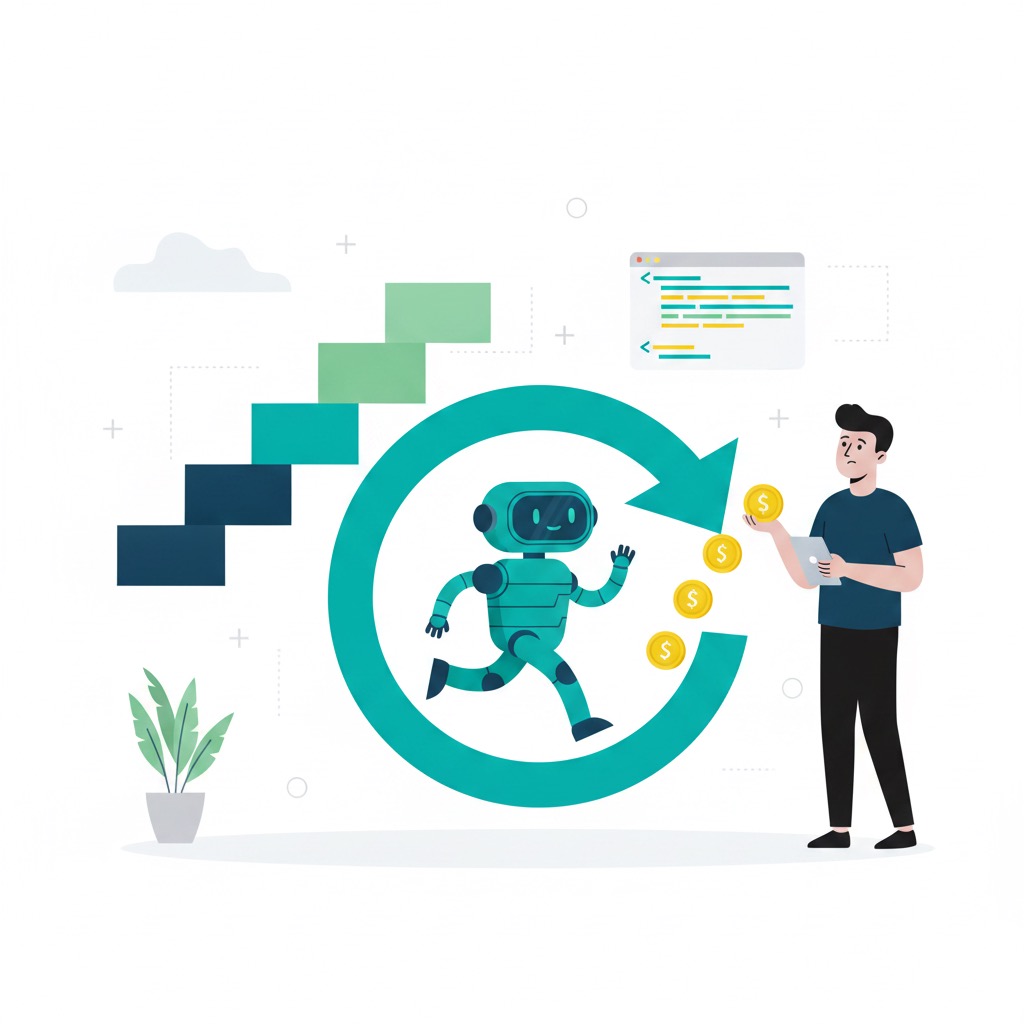
If AI is good at anything, it is good at coding. This would make you expect that if anyone was going to be made redundant by AI it would be the software developers. However, at least in the tech industry, it is the management layers that are seeing lay offs.
In a global survey of 15,000 professionals conducted by Korn Ferry, 41% of employees said their organisation had cut management layers in the last year.
This is not due to AI taking on the role of managers so much as AI dispersing a broad category of management’s function into the organisation’s automation layer.
In this article we’re going to look at what is behind this twist, and how it is changing the structure of businesses, at least those whose core is built around software development.
There’s managing and then there’s managing
A significant portion of management work has always been coordination: gathering information, communicating updates, scheduling meetings, tracking progress, and keeping teams aligned.
The Mythical Man Month by Fred Brooks is the classic book on software project management. Its major contribution was the awareness that adding more people to a project will make it slower, not faster, because adding people increases coordination costs.
AI is making software development teams smaller as coding agents enable each developer to take on broader roles and complete more work. This intrinsically reduces the need for coordination and rendering dedicated project management unnecessary.
Gitlab recently reorganised its research and development division into roughly 60 smaller autonomous teams and removed up to three layers of management in different areas.
Atop the lower coordination burden of smaller teams, AI is able to perform the scheduling, gathering, communicating and tracking tasks of managers but continuously and at scale.
Scheduling
Automated scheduling has been around for sometime, but AI agents make it smarter and also easier to adapt to feedback to optimise and prioritise meetings across multiple calendars.
Gathering information
An AI agent is integrated into the team’s workspace. Every Friday at 3:00pm the AI automatically scans the team’s public Slack channels, public GitHub commits, and updated Jira cards from the past seven days and drafts a report for the team containing what’s on track, what’s at risk and any actions required.
Communicating information
If you have ever used a video call transcription agent and received a summary of the call and a list of action points, you’ve already experienced this facet of automation.
But communicating information is also the automation of more complex reports that agents can now handle and generate on demand or on schedule to meet the exact needs of the audience.
Tracking progress
AI can track progress by monitoring live code repositories and automatically running test suites to measure feature readiness. Agents can update dashboards, email regular reports, etc.
Keeping teams aligned
This feature of management arises out of the meetings, the communication and the progress tracking. With project information provided by agents on a continuous basis for any facet and at any level of detail required, everyone has a clear picture of project status.
The only three roles in an organisation
After Cloudflare’s recent round of lay-offs where their headcount was reduced by 20%, CEO Matthew Prince said:
“The vast majority of those we laid off last week were measurers”
He defined “measurers” as those in middle management, finance, legal, internal auditing, and revenue recognition.
Who Cloudflare kept were the “builders”, such as engineers, and they increased their headcount of engineers significantly following the layoffs.
The third role according to Prince is “sellers”, which he says are also relatively safe from having their roles automated away.
What do these three roles – measurer, builder, seller – say about the future of the AI-powered workplace?
Economist Ronald Coase observed that businesses build services internally when it is cheaper than what the market can or will supply.
As companies grow, an increasing proportion of employees spend their time helping other people work rather than directly creating value for customers
AI reduces coordination costs, which means companies can produce more with the same headcount, direct more staff to value delivery/creation, bring more outsourced capabilities in-house, and grow faster while remaining nimble.
The companies that will benefit from AI are the ones that can increase the proportion of their staff directly involved in creating or selling something customers pay for. AI taking over coordination functions makes that possible.
What AI can’t manage
Reducing coordination costs, which is also reducing coordination frictions, increases the velocity at which a business can operate. It does come with the loss of the coordinators, which is great for budgets and a flatter business is a faster business, but there are some management functions that aren’t about coordination and that AI can’t automate.
Human leadership skills are still needed. At the team level you still need someone to build trust, resolve conflicts, mentor staff, and deal with change.
At the organisation level, you need people to set direction, exercise judgement, resolve conflicts, and to be accountable.
How is your business or organisation using AI to reduce coordination costs?