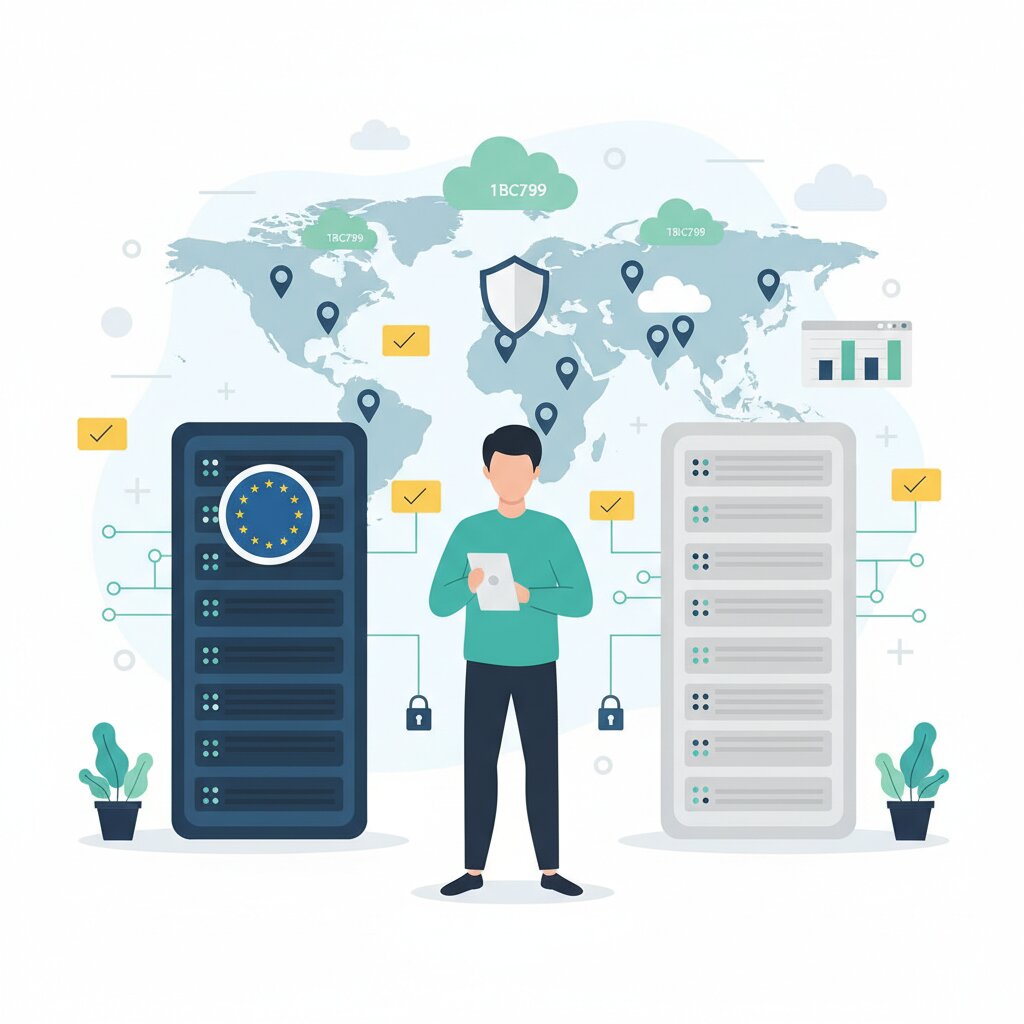

European organisations are making difficult decisions about cloud infrastructure. You’re balancing performance needs against data sovereignty concerns, regulatory compliance, and geopolitical risks. The numbers tell the story: EUR 264 billion in European cloud and software spending flows annually to US hyperscalers, representing 1.5% of EU GDP.
That dependency creates strategic vulnerabilities. As part of the broader European digital sovereignty movement, European cloud providers and open source alternatives offer compliance-native solutions with different tradeoffs in features, performance, and cost.
This article provides head-to-head comparisons across five dimensions: performance, feature completeness, compliance capabilities, sovereignty protection, and cost. We’ll look at federated data space implementations, European AI alternatives, and real-world migration case studies. Let’s start with who these European providers are.
What are the main European cloud providers and how do they compare to AWS, Azure, and Google Cloud?
The European cloud landscape includes several mature providers. OVHcloud operates 43 data centres across 9 countries. STACKIT launched in 2024 as a Deutsche Telekom subsidiary. Other established players include Cyso Cloud (Netherlands), Open Telekom Cloud (Germany), IONOS (Germany), Scaleway (France), UpCloud (Finland), Exoscale (Austria), ELASTX (Sweden), and Nine (Switzerland).
These providers offer comparable service portfolios to US hyperscalers. You’ll find Infrastructure-as-a-Service (VMs, storage, networking), managed Kubernetes and containers, managed databases (PostgreSQL, MySQL, MongoDB), and higher-level PaaS services.
Customer demand is driving growth. Since early 2025, customers have been actively requesting cloud providers that are natively European companies. The European Alternatives website saw 1,100% traffic growth in 2025, and search queries for “European alternatives” average 2,400 monthly searches with a 660% year-over-year increase.
Services vary by provider. Cyso Cloud is OpenStack-based with NEN 7510 healthcare certification. Scaleway offers managed AI and serverless services. Exoscale specialises in DBaaS including Kafka and OpenSearch.
The pricing landscape differs from US hyperscalers. Among US hyperscalers, Azure offers the most cost-effective storage services. For compute-optimised instances, Azure offers better value than AWS or Google Cloud. ARM-based processors consistently undercut x86 pricing, with Azure showing the largest savings gap at 65% lower on On-Demand and 69% lower on Spot instances.
Spot instance strategies create opportunities for cost optimisation. AWS Spot Instances offer up to 90% savings, Google Preemptible VMs up to 80% discount, and Azure Spot VMs the highest discount percentage.
Pricing stability varies. AWS exhibits the most dynamic pricing, averaging 197 monthly price changes, while GCP averages one change every three months. This matters for budget planning.
Geographic coverage reflects different strategies. UpCloud operates 13 data centres across 4 continents, providing the broadest reach among European providers. Most concentrate in the DACH region (Germany, Austria, Switzerland), France, and the Netherlands for data residency guarantees. That concentration matters when 62% of organisations choose local cloud providers primarily for data sovereignty and compliance.
AWS claims customers have control over where they store their data and how it is encrypted, calling AWS Cloud “sovereign-by-design”. Whether this constitutes genuine digital sovereignty is what we need to look at next.
What is digital sovereignty and why does it matter for cloud infrastructure decisions?
Digital sovereignty means maintaining control over data, infrastructure, and technology without external interference. As explored in what digital sovereignty means, this goes beyond GDPR compliance—it demands full control over data, infrastructure, and legal jurisdiction.
The strategic dependency runs deep. Over 74% of all publicly listed European companies depend on US-based email services and productivity suites778576_EN.pdf). That EUR 264 billion in annual spending to US hyperscalers represents more than a financial transfer—it’s a sovereignty vulnerability.
The US CLOUD Act creates direct conflicts. It’s a federal law passed in 2018 that allows US law enforcement to compel American companies to provide access to data stored abroad, even if that data belongs to non-EU persons and resides in EU data centres. It applies to sovereign cloud providers like Microsoft, Google and Amazon, communication tools like Teams or Slack, and any US-owned platform storing data globally.
This puts the CLOUD Act in direct conflict with GDPR. GDPR Article 48 states that foreign authorities require an international agreement to access EU data. Yet if a cloud provider is headquartered in the US, the CLOUD Act still applies regardless of where data is stored.
US law enforcement agencies have broad powers to request access to data, and approximately 92% of Western data currently resides in US-based infrastructure.
Over 50% of public cloud decision-makers cite digital sovereignty regulatory constraints as a top obstacle to public cloud adoption. Yet 84% consider digital sovereignty a key factor in vendor selection, though only a minority feel confident their current stack complies with regional mandates.
Platforms marketed as “sovereign” may store data in the EU, but if the vendor is US-based, they remain subject to laws like the CLOUD Act. This creates a fundamental challenge: organisations are in a bind—comply with GDPR and risk violating the CLOUD Act, or comply with US subpoenas and risk GDPR penalties.
For genuine digital sovereignty, you need client-side encryption, open-source EU-owned platforms, and zero-trust federated architectures. Real control starts with choosing infrastructure aligned with your legal environment, meaning European-built, open-source, and jurisdictionally secure platforms. Understanding these independence foundations helps frame the comparison of alternative platforms.
What is Gaia-X and how do federated data spaces like Catena-X work?
Gaia-X is a European project that has developed a federated secure standard for data infrastructure whereby data are shared, with users retaining control over their data access and usage. Launched in 2020 by France and Germany, it’s a strategic response to North American cloud dominance.
Rather than building another centralised cloud platform to compete with AWS or Azure, Gaia-X takes a different approach. It functions as an ecosystem of nodes interconnected via open standards designed to prevent power concentration. The stated goal is ensuring that companies and business models from Europe can be competitive and share data within a trustworthy environment.
As of 2025, Gaia-X is in its implementation phase with more than 180 data spaces. GAIA-X, along with initiatives like the Important Project of Common European Interest for Cloud Infrastructure and Services (IPCEI CIS), aim to create a federated architecture778576_EN.pdf) where multiple providers offer services under shared standards and governance.
Industry-specific data spaces show how this works in practice. Catena-X for automotive data and the European Health Data Space (EHDS) allow Europe’s industrial champions to pool data in a sovereign way778576_EN.pdf) and build tailored services.
Catena-X is an automotive industry data space built on Gaia-X framework enabling secure supply chain data exchange among manufacturers like BMW, Mercedes, and Volkswagen778576_EN.pdf), along with their suppliers and logistics partners. Instead of a central platform controlling data flow, the federated architecture lets organisations maintain ownership whilst sharing necessary information.
Lighthouse Data Spaces are recognised by Gaia-X AISBL as the best examples to showcase how Gaia-X concepts can foster European data sovereignty and value creation.
The technical framework includes several key documents that matter when you’re evaluating whether to join a Gaia-X data space or assessing a provider’s federation capabilities. The Gaia-X Architecture Document explains concepts and requirements for technical and syntactical interoperability. The Gaia-X Compliance Document expresses all the rules to follow to enable organisational and semantical interoperability. The Gaia-X Identity, Credentials and Access Management Document specifies how to deal with rights, authentication and access when interacting with a Gaia-X Ecosystem.
A Gaia-X Label is issued by a Gaia-X Digital Clearing House when the proofs given by the requestor fulfill the requirements expressed in the Compliance Document. Four Labels are available: Gaia-X Standard, Gaia-X Label level 1, Gaia-X Label level 2, and Gaia-X Label level 3.
The implementation faces challenges. Managing relationships between players whose interests don’t always align is a major challenge for Gaia-X. Governance tensions, insufficient technical maturity, and misaligned European stakeholder priorities create implementation delays and uncertainty about long-term viability.
Despite these challenges, X-ROAD platform infrastructure enables new data space creation, providing practical paths for organisations to participate in federated data ecosystems.
What open source alternatives exist for Microsoft 365, Slack, and Google Workspace?
You can replace the entire US SaaS stack with open source alternatives. The question is whether you should, and under what circumstances.
NextCloud Office is powered by LibreOffice and lets you collaborate on documents, spreadsheets, presentations, and even diagrams. NextCloud Talk provides a user experience that feels like Google Meets. NextCloud Groupware handles calendar and contact management.
Nextcloud (an open-source collaboration platform founded in Germany) has been adopted by some schools, governments and companies as an alternative to Google Drive or Microsoft OneDrive778576_EN.pdf).
For team communication, Mattermost provides Slack-equivalent functionality and runs on your own server with native desktop and mobile apps. Mattermost gives you threaded conversations, file sharing, and integrations. Enterprise features include SSO, compliance exports, and advanced permissions.
RocketChat is used by US government departments, known for being really secure, with a Discord-like interface.
Matrix + Element is an open-source framework for online chats that provides WhatsApp-similar user experience when self-hosted. For video conferencing, Jitsi leads in standalone platforms for open-source video and audio.
For lighter deployments, Baïkal and Radicale are lighter alternatives for calendar and contact management. Pydio Cells offers strong collaboration features and enterprise-grade security controls.
LibreOffice is an open-source solution for document editing778576_EN.pdf) that powers NextCloud Office for in-browser collaboration. OnlyOffice provides an alternative with better Microsoft format compatibility.
At the infrastructure layer, OpenStack provides IaaS foundation for providers like Cyso Cloud. This enables European providers to build services on non-proprietary foundations. Kubernetes handles container orchestration, replacing EKS/AKS/GKE. MinIO provides S3-compatible object storage. PostgreSQL and MySQL offer database alternatives to proprietary solutions.
The deployment tradeoff matters here. Self-hosted provides maximum sovereignty control but requires operational expertise. Managed open source offerings from European providers—like OVHcloud managed Kubernetes or STACKIT databases—reduce operational burden whilst maintaining sovereignty benefits.
Understanding deployment options for open source alternatives is one piece of the sovereignty puzzle. The other is understanding how different providers handle compliance requirements. When you’re ready to move forward, platform transition strategies provide frameworks for managing this adoption pathway.
How do European cloud providers compare to US hyperscalers for GDPR and data residency compliance?
European providers (OVHcloud, STACKIT, IONOS) operate under EU jurisdiction by default, making GDPR compliance and data residency guarantees native architecture rather than add-on features. This is the fundamental difference.
Microsoft Cloud for Sovereignty, AWS European Sovereign Cloud, and Google Cloud Sovereign Controls provide enhanced data residency and access controls but don’t eliminate parent company US jurisdiction. Legal analysis suggests the CLOUD Act still applies to sovereign offerings despite contractual protections.
Sovereignty isn’t just about where data is stored, it’s about who controls it. Microsoft 365 “EU Data Boundary”, Amazon’s “European Sovereign Cloud”, and Google’s “Sovereign Controls” provide the illusion of control while remaining subject to US legal demands.
The regulatory landscape includes several overlapping requirements. GDPR requires data residency control. The Data Act mandates cloud switching rights. NIS 2 Directive imposes stricter cybersecurity requirements on critical infrastructure sectors (finance, healthcare, energy).
DORA (Digital Operational Resilience Act) has specific requirements for financial services. DORA is a regulation that directly applies to all EU member states while NIS2 is a directive that each EU country must transpose into national legislation.
Sector-specific certifications differentiate European providers. Cyso Cloud holds NEN 7510 for Dutch healthcare. OVHcloud has SecNumCloud (French sovereign hosting) certification778576_EN.pdf). STACKIT focuses on Gaia-X compliance778576_EN.pdf).
What are the performance and feature gaps between European providers and AWS/Azure/Google Cloud?
European providers offer equivalent compute (EC2/Azure VMs alternatives), storage (S3/Blob alternatives with MinIO compatibility), managed databases (PostgreSQL/MySQL replacing RDS/CosmosDB), and managed Kubernetes. For standard workloads, European providers typically match hyperscaler compute performance.
Providers vary in their breadth of services, with differences particularly evident in AI offerings and advanced PaaS features. AWS is renowned for its scalability, extensive range of services, and global reach.
The AI and machine learning gap is real. US hyperscalers offer extensive managed AI services that European providers don’t match directly. However, Scaleway offers managed AI infrastructure, and European providers support bring-your-own AI frameworks via Kubernetes and GPU instances.
Developer tooling and ecosystem maturity favour US hyperscalers. Standard infrastructure-as-code tools like Terraform work with OVHcloud, STACKIT, and IONOS, as do Kubernetes for container workloads. The gap is primarily in proprietary PaaS integrations rather than core infrastructure.
Core cloud skills (Linux administration, networking, Kubernetes, Terraform) transfer directly between US and European providers. This reduces migration technical debt for teams with existing cloud experience.
How much does it cost to migrate from AWS/Azure to European cloud providers?
Total Cost of Ownership includes several components. You’ve got base infrastructure pricing (usually comparable or lower for European providers), data egress costs (often lower for EU providers), software licensing (unchanged unless replacing proprietary services), migration professional services, team training, and productivity loss during transition. For detailed financial analysis, see our guide on TCO comparison between European and US platforms.
Egress fees create one-time migration costs. Traffic exiting AWS is chargeable outside of the free tier within the range of $0.08–$0.12 per GB. The free tier provides 100GB of free data transfer out per month for AWS.
Traffic between AWS regions usually costs $0.09 per GB for the egress of both the source and destination. For Microsoft Azure, data transfer between Availability Zones in the same region costs $0.01 per GB.
For Azure internet egress, the first 100 GB is free of charge, the next 10 TB cost $0.087 per GB, and the following 40TB $0.083 per GB. For Google Cloud Platform, there’s no charge for network egress within the same location.
Egress charges typically average around 9 cents per GB. Most cloud providers will charge up to $0.09 USD per every GB transferred out of their storage. For a 10TB dataset, you’re looking at around $900 in one-time egress costs during migration.
Specific egress fees depend on customer tier, volume of transferred data, country of origin, data source and destination, failover control requests, and data transfer speedup. For Amazon S3, egress costs are typically 5-7 cents more on top of basic cloud storage charges.
Cost optimisation strategies during migration can offset egress fees. Teams can carefully select workloads and create cloud architectures that maximise efficiency by prioritising reduced inter-regional data transfers, use of data deduplication and compression, and redesigning data-intensive apps to just download differences in data.
Companies can negotiate lower regional transfer fees or arrange to have part or all of their egress costs included in their subscription rates. It may be less expensive to move archived material to a tier that allows for more frequent access than to pay additional costs to retrieve it from cold storage.
Direct cost comparison shows like-for-like infrastructure pricing typically competitive. IONOS targets SMB affordability, OVHcloud offers volume discounts for enterprises, STACKIT positions at Azure parity for the German market.
Hidden costs matter too. Downtime during migration (minimised with hybrid transition), team retraining on new platforms (European providers offer similar UIs/APIs reducing learning curve), dual-running costs during overlap period (can be months for large estates). Understanding these pricing comparisons helps frame business cases for sovereignty investment.
Cost savings opportunities include eliminating egress fees for European-to-European traffic, rightsizing instances during migration discovery (often reveals overprovisioning), and replacing expensive proprietary services with open source alternatives like moving from RDS to self-managed PostgreSQL on Kubernetes.
AWS applies egress charges for data transferred out from its services to the internet, which can impact overall costs. These ongoing costs often exceed initial migration expenses over multi-year periods.
What are real-world examples of successful migrations to European cloud providers?
Multiple German federal states (Bundesländer) migrated from Microsoft cloud services to sovereign alternatives using STACKIT and Open Telekom Cloud for GDPR compliance and digital sovereignty778576_EN.pdf). These German state migrations involved thousands of public sector employees778576_EN.pdf).
The automotive industry provides another example. BMW, Mercedes-Benz, Volkswagen, and tier-1 suppliers use Catena-X federated data space built on Gaia-X framework for secure supply chain data exchange778576_EN.pdf). This enables coordination without centralised US platform control.
France’s public sector took a regulatory approach. France’s “cloud de confiance” (trusted cloud) initiative mandates SecNumCloud-certified providers (OVHcloud, Scaleway) for sensitive government workloads778576_EN.pdf).
Private sector migrations are happening too. Medicusdata, a company providing text-to-speech services to doctors and hospitals in Europe, moved some services to Exoscale after customers actively asked for natively European companies. Having data in Europe has always “been a must” but customers have been asking for more in recent weeks.
These migrations reflect growing momentum in the sovereignty platform landscape, with organisations prioritising compliance and geopolitical resilience alongside technical capabilities.
How do you evaluate which European cloud provider meets NIS 2 Directive requirements?
NIS 2 is an EU Directive on security of network and information systems that applies to “essential” and “important” entities in sectors including energy, transport, banking, health, digital infrastructure, public administration, space, and manufacturing. It mandates cybersecurity risk management, incident reporting, and supply chain security.
NIS 2 compliance requires both provider-level controls (physical security, network protection, incident response) and customer configuration (encryption key management, access policies, monitoring).
STACKIT and Open Telekom Cloud emphasise NIS 2 pre-alignment for German infrastructure778576_EN.pdf). European providers often provide better default security postures than hyperscalers requiring extensive configuration.
NIS 2 mandates supplier risk management; European providers with EU-based operations and open source foundations (OpenStack, Kubernetes) reduce foreign dependency risks versus US hyperscalers.
Implementation timelines are tight. According to an ENISA Senior Cybersecurity Policy Expert, if you haven’t started implementing NIS 2 measures yet, you’re already late.
Evaluation criteria include incident response capabilities, security certifications (ISO 27001, SOC 2, sector-specific like NEN 7510 healthcare), supply chain transparency, encryption standards, access controls, and audit logging.
What European AI alternatives exist to OpenAI and Claude for sovereignty-compliant deployments?
Europe accounts for only roughly 4-5% of global AI compute capacity778576_EN.pdf). But infrastructure investments are addressing this gap.
The EuroHPC Joint Undertaking has produced supercomputers like JUPITER, Europe’s first exascale system, which is also the world’s most energy-efficient supercomputer module. JUPITER is part of a strategy to create AI factories and gigafactories, which will be networked across the continent to provide massive compute capacity778576_EN.pdf).
These advanced HPC facilities reduce dependence on foreign compute resources, making it easier to keep data and workloads within EU jurisdiction778576_EN.pdf).
EuroStack addresses technology across seven interconnected layers including Cloud Infrastructure, Software, and Data and Artificial Intelligence. SovereignAI is AI-as-a-Service for strategic autonomy.
European language models are emerging. Token-7B is a language model trained equally on all 24 official EU languages. Apertus is a model developed in full EU AI Act compliance with documented training transparency.
EU telecommunications companies are building sovereign computing alternatives. Mistral signaled intent to support downstream operators with appropriate documentation on AI models. The European Commission’s AI Pact offers opportunities for peer exchange around the EU AI Act.
Achieving sovereign AI means creating the conditions to train, deploy and govern AI models within Europe, using computing and data infrastructures subject to EU laws, ethical standards and democratic accountability778576_EN.pdf).
Sovereign AI is increasingly understood as a strategic asset, even on par with economic and military strength778576_EN.pdf). Leadership in advancing AI-related technology has a impact on countries’ defence capacity given the growing hybridisation of warfare778576_EN.pdf).
Most organisations control only the application layer while depending entirely on foreign entities for deeper layers (infrastructure, data, model, governance). Implementation involves assessment of current dependencies, infrastructure evaluation and gap identification, skills development or partner relationships, phased migration maintaining operational continuity, and governance process establishment. For technical setup details, our implementation guidance covers deployment procedures for European alternatives.
FAQ
Can European cloud providers handle global deployments or are they limited to Europe?
European providers primarily concentrate datacenters in the EU for data residency guarantees. UpCloud operates 13 datacenters across 4 continents including Asia-Pacific and North America. OVHcloud provides most extensive non-EU coverage among European providers with Canadian and Asia-Pacific presence.
For organisations requiring global presence, hybrid architecture combining European providers for sovereignty-critical workloads with US hyperscalers for global edge delivery offers a balanced approach.
What happens to my data if a European cloud provider is acquired by a US company?
Gaia-X Trust Framework and CISPE Sovereign Cloud Manifesto establish standards requiring providers to maintain EU jurisdiction even under ownership changes.
Due diligence on provider ownership structure and contractual data sovereignty guarantees remains necessary. German government cloud contracts often include sovereignty clauses preventing data access following ownership changes.
Do European cloud providers support containerised workloads and Kubernetes?
You’ll find managed Kubernetes services across all major European providers, compatible with standard kubectl and Helm workflows. Many European providers built on OpenStack foundations, providing strong Kubernetes integration.
Container portability across European providers and US hyperscalers enabled by standardised Kubernetes APIs reduces vendor lock-in risk compared to proprietary PaaS services.
How do egress fees compare between European providers and AWS/Azure/Google Cloud?
US hyperscalers charge 0.05-0.09 EUR/GB for data egress, creating substantial ongoing costs for data-intensive applications. European providers typically offer lower egress fees or unlimited egress within Europe.
OVHcloud and IONOS particularly emphasise transparent pricing without egress surprise charges. Regulatory pressure from EU Data Act on switching costs likely to further reduce egress fees industry-wide.
Can I use AWS/Azure/Google Cloud sovereign offerings instead of European providers?
For organisations prioritising sovereignty over feature breadth, European providers under EU jurisdiction provide stronger legal guarantees. The parent company US jurisdiction issue means that even sovereign offerings from US hyperscalers don’t eliminate CLOUD Act exposure.
Hybrid approach common: US sovereign offerings for familiar tooling with European providers for highest-sensitivity workloads.
What skill gaps exist when migrating from AWS/Azure to European cloud providers?
Core cloud skills (Linux administration, networking, Kubernetes, Terraform) transfer directly. Specific service knowledge (AWS Lambda, Azure Functions, proprietary databases) requires relearning European equivalents or open source alternatives.
European providers often provide migration guides and professional services. Team retraining typically 2-4 weeks for experienced cloud engineers.
How do European cloud providers handle compliance with both GDPR and industry-specific regulations?
Sector-specific certifications differentiate providers: Cyso Cloud NEN 7510 (Dutch healthcare), STACKIT focus on financial services DORA compliance778576_EN.pdf), OVHcloud SecNumCloud (French government)778576_EN.pdf), plus IONOS ISO 27001 and other standard certifications.
GDPR provides baseline with industry regulations (DORA for finance, NIS 2 for infrastructure) requiring additional controls. European providers typically offer compliance templates and audit support.
What is the performance impact of data residency restrictions?
For European end-users, European datacenters often provide lower latency than routing through US regions (20-50ms improvement). Global applications face tradeoff: data residency in EU datacenters increases latency for non-European users but ensures compliance.
Content delivery networks (OVHcloud CDN, Cloudflare) and edge caching minimise performance impact. Hybrid architectures common: EU databases with global CDN for read-heavy workloads.
How mature are European cloud provider ecosystems compared to AWS/Azure marketplaces?
US hyperscaler marketplaces offer thousands of third-party integrations; European provider ecosystems smaller but growing. You’ll find Terraform support for infrastructure-as-code across OVHcloud, STACKIT, and IONOS, along with standard Kubernetes and common open source tools.
Gap is primarily in proprietary PaaS integrations rather than core infrastructure. Open source foundations of European providers often enable easier integration via standard APIs.
Can European cloud providers support AI/ML workloads without AWS SageMaker equivalents?
Scaleway offers managed AI infrastructure; other European providers support bring-your-own AI frameworks via Kubernetes and GPU instances. European AI workflow: European models for inference, EuroHPC JUPITER for training, European cloud Kubernetes for deployment orchestration.
Lacks hyperscaler managed services convenience but achieves sovereignty. Trade-off: more operational responsibility for greater data control and GDPR compliance for AI training data.
What happens if a European cloud provider experiences downtime or goes bankrupt?
Service level agreements (SLAs) typically match hyperscaler uptime guarantees (99.9-99.99%). Kubernetes and containerised architectures enable workload portability across providers, reducing single-provider dependency.
Federated data space architecture (Gaia-X framework) explicitly designed for multi-provider resilience. For bankruptcy risk mitigation, data backup to secondary European provider or hybrid strategy maintains availability.
How do European providers handle vendor lock-in compared to AWS/Azure proprietary services?
European providers’ OpenStack and Kubernetes foundations reduce lock-in versus hyperscaler proprietary services (AWS Lambda, DynamoDB, Azure CosmosDB). Data Act switching rights (effective 2025) mandate cloud providers facilitate workload portability, favouring European providers already built on open standards.
Container-based architectures (Kubernetes, Docker) enable migration across providers with minimal refactoring. Tradeoff: managed service convenience versus portability; European providers optimise for latter.