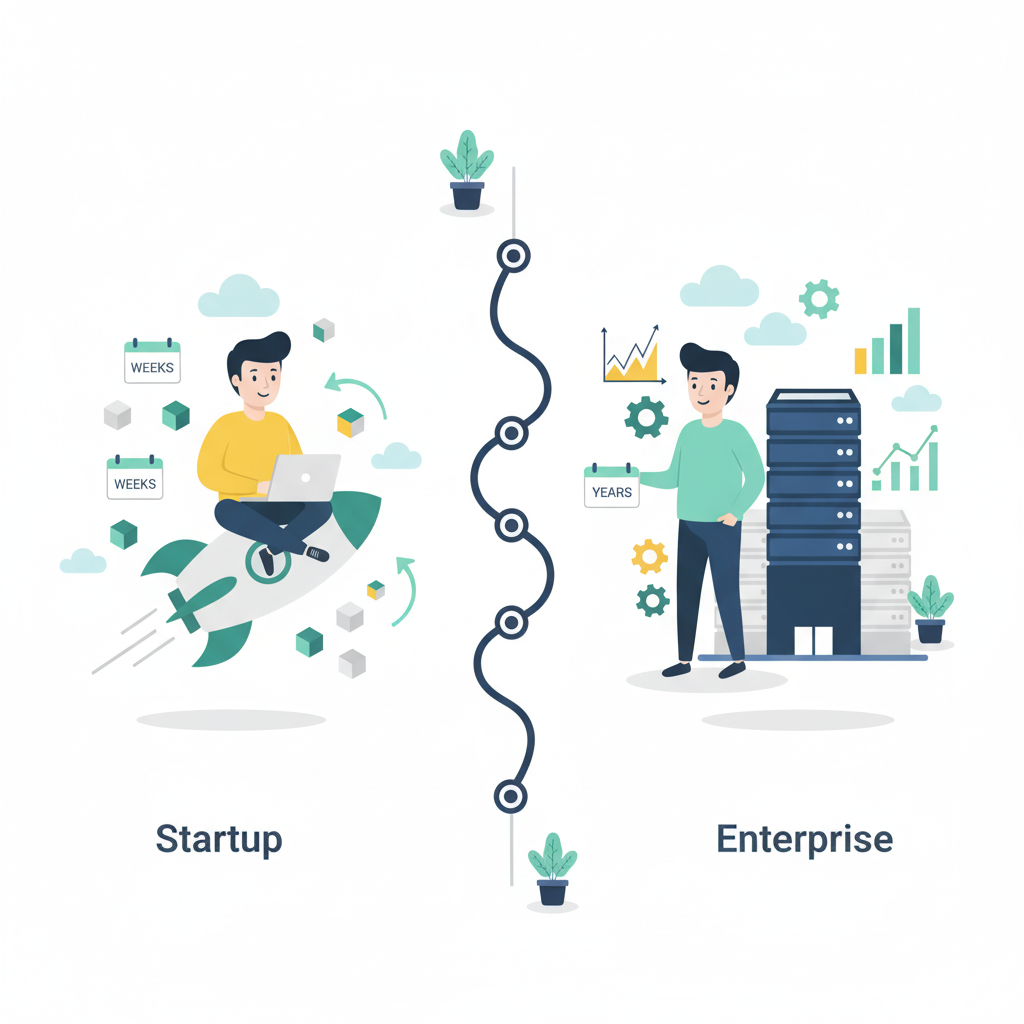
You’re probably facing this right now. Someone on your leadership team is pushing you to “build it right” while investors want you to “move fast and break things.” It feels like choosing between quality and speed.
The real question is simpler: what’s your actual time horizon?
If you’re genuinely building for a 10-year future, you need one set of architectural decisions. If you’re in the messy middle of finding product-market fit with 9 months of runway, you need completely different ones. Most “best practices” articles ignore this, pushing enterprise patterns onto startups or startup shortcuts onto established platforms.
This article gives you a framework to figure out your realistic time horizon, then shows you exactly what architectural choices make sense for where you actually are. Not where you hope to be. Where you are.
You’ll see concrete examples from Instagram (monolith to $1B acquisition), Amazon (multi-year evolution to services), and Basecamp (disciplined monolith at scale). You’ll get clarity on when “quick and dirty” decisions are right, and when sophistication becomes worth the cost.
Your architecture should match your business timeline, not someone else’s idea of excellence.
What is Your Realistic Time Horizon?
Your time horizon is the realistic planning period before major business change happens. That could be a pivot, an acquisition, hitting a scale inflection point, or running out of money.
Notice the word “realistic” there. Not your imagined hockey stick growth. Not the vision you sold investors. The actual timeline your funding, runway, and market position support.
Most founders optimise for an imagined 10-year future when their business model actually suggests an 18-month acquisition timeline. Or they build quick-and-dirty MVPs when they’ve got Series B funding and a clear path to IPO. Both waste resources.
Here’s a simple diagnostic framework using five questions:
Exit strategy: Are you building to get acquired in 2-3 years, or going for an IPO in 7-10 years? This matters more than anything else. Companies optimising for acquisition need different patterns than those building toward IPO.
Funding runway: How many months do you actually have? If it’s less than 12 months, you can’t afford 3-month infrastructure projects no matter how “right” they feel.
Product-market fit status: Are you still searching or have you found it? Before PMF, most code gets discarded or replaced. Research shows 67% of features get dumped in the first year. Building robust architecture for disposable code is waste.
Team growth trajectory: Where will headcount be in 12 and 24 months? Team size drives architectural needs. 5 engineers can share a monolith. 50 engineers need boundaries.
Competitive pressure: Are you in a land grab or optimisation phase? Time-to-market urgency changes what quality bars you can afford.
Put these together and you get concrete time bands:
- 6-week experiments: Validating ideas with throwaway code
- 6-month MVPs: Finding product-market fit, high pivot probability
- 2-year growth stage: PMF validated, scaling to Series A/B
- 5-year mature product: Established business, team over 30 engineers
- 10-year public company: Platform business, compliance requirements
Instagram is the perfect example. They deliberately optimised for a 6-month to 2-year horizon. Python/Django monolith. PostgreSQL database. 30 million users with 13 engineers. When Facebook acquired them for $1B, the clean simple codebase was attractive, not a liability.
Compare that to Amazon. They knew they were building for a decade-plus horizon. Started with a monolith, then evolved to service-oriented architecture over multiple years as team size and business complexity demanded it.
Your exit strategy determines your architecture. Acquisition targets need different patterns than IPO candidates.
Why Do Startups Prioritise Speed Over Stability?
Startups optimise for learning velocity and pivot capability, not longevity. This is economics, not recklessness.
During the product-market fit search, you’re throwing things at the wall to see what sticks. Most features get discarded or replaced during the first year. Building robust, well-tested, properly abstracted architecture for code that might not exist in 6 months is waste.
Look at the resource constraints. You’ve got a 6-person team with 9 months of runway. Spending 3 months building infrastructure is 33% of your available time. Can you afford that? Usually not.
Strategic technical debt addresses this reality. Not accidental debt from sloppy work. Deliberate shortcuts to accelerate learning when code lifespan is uncertain.
Contrast this with enterprise platforms. Once you’ve validated your business model and have a 5-10 year horizon, infrastructure investment pays compound returns. But before that inflection? Speed wins.
The premature optimisation warning applies here. Building microservices for imagined scale kills velocity and increases cognitive load when you’re still searching for product-market fit. Your 6-person team doesn’t need the coordination overhead of distributed systems.
WhatsApp is the extreme example. Minimal infrastructure running Erlang, supporting billions of messages with about 50 engineers. Acquired for $19B. They made technology choices aligned with their time horizon and stuck with them.
The key principle: “quick and dirty” is professionally appropriate when your time horizon is short. The key is making it a conscious choice with awareness of when you’ll need to pay it back.
What Architectural Patterns Suit 6-Week to 6-Month Timelines?
Start with a monolith. A single deployable unit optimises for what matters at this stage: iteration speed.
With all components in one codebase, deployment is straightforward. Your developers can understand the entire application flow. Changes happen in one place and you see effects immediately. No distributed system coordination. No microservices deployment choreography.
Keep abstraction minimal. YAGNI applies here: You Aren’t Gonna Need It. Future requirements are unknown and code may be discarded during pivots. Building flexibility you don’t need yet is waste.
Manual deployment is acceptable. If you’re doing 1-2 deploys per week, sophisticated CI/CD automation doesn’t pay for itself. That 3-week investment to build the perfect pipeline? Your startup doesn’t have 3 weeks.
Testing strategy should favour end-to-end tests over unit tests. Validate user workflows, not implementation details. When you’re pivoting frequently, implementation changes constantly but user workflows are more stable.
Database choice is the ONE area where you should think longer-term because migration costs can cripple momentum later. Instagram’s early PostgreSQL choice and Shopify’s abstraction layers both proved valuable when scale demands changed.
Feature flags over branches. This lets you roll back features without deployment complexity. Enable quick experiments with quick reversions.
Keep documentation minimal: a README and inline comments are sufficient. Skip architecture decision records. You don’t need that overhead yet.
Specific patterns for this stage:
- Single Rails/Django/Laravel application
- Embedded database like SQLite or single PostgreSQL instance
- Heroku or Render for deployment simplicity
- Environment variables for configuration
The technology matters less than the simplicity. Pick boring, well-understood tools with good documentation.
How Do 5-Year to 10-Year Platforms Differ Architecturally?
Long planning horizons justify upfront investment. Infrastructure work pays compound returns over years.
Microservices typically make sense when teams grow beyond 20-30 engineers. Before that threshold, coordination overhead outweighs the benefits. After it, monolith coupling becomes the bigger problem.
Microservices don’t reduce complexity. They make complexity visible and more manageable by separating concerns into smaller, focused services. Each service has its own business logic and database. Teams can work independently.
Abstraction investment pays off at this stage. Generic frameworks and libraries that initially slow development accelerate long-term velocity. You’re building leverage for the future.
Comprehensive testing becomes necessary. Unit tests provide a safety net for refactoring across years of team turnover. When developers who wrote the original code have left, tests document behaviour and prevent regression.
Blue-green and multi-region deployment patterns become standard. Zero-downtime requirements for platforms with millions of users and revenue dependency. You can’t just “deploy and hope” anymore.
Documentation becomes necessary. Architecture decision records. Runbooks. System diagrams. These enable developer succession planning when your team has grown from 5 to 50 engineers.
Security investment becomes mandatory. Public company compliance requirements like SOC2, GDPR, HIPAA. Sophisticated threat modelling. This stuff takes time and money, but it’s table stakes for 10-year platforms.
Amazon’s evolution shows the pattern. Started as a monolith. As the codebase became messy and new features took longer, they consciously shifted to a “services company” with well-documented APIs. Service-oriented architecture enabled team autonomy and independent scaling.
Netflix’s 2008 data corruption incident served as a catalyst for their cloud migration, but their fundamental driver was enabling independent team velocity at scale. They moved to AWS cloud-based microservices, breaking the application into over 700 microservices so engineers could make changes without bringing down the entire system.
The timeline for this evolution: Year 1 monolith → Year 2-3 modular monolith → Year 4-5 selective microservices → Year 5+ comprehensive services.
When Should You Transition from Monolith to Microservices?
Don’t transition based on “best practices.” Wait for actual constraints.
Four signals indicate readiness:
Signal 1: Team size exceeds 20-30 engineers. A TravelTech company hit the breaking point at 15 engineers when deployment conflicts doubled in a single quarter. Multiple teams modifying the same components created bottlenecks.
Signal 2: Independent scaling requirements emerge. One service needs 10x resources while others don’t. Running everything together wastes money and complicates deployment.
Signal 3: Deployment coupling blocks velocity. Every deploy requires full regression testing. Multiple teams coordinate releases. These are symptoms that the monolith is holding you back.
Signal 4: Domain boundaries stabilise. Your business model is validated. Major pivots are unlikely. You can identify clear service boundaries that won’t change in 6 months.
Counter-examples matter here. Basecamp and GitHub sustained monoliths at massive scale through disciplined refactoring. GitHub runs Rails monolith demonstrating that monoliths can serve 10-year timelines with proper maintenance.
The modular monolith provides a middle path: maintain a single deployable unit while enforcing strong internal boundaries between domains. This gives you organisational benefits without operational overhead.
Migration approach: strangler fig pattern over big-bang rewrite. Incremental service extraction. Coexistence during transition. The pattern gets its name from how strangler fig plants grow around trees, slowly enveloping and eventually replacing the host.
Shopify’s database abstraction layer is the model here. They invested in abstraction at the right time, enabling MySQL-to-multi-shard migration later.
Timeline reality: monolith-to-microservices transition takes 12-24 months, not 6 months. Plan accordingly.
How Does Technical Debt Change Across Time Horizons?
Technical debt has context-dependent value. It’s a tool that works differently depending on your time horizon.
For 6-week to 6-month MVPs, strategic technical debt is an asset. Shortcuts enable rapid learning when code lifespan is uncertain. You move faster, learn faster, pivot faster. The debt pays dividends when code gets replaced during pivots.
Product-market fit is the inflection point. Before PMF, debt accelerates learning. After PMF, debt transitions from asset to liability because code longevity increases.
For 2-year to 5-year products, incremental refactoring becomes necessary. Allocate 15-25% of sprint capacity to debt reduction. Like paying down a mortgage, small consistent payments prevent the compound interest from crushing you.
For 5-year to 10-year platforms, technical debt becomes a significant burden. Maintenance burden exceeds feature velocity. You’re stuck in the “legacy codebase” trap where every change requires touching ten files and breaking three things.
Specific debt examples:
No automated tests: Acceptable for 6-week MVP. Necessary for 5-year platform. Solo developer knows the code. Team of 30 with annual turnover needs test documentation.
Hardcoded configuration: Fine for monolith with single deployment environment. Blocks microservices with multiple regions and environments.
Lack of abstraction: YAGNI for startups where requirements change weekly. Expensive for enterprises that need to swap out infrastructure providers.
The key principle: consciously take on debt with awareness of repayment timing. Wait for product-market fit signals before major refactoring investment.
Instagram paid down debt before acquisition, resulting in a clean codebase attractive to Facebook. They made the strategic choice to refactor once PMF was clear and acquisition looked likely.
Frame technical debt as “financial liability” that silently taxes innovation and creates competitive risks. This helps communicate with non-technical stakeholders about why refactoring matters.
The difference between strategic and accidental debt: Strategic debt involves conscious shortcuts to accelerate learning. You know what you’re doing and why. Accidental debt results from lack of knowledge or care. Strategic debt has planned repayment timing. Accidental debt just accumulates.
What Operational Maturity Suits Different Time Horizons?
Match tooling investment to time horizon. Premature sophistication wastes resources.
CI/CD sophistication progression:
- 6 months: Manual deploys
- 1 year: Basic automation pays off. Push-to-deploy simplicity.
- 3 years: Blue-green deployment for zero-downtime requirements.
- 5-10 years: Multi-region with chaos engineering.
Testing investment scaling:
- 6 months: Manual testing or focused E2E tests covering critical paths.
- 1 year: E2E tests for user workflows.
- 2 years: Unit tests for core business logic.
- 5+ years: Comprehensive test pyramid with integration tests.
Documentation requirements:
- 6 months: Inline comments sufficient.
- 1 year: README with setup instructions.
- 2-3 years: Architecture decision records documenting trade-offs.
- 5+ years: Full architecture docs, runbooks, system diagrams.
Security investment timing:
- 6 months: Basic authentication.
- 1 year: HTTPS and encryption.
- 2-3 years: Compliance preparation.
- 5+ years: SOC2, GDPR, full compliance.
Monitoring and observability:
- 6 months: Error tracking.
- 1 year: Application performance monitoring.
- 3 years: Distributed tracing.
- 5+ years: Custom metrics, sophisticated alerting.
You don’t need Kubernetes yet. For 6-month MVPs, a single Heroku dyno is professionally acceptable. The sophistication can wait.
Stripe is the exception that proves the rule. They implemented API versioning from early stages because their platform business model suggested long-term compatibility commitments. They knew their time horizon from the start.
Watch for signals that you need to invest in the next maturity level: team growth, user base criticality, funding milestones.
How Do You Recognise When Your Time Horizon Changes?
Your time horizon isn’t static. Business context changes. Architecture must evolve with it.
Product-market fit validation signals shift from 6-month to 2-year horizon. Recurring revenue. Low churn. Organic growth. These mean your code will live longer than you initially thought.
Funding events extend time horizon. Seed round gives you 18 months. Series A suggests 2-3 years. Series B implies 5 years. Each milestone changes what architectural investment makes sense.
Team growth milestones trigger change. Crossing 15, 30, or 50 engineers creates different organisational and architectural needs. Manual processes break down as teams scale beyond certain thresholds.
User base inflection points create different reliability requirements. 1K users tolerate downtime. 100K users expect stability. 1M users demand it. Each order of magnitude changes what you can get away with.
Competitive dynamics shift from land grab to optimisation. During land grab, time-to-market trumps quality. During optimisation, quality becomes competitive advantage.
Exit opportunity changes can shorten or extend horizon. Acquisition offer shortens it—optimise for clean handover. IPO path extends to 7-10 years—invest in enterprise patterns.
Architectural evolution strategy: use the strangler fig pattern rather than big-bang rewrites. Rather than halting development for 18 months to rebuild, you gradually replace components while keeping the system running.
Rewrite versus refactor decision: Systems under 2 years old might warrant rewrite if there’s a fundamental architectural mistake. Systems over 10 years favour incremental improvement. The risk of big-bang failure increases with system age and complexity.
Team composition implications: hire for velocity during product-market fit search. Hire for stability when you extend to 5-year horizon. The skills you need change as time horizon changes.
Key principle: architecture must evolve with business context, not remain static from founding.
Should I build microservices from day one for my startup?
No. Microservices create coordination overhead and operational complexity that kills velocity for small teams. Start with a monolith and extract services only when team size (20-30 engineers) or independent scaling needs justify the complexity. Instagram and WhatsApp both scaled to acquisitions with monolithic architectures.
How much technical debt is acceptable in a startup MVP?
Strategic technical debt is not just acceptable but optimal for 6-week to 6-month MVPs. Shortcuts enable rapid learning when code lifespan is uncertain. The key is conscious debt with planned repayment timing. Wait for product-market fit signals before major refactoring investment.
When should I invest in comprehensive automated testing?
Testing investment should scale with time horizon. 6-month MVPs need only focused E2E tests covering critical paths. 1-2 year products benefit from unit tests for core business logic. 5-10 year platforms require comprehensive test pyramids for refactoring safety across team turnover.
Is it ever worth doing a complete rewrite of a startup’s codebase?
Rarely. Complete rewrites typically fail or take 2-3x longer than estimated. The strangler fig pattern (incremental service extraction with coexistence) succeeds where big-bang rewrites fail. Only consider rewrites for systems under 2 years old with fundamental architectural mistakes.
How do I know when to transition from monolith to microservices?
Four signals indicate readiness: (1) team exceeds 20-30 engineers, (2) independent scaling requirements emerge, (3) deployment coupling blocks velocity, (4) domain boundaries stabilise. Don’t transition based on “best practices.” Wait for actual organisational or technical constraints.
What’s the difference between strategic and accidental technical debt?
Strategic debt involves conscious shortcuts to accelerate learning when code longevity is uncertain (acceptable for startups). Accidental debt results from lack of knowledge or care (always problematic). Strategic debt has planned repayment timing aligned with business milestones like product-market fit.
How does exit strategy affect architectural decisions?
Acquisition-targeted companies (2-3 year horizon) optimise differently than IPO candidates (7-10 years). Instagram’s clean monolith was attractive to Facebook acquirer. Public companies need enterprise patterns (microservices, compliance, documentation) that would waste resources in acquisition scenarios.
Can a monolith serve a 10-year enterprise platform?
Yes, with discipline. Basecamp and GitHub sustained monoliths at scale through rigorous refactoring and modular boundaries. Shopify also maintained a Rails monolith while growing to $5B+ revenue before selectively extracting services. Monoliths can work for 10-year horizons if team size stays under 30 engineers and domain complexity remains manageable. Not all enterprises need microservices.
What architectural mistakes do startups make that cost them later?
Top mistakes: (1) premature microservices killing velocity, (2) wrong database choice requiring expensive migration, (3) lack of abstraction around external services, (4) no feature flags making rollbacks difficult, (5) skipping basic security enabling breaches during growth.
How long does transitioning from startup to enterprise architecture take?
Realistic timeline is 12-24 months for monolith-to-microservices migrations. This includes infrastructure setup, gradual service extraction, team reorganisation, and operational maturity improvements. Companies that attempt 6-month “big bang” transitions typically fail or create distributed monoliths.
When should I hire for maintenance and stability versus pure velocity?
Hire for velocity during product-market fit search (6-month to 2-year horizon). Start hiring for stability when you achieve product-market fit and extend to 5-year horizon—typically after Series A/B funding. Team composition should shift from “move fast” generalists to specialists in reliability, security, and performance.
What’s the minimum viable CI/CD for an early-stage startup?
Manual deployment is acceptable for early MVPs. Basic automation (push to deploy) becomes valuable around 1-year horizon with daily deploys. Don’t invest in blue-green or multi-region until 3-year horizon with reliability requirements.