When Andrej Karpathy came up with the term vibe coding he was talking about coding that involved instructing an AI and never looking at the code.
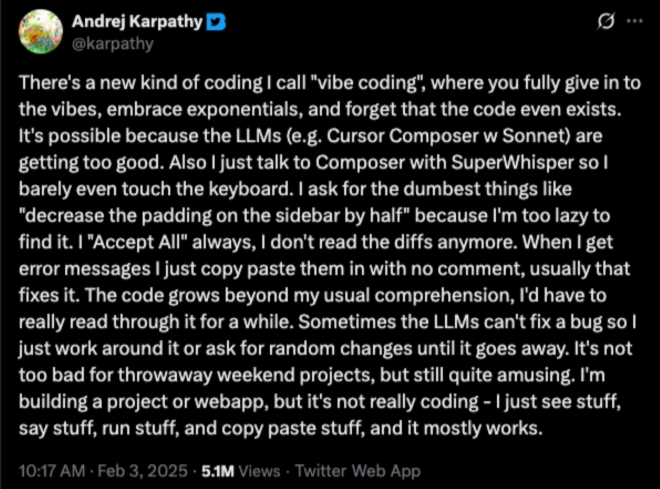
As you can see, that tweet had 5.1 million views at one point. It was responsible for opening people’s eyes to how capable AI had become at coding and set off an inrush into app development.
No surprise, but there were thousands of people who wanted to build apps but didn’t know how to code. It felt like their time had finally come. They could forget no-code/low-code tools and get AI to write the code for them.
But the challenges of vibe coding quickly became apparent.

Post Vibe-coding vibes
The issues with vibe coding were immediately apparent to developers. But the fact that AI was getting code 80% complete, and for simple things 100%, meant there was promise.
The goal became not to get AI to write entire apps, but to write as much of an app as possible.
The failures in vibe coding can be divided into model ability and information availability.
AI is now quite good at understanding code and writing code. The problem is context – the amount of information that an AI successfully work with.
This includes instructions, any files it needs, results of its own thinking, research, and the file changes it makes as it works.
AI doesn’t know what a project is about unless that information has been added to its context.
It doesn’t know what database schema it should be following unless that information has been added to its context
It doesn’t know anything about the API endpoints it should be using unless that information is in its context
There is so much knowledge in a software developer’s head for even the smallest project. And it’s always more information than can fit in an AI’s context.
This drove the focus on “context engineering” – getting the right information into the AI’s context, and setting tasks that could be completed within the effective length of the AI’s context, as performance noticeably reduced as the context lengthened.
From Vibe-coding to Context Engineering
The BMAD Method, started and open sourced by senior engineer Brian Madison (thus the BMAD) and now developed by a team of contributors, is currently one of the most effective approaches to dealing with the challenges of AI-assisted software development.
It works by automating the generation of the detailed, modular documentation an AI needs to be effective across 4 main areas of development:
- Analysis (Optional) – Brainstorm, research, and explore solutions
- Planning – Create PRDs and tech specs
- Solutioning – Design architecture, UX, and technical approach
- Implementation – Story-driven development with continuous validation
This is handled by treating the process as a series of workflows instead of one ongoing conversation. The workflows are handled by “agents”, which are focused prompts that target a particular outcome, such as a PRD, a system design doc, a task list for coding, a file of code, or the results of a test run.
Developing software becomes working with the agents at each stage of the process to specify, record and review the documentation at each stage of development.
The power of this approach is that the amount of documentation an AI needs is immense compared to what a human software developer requires, but you can use AI to create it. Or recreate it if new constraints or issues arise as development progresses.
And an AI agent is naturally relentless and unceasing in its requests for the required information to create all the necessary documents. It won’t take shortcuts or skip steps unless ordered to.
BMAD is by design modular to avoid the problems of overflowing context, and robust to interrupted workflows and restarts. Each module/workflow is designed to load just the documentation it needs, and the documentation they produce is designed to be as concise as possible while still serving its purpose. Where documents are long, BMAD can shard them so only the necessary portions need to be loaded into the AI’s context.
BMAD Method Saves Typing, Not Thinking
When you kick off the BMAD Method it will hold your hand every step of the way. It is designed to guide you through decision making based on standard software development planning, design and execution practices. You can “vibe code” it and get it to make all decisions for you (it even has a #YOLO mode) and never look at any of the documentation it produces. But that won’t work.
The devil is in the details, and software development is all details, and most of those details start out in your or your PM’s head. Or in your codebase templates and runbooks.
If you use BMAD Method diligently, and provide it with your templates and runbooks (at the appropriate point), and get it to research the answers you’re not sure of and answer the questions you are sure of and review the documents it produces and make it fix any issues you find, then it will work much better.
But it isn’t easy work. Even with an AI to ask questions and turn answers into documents, going from an idea for a software product to a full set of design, technical, and implementation documents is mentally challenging.
Normally this work is split across multiple people, each with specialised skill sets and knowledge. They have meetings. They cover whiteboards with sticky notes in different colours. BMAD Method can be run by a single person sitting at a laptop. But we find this doesn’t give the best results.
You want the relevant experts involved at each stage. AI has shifted the burden in software development from production to review, even for documentation. Review is where errors are spotted. When AI can work autonomously for hours, generating or changing hundreds of files, you want to catch all errors as early as you can. And it’s the experts that are best at this.
Beating inter-session amnesia
Once you’ve completed documentation with the BMAD Method – including generating epics and stories for agile development, you eventually reach the actual code generation.
In BMAD Method v6, currently in alpha but the recommended version to work with, they have integrated the lightweight, AI-friendly beads issue tracker into their code generation phases.
beads was created by Steve Yegge, ex-Amazon, ex-Googler and well known blogger in tech circles. He developed it as antidote to what he called “inter-session amnesia”.
“Inter-session amnesia” is another side effect of the limited context that AI has to work with. They have limited memory and that memory is empty every time you start a new session. And if you fill up the context of a coding agent, the current strategy for most tools (eg Claude Code, OpenAI Codex, Google Gemini) is to “compact” the context by removing some items and summarising others. Most developers find this results in poor performance and the recommended practice is to never let a task reach the point of triggering compaction and to always start with an empty context.
This empty context means at the start of a task the AI needs to be told what to do. Using the beads issue tracker, the AI can be instructed to add issues to it, and to query it for any outstanding issues that need to be worked on.
Coupled with BMAD Method’s documentation of epics and stories to guide implementation, beads enables agentic coding assistants like Claude Code to run for longer and accomplish more.
Given instructions to log errors and other problems that occur, and given the tools to address them (linters, debuggers and test harnesses), this combination of BMAD Method and beads can greatly increase the amount of working, tested code agents can produce.
Of course the quality depends on the documentation (including QA requirements), and it still needs to be reviewed. But the reviews are less about “does this code work” and “does this code fulfill requirements”.
How Long Will BMAD Method Last?
Vibe coding was only coined in February 2025.
Agentic coding has only been a “thing” since March 2025.
Spec driven development, of which BMAD Method is a flexible and modular implementation, has only been around since May 2025.
All these changes have happened in tandem with increasing model capabilities and the continued experimentation of developers trying to get the most out of them.
It may be that in 6 months there is a new paradigm for software development. At SoftwareSeni we will be ready to move from BMAD Method when that something better comes along.
But for now, we’re seeing how far and how fast we can take the BMAD Method to drive our projects forward.