
When Google AI Overviews appear in search results, organic click-through rates collapse. Seer Interactive tracked 3,119 queries across 42 organisations over fifteen months and found a 61% CTR drop — from 1.76% to 0.61%.
The industry response has produced a terminology mess. “AEO,” “GEO,” “AI SEO,” and “generative search optimisation” are used interchangeably, sometimes in the same paragraph. So let’s be clear about what we mean. In this article, SEO, Answer Engine Optimisation (AEO), and Generative Engine Optimisation (GEO) are distinct layers in a composite optimisation stack — and we’re going to treat them that way.
Three things to cover: a clear definitional hierarchy, a resource allocation model for constrained SMB tech teams, and a framework for making the board-level business case. For the wider context on the search-to-answer shift driving all of this, the pillar article lays out the full picture.
Why SEO, AEO, and GEO are layers in a stack — not alternative strategies
SEO, AEO, and GEO are not competing choices. They’re composite dependencies. You do not pick one over the others; you build upward through the stack based on where your foundations currently are.
Think of the OSI model in networking: application-layer protocols depend entirely on the transport and network layers below. Upper layers cannot perform if lower layers are broken.
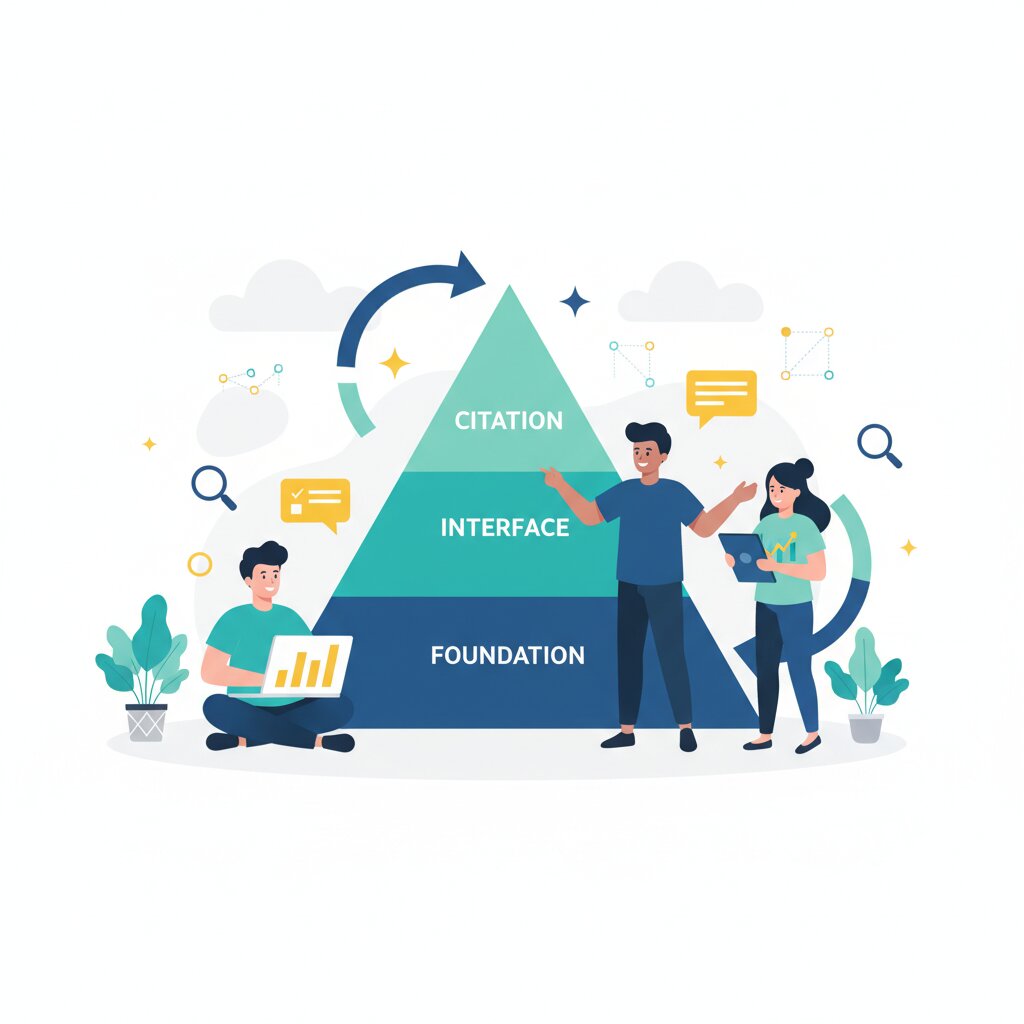
The SEO/AEO/GEO stack works the same way:
- SEO (the foundation layer) targets crawlers, ranking algorithms, and domain authority signals. Its job is indexability, technical health, and the credibility baseline everything else builds on.
- AEO (the interface layer) targets AI-powered search features — Google AI Overviews, Bing Copilot, Perplexity. Its job is structuring content so AI extraction systems select it as a direct answer.
- GEO (the citation layer) targets standalone large language models — ChatGPT, Claude, Gemini. Its job is creating content authoritative enough that LLMs cite it in AI-generated responses, regardless of whether a click-through occurs.
The dependency runs one way: upward. Weak SEO undermines AEO — if your domain authority is low or E-E-A-T signals are absent, AI Overview systems are unlikely to select your content no matter how well structured it is. Weak AEO reduces GEO surface area — LLMs preferentially cite sources that are structured for machine-parseable authority signals.
Why the OSI analogy matters for decision-making
When organisations treat these layers as alternatives — “should we invest in SEO or AEO?” — they underinvest in foundations. A team that redirects budget toward GEO while domain authority sits below 30 will find LLMs simply do not preferentially cite low-authority domains.
The right question is: “Where are we in the build sequence, and what does that tell us about where to allocate next?”
One note on limits: the stack is not strictly sequential. FAQ schema and answer-first restructuring can run in parallel with SEO remediation at low cost. The value is strategic clarity, not technical precision.
The foundation layer: what SEO still does well and where it now falls short
SEO remains useful for technical health, domain authority, and non-AIO queries that still generate clicks. What has changed is its role as a standalone traffic driver.
What SEO still does well in 2026
Branded, navigational, and transactional queries often return traditional organic results. Top-3 positions still capture the majority of available clicks. Technical site health — crawlability, indexability, mobile responsiveness — is a prerequisite for AI access. If AI crawlers cannot index your pages, you will not appear in AI answers regardless of your AEO or GEO signals.
The backlink profile and domain authority you build through SEO are the same authority signals that determine AEO citation probability and GEO citation frequency. Same asset, different layers.
Where the CTR floor is collapsing
Seer Interactive found organic CTR for AI Overview queries fell from 1.76% to 0.61% — a 61% decline. Non-AIO queries are also declining: CTR peaked at 3.14% in February 2025 and fell to 1.62% by September 2025. Seer’s conclusion is worth quoting directly: “If you’ve been waiting for CTRs to bounce back, the data is telling you to stop waiting. This is the new baseline.”
The Reuters Institute‘s 280 digital leaders across 51 countries are deprioritising “old-style Google SEO” (net score -25) while planning to invest heavily in AI platform distribution (+61 net score).
The strategic reframe: SEO’s objective shifts from “drive traffic” to “build the authority foundation that makes AEO and GEO possible.”
The interface layer: what AEO is and why it matters now
Answer Engine Optimisation (AEO) is structuring content so AI-powered search features — Google AI Overviews, Bing Copilot, Perplexity — select it as a direct answer to a user query. It’s the near-term, highest-return layer: infrastructure is already established and measurable signal appears quickly.
What AEO content looks like structurally
AEO is a content operations task, not a net-new content task. You restructure existing content for AI extraction: answer questions directly, name your sources, make credentials parseable, position answers at the top of each section.
Perplexity is worth flagging specifically. It always surfaces citations and strongly rewards both AEO structure and underlying authority — it’s the platform where AEO and GEO converge most directly.
The citation advantage: what the Seer Interactive data actually says
“Being cited in AI Overviews yields 35% higher organic CTR and 91% higher paid CTR compared with non-cited brands at the same ranking position.” — Seer Interactive, 3,119 queries, 42 organisations, June 2024–September 2025
Seer flags the caveat explicitly: correlation, not confirmed causation. High-authority brands may earn citation and high CTR from the same underlying E-E-A-T characteristics.
The practical implication is clear enough regardless: “If an AIO appears for your key queries and you’re not in it, you’re essentially invisible.” AEO investment is justified either way. Measurable featured snippet movement appears within two to eight weeks; AI Overview citation typically takes four to twelve.
The citation layer: what GEO is and why it requires a longer investment horizon
Generative Engine Optimisation (GEO) is creating content that large language models — ChatGPT, Claude, Gemini — identify as authoritative and cite in AI-generated responses, regardless of whether a click-through occurs. Some sources use “GEO” to mean everything above traditional SEO. In this article, it means standalone LLMs specifically — not AI-integrated search features.
How GEO differs from AEO in practice
Both depend on E-E-A-T, but they target different citation mechanisms on different timelines.
AEO targets AI-integrated search. Google AI Overviews refresh in near-real-time; Bing Copilot draws from the current web index. Structural content changes show up within weeks.
GEO targets LLM training data and retrieval-augmented generation indexes. The lag between publishing and being cited by ChatGPT or Claude is measured in months to years. The a16z framing captures it well: GEO is “encoding your brand into the AI layer” — it’s about whether your brand is a recognised participant in a topic space, not whether a single piece ranks.
The LLM citation mechanism: why original research matters
Pages with quotes or statistics show 30–40% higher visibility in AI-generated answers (Backlinko GEO research). LLMs weight authoritative, verifiable, specific information more heavily than generic claims.
GEO content requires original research with clear data provenance, transparent authorship, and deep coverage of a narrow domain. Co-citation presence matters too — appearing on Reddit, LinkedIn, and in industry publications signals domain relevance to LLM retrieval systems. Start now; meaningful citation frequency takes six to eighteen months.
How E-E-A-T connects all three layers into a unified quality framework
Experience, Expertise, Authoritativeness, and Trustworthiness — E-E-A-T — is Google’s framework for evaluating content quality, and it’s the cross-layer signal that connects all three optimisation tiers. The same credentials that improve organic rankings also increase AI Overview citation probability and LLM citation frequency.
What E-E-A-T looks like differently at each layer
At the SEO layer: backlink profile, branded search volume, and content depth — the signals quality raters use to evaluate ranking worthiness, particularly for YMYL categories.
At the AEO layer: E-E-A-T must be machine-readable. Author bylines with credentials, clear publication dates, and cited sources need to be structured so AI extraction systems can actually parse them.
At the GEO layer: E-E-A-T is demonstrated through the content itself — original data, expert authorship, detailed analysis, external corroboration. Getting mentioned on platforms where LLMs train builds E-E-A-T as co-citation presence.
Why E-E-A-T investment is the highest-leverage action for constrained teams
An original research piece with clear authorship, cited sources, and verifiable data simultaneously improves organic ranking authority (SEO), AI Overview citation probability (AEO), and LLM citation eligibility (GEO). No other single content investment achieves cross-layer benefit at the same rate. Implement the expert bylines. Cite your data sources. It is that straightforward.
How to allocate effort across SEO, AEO, and GEO with a constrained team
No existing industry model addresses resource allocation across all three layers for SMB tech teams. The framework below fills that gap. The allocation depends on three variables: current SEO health, team capacity, and strategic time horizon.
The three-stage allocation model
Stage 1 — Shaky SEO foundation (domain authority below 30, technical issues present) SEO 70% / AEO 20% / GEO 10% Priority: fix indexability; establish E-E-A-T baseline; build backlink foundation
Stage 2 — Solid SEO, no active AEO programme SEO 40% / AEO 40% / GEO 20% Priority: deploy FAQ schema; restructure top content in answer-first format; start original research pipeline
Stage 3 — Active SEO + AEO programme, seeking GEO growth SEO 30% / AEO 30% / GEO 40% Priority: topical authority depth; commission original research; build co-citation presence
Teams that skip Stage 1 waste resources. The 10% GEO budget in Stage 1 is for learning — manual LLM testing, understanding your citation baseline — not content production.
Once the foundation is solid, AEO becomes the highest-return investment. As Microsoft Ads puts it: “Most brands already have the data AI needs. It’s just buried.” Stage 2 AEO work is about surfacing and structuring what already exists.
In Stage 3, topical authority — deep coverage of a coherent domain — is the primary GEO lever. For an SMB team: one high-quality original research piece per quarter.
How team size affects the right split
A two-to-three person team should be in Stage 1 or Stage 2, not attempting a full GEO build. Schema and restructuring can be batched. GEO at small scale means one authoritative research piece per quarter and ensuring your experts are active on Reddit and LinkedIn.
A five-to-ten person team can run all three layers at Stage 2 allocations. The constraint shifts from headcount to editorial judgement: GEO requires an editor who can commission original research, not just a writer who can produce to a brief.
What to sequence first: the AEO before GEO argument
AEO produces measurable results in weeks; GEO requires six to eighteen months. For a constrained team that needs to demonstrate ROI, AEO wins the near-term allocation competition. Perplexity rewards both AEO structure and GEO-quality content simultaneously — building AEO signals creates a useful shortcut into the citation layer.
Making the board-level case for the strategy transition
Boards and CFOs understand traffic. They do not yet understand citation share. The business case must translate between these KPI systems without losing the urgency or papering over attribution difficulty.
How to translate citation share into board language
Frame citation share as the new domain authority. A decade ago, domain authority was a long-horizon investment — backlinks and content that created durable competitive moats. Citation share in AI systems is the 2026 equivalent: businesses that build recognised authority within LLMs now will be structurally harder to displace as AI search becomes the dominant discovery channel.
The evidence:
- Reuters Institute Digital Report 2026 (280 digital leaders, 51 countries): -25 net score for traditional SEO; 43% search traffic decline expected within three years
- Chartbeat: Google organic traffic already down 33% globally year-over-year
- Seer Interactive (15-month longitudinal, 25.1M impressions): 35% organic CTR and 91% paid CTR advantage for AI-cited brands
The competitive moat argument for early investment
Two quotes worth having ready for the room:
Seer Interactive: “Treat AIO citations as your competitive moat. Your share, authority, and that CTR boost are one of the few remaining ways to maintain competitive separation.”
Microsoft Ads: “The ones who move now won’t just be discoverable when it matters. They’ll be the benchmark everyone else is catching up to.”
The honest counter-argument and how to address it
ROI attribution is harder in early-stage AEO/GEO programmes. Include this honestly. Tracking AIO citations, segmenting CTR by AIO presence, and building assisted conversion models for zero-click impressions requires more infrastructure than last-click attribution. GEO attribution is harder still.
The honest framing: think of it as a compounding infrastructure investment with a 2–3 year payback horizon. Near-term AEO produces measurable signal within months. GEO requires a longer payback in exchange for competitive positioning in the channel likely to overtake traditional search by 2027–2028.
How to measure progress across all three optimisation layers
To defend AEO and GEO investment at board level, you need measurement infrastructure. Tooling maturity varies significantly across the three layers.
Measuring the SEO foundation layer
The SEO toolkit is well-established: organic rankings, domain authority, crawl health (Google Search Console), backlink profile (Ahrefs/Semrush), and branded search volume. No new tooling required.
Measuring AEO performance: what is trackable today
- AI Overview citation rate: manual query testing or Semrush AI Toolkit, which tracks AIO presence and citation status at scale
- Featured snippet capture rate: Google Search Console and Semrush
- CTR for AIO-impacted vs. non-AIO queries: segmentable in Google Search Console — compare click rates where AIO fires versus where it does not
Measuring GEO performance: the emerging toolkit
- Manual LLM testing: query ChatGPT, Perplexity, and Claude on your content topics before investing in dedicated tools
- Semrush AI Toolkit: tracks LLM visibility across ChatGPT, Claude, and Google AI Overviews; compares citation frequency against competitors
- Profound and Peec AI: run prompts at scale to track brand appearance across multiple LLM platforms
- Ziptie.dev: surfaces unlinked brand mentions across AI outputs
- AI referral traffic in GA4: small volumes today but the right measurement habit to build now
The board-level metric is “share of voice in AI responses” — what percentage of relevant category queries cite your brand versus competitors. No single tool provides this comprehensively; combine Semrush AI Toolkit, manual LLM testing, and GA4 AI referral attribution into a custom dashboard. Factor the measurement infrastructure into your resource allocation model.
For a complete treatment of methodologies and tool selection, see measuring AEO and GEO progress and tracking citation presence over time.
Conclusion
SEO, AEO, and GEO are not competing investment choices. They are composite dependencies, and the strategic question is not “which one?” but “where am I in the build sequence?”
Three things to take away from this:
-
The definitional hierarchy: SEO is the foundation layer; AEO is the interface layer; GEO is the citation layer. Upper layers depend on lower layers being healthy.
-
The resource allocation model: Stage 1 allocates 70/20/10; Stage 2 allocates 40/40/20; Stage 3 allocates 30/30/40. Skipping stages wastes resources.
-
The board-level business case: frame citation share as the new domain authority. The urgency is real (Reuters Institute: 43% search traffic decline within three years), the near-term ROI is measurable (Seer Interactive’s CTR data), and first-mover advantage compounds.
You should be able to articulate the three-layer model in a board meeting and know which stage allocation applies to your team today.
For the technical detail — how to deploy AEO signals, implement schema markup, and engineer the citation eligibility layer — the next article covers technical implementation of AEO signals. For the full picture of AI search disruption, the hub article covers what changed in the discovery funnel and why.
Frequently Asked Questions
Can I do AEO without first having strong SEO in place?
No — AEO depends on SEO foundations: domain authority, crawlability, and E-E-A-T signals. AI Overview systems are unlikely to select content from domains Google does not already recognise as authoritative. Stage 1 allocation (70% SEO remediation) is the right starting point. Exception: FAQ schema and answer-first restructuring on existing top-ranking content can run in parallel at low cost.
How quickly does AEO investment produce measurable results?
FAQ schema and answer-first restructuring shows featured snippet movement within two to eight weeks. AI Overview citation typically takes four to twelve weeks. GEO requires six to eighteen months for meaningful LLM citation frequency — set board expectations accordingly.
What does GEO content look like differently from standard blog content?
GEO content is built around original data, expert authorship, and topical depth — not keyword density. It cites sources explicitly, names contributors with visible credentials, and is evidence-dense with analysis that goes beyond existing sources. Pages with quotes or statistics show 30–40% higher visibility in AI-generated answers (arXiv GEO research, Backlinko).
Do AEO and GEO require separate content, or can the same content serve both?
The same content should serve both. AEO-optimised structure (FAQ schema, answer-first paragraphs) applied to GEO-quality content (original research, expert authorship, cited sources) works at both layers simultaneously. A well-structured research article with FAQPage schema is strong at both.
What is the difference between GEO and AEO in one sentence?
AEO focuses on getting cited by AI-powered search features like Google AI Overviews and Bing Copilot; GEO focuses on getting cited by standalone large language models like ChatGPT and Claude.
Is E-E-A-T a ranking factor, an AEO signal, or a GEO signal — or all three?
All three. For SEO, it correlates with ranking performance, particularly for YMYL categories. For AEO, Google uses E-E-A-T to determine AI Overview citation eligibility. For GEO, LLMs preferentially cite sources with real authors, verifiable data, and external corroboration. Every E-E-A-T investment improves performance at every layer.
What is “share of voice” in AI search and why does it matter more than traffic?
AI Share of Voice measures how often your brand is cited in AI responses versus competitors, across relevant category queries. Zero-click behaviour makes traditional CTR misleading — citation delivers value without a click-through, the way PR builds brand recognition without a direct conversion. Track it via Semrush AI Toolkit, Profound, and Peec AI.
Can a small team of two to three people realistically run all three optimisation layers?
Yes — stay in Stage 1 or Stage 2. AEO is capital-efficient: schema and restructuring batch across existing content. GEO at small scale means one original research piece per quarter and ensuring your experts are active on Reddit and LinkedIn.
Is the OSI model analogy accurate — do the layers actually depend on each other the way networking protocols do?
Structurally, yes. Technically, no — the optimisation stack is not strictly sequential. The analogy’s value is strategic clarity: treating the layers as alternatives rather than a stack leads to misallocation.
How do AI-generated overviews differ between Google, ChatGPT, and Perplexity — and does that change the strategy?
- Google AI Overviews: integrated into SERP, refreshed in near-real-time — primarily an AEO target
- ChatGPT: influenced by training data and Bing integration; benefits from longer, evidence-backed passages — primarily a GEO target
- Perplexity AI: citation-first, always surfaces sources, rewards both AEO and GEO simultaneously — start here for benchmarking
- Claude: benefits from longer, coherent passages with clear source attribution — GEO-oriented
AEO-first investment addresses Google, Bing Copilot, and Perplexity. GEO-first addresses ChatGPT and Claude.