
The AI workforce debate usually runs on a binary: either AI deletes whole jobs, or it leaves work mostly untouched. Neither matches what people see on the ground. Unemployment stays low, yet entry-level roles feel scarcer and experienced people keep leaving early. Something is going wrong, but it is not showing up as mass layoffs.
This article explains the mechanism, using data from Boston College’s Center for Retirement Research, Stanford SIEPR and the Stanford Digital Economy Lab, and building on the earlier piece on whether AI eliminates or restructures jobs and the cluster overview. By the end, the senior exits, the junior hiring drop, the “big freeze” and the software headcount paradox read as one mechanism.
Why is AI hollowing out the middle of the career ladder rather than replacing jobs wholesale?
AI hollows rather than replaces because it automates tasks, not whole jobs. The routine, codifiable work it absorbs first sits at the entry and mid levels, so those rungs thin while headcount holds steady or grows, as Stanford SIEPR’s policy brief sets out.
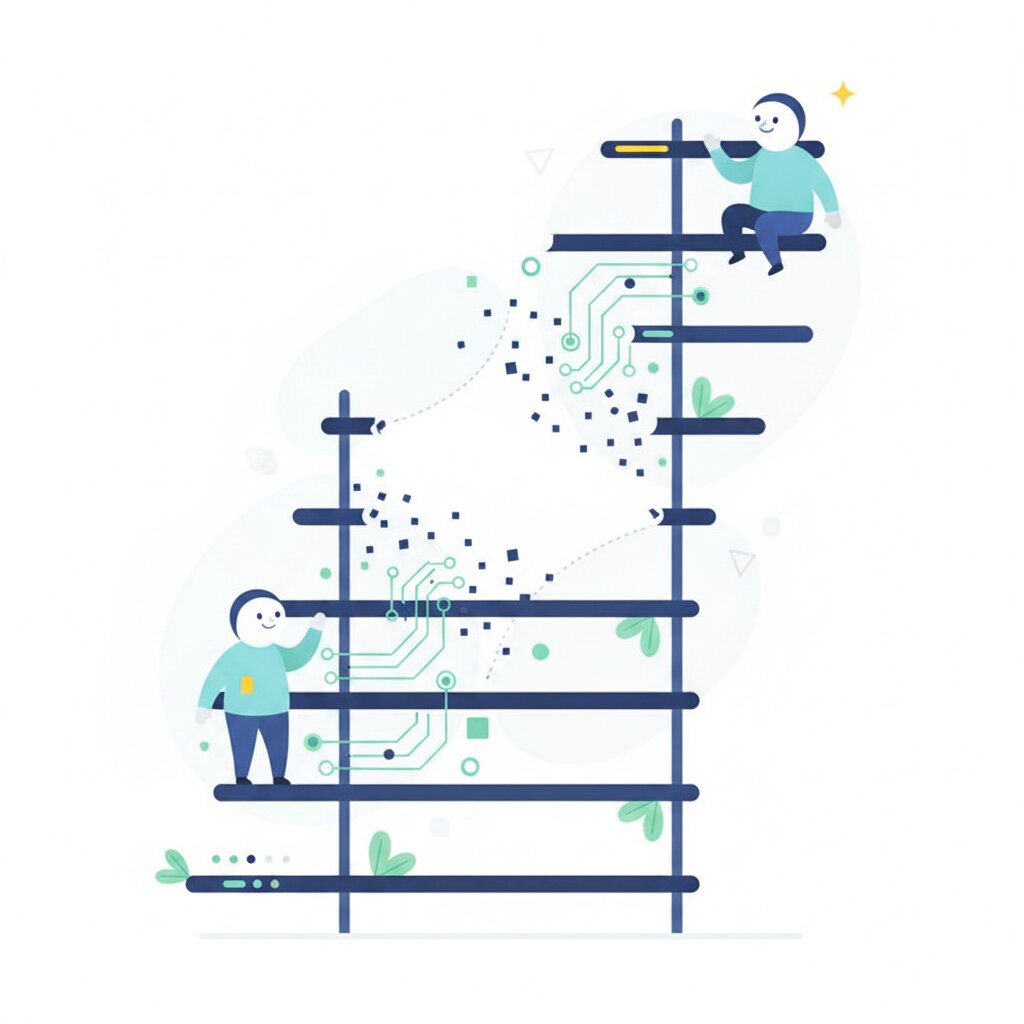
Call it the middle-rung squeeze. At the bottom, the tasks that used to teach juniors are automated away. At the top, experienced workers exit rather than retrain. The World Economic Forum describes junior work being pushed upward, leaving mid-level and senior people on your team overextended.
Hollowing-out parts ways with wholesale replacement. Substitution removes the learning tasks that fed the ladder while the titles above stay, leaving a thinner talent pipeline each year and a reskilling problem organisations have not designed for. The first place that squeeze shows up is the bottom of the ladder.
Why has employment for workers aged 22-25 in AI-exposed roles dropped while overall unemployment stays low?
Stanford SIEPR reports a 13% employment decline for workers aged 22 to 25 in the most AI-exposed occupations, even as overall unemployment stays low. Its policy brief is titled “What is really happening to jobs? Separating AI hype from reality.”
Low headline unemployment hides the junior-intake drop. Experienced workers keep their seats while the junior intake stops. The entry-level tasks AI automates first, boilerplate code, first drafts, documentation, routine analysis, are also where juniors built foundational skills. Remove them and you remove the place people learned to be mid-level.
Brynjolfsson, Chandar and Chen treat these early-career workers as canaries in the coal mine. The Dallas Fed’s summary reads the decline as a leading indicator, concentrated in AI-exposed work while the rest of the market hums along.
Before you freeze junior hiring, understand what to weigh.
Why are workers aged 55+ in AI-exposed white-collar roles leaving the workforce at a higher rate since ChatGPT?
Boston College’s Center for Retirement Research finds workers aged 55 and over in AI-exposed white-collar roles are leaving the workforce at a rate 25% higher than before ChatGPT, with the sharpest jump among computer programmers.
Experienced workers face a steeper reskilling cost curve, so many exit rather than retrain, while employers weigh automation against a senior salary. CNBC’s reporting finds the exits driven as much by voluntary departure as by unemployment.
That exit removes institutional knowledge and the mentorship your juniors depend on, compounding the hollowing below. How teams restructure as senior roles shift features in our piece on agentic AI and new roles.
That raises the obvious question: if automation is thinning the ladder, why does the most automated field keep adding people?
Why is software engineering headcount still growing while coding-heavy tasks are automated?
Software headcount keeps growing because demand is expandable, Brynjolfsson, Chandar and Chen at the Stanford Digital Economy Lab find. When automation makes coding cheaper, organisations buy and build more software, so total engineering work grows even as individual coding tasks automate.
Software’s demand is elastic: lower the cost and people buy more of it. BCG finds that as AI reduces the time and cost to build, organisations build more, so job volume holds or grows even as engineers get more productive.
The same cost drop does not expand demand everywhere. Routine legal review and back-office processing get cheaper without anyone buying more of them, so the same automation hollows those fields out.
But the growth has a sharp age split. Employment for software developers aged 22 to 25 fell nearly 20% from its late-2022 peak, while older age groups in the same occupation expanded. Growth at the top coexists with a narrowing entry point.
The classic analogy is textiles, where automation cut the cost of cloth and consumption rose a hundredfold, as CNN’s reporting on AI software jobs notes. That is the full restructuring picture.
But demand expandability is not the whole hiring story. Even in growing fields, who gets hired is changing.
What is the “big freeze” in hiring and how is AI driving it?
The “big freeze” is broad hiring caution concentrated in early-career and mid-level roles. Yale’s analysis finds it shows up as unposted roles and unfilled seats rather than terminations, so headcounts stay flat while the ladder’s bottom thins.
AI drives it from two directions. As a productivity lever, it lets the same workforce produce more, so fewer new hires are needed. As an uncertainty driver, it makes leaders defer commitments. “Employment looks stable. Opportunity is not,” the Yale researchers write.
A formal freeze stops all hiring with an announcement. The big freeze is quieter and more selective, concentrated where the pipeline is thinnest. When you are weighing whether to automate or hire, the freeze is the default outcome of choosing caution.
Who becomes the senior engineers in five years if today’s juniors never develop foundational skills?
Nobody, unless the learning pathway is rebuilt. Cut the junior rungs now and the pipeline that produces mid-level and senior engineers dries up five to seven years later.
The cohort learning with AI today reaches senior level around 2029 to 2032, right when the capability gap lands. SoftwareSeni’s breakdown points to a 17-point comprehension gap when juniors learn with AI assistance, largest on debugging questions.
You cannot hire your way out of this. If juniors everywhere develop the same gaps, the senior shortage becomes industry-wide, so firms have to grow their own seniors. That is where upskilling, reskilling and redeployment become the counter-strategy, expanded in the pipeline assessment piece.
Without a deliberate pipeline, organisations also lose the culture renewal and knowledge transfer junior intake carries. Wharton’s researchers are blunt: organisations are “inadvertently dismantling the career ladders” that produce skilled professionals.
Conclusion
The hollowing pattern resolves as restructuring, not elimination. Automation removes the entry-level learning tasks at the bottom, senior exits take mentors out the top, and the big freeze narrows the middle of the ladder. Software’s demand expandability proves restructuring can coexist with growth: automation changes which tasks get done and shifts work into new tasks and roles.
If today’s juniors never build foundational skills, the binding constraint five to seven years out is a succession gap. The counter-strategy is upskilling, reskilling and redeployment, keeping a pipeline alive without junior-heavy hiring.
So the question worth asking shifts from “will AI take my job?” to “will the ladder still carry people from junior to senior?” The pathway is what is at risk.
If your junior-to-senior pipeline thins out, the senior engineers you need later won’t just appear locally. That’s a resourcing decision, not a technical one. SoftwareSeni’s extended development teams put senior developers alongside your existing engineers now, inside Australian business hours, instead of leaving that supply to a local market about to feel the same shortage everywhere else.
see how extended development teams add senior capacity to an existing team →
“I’ve worked with SoftwareSeni for many years now across different CTO roles. Davo and his team are such a pleasure to work with and they have always provided the best and most capable resources when I needed them. They run a well oiled process to ensure they find and present the best candidates, plus they ensure smooth onboarding process. I highly recommend SoftwareSeni to any company that is wanted to expand their team and keen to explore an embedded team model.”
— Simon Farrell, VP of Engineering, Forage
Frequently Asked Questions
Is AI actually causing mass unemployment?
Not in the way the debate usually frames it. Unemployment remains low, and the pattern is restructuring rather than elimination. What the data show is a squeeze: entry-level roles are quietly cut and senior workers leave early, while headline job numbers stay stable. The real loss is not millions of jobs at once, it is the pathway that turns juniors into seniors.
What does “hollowing out” mean in practice for someone already mid-career?
For a mid-career worker, hollowing out means the rungs above and below thin at once. Fewer juniors are hired beneath you, so there is less support and less upward pressure, while senior exits reduce mentorship and succession options above. Your own job may remain, but the ladder around it narrows, which raises workload, limits progression and concentrates responsibility on the middle.
Which entry-level tasks is AI automating first?
AI automates the routine, codifiable work that used to train juniors first: boilerplate code, first drafts, documentation, routine analysis and standardised reports. These tasks are the highest-volume and easiest to specify, so they are the earliest to go. Because they were also the learning tasks, removing them does more than cut output. It removes the practice ground where juniors built foundational skills.
Is the “big freeze” the same as a hiring freeze?
Not quite. A traditional hiring freeze stops all new roles, usually through a formal announcement. The big freeze is quieter and more selective: roles go unposted and seats stay unfilled, concentrated in early-career and mid-level positions, while headcounts remain flat. There are few layoffs to see, so it reads as caution rather than a freeze, but the entry points close just the same.
Should employers slow AI adoption to protect their junior pipeline?
No, slowing adoption rarely fixes the pipeline and usually hands the cost problem to competitors. The better response is to redesign how juniors learn. Employers can pair automation with structured rotations, mentor-led review and real stretch assignments so entry-level workers still build foundational skills. The risk is not AI itself, it is adopting AI without replacing the learning tasks it removes.
Does demand expandability mean software engineers are safe?
Not automatically. Demand expandability explains why software headcount can grow while coding tasks are automated, but it does not protect every engineer. As coding gets cheaper, more software is demanded, yet the work shifts toward higher-level judgement, integration and product thinking. Engineers doing only routine coding tasks face the same squeeze, while those who move up the value chain benefit.
What can early-career workers do while junior roles are scarce?
Focus on the tasks AI does not own: judgement, integration, client context and ownership of outcomes. Seek projects that expose you to real decisions, not just execution, and treat documentation, testing and review as leverage rather than busywork. Building a portfolio of shipped work and finding a mentor who will sponsor you into stretch assignments matters more now than waiting for a traditional junior title.
What should mid-career workers do before the squeeze reaches them?
The safest position is to own outcomes, not tasks. Shift toward work that requires coordination, judgement and accountability, and deliberately broaden your skills before the middle rungs narrow further. Volunteer for the integration and mentoring roles that AI cannot perform, and keep a live record of the decisions you have made and their business results. Mobility comes from demonstrated responsibility, not tenure.
Is the early-career employment drop entirely caused by AI?
The 13% drop for workers aged 22 to 25 in AI-exposed roles is closely associated with AI exposure, but it is not proof that AI alone caused every decline. Economic conditions, hiring caution and shifting role definitions all play a part. The Stanford SIEPR finding is significant because the decline concentrates in AI-exposed work while overall unemployment stays low, which points to a structural change rather than a broad downturn.
Will the career ladder rebuild once AI tools mature?
Only if organisations deliberately rebuild the learning rungs. Mature tools will not restore the junior pipeline on their own, because the routine tasks that trained juniors are the tasks AI now absorbs. The ladder can recover through upskilling, reskilling and redeployment, but that requires active design. Left to default, the gap between today’s juniors and tomorrow’s seniors will simply widen.
What should workers aged 55 and over weigh before leaving the workforce?
Before exiting, weigh the reskilling cost against the loss of institutional knowledge and mentorship you take with you. The data show faster exits in AI-exposed white-collar roles, but leaving early is not always the best economic or personal choice. Test whether your experience can be repositioned toward judgement, governance and teaching roles, which are harder to automate and still in demand.
If the pipeline that grows your senior engineers is thinning, is waiting on the market really the plan? Talk to SoftwareSeni about extended development teams