
You’ve deployed AI across your enterprise. Sales has it. Support has it. Product has it. Ask the same question from each department and you get three completely different answers. Welcome to the semantic gap—where your AI burns through tokens trying to figure out which of your conflicting data definitions to trust.
The numbers don’t lie. Research shows only 67% semantic accuracy in typical enterprise AI deployments. Your AI system is chewing through 13,281 tokens per decision, running in loops trying to resolve the ambiguity you’ve baked into your data infrastructure. That’s not just an accuracy problem—that’s money leaking out of your infrastructure budget with every query.
So what’s the fix? Data-centric architecture. That means semantic layers, real-time data flow, and hierarchical multi-agent systems that actually address the semantic gap instead of pretending it doesn’t exist. This article covers the technical challenges, the architectural solutions, the implementation frameworks, and the build-versus-buy decisions—all within the broader context of AI-driven business transformation reshaping competitive landscapes.
Let’s get into it.
What is the semantic gap challenge in agentic AI systems?
The semantic gap is the translation problem between what people mean when they ask questions and what your systems think they mean. It shows up as inconsistent AI responses when different departments use conflicting definitions for the same terms. And it undermines trust in your autonomous AI systems, which limits how much of your enterprise will actually adopt them.
Here’s how it plays out in real life. Your sales team defines “customer value” by revenue potential. Your support team defines it by satisfaction scores. Your product team defines it by engagement metrics. So your AI agent gives three different answers to the same question depending on which context it’s running in—not because the AI is broken, but because you’ve got three conflicting definitions living in your systems.
The technical definition is straightforward—it’s the disconnect between human intent expressed in natural language and the precise technical configurations your AI needs for consistent execution. But the implications ripple through your entire AI deployment.
Traditional approaches don’t work. They either require structured policy languages that exclude non-technical operators, or they rely on rule-based systems brittle to linguistic variation. Most organisations discover there’s a gap between their current data infrastructure and what Agentic AI requires, with most semantic layers not designed for this transition.
The root causes? Data fragmentation, inconsistent ontologies, and workflow-centric architectures that prioritise process over data consistency. When each application maintains its own data definitions and business logic, semantic conflicts are inevitable. Check out startup refounding case studies for technical implementation examples addressing these challenges.
How does semantic gap impact AI system accuracy in enterprise deployments?
The semantic gap forces your AI into ReAct iteration loops that consume 13,281 tokens per decision as it tries to self-correct. Department-specific inconsistencies destroy user trust. Infrastructure costs balloon through repeated API calls. And adoption of agentic AI gets blocked because no one believes the answers.
This accuracy degradation comes from enterprise semantic inconsistency in your data infrastructure, not from limitations in your AI models. Controlled environments achieve 95%+ accuracy, but throw that AI into your enterprise semantic complexity and it drops to 67%. Your AI is burning tokens trying to resolve ambiguity that shouldn’t exist in the first place.
Token consumption economics show up in your infrastructure budget as line items you can’t ignore. At current API pricing, this translates to measurable cost increases that compound as usage scales. And your teams stop using the system because they can’t rely on it. Inconsistent answers across departments lead to abandonment of AI tools—you’ve seen it happen.
Scaling limitations follow close behind—human oversight requirements prevent autonomous operation at scale. AI-native competitors with semantic consistency gained their advantage by building data-centric architecture from day one. When you’re reviewing infrastructure costs and margins, remember that API pricing impacts extend well beyond the obvious per-token charges.
What is the difference between data-centric and workflow-centric AI architectures?
Workflow-centric architectures prioritise application processes with data fragmented across systems. Data-centric architectures prioritise unified data accessibility with applications pulling from a shared semantic layer.
Workflow-centric causes semantic gaps through inconsistent definitions per application. Data-centric establishes a single source of truth enabling consistent AI interpretations across your entire enterprise. The migration timeline? 18+ months for a comprehensive transformation.
AI data architecture is an integrated framework that governs how data is ingested, processed, stored, and managed to support AI applications. Unlike traditional data systems designed mainly for historical reporting, AI data architecture needs to support real-time and batch data processing.
Workflow-centric characteristics include application silos, data duplicated per workflow, definitions embedded in application logic, and batch data updates. Data-centric characteristics include a unified semantic layer, real-time data flow, definitions in a centralised ontology, and event-driven updates.
Workflow architectures create definition conflicts by design. Data architectures enforce consistency through centralised semantic layers. Organisations that try to deploy advanced AI agents without first cleaning up their data and processes are taking a shortcut that won’t get them to the desired state. Have a look at data flywheel case studies for migration examples.
How do semantic layers enable agentic AI readiness?
Semantic layers provide unified data definitions that prevent conflicting AI interpretations. They act as a single source of truth for business logic and metrics across all your systems. Your AI agents access consistent data regardless of department or context. Vendor solutions implement in 3-6 months. DIY approaches require 18+ months.
The technical function is an abstraction layer translating a unified ontology to your underlying heterogeneous data sources. Maturity Stage 1 (Chaos) has no standardisation—each application defines its own terms and AI semantic gaps are inevitable. Stage 2 (Islands) has department-specific consistency but cross-department conflicts persist, limiting agentic AI capability. Stage 3 (Intelligence) has enterprise-wide semantic consistency, making agentic AI deployable with confidence.
You evaluate your current maturity using definition consistency metrics, cross-department data reconciliation needs, and governance enforcement capability. Test your AI systems with identical questions from different department contexts—inconsistent answers indicate you’re at Stage 1 or 2.
Implementation approaches split between vendor and DIY. Vendor platform solutions like AtScale deliver faster timelines with higher cost. DIY approaches have longer timelines, lower ongoing cost, and maximum control. Your build-versus-buy decisions connect to the economics of custom versus API models.
What is a data flywheel and how does it enable continuous AI improvement?
A data flywheel is a continuous feedback loop capturing AI outputs to retrain your models. It creates compounding improvement—more usage generates more training data, which generates better models. NVIDIA NeMo and Arize platforms provide enterprise implementation infrastructure.
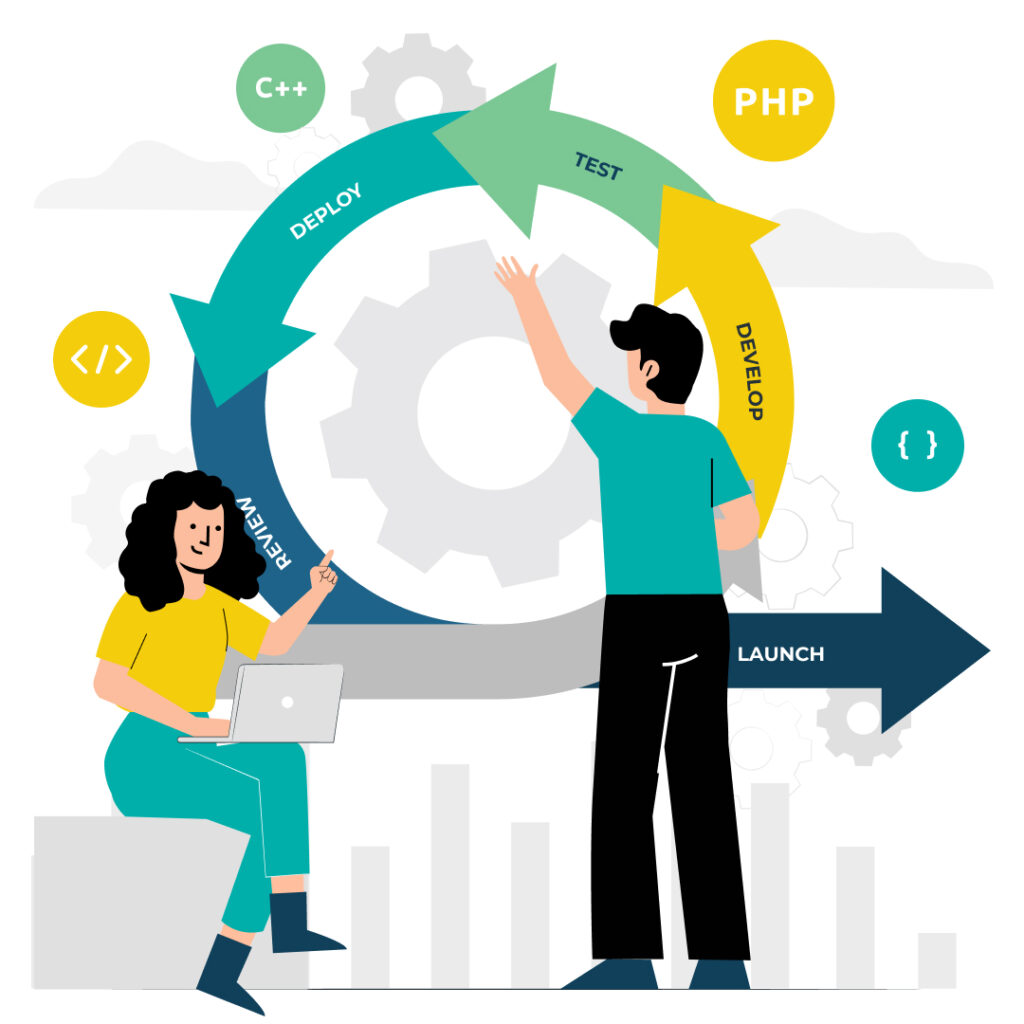
The five-stage process works like this: (1) Capture AI outputs and user feedback, (2) Analyse performance and identify improvement opportunities, (3) Retrain models with new data, (4) Deploy improved models, (5) Repeat continuously. Production data refines your models, better models generate better outputs, and better outputs create more valuable training data.
The economic rationale is compelling. API pricing grows linearly with usage. Custom models have upfront investment but declining per-use cost. Traditional B2B SaaS enjoys margins of 80-90%, but AI-first companies typically operate at 50-65% gross margin due to inference and infrastructure costs.
NVIDIA NeMo provides modular microservices including Curator, Customiser, Evaluator, Guardrails, and Retriever components. Arize AX provides trace collection, online evaluations, human annotation workflows, monitoring, and experimentation features. Integration enables your organisation to transform static models into continuously improving systems, reducing iteration cycles from weeks to hours. Infrastructure requirements link to data flywheel case studies.
What does migration from workflow-centric to data-centric architecture involve?
Migration involves semantic layer implementation, real-time data infrastructure, and organisational change management. Four stages: (1) Assess current state, (2) Implement semantic layer, (3) Establish real-time data flow, (4) Migrate applications iteratively.
Timeline is 18+ months for the DIY approach, 3-6 months for a vendor semantic layer foundation. Prerequisites include a skills inventory (data engineering, MLOps, AI expertise), executive sponsorship, and a governance framework.
Assessment phases evaluate semantic layer maturity, inventory data sources, identify definition conflicts, and assess organisational readiness. Your organisation must first ensure comprehensive digital representation of operations extending beyond isolated connectivity to creating an up-to-date digital model of the entire enterprise.
Semantic layer implementation involves build-or-buy decisions, ontology design, definition governance establishment, and initial system integration. Your choice between vendor and DIY approaches depends on available engineering resources, timeline constraints, and budget allocation.
Real-time data flow establishment involves event-driven architecture implementation, MQTT or similar protocol deployment, and Unified Namespace establishment. MQTT brokers serve as the central nervous system of data infrastructure. HiveMQ platform is one option for implementation.
Application migration commonly uses prioritisation frameworks—high-value AI use cases first. Parallel operation of old and new systems maintains business continuity. Iterative validation and adjustment catches issues early.
Organisational readiness assessment evaluates skills inventory, cultural prerequisites, governance capacity, and change management timeline. Fast track organisations complete in 18-24 months with strong existing data infrastructure. Standard implementation takes 24-30 months with moderate data maturity. Complex transformation requires 30-36+ months with legacy system integration challenges. Implementation frameworks connect to AI-driven business transformation strategic context.
What role does real-time data flow play in autonomous AI agents?
Real-time data enables your AI agents to access current information for autonomous decisions. Batch data creates staleness that causes inaccurate autonomous actions. Event-driven architecture with MQTT protocols provides millisecond-latency data updates. The Unified Namespace concept from industrial IoT establishes a real-time semantic data fabric. This is critical for agentic AI deployment in production environments.
Batch data is hours or days stale. Real-time data is millisecond-current. Current data enables confident autonomous action. Stale data undermines autonomous decision quality, forcing fallback to human oversight that defeats the entire purpose of automation.
With agentic AI, data’s role shifts from learning patterns and feeding predictions to becoming a continuous fuel stream that powers autonomous, goal-driven action in dynamic environments.
Use case examples include autonomous customer service agents requiring current account state, supply chain AI needing real-time inventory, and pricing AI using current market conditions. For a SaaS platform, real-time data flow enables usage analytics agents to monitor subscription metrics, detect anomalies in user behaviour patterns, and trigger retention workflows based on engagement signals. The sooner an AI agent can observe change and act on it, the greater the impact.
Infrastructure implementation includes MQTT broker deployment, event schema design, latency optimisation, and semantic layer integration for consistent event interpretation. Technical implementation connects to technical implementation examples.
Horizontal AI platforms vs vertical AI agents: which has better margins?
Horizontal platforms serve multiple industries with generalised capabilities and higher customer acquisition costs. Vertical agents specialise in specific industries with deep domain optimisation and lower CAC through targeted positioning.
Vertical agents achieve better margins through fine-tuned models reducing API costs, domain-specific semantic layers, and focused go-to-market efficiency. Horizontal platforms benefit from broader addressable market, platform network effects, and cross-industry data flywheel.
Horizontal platform characteristics include multi-industry applicability, generic semantic layer, API-dependent models, broad marketing required, and platform economies of scale. Vertical agent characteristics include industry-specific ontologies, fine-tuned domain models, narrow but deep market positioning, and specialised semantic layers.
Traditional B2B SaaS enjoys margins of 80-90%, but AI-first companies typically operate at 50-65% gross margin due to inference and infrastructure costs. Early-stage AI startups have reported margins as low as 25%, sometimes even negative initially. Four primary cost drivers include model development, inference costs, infrastructure expenses, and third-party dependencies.
Margin analysis for vertical advantages includes infrastructure costs—custom models are cheaper long-term than APIs. Customer acquisition benefits from targeted positioning. Pricing power increases from domain expertise premium. Vertical AI is changing startup physics in the enterprise software landscape.
Margin analysis for horizontal advantages includes broader market size, development efficiency (one platform serving many industries), and network effects from cross-industry insights.
Data flywheel differences matter. Vertical flywheel improves domain-specific accuracy faster. Horizontal flywheel benefits from diverse data but slower domain optimisation. Infrastructure cost models show custom fine-tuned models have upfront investment but declining per-use cost versus API linear cost growth. See economics comparison for detailed analysis.
Strategic decision factors include market positioning, available resources, domain expertise depth, and time-to-market urgency. 92% of AI software companies now employ mixed pricing models combining subscriptions with consumption fees. Economic analysis connects to outcomes-based pricing and margin economics.
FAQ Section
Can you explain what the semantic gap problem is in AI systems?
Semantic gap is the disconnect between how humans describe what they want in natural language and the precise technical configurations your AI systems need to deliver it. For example, when sales defines “high-value customer” by revenue potential but support defines it by satisfaction scores, your AI agents give inconsistent answers depending on context. This translation problem undermines enterprise AI reliability.
How do I know if my company’s semantic layer is ready for agentic AI?
Assess using the three-stage maturity model. Stage 1 (Chaos) has no standardisation—agentic AI isn’t viable. Stage 2 (Islands) has department-specific consistency but cross-department conflicts—limited agentic capability. Stage 3 (Intelligence) has enterprise-wide semantic consistency—agentic AI is deployable. Evaluate by testing whether your AI queries return consistent answers across all departments and contexts.
What’s the difference between building my own data flywheel versus using a vendor platform?
DIY approach using open-source tools requires 18+ months, deep MLOps expertise, but offers maximum control and lower long-term costs. Vendor platforms like NVIDIA NeMo with Arize implement in 3-6 months with proven patterns but higher ongoing costs. Choose based on available ML engineering talent, time-to-market urgency, and budget for vendor licences versus infrastructure investment.
Why do my AI agents give inconsistent answers across different departments?
Inconsistency stems from semantic gaps where each department maintains conflicting data definitions. Sales, support, and product teams define the same terms differently, causing your AI to provide department-specific answers. The solution requires a unified semantic layer providing consistent definitions across all systems, implemented through data-centric architecture transformation.
Should I build custom AI models or just use OpenAI’s API for my enterprise system?
Start with APIs for rapid prototyping and low initial cost. Transition to custom fine-tuned models when usage volume makes API costs exceed custom infrastructure investment (typically 12-24 months), domain-specific accuracy requirements exceed general-purpose models, or your data flywheel generates sufficient training data for meaningful improvement. Breakeven analysis depends on your usage volume and accuracy requirements.
What does it take to transition from workflows to data-centric AI architecture?
Three parallel streams are required. (1) Technical—implement semantic layer and real-time data infrastructure (12-18 months). (2) Organisational—change management for data-driven culture adoption (12-18 months). (3) Governance—establish semantic consistency enforcement mechanisms (6-12 months). Prerequisites include data engineering talent, executive sponsorship, and phased migration strategy maintaining business continuity.
How long does it really take to implement a production-ready data flywheel?
Vendor platforms (NVIDIA NeMo + Arize) implement foundational infrastructure in 3-6 months. DIY approach requires 12-18 months for feedback capture systems, model retraining pipelines, evaluation analytics, and deployment automation. Add 6-12 months for organisational learning cycles before flywheel momentum becomes self-sustaining. Timeline depends on existing MLOps maturity, available ML engineering resources, and domain complexity.
What’s the deal with real-time data streaming for AI agents—do I really need it?
Required for autonomous decision-making where agents act independently without human approval. Batch data (hours or days stale) creates significant accuracy risk for autonomous actions. Real-time streaming (millisecond latency) enables confident autonomous operation. Assess by determining whether your agents make autonomous decisions, what’s the cost of stale-data errors, and can your business tolerate batch-update delays. If answers indicate autonomous operation, real-time infrastructure is mandatory.
What are the three stages of semantic layer maturity and how do I assess where we are?
Stage 1 (Chaos) has each application defining its own terms, no standardisation, and inconsistent AI answers guaranteed. Stage 2 (Islands) has department-level consistency but cross-department conflicts persist, limiting AI reliability. Stage 3 (Intelligence) has enterprise-wide unified definitions, consistent AI answers, and agentic deployment is viable. Assess by querying your AI systems with identical questions from different department contexts—inconsistent answers indicate you’re at Stage 1 or 2.
How do hierarchical multi-agent systems reduce semantic gaps?
Hierarchical architectures use specialised agents for specific domains coordinated by master agents. Each specialist agent operates within a consistent domain-specific semantic layer, reducing ambiguity. ArXiv research shows 67% accuracy improvement versus monolithic models. Master agents handle cross-domain coordination using a unified semantic layer. Orchestration platforms like LangChain, CrewAI, and LangGraph implement these patterns.
What’s the ROI timeline for semantic layer investment?
Vendor semantic layer (AtScale) has 3-6 month implementation. ROI depends on reduced AI error costs and autonomous operation value—typically 12-24 months to positive ROI. DIY semantic layer has 18+ month implementation, lower ongoing cost, ROI 24-36 months but better long-term economics. ROI accelerates with higher AI deployment volume, more autonomous operations enabled, and reduced manual oversight requirements.
Which is better for enterprise accuracy: GraphRAG or vector similarity search?
GraphRAG maintains semantic relationships between entities, providing better accuracy for complex enterprise contexts where relationships matter (org charts, process flows, regulatory connections). Vector similarity search is faster and simpler but loses relationship context. Choose GraphRAG when accuracy requirements exceed 90%, relationship context is necessary for correct answers, and Fluree or similar platform investment is justified. Use vector search for rapid prototyping, lower accuracy tolerance, and simpler implementation requirements.