Triple arrow up Triple arrow down

CLIENT CASE STUDY

The Death of the Feature Advantage:

How Forage is Navigating the AI Era

VP of Engineering Simon Farrell on why execution - not code - is the new competitive moat after a decade of building software in collaboration with SoftwareSeni

Read the Interview

arrow down icon
circle dot image icon forage preview image
client picture image client verified image

Simon Farrell

VP of Engineering at Forage

Simon has seen software development grow from auto-complete in the 90s to AI agents today, from both the SME and enterprise ends of the market. He's been a SoftwareSeni client for over 11 years, working with us across several different ventures.

11+ Years Partnership

Dedicated Development Team

AI Early Adopter

Summary

Key Insight

AI key icon

AI is a Force Multiplier

A team of 5 senior engineers can now do the work of 8-10 with proper AI adoption.

Execution key icon

Execution Over Features

Software features are no longer the competitive advantage. Business execution is.

Learning key icon

Continuous Learning Culture

SoftwareSeni's engineers split time between client work and mentoring, constantly levelling up.

The Full Interview

Q

Can you give us a quick background on you, your role, and your history with SoftwareSeni?

Person answer icon
Forage presentation documentation

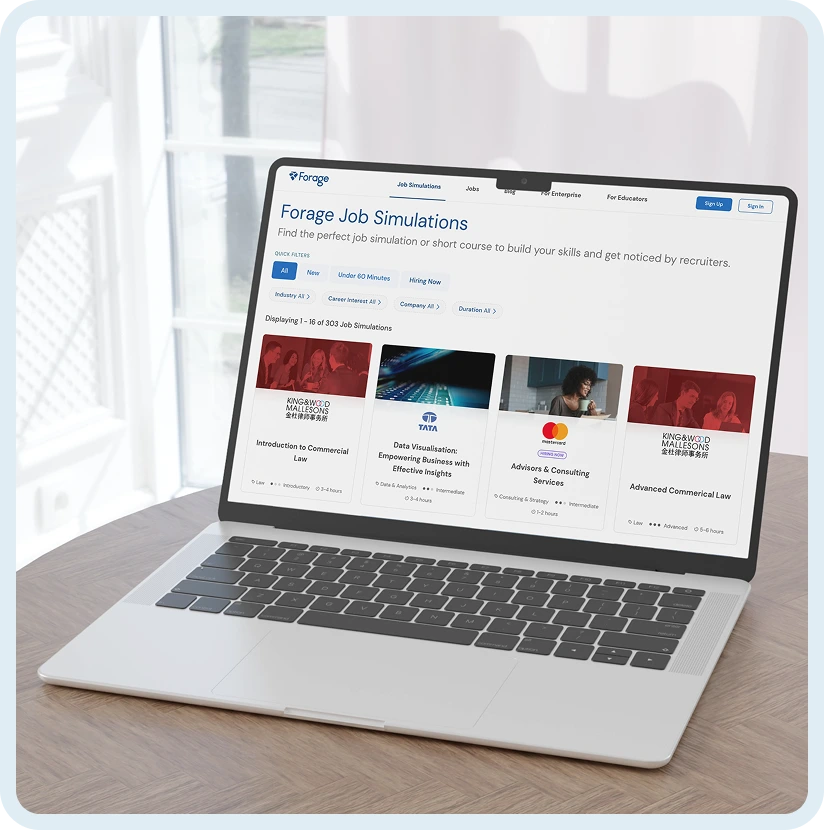
I'm the VP of Engineering at Forage. We partner with companies to create job simulations that students can use to build skills and gain experience.

We currently have several SoftwareSeni developers on our team at Forage. And I'll always grow that team where I can.

I like how SoftwareSeni operate. Their top engineers split their time between working for clients like Forage and mentoring. They're constantly training, constantly levelling up their entire team.

One of the things that I've been really impressed with SoftwareSeni is their AI adoption. They run AI hackathons. They're constantly training. I went over there for the first time in July. And when I was there, we ran through their AI plan. They have a whole action plan on how they're making all their engineers, all their staff, AI enabled.

Forage was ahead of the curve. Two years ago we told our SoftwareSeni developers "Yes, you can use Copilot," but then once Cursor came out everyone was on it. I was paying for Cursor for our dedicated developers on the corporate credit card before it became enterprise-wide within EAB (Forage's parent company) because I wanted the team to have it.

So our dedicated developers were among the first using AI. What they learned was shared with the rest of SoftwareSeni because they're all always learning and sharing what they've learned.

Q

When did AI hit your radar?

Person answer icon

OpenAI launched GPT-3 in late 2019. I remember playing around with it in their playground. It was all API based and to be honest I didn't really get it. I was like "Cool, I could generate some text".

Then in 2022 ChatGPT was launched and it really changed things for us, especially for my role, because all of a sudden we had this UI and it wasn't just code related. We had this tool that we could ask questions. And it's gotten exponentially better since then.

From a code point of view it was GitHub Copilot. It launched first. We started playing with it when it came out.

Q

What did your first uses of AI for coding or product development look like?

Person answer icon

At Forage we're GitHub users. So we started with GitHub Copilot. We got a few developers on the team to play around with it. Most of the functionality then was autocompletion, inline edits — "Can you rewrite this to do this? Can you review this code?", etc.

And it was okay. It wasn't that great. A lot of the team found it a bit annoying. It was like when auto-predict text came out in the mid 90s. But we got used to it. Copilot got stuff wrong but the team continued to use it.

Q

What event or product made you go 'I need my team using AI'?

Person answer icon

“ And the question when did I really go I need this - It's the agents. Claude Code.

It wasn't really until Cursor came out in early 2023 that my team and even I was like "I should try this thing".

A good friend of mine told me, "You should try Cursor." So I downloaded it, played with it, and then you start to see, "Oh my god, it's not just predicting one line."

That was the time we recognised that this is real, and we should start baking AI into our processes and the tooling we use.

And the question when did I really go I need this — It's the agents. Claude Code. That was the time when I went, "I get it. I don't even have to see it."

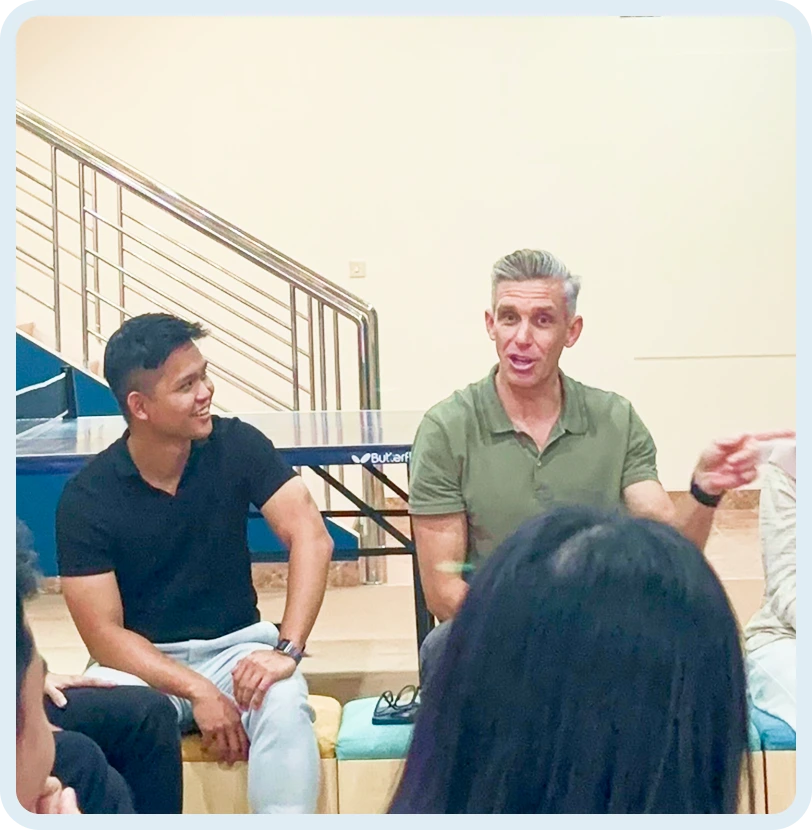
Forage presentation documentation

Q

How did you run AI tool adoption?

Person answer icon

We had a group of our people using Cursor. I wanted to be agnostic — that's my approach. I didn't want to dictate to the team "you must use this tool" because at the time, and this is two years ago, GitHub Copilot was still pretty popular, there was Cursor starting to gain momentum, Windsurf wasn't out yet.

There were a few on the team using other tools and my stance was "You can use whatever tools you want but I want to see you implementing things".

We run a brown bag every three weeks. We get together and we go, "Hey, what's cool that we've been doing from a tech perspective? What's changing? What are we working on?"

So not a product related discussion. It's very much tech-related. For a few of those, it was all about "Show us what you've learned about Copilot. Show us what you learned about Cursor."

I had a couple of mates saying they've been able to rebuild legacy code bases in new stacks purely using prompts. So one of our brown bag sessions we ran with that.

We extended the session. We spent a half a day coding where I had everyone — we've got a student-focused team, a university-focused and an enterprise-focused team — grab a section of legacy code and told them "Use whatever tool you want, try single-shot, multi-shot, high context, low context, long prompt, short prompt, just try things and see what we get."

And the results were pretty amazing.

Q

What were some early wins with adopting AI tools?

Person answer icon

“ One team was able to rebuild our internal program editor in just two hours.

During that brown bag legacy code session, one team was able to rebuild our internal program editor. They did an amazing job in just two hours. We actually start that project, updating the legacy editor, next quarter and we will use what was built during the session as the basis.

Q

Have you been able to link growth to AI adoption?

Person answer icon

Not necessarily. We've been able to deliver quicker. The teams are using AI so they're building a lot more. There's a lot more output that's coming through in the same amount of time.

But there is no clear line between that and growth.

Q

Have you noticed any change in your market since AI has become more generally adopted?

Person answer icon

Forage is in the early talent market. This is the worst hiring market in five years. Forage's business is still growing but growing slower than we were because no one's hiring. And there's a lot of reasons people aren't hiring and there's macro elements to that — the Trump administration, there's interest rates, but there's also the big hairy AI scaring people.

So we know that our customers are hiring less, but they're still hiring because these are 10,000 people firms, 100,000 people firms, and part of bringing juniors in is the importance of longevity in the business and business knowledge. There's people leaving and people retiring and they need to fill the bottom of the bucket.

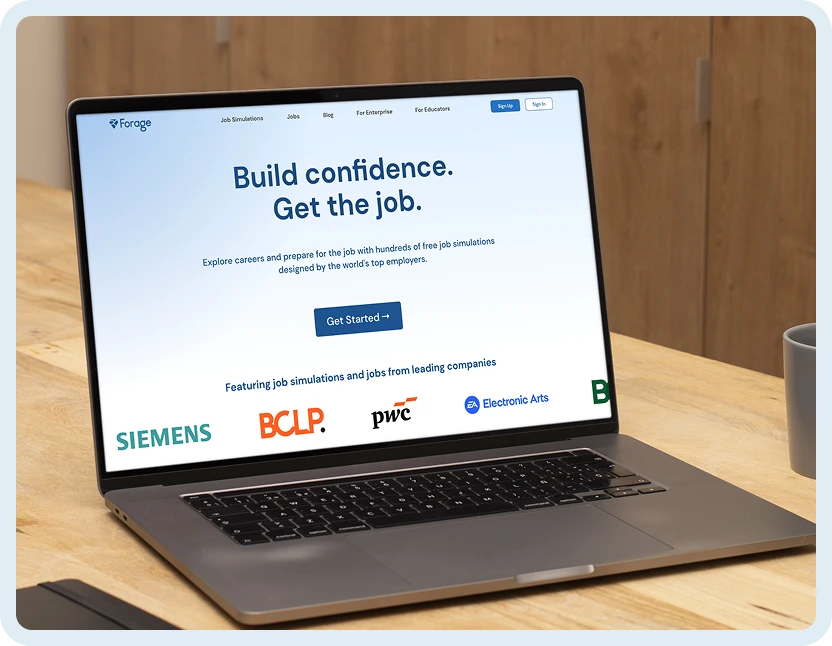
Forage landing page documentation

So I don't ever think juniors aren't going to be needed. They're just going to be done differently. But I think it'll be the big companies hiring them. If I was telling a junior engineer what to do today, I'd tell them to go and work in a large company because you can get a lot of experience there.

Maybe you could go with a startup. But startups these days would be crazy to hire juniors. When I worked for small, mid-market companies we'd hire a couple of juniors because they're cheaper and we can train them up and we only need a certain level of output.

But now a team of five very senior engineers can probably do the work of eight to 10 engineers. So that's why I'd say as a startup it wouldn't make sense to hire a junior engineer, but as a big company, it makes more sense.

Q

What about competition? Has AI given you an edge or helped you 'catch up'?

Person answer icon

“ Software is no longer your secret weapon.

If you consider the competitive advantages of using AI, it turns out your product features are no longer an advantage.

Pre-AI, if you had a complex feature that would take a team six months to build and you got there before your competitor, that was an advantage.

But that's not an advantage anymore because that six months can now probably be duplicated in a month or faster with a team of well-trained engineers.

I don't think features are the advantage anymore. The advantage is not in the tech anymore. It's the execution of the business.

And so how do you go to market with that? At Forage, our advantage is that we have relationships with some of the biggest employers. We've got relationships with thousands of universities. Our parent company is one of the biggest edtech companies in the US. So that's our advantage. It's not the tech.

I've spent my whole career building software. Software is no longer your secret weapon. You can get smart about features or the way you present things, UX/UI is really important but it's just so easy now.

And if you follow Product Hunt you see thousands of product copy-cats come out now and I always laugh because they'll all be dead soon because they'll realise how hard it is to sell a product, obtain a customer, service a customer. There's a lot more to building and running a business than just building tech.

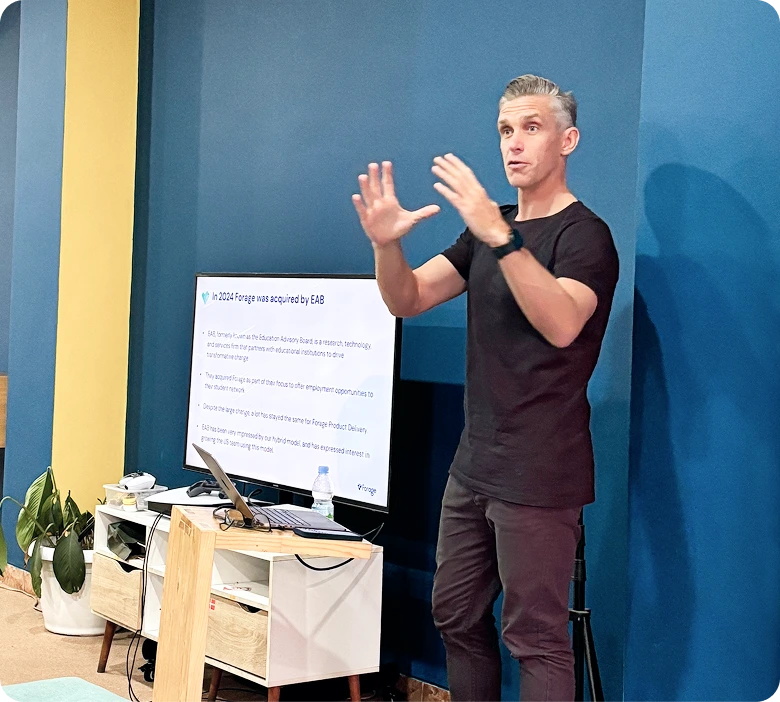
Forage speech documentation

If you're targeting SMEs, you'll probably find a saturation of duplicate products in the SME to mid-market.

You could replicate Forage, but trying to get it out to market and get in the door is the barrier. Once you move upwards into mid-market, into enterprise, you need to have someone that's experienced in selling to them. They want to know who you work with, what's your security stance, what's your compliance stance…You need to be able to tick those off.

Some guy who has vibe coded an app, the new "Airbnb" or the new enterprise "Airbnb" app, is just going to fall over with that.

And that's where the experience comes in for these companies. The incumbents aren't going to be ripped to pieces. They're just going to be pushed to build better products. But now they can, and faster.

Often the advantage of an existing incumbent was "their software's crap and mine's better". That's no longer the advantage because those incumbents now can invest in getting their engineers up to speed with AI and they're now able to turn around faster.

Enterprises will become way more nimble, but only if they adopt the tools. I'm sure there's a lot of them out there that are a bit apprehensive. And I'm sure a lot - like CBA - are pretty fast moving and modern thinking. But everyone's got the same tools now.

Forage's competitors, they may come out with a new way of doing career simulations, but they have to grow their network. It took Forage eight years to get there and a strong competitor could possibly accelerate and halve it, but that's still four years. And in four years we could then look at them and go, "Oh, they're doing something great" and we just build that in.

Visit LIVE SITE

Need a reliable team to help achieve your software goals?

Drop us a line! We'd love to discuss your project.

Offices Dots
Offices

BUSINESS HOURS

Monday - Friday
9 AM - 9 PM (Sydney Time)
9 AM - 5 PM (Yogyakarta Time)

Monday - Friday
9 AM - 9 PM (Sydney Time)
9 AM - 5 PM (Yogyakarta Time)

Sydney

SYDNEY

55 Pyrmont Bridge Road
Pyrmont, NSW, 2009
Australia

55 Pyrmont Bridge Road, Pyrmont, NSW, 2009, Australia

+61 2-8123-0997

Yogyakarta

YOGYAKARTA

Unit A & B
Jl. Prof. Herman Yohanes No.1125, Terban, Gondokusuman, Yogyakarta,
Daerah Istimewa Yogyakarta 55223
Indonesia

Unit A & B Jl. Prof. Herman Yohanes No.1125, Yogyakarta, Daerah Istimewa Yogyakarta 55223, Indonesia

+62 274-4539660
Bandung

BANDUNG

JL. Banda No. 30
Bandung 40115
Indonesia

JL. Banda No. 30, Bandung 40115, Indonesia

+62 858-6514-9577

Subscribe to our newsletter