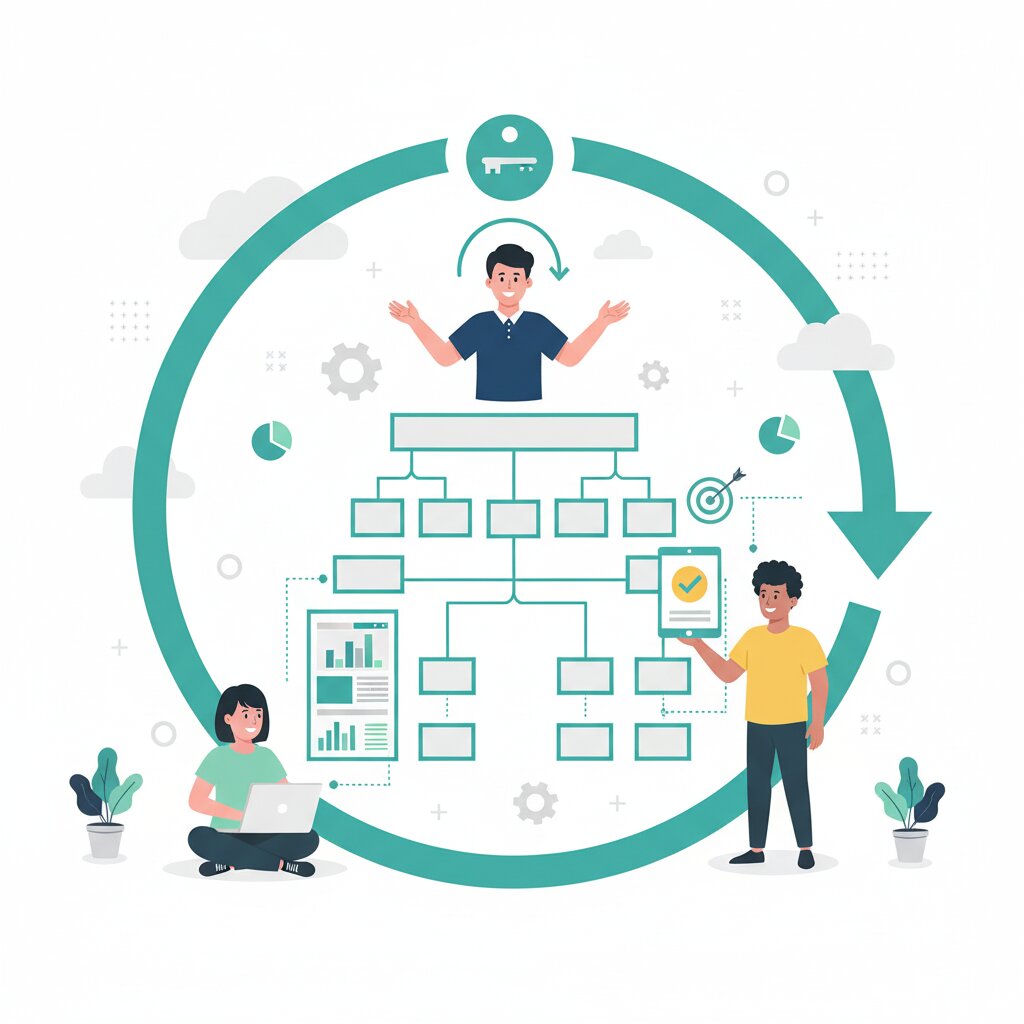
Only 33% of AI pilots reach production — and it’s not because the models broke. The technology worked. The ownership didn’t.
This is what we call the ownership vacuum. Data scientists own the experiment. No business leader owns the outcome. Engineering delivers what was asked, then the whole thing stalls because nobody has a mandate to take it further.
The fix is an ownership framework — who owns what, how to assign it, and what “owning an AI outcome” actually means in practice. For the root-cause analysis, see why organisational design is the root cause; for the full failure landscape, AI pilot purgatory covers it.
Why do AI pilots stay stuck in the lab when the technology works?
BCG’s 10-20-70 principle says 10% of AI success comes from the algorithm, 20% from data and technology, and 70% from people and process. Most organisations pour effort into the 10% and do almost nothing about the 70%.
When a pilot finishes and the demo goes well, someone has to make the hard calls — fund production, define success metrics, accept business risk. Without a named owner, those decisions default to committees or get deferred indefinitely. Committees discuss. They don’t decide.
Argano identifies the production funding gate as the specific moment this breaks down. Pilots without business ownership fail right there because no executive has put their name on the business case. And there’s a downstream consequence: without an ownership structure, AI gets deployed informally. Nearly 60% of employees already use unapproved AI tools at work, with shadow AI now accounting for 20% of all breaches.
The ownership vacuum is an operating model problem. The technology is fine. What’s missing is someone who has formally accepted accountability for the business result. The enterprise AI pilot purgatory statistics confirm this pattern holds across sectors and company sizes — the variable is always ownership, not capability.
What does it actually mean for a business leader to own an AI outcome?
AI outcome ownership means a named business leader — VP or above, not a data scientist — holds formal accountability for the business result: revenue impact, cost reduction, risk reduction. Not model accuracy or uptime. Those stay with engineering.
The RACI framework makes this concrete. Responsible is who does the work. Accountable is who answers for the outcome. Only one person can be Accountable. When two people share it, nobody really holds it.
The business owner is responsible for three things: defining success in business terms, securing production funding, and holding stop authority. Infosys is direct on stop authority — it’s the explicit, documented right to pause or roll back an AI system in production. Engineering is not positioned to make that call. Halting a production system is a business risk decision.
In a mid-size company without a dedicated AI function, this doesn’t require new headcount. A two-sentence role definition per initiative covers it: what business metric this person owns, what their stop authority is, and the escalation path when they and the CTO disagree.
How do you build a minimum viable ownership structure for enterprise AI without creating bureaucracy?
Most CTOs either skip governance entirely — which creates the vacuum — or overcorrect by importing Fortune 500 committee structures that slow everything down. Neither works at mid-market scale.
The minimum viable structure for a 50–500 person company has three components:
- A named business owner per initiative — a VP or functional lead accountable for business outcomes.
- A decision-rights document — two pages maximum — specifying who approves production go-live, who holds stop authority, and the escalation path when the business owner and CTO disagree. Time-box that escalation: if unresolved in 48 hours, the CTO makes the call and documents it.
- A production funding gate — a formal moment where the pilot’s business case gets a pass/no-pass decision, not an indefinite review cycle.
Agility at Scale calls this the governance delta: pilot governance is informal and team-level; production requires formal, organisation-level governance. That delta must be added at the production gate — not retrofitted after problems emerge.
This isn’t an AI ethics board or a multi-quarter governance design project. You can put it in place in one meeting and one document.
AI Centre of Excellence vs. distributed ownership — which model ships more AI to production?
Two models. The AI Centre of Excellence holds AI capability centrally — business units consume AI as a service. Distributed ownership embeds accountability within business units, pairing capability with clear ownership.
Infosys identifies the CoE failure mode: the CoE owns the pilot technically but has no authority over budget, adoption, or integration. The business unit has no accountability because AI was delivered to them as a service. Ownership vacuum, created structurally.
At 50–500 employee scale, a full AI CoE is rarely feasible. The right structure is a hybrid: a small AI capability function — two to four people — supporting business units rather than owning delivery, with the business unit holding production accountability. For genuinely cross-functional use cases, the CoE holds ownership temporarily and hands off to a cross-functional steering group with a named executive.
Bain Capital Ventures practitioner evidence backs this up: programmes that reach production get integrated into departmental budgets — a forcing function for teams to vet ROI and take real ownership of value.
Which AI use cases have the highest production success rates — back-office or customer-facing?
Back-office AI — document processing, contract review, compliance automation, internal search — reaches production more often and more reliably than customer-facing personalisation or recommendation engines.
The reason is structural. Back-office ownership is simpler: the business owner is close to the outcome, failure is internal and correctable, and success metrics are objective — processing time, error rate, cost per document. Customer-facing AI has more ownership friction. Customer risk means legal, compliance, customer success, and sales all want input. Nobody wants to own a customer-facing failure, so nobody owns the outcome.
Weight back-office use cases heavily in your first 12–18 months. Build internal capability and governance muscle before taking on higher-friction customer-facing initiatives. Customer-facing AI requires more governance overhead by design — output quality is harder to control when customers are on the receiving end.
What should you do when a technically successful pilot cannot get production funding?
When a technically successful pilot can’t secure production budget, look at the ownership structure before you touch the budget question. The production funding conversation is where the ownership vacuum becomes visible.
Run three diagnostic questions. Is there a named business owner — not the CTO, not the data science lead — formally accountable for the outcome? Was a production funding gate defined before the pilot started? Is the business case in business terms, or in technical terms?
Then follow the intervention path. No business owner: stop and assign one before any further production conversation. Business case in technical terms: translate it — converting technical performance into business impact is the CTO’s job at this gate. Owner exists and case is clear but funding is still blocked: escalate to the CEO or COO with a time-bound ask.
When ownership is genuinely contested, the pilot triage decision framework provides the resolution mechanism. The production funding gate is one dimension of production readiness; production readiness governance criteria covers the full assessment that follows.
For context on where ownership failures sit within the broader picture, the full AI pilot failure landscape maps every failure category — organisational, technical, and governance — with the supporting data.
Frequently asked questions
What is an AI outcome owner and how is this role different from a product owner?
An AI outcome owner is a senior business leader — VP or above — formally accountable for what an AI system delivers to the business: revenue, cost reduction, risk reduction. A product owner manages delivery. The outcome owner holds accountability for the result and stop authority in production. One person can hold both roles, but the accountability distinction must be explicit.
How do you assign a business owner to an AI use case in practice?
Start with the business unit receiving the largest share of the AI system’s output. Identify the senior leader of that unit. Assign them formal accountability in a brief written document: what metric they own, what stop authority they hold, and the escalation path when they and the CTO disagree. No new role. No new headcount.
What is the difference between AI accountability and AI responsibility?
In the RACI framework: Responsible is who performs the work. Accountable is who answers for the outcome — the business owner. Only one person can be Accountable. Confusing the two is the primary cause of the ownership vacuum.
How do you build a RACI matrix for AI governance in a mid-size company?
A functional AI RACI covers four decision categories: pilot go/no-go; production go-live; in-production modifications; production halt/rollback. Each category needs a designated Accountable party, not a committee. Agility at Scale provides an AI-specific RACI template that keeps the structure to a single page.
What should happen at the production funding gate for an AI project?
The production funding gate is a formal, time-boxed decision point — not an indefinite review cycle — where three questions get answered: Does pilot evidence support the business case in business terms? Is there a named business owner formally accepting accountability? Is there a production budget approved? If any answer is no, the pilot does not proceed.
Why shouldn’t the CTO own AI outcomes in a mid-size company?
The CTO owns technical performance — infrastructure, model accuracy, uptime. Assigning the CTO as business outcome owner creates a structural conflict: the CTO is incentivised to report technical success rather than business outcome success. Business outcome ownership requires authority over business metrics, adoption decisions, and production risk acceptance — that authority sits with the business unit lead.
What is the AI value gap and how does it relate to ownership?
The AI value gap is the widening performance difference between organisations generating measurable production AI value and those permanently stuck in pilot mode. Organisations generating production value have resolved the ownership vacuum — named owners, functioning funding gates, lightweight governance. The value gap is the compound consequence of the ownership gap.
How does the AI governance framework differ between a CoE model and a distributed model?
CoE governance is centralised — the CoE holds decision rights, business units are consumers. Distributed governance is embedded — each business unit holds decision rights with central oversight for cross-cutting concerns. For mid-market companies, the hybrid works best: lightweight central oversight with business-unit-level accountability.
What does the EU AI Act require in terms of AI ownership and accountability for FinTech and HealthTech companies?
The EU AI Act assigns accountability at the “deployer” level. For FinTech and HealthTech companies using high-risk AI, the Act requires a named individual accountable for compliance. The business outcome owner can serve as that regulatory accountability point — one role, not two.
What is stop authority and why does every production AI system need it?
Stop authority is the explicit, documented right to pause or roll back an AI system in production. Without it, a production system generating bad outcomes enters the same vacuum that stalled the pilot — nobody has authority to halt it. Stop authority belongs with the business outcome owner, not engineering, because halting an AI system is a business risk decision.
How does agentic AI change the ownership requirements compared to advisory AI?
Advisory AI advises; humans decide. Agentic AI acts autonomously — approving refunds, routing complaints, modifying credit limits. When the AI acts rather than advises, consequences are faster and harder to reverse. Agentic AI requires more explicit stop authority, shorter escalation paths, and tighter decision rights. The minimum viable ownership structure is the starting point — for agentic deployments, it’s a prerequisite.
What do you do when you have AI already deployed in production without clear ownership documentation?
Triage it. For each AI system in production, identify who would be called first if it produced a bad output — that person is the de facto owner; make it formal. Any system where that produces a blank or a committee is a shadow AI risk — assign ownership within 30 days. For each assigned owner, produce the minimum two-page decision-rights document. Days, not months.