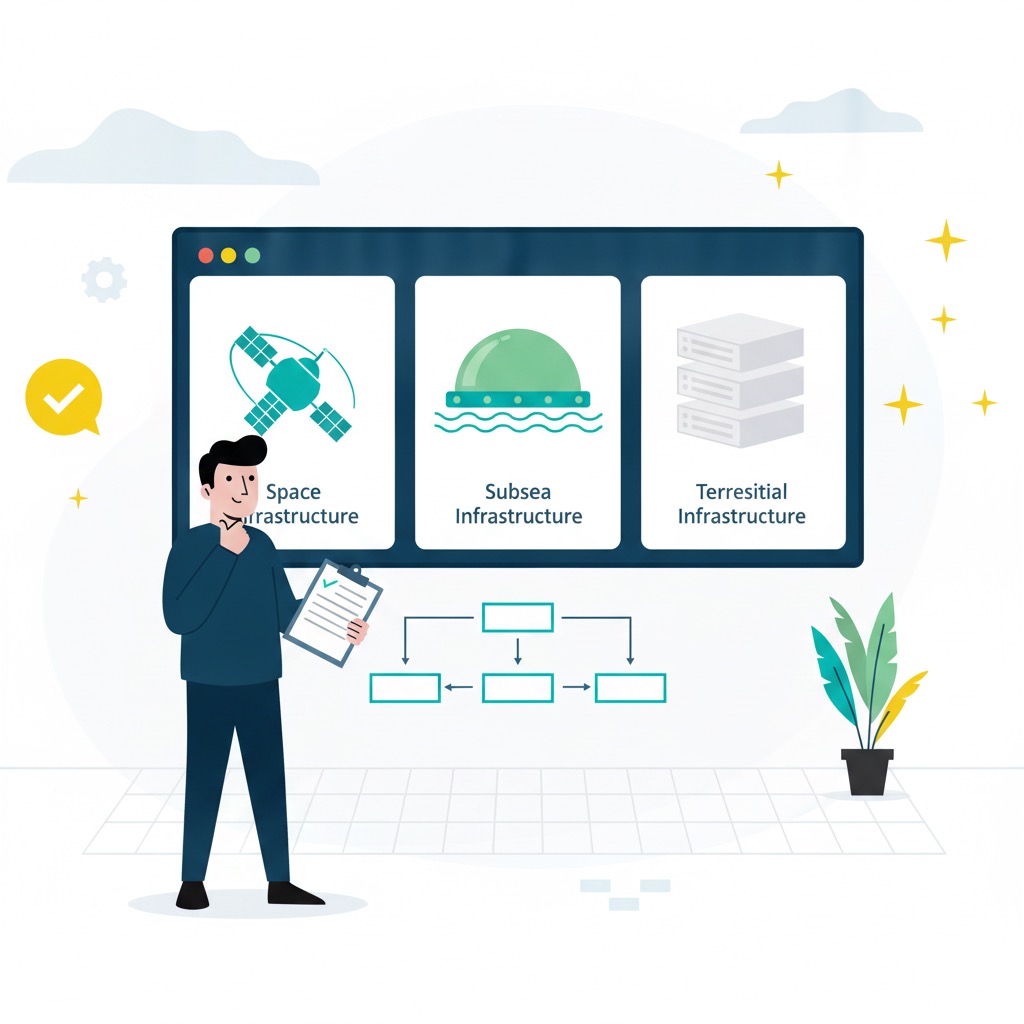

SpaceX filed for a million-satellite orbital data centre constellation, Starcloud hit a $1.1 billion valuation in March 2026, and eight organisations committed major orbital data centre funding in the first 90 days of 2026 alone. That is a lot of money moving in one direction. But investment activity is not the same as procurement readiness.
For most mid-market companies in 2026, these belong on a watch list — not an infrastructure roadmap. This article explains why, and what conditions would change that. If you want the full landscape first, the computing beyond the grid primer is a good place to start.
ABI Research puts orbital compute at roughly 78 times the cost per unit of a terrestrial equivalent. They flag it as a rough estimate. But even if you discount it aggressively, you are not landing at 2x or 3x — where early adopters might take a punt. You are at an order of magnitude that rules out cost-motivated adoption for any mid-market company this year.
Is it too early to consider orbital or underwater data centres for enterprise infrastructure planning?
Yes — for most mid-market companies in 2026, orbital and underwater compute belongs on the watch list, not an active infrastructure roadmap. The ABI Research 78x TCO premium is the number that anchors that decision.
Underwater data centres are further along than orbital. China’s Hainan facility has been operational since 2025 — 24 racks at 35 metres depth, with a PUE of 1.07 using natural seawater cooling. Microsoft’s Project Natick showed lower hardware failure rates for sealed subsea deployments than terrestrial equivalents. Both required hyperscaler-scale capital. Neither is a mid-market procurement option today.
The planning horizon to watch is ABI Research’s 2035 forecast, where orbital compute $/W reaches convergence with terrestrial benchmarks. The trigger conditions are not yet met. Monitor with discipline, allocate no budget in 2026, and establish the criteria that would actually change the assessment.
What conditions move orbital compute from “watch list” to an active infrastructure planning factor?
Five conditions, met together, would move orbital compute from background monitoring to active planning consideration. No single one is enough on its own.
1. Starship commercial flight cadence reaching approximately 12 launches per year Not yet at commercial frequency. You can track this through FAA launch licences and SpaceX manifests. Starcloud CEO Philip Johnston expects commercial Starship access in 2028–2029.
2. Launch cost approaching $200/kg Not yet demonstrated. It is Starship-dependent — best-case Falcon Heavy sits at roughly $1,500/kg as of mid-2026.
3. A published SOC 2 or equivalent compliance framework for orbital workloads No framework exists. No orbital provider has undergone a SOC 2 audit for space-based workloads.
4. Commercially available ODC capacity from non-BHDT vendors Limited. The closest evaluable product today is Atomic-6’s ODC.space marketplace — a sovereign 42U rack at $3.5M per month with 2–3 year delivery. That means 2028–2029, not 2026.
5. At least one verifiable enterprise deployment at scale None as of 2026.
The next concrete evidence events to watch: Lonestar StarVault’s October 2026 launch, NVIDIA Space-1 confirmed for 2027, and the FCC ruling on SpaceX’s million-satellite application SAT-LOA-20260108-00016. For more on the SpaceX FCC filing and S-1 risk disclosures, and what Axiom Space’s commercial orbital nodes actually look like in practice today, we have articles covering both.
Which workloads are candidates for orbital or alternative data centre environments — and which are not?
The viable candidates in 2026 are non-critical, latency-tolerant, compute-heavy workloads. Real-time transactional workloads, regulated-data processing, and AI training runs are not viable. Full stop.
Rishi Gupta of Infosys puts the starting point well: identify non-critical workloads. LEO introduces 20–40ms roundtrip latency. Any workload where sub-10ms latency is baked into the architecture is unsuitable.
Here is the workload split:
Viable today (2026)
- Content distribution
- Batch processing
- Backups and archival
- Satellite imagery processing
- Earth observation and SAR data processing
- AI inference at kW scale
Viable in the 2030s
- AI training runs
- Real-time transactional workloads
- Hyperscale compute-as-a-service
- Anything requiring MW-scale infrastructure
The AI inference versus training distinction is the one that matters most for your planning. Inference requests are independent and parallelisable, which makes kW-scale LEO edge nodes viable today. Training requires tightly coupled multi-GPU systems with high-bandwidth interconnects — infrastructure that does not exist in orbit in 2026. For the thermal constraints that define workload viability, see the physics of orbital and underwater cooling and the NVIDIA Space-1 hardware roadmap.
What does the compliance gap mean for regulated industries considering orbital workloads?
No SOC 2, GDPR, HIPAA, or FedRAMP framework currently applies to data processed in orbital environments. For FinTech, HealthTech, and regulated SaaS companies, that makes orbital data processing non-compliant by default.
Here is where each framework stands:
SOC 2: designed for cloud providers in defined geographic jurisdictions with physical access controls — none of those assumptions hold in orbit. No orbital provider has undergone a SOC 2 audit for space-based workloads.
GDPR: Chapter V assumes data crosses between jurisdictions with defined adequacy frameworks. Orbital processing sits in a legal grey zone with no published adequacy determination.
HIPAA: no published Business Associate Agreement template exists for orbital healthcare data processing.
FedRAMP: requires authorised providers on US soil or in documented overseas environments. Orbital is excluded.
The underlying question — which jurisdiction governs data processed in orbit? — is unresolved. The operator’s incorporation, the satellite’s flag state, the ground station jurisdiction, and your data residency requirements may all apply and conflict with each other.
ITAR is worth noting too: US-manufactured satellites and hardware are typically ITAR-controlled, creating potential obligations for non-US customers on US-domiciled orbital providers. For a broader view of the alternative computing landscape — including the underwater and orbital environments where these compliance gaps apply — the computing beyond the grid overview maps the full scope.
What is the vendor lock-in risk when orbital compute providers are pre-revenue startups?
Most orbital compute providers have no track record of operating commercial data services — no SLA history, no uptime data, no established escalation paths. That is categorically different from procuring from a hyperscaler.
Starcloud raised $170 million at $1.1 billion valuation — Y Combinator’s fastest unicorn — with AWS, Google Cloud, NVIDIA, and Crusoe delivering hardware for Starcloud-2. A meaningful credibility signal. But not revenue.
SpaceX’s S-1 uses the language “significant technical complexity and unproven technologies, and may not achieve commercial viability”. That is three months after Musk called orbital data centres a “no-brainer” at Davos. The S-1 is the legally binding document. Keep that in mind.
Atomic-6 at $3.5M per month with 2–3 year delivery is procurement for 2028–2029. Lonestar StarVault (October 2026) is a storage service, not a compute platform. Hardware obsolescence compounds the risk: GPUs depreciate every 2–3 years, but in orbit every replacement requires a launch or a robotic servicing mission.
What signals should infrastructure leaders track over the next 24 months?
Six publicly observable signals, reviewed quarterly, turn passive awareness into structured monitoring.
Starship commercial flight rate via FAA launch licences and SpaceX manifests. Watch for a sustained cadence of 12 or more commercial launches per year.
NVIDIA Space-1 Vera Rubin Module (2027) — the first space-hardened GPU from a Tier 1 vendor. Its availability validates the AI inference thesis.
Lonestar StarVault October 2026 launch — the first concrete evidence event. If it operates for 90+ days, the “first commercial orbital data service” claim becomes verifiable. If it slips, reset your timeline expectations.
Starcloud-2 late 2026 launch — the first satellite to run commercial cloud workloads for Crusoe, AWS, and Google. Hardware is being delivered to the Redmond integration facility now.
FCC ruling on SAT-LOA-20260108-00016 — approval or denial signals whether the FCC will licence large-scale orbital data centre constellations. More than 1,000 public submissions have been received, the majority opposed.
Any published compliance framework for orbital workloads from CSA, CISA, or ENISA. Its emergence would be a step-change signal for regulated industries.
Monitoring setup: Google Alerts for “orbital data centre,” “space compute,” “Starcloud,” “Lonestar StarVault”; FCC IBFS for SAT-LOA-20260108-00016 docket activity; Atomic-6 ODC.space for delivery updates. The energy economics trajectory and ABI Research 2035 convergence forecast has the cost curve context for all of these.
How should you respond when board questions arrive about SpaceX or Google orbital compute?
Once you have the watch-list in place and the threshold conditions clear, the board question is easy to handle. It usually arrives triggered by a news cycle. The structure of the answer is the same every time.
SpaceX’s S-1 simultaneously promotes and disclaims orbital data centres — it is a credible growth story for a $1.75 trillion pre-IPO valuation, sitting alongside “significant technical complexity and unproven technologies” in the same document. Google Project Suncatcher is a research initiative, not a commercial product. Neither is a procurement option.
Hyperscalers have the capital to participate as early adopters. Mid-market companies do not need to — the adoption curve works in their favour if they monitor the right signals and move when threshold conditions are met.
Board-ready summary: “The 78x cost differential established by ABI Research rules out cost-motivated adoption today. The convergence forecast is 2035, contingent on Starship economics not yet demonstrated. No compliance framework exists for orbital workloads — a hard blocker for our regulated data. We have a watch-list of six trackable signals reviewed quarterly. We will revisit when [specific threshold condition].”
The more immediate planning pressure for most mid-market companies is not space infrastructure — it is terrestrial capacity constraints. Grid interconnection queues in North American and European hubs now average seven to ten years, with seven of 13 major US grid regions projected below critical safety margins by 2030. That is the near-term infrastructure risk that deserves budget attention now. For geopolitical context and underwater commercial evidence, the China underwater data centres analysis covers both Project Natick and China’s deployments.
For a complete overview of orbital, underwater, and alternative data centre environments — and how all the pieces fit together — see the full scope of orbital and underwater data centres.
Deciding whether a planning factor is worth acting on is one thing. Having the engineering capacity ready to act on it is another. SoftwareSeni’s extended development teams put senior developers on your roadmap without a hiring round, so you can evaluate and adopt new infrastructure options as they mature instead of waiting for headcount to catch up.
see how extended development teams could support our roadmap →
“I’ve worked with SoftwareSeni for many years now across different CTO roles. Davo and his team are such a pleasure to work with and they have always provided the best and most capable resources when I needed them. They run a well oiled process to ensure they find and present the best candidates, plus they ensure smooth onboarding process. I highly recommend SoftwareSeni to any company that is wanted to expand their team and keen to explore an embedded team model.”
— Simon Farrell, VP of Engineering, Forage
Frequently asked questions
What is the ABI Research 78x TCO figure and should I trust it?
ABI Research explicitly describes the 78x figure as a “rough estimate” — treat it as an order-of-magnitude indicator, not a precise ratio. Its value is in confirming that we are not at 2x–3x, where early adopters might experiment. We are at an order of magnitude that rules out cost-motivated adoption for mid-market companies in 2026.
Is orbital data centre compute the same as edge compute?
Orbital compute is a subset of edge compute architectures, but the physical constraints — launch cost, radiation hardening, vacuum cooling, limited repair access — make it categorically different from terrestrial edge. ABI Research’s kW-scale versus MW-scale taxonomy is the useful distinction: today’s orbital nodes operate at kW-scale edge capacity; terrestrial edge data centres routinely operate at MW scale.
What is the difference between sovereign orbital capacity and colocated orbital capacity?
Atomic-6’s ODC.space introduced this distinction: sovereign capacity means owning an entire dedicated satellite ($3.5M per month, 2–3 year delivery); colocated capacity means renting shared capacity on a multi-tenant satellite at lower cost. Neither is practical for mid-market companies in 2026. The colocated model, if it matures, would be the more accessible entry point for non-hyperscale buyers.
Why does it matter which jurisdiction governs data processed in orbit?
GDPR, HIPAA, and data residency laws all assume data is processed in a geographic jurisdiction with defined legal obligations. Orbital processing sits outside any jurisdiction’s clear remit. For regulated industries, there is no legal basis for claiming compliance with frameworks your customers or auditors expect. Orbital data processing is non-compliant by default until a specific certification framework is published and audited.
When is the first commercially available orbital data service launching?
Lonestar StarVault, launching October 2026 aboard LizzieSat-4, is the first commercially purchasable non-BHDT orbital data service — a storage service, not a compute platform. Starcloud-2 (late 2026) would be the first commercial orbital compute offering, but enterprise availability is likely 2027–2028 at the earliest.
How do AI training and AI inference differ in orbital viability?
AI inference is viable at LEO edge scale because each request is independent and parallelisable. AI training requires tightly coupled multi-GPU systems with high-bandwidth interconnects — infrastructure that does not exist in orbit in 2026. Edge inference is a candidate workload today. Training runs in orbit are a 2030s proposition.
What is Google Project Suncatcher?
Google Project Suncatcher is a Google Research initiative equipping satellites with Tensor Processing Units, targeting a two-satellite learning mission with Planet Labs by early 2027. It is not a commercial product. Its significance is that Google Research projects cost parity by approximately 2035 — the same convergence horizon ABI Research forecasts.
What is the Starcloud-2 mission and why does it matter?
Starcloud-2 is scheduled for launch before year-end 2026, using AWS Outposts hardware alongside NVIDIA, Google, and Crusoe. It generates about 8 kilowatts — 100 times more than Starcloud-1. Philip Johnston’s 2028–2029 estimate for earliest viable commercial orbital compute is based on Starcloud-2 delivering and Starship reaching sufficient launch cadence.
How do underwater data centres compare to orbital ones?
Both use unconventional cooling, are physically inaccessible once deployed, and are in earlier commercial maturity than hyperscaler cloud regions. China’s Hainan facility — operational since 2025, 35 metres below the surface, PUE of 1.07 — proves the technology works at commercial scale. China’s deployments are not directly accessible to Western mid-market companies, but the technology proof is real.
Should orbital compute be on my five-year infrastructure roadmap?
For most mid-market companies in 2026, no. The 78x cost differential, compliance gap, pre-revenue vendor landscape, and Starship-dependent timeline all point to 2030 at the earliest as realistic. Set up a structured watch-list with an annual review cadence instead. The conversation that deserves active budget attention now is grid interconnection queue risk: the average wait time for a new large-scale grid connection in North American and European hubs is now seven to ten years.
What does ITAR mean for non-US companies evaluating orbital compute?
ITAR restricts transfer of defence-related technology; US-manufactured satellites and hardware are typically ITAR-controlled. Non-US companies using US-domiciled orbital infrastructure — Atomic-6, Starcloud, and Lonestar are all US-based — may face ITAR obligations depending on their workloads. Get legal advice on ITAR exposure before any LOI or commercial agreement with US orbital providers.
Not sure this belongs on your roadmap yet? Talk it through with SoftwareSeni