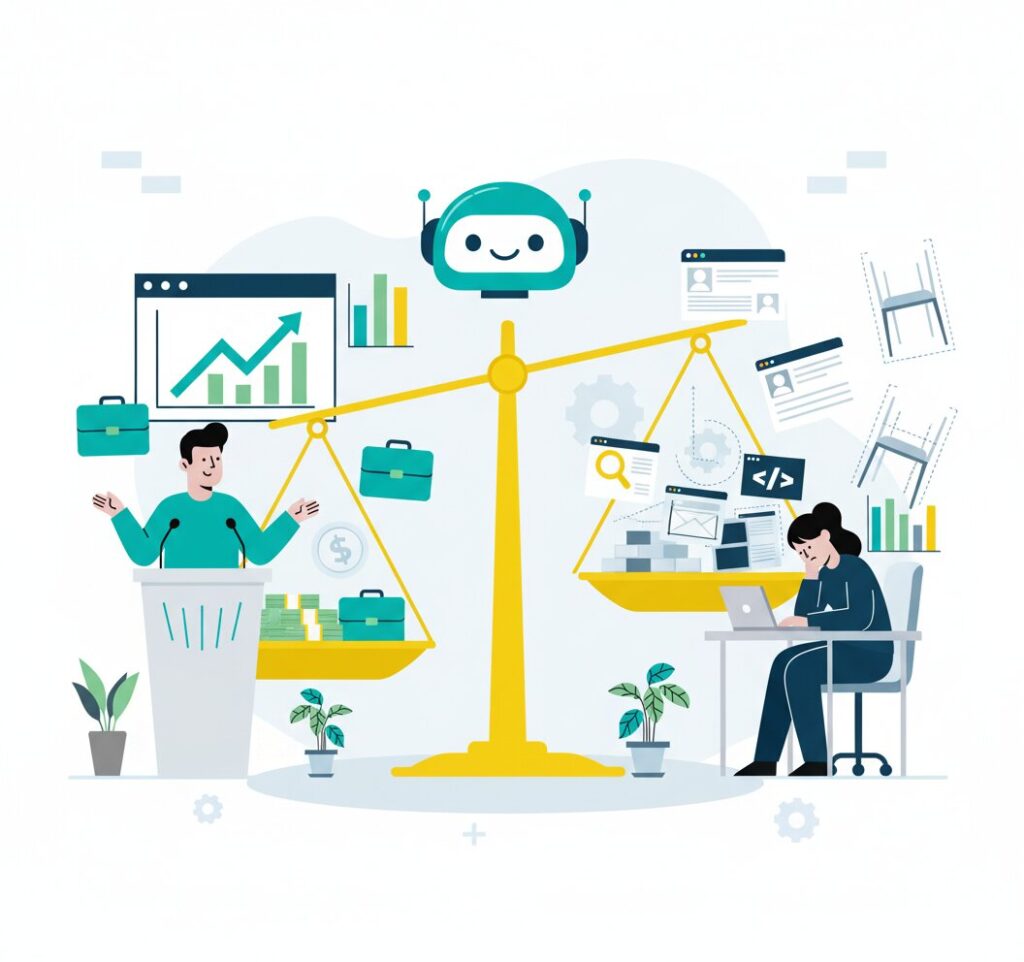

There are two separate conversations about AI-washing versus genuine displacement and they keep getting muddled together. One is companies using AI as cover for restructuring they were going to do anyway. The other is real, documented employment effects happening right now — plus a credible set of frameworks about what comes next. Both deserve honest treatment.
If the debunking conversation ends up creating the impression that AI has zero employment impact, that is a calibration failure of a different kind. So here is the counterpoint: what genuine AI-driven displacement actually looks like, what the best current data shows about early-career workers, and why limited evidence today does not mean the trajectory is fine. This article is part of our series on the corporate fiction behind AI-driven layoffs.
What does a confirmed AI-driven workforce reduction actually look like in practice?
Salesforce is the benchmark case. CEO Marc Benioff stated he reduced customer support staff from approximately 9,000 to 5,000 because “I now use AI agents. I need less heads” — a 44% reduction in a single, bounded function. The AI system is Agentforce, a named product handling support queries autonomously.
Named system. Named function. Named mechanism. Specific numbers. That combination is what distinguishes this case from basically everything else claiming AI displacement.
Oxford Internet Institute researcher Fabian Stephany assessed the Salesforce case as plausible, noting that customer support work is “relatively close to what current AI systems can perform.” Routine, rule-based, measurable — the same characteristics that make a function most susceptible to early automation.
There are caveats. Salesforce stated it “redeployed hundreds” of employees, but what happened to the remaining thousands has not been verified publicly. Industry analyst Matt Pieper noted simply that “We don’t know.” Anthropic’s March 2026 Labour Market Impacts research independently identifies Customer Service Representatives as the second-most exposed occupation by observed AI use in real workplaces — which supports the case, but does not close it completely.
The honest read: this is the most credible documented AI displacement case available, with limitations acknowledged. It is the standard against which all other displacement claims should be measured. For a company-by-company comparison that places Salesforce alongside Amazon, Klarna, and Duolingo on the AI-washing spectrum, see the full case study analysis.
What is the difference between an AI exposure score and actual observed job displacement?
AI exposure scores estimate what percentage of tasks within a given occupation AI is technically capable of performing — mapped against the O*NET occupational task database. The MIT Iceberg Index applies this approach and finds roughly 11.7% of the US workforce is theoretically replaceable based on task exposure. That is approximately $1.2 trillion in wages.
The problem is that theoretical capability and observed employment outcomes are two very different things, and the gap between them is large.
Yale Budget Lab found “no substantial acceleration in the rate of change in the composition of the labor market since the introduction of ChatGPT.” Executive director Martha Gimbel put it plainly: no matter how you look at the data, right now, there just are not major macroeconomic effects showing up.
Anthropic’s March 2026 Labour Market Impacts research put numbers on the gap — Claude currently covers just 33% of tasks in the Computer and Math occupational category despite theoretical capability covering 94%. Organisations are simply not deploying AI at the scale that exposure scores assume. Deployment lags capability by years.
When you are evaluating an AI displacement claim, the useful question is: is this based on observed deployment data or theoretical capability scoring? Most claims are the latter.
What does the Brynjolfsson Stanford data show about early-career workers right now?
Erik Brynjolfsson, director of the Stanford Digital Economy Lab, published a study tracking longitudinal employment of workers aged 22–25 in AI-exposed occupations using ADP payroll data — nicknamed “Canaries in the Coal Mine.” The headline finding: a 13% relative employment decline for early-career workers in high AI-exposure occupations over the 33 months since ChatGPT’s November 2022 release.
Anthropic’s own March 2026 research corroborates this — a 14% drop in the job-finding rate for workers aged 22–25 in the most AI-exposed occupations. Driven primarily by a slowdown in hiring rather than layoffs. The effect is appearing in who gets hired, not who gets fired.
Why early-career workers specifically? Entry-level roles are disproportionately composed of routine, well-defined tasks — exactly what AI automates most readily. The Law and Economics Center’s February 2026 review of AI productivity evidence documents this pattern consistently across multiple studies, calling it “skill compression” — less-experienced workers see disproportionately large productivity boosts from AI assistance, which compresses the value gap between junior and senior labour.
The canary framing holds. Early-career employment decline in AI-exposed occupations may be the leading indicator of broader effects that have not yet appeared in aggregate statistics.
There is a contested reading worth flagging. In a February 2026 Financial Times op-ed, Brynjolfsson argued that productivity data is now showing the “harvest phase” beginning — citing a 2.7% year-over-year productivity jump alongside a decoupling of job growth and GDP growth. He sees these as consistent: early-career workers experiencing displacement while aggregate productivity begins to rise. That is his interpretation of emerging data, not yet consensus.
One practical note: this data is US-centric, using ADP payroll records. The early-career effect may not translate directly to Australian or other markets with different occupational structures or AI adoption rates.
What is the J-Curve framework and what does it mean for thinking about AI displacement timelines?
The J-curve describes AI’s employment effects as J-shaped: an initial descending phase of disruption and investment, an inflection point, then an ascending phase of net employment growth as new roles emerge and productivity gains compound. The model is articulated by Torsten Slok, Apollo’s chief economist, and reviewed in the Law and Economics Center’s February 2026 assessment.
Slok’s observation is direct: AI is everywhere except in the incoming macroeconomic data. Robert Solow said the same about computers in 1987. Electrification and computerisation both showed decade-long lags between large-scale technology deployment and observable productivity gains. AI may be following the same pattern.
Slok notes explicitly that after three years with ChatGPT and still no signs in aggregate data, AI will likely be “labor enhancing in some sectors rather than labor replacing in all sectors.” It is a framework, not a guarantee.
For workforce planning, the implication is specific. Today’s limited evidence does not mean the descending phase is over. Build the J-curve inflection as a trigger condition to monitor — not a present-day risk to act on, but not something to dismiss just because current data looks stable.
Why do the Amodei and Altman warnings not support AI-washing claims despite their alarming framing?
In his January 2026 “Adolescence of Technology” essay, Anthropic CEO Dario Amodei warned that AI could displace 50% of entry-level white-collar jobs in the near term. Sam Altman at the India AI Impact Summit acknowledged both sides: some AI-washing is happening, and real displacement is on its way.
Both statements are forward-tense forecasts. Amodei and Altman are describing what they believe AI will do, not documenting what it has already done at scale. Using those predictions as justification for current layoffs is a logical error — presenting a future-tense forecast as present-day evidence.
There is also a credibility gap worth noting honestly. Amodei predicted in early 2025 that AI would be writing 90% of code within six months — accurate inside Anthropic, but the broader software industry figure came in at 25–40%. His predictions may be accurate at the technology frontier while being systematically early for the broader economy.
None of that means the warnings should be ignored. Amodei and Altman are naming entry-level white-collar workers as the leading edge of future displacement — the same category where Brynjolfsson’s data shows a 13% early-career employment decline. They disagree on speed and scale, not direction. The error is using forward-looking signals as current evidence.
How does AI-washing undermine credibility for legitimate future displacement signals?
When AI is routinely used as cover for routine restructuring, it erodes the analytical signal value of genuine displacement claims. Understanding why AI-washing now undermines credibility of real future displacement claims requires looking at the investor incentives that make this behaviour structurally rational. Deutsche Bank analysts warned that “AI redundancy washing will be a significant feature of 2026.” Oxford Economics concluded that firms don’t appear to be replacing workers with AI on a significant scale and described the pattern as “corporate fiction.”
Wharton management professor Peter Cappelli told Fortune he has seen research showing firms announce “phantom layoffs” that never fully execute, arbitraging the positive stock market reaction. The signal is being diluted at scale.
The professional risk here is calibration failure. If you take AI-washing claims seriously now — when observed displacement evidence is limited — the frameworks you build for workforce planning get calibrated to noise rather than signal. When actual displacement begins to accelerate, those miscalibrated frameworks will be slow to recognise it.
How do you build a workforce plan that accounts for real displacement without inflating it?
The planning problem is specific: account for narrow current displacement (real, documented) without acting on AI-washing projections (fictional, strategic), while not dismissing legitimate forward-trajectory concerns. The workforce planning framework for distinguishing real from fictional displacement builds directly on the evidence established here.
A three-layer framework handles this.
Layer 1 — Current documented displacement. Salesforce/Agentforce and the Brynjolfsson data form the baseline. The displacement that exists now is narrow, function-specific, and early-career focused. Organisations with equivalent bounded, routine, measurable processes being handled by AI agents carry the most current documented risk.
Layer 2 — Theoretical exposure without observed outcome. AI exposure scores for roles in the organisation are a useful input, but only with the observed-versus-theoretical gap correction applied. The question is whether the organisation is actually deploying AI to perform those tasks autonomously. If the answer is no, the exposure score is a theoretical ceiling, not a current risk.
Layer 3 — Forward-tense trajectory monitoring. The J-curve inflection functions as a trigger condition rather than a present-day risk. Leading indicators worth monitoring include aggregate productivity acceleration, early-career hiring data in your sector, and AI deployment rates in your specific function.
Evaluating external AI displacement claims requires a consistent standard. Does the company name the AI system? Name the displaced function? Are the numbers independently verifiable? Is the mechanism explained — task replacement versus a reduction in hiring rate?
The Klarna case illustrates why that last question matters. AI did reduce Klarna’s hiring rate and allowed the company to operate with fewer staff, but the workforce reduced approximately 50% through attrition from 2022 onward — and the company had significantly overhired during the fintech boom. Even legitimate cases are rarely clean.
For the full framework on AI-washing versus genuine displacement, the corporate fiction and what lies beneath it is a longer conversation worth having with your planning cycles, not just your vendor assessments.
Right-sizing engineering headcount around a story you can’t fully verify is the real risk here. SoftwareSeni’s extended development teams give an Australian company additional developers who scale up for a deadline push and back down once it passes, so no redundancy exposure sits on your books if the narrative shifts again.
see how extended development teams scale up and down with demand →
“SoftwareSeni are extremely valuable partners of our business, and have been integral to our growth to date. They have provided a range of technical resources, which could be scaled up or down depending on our requirements. For any one looking to expand their development team or establish from scratch, we would highly recommend seeking our their services.”
— Joshua K, Co-Founder, rePrecinct
FAQ
Is AI actually eliminating jobs right now or is that just hype?
Both are partially true. Narrow, documented AI displacement exists — Salesforce’s customer support reduction from approximately 9,000 to 5,000 using Agentforce is the clearest case. But AI was cited as the reason for only 4.5% of total reported US job losses in 2025 — around 55,000 out of over 1.2 million total. The broad displacement claimed in many corporate AI announcements is not supported by current labour market data at scale.
What did the Brynjolfsson Stanford study actually find?
The “Canaries in the Coal Mine” study by Erik Brynjolfsson and the Stanford Digital Economy Lab found a 13% relative employment decline for workers aged 22–25 in occupations with high AI exposure, measured over the 33 months following ChatGPT’s November 2022 release. The decline is driven primarily by a slowdown in hiring rather than direct layoffs. Experienced workers showed much smaller effects.
How much of the US workforce is AI actually replacing right now?
Theoretically, the MIT Iceberg Index suggests approximately 11.7% of the US workforce is replaceable based on task capability. Observed employment outcomes do not show displacement at that scale. Yale Budget Lab found no substantial acceleration in occupational mix change since ChatGPT’s release. The gap between theoretical exposure and actual job loss is large.
What is the J-Curve theory of AI employment and where does it come from?
The J-Curve framework describes AI’s employment effects as J-shaped: an initial descending phase of disruption and displacement, followed by an inflection and ascending phase of net employment growth. The model is associated with Torsten Slok at Apollo and reviewed in the Law and Economics Center’s February 2026 empirical assessment. Current data is consistent with the early descending phase.
What did Dario Amodei actually say about AI and white-collar jobs?
In his “Adolescence of Technology” essay (January 2026), Anthropic CEO Dario Amodei warned that AI could displace approximately 50% of entry-level white-collar jobs within five years. This is a forward-tense forecast, not a statement about current observed displacement — a distinction AI-washing exploits by presenting it as present-day evidence.
What is “AI redundancy washing” and who coined the term?
Deutsche Bank coined “AI redundancy washing” for companies attributing layoffs to AI adoption when the actual drivers are cost-cutting or restructuring. Oxford Economics uses the parallel term “corporate fiction.” Both describe using AI as a reputationally convenient justification for workforce reductions that would have occurred anyway.
Is the Klarna AI headcount reduction a genuine case of AI displacement?
Klarna is a partial case — AI reduced the hiring rate, but the workforce reduction was intertwined with overhiring during the fintech boom. The full analysis is in the workforce planning section above.
Why are entry-level workers more vulnerable to AI displacement than experienced workers?
Entry-level roles are disproportionately composed of routine, well-defined tasks — the type of work AI automates most readily. Experienced workers tend to perform more complex, judgment-intensive tasks involving context, relationships, and ambiguity. The Law and Economics Center documents this as “skill compression” — AI assistance disproportionately boosts less-experienced workers, which compresses the value gap between junior and senior labour.
What is the “observed versus theoretical capability” distinction and why does it matter?
Anthropic’s March 2026 Labour Market Impacts research distinguishes between what AI is theoretically capable of doing and what it is actually being used to do in workplaces. The gap is large — Claude covers only 33% of tasks in Computer and Math occupations despite theoretical capability covering 94%. Most organisations are not deploying AI at the scale that exposure scores assume.
How does the Productivity Paradox relate to current AI employment data?
The Productivity Paradox describes how electrification and computerisation both showed extended lags — often a decade or more — between large-scale technology deployment and measurable productivity gains. Apollo’s Torsten Slok observes the same pattern today: AI is everywhere except in the incoming macroeconomic data. Limited current evidence of displacement does not invalidate future displacement risk.
Should I be concerned about my company’s AI displacement risk right now?
Current documented AI displacement is narrow and function-specific — primarily routine, measurable processes like customer support automation. The real risk for most organisations is calibration failure: either acting on AI-washing claims (overcorrecting) or dismissing the J-curve trajectory (undercorrecting for future risk). Honest workforce planning requires distinguishing those two error modes.
Trying to decide whether to hire or borrow the extra engineering capacity? Talk to us about extended development teams.