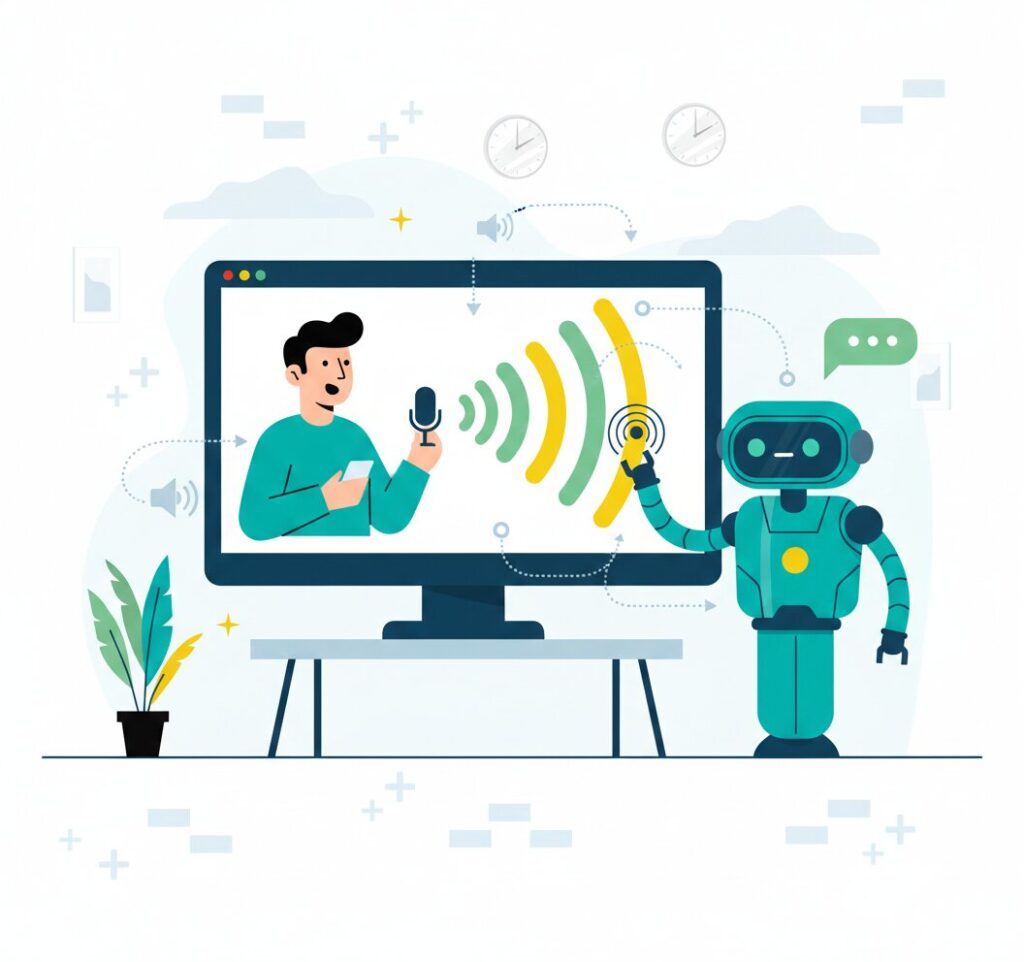

On 7 May 2026, OpenAI released GPT-Realtime-2 — a native speech-to-speech model that collapses the assembled STT/LLM/TTS pipeline into a single API call carrying GPT-5-class reasoning. That is the technology signal. The business signal has been building longer: enterprise voice agent deployments grew 340% year-on-year, and voice agents now handle 19% of inbound contact-centre volume — up from 6% in 2024. These are production deployments, not previews.
64% of enterprise CX teams are running agentic AI pilots while only 27% have reached full production (Gartner). That gap is where the real work lives. The seven articles in this cluster map every domain that sits in between: models, latency architecture, multilingual accuracy, compliance frameworks, production failure modes, and end-to-end governance.
In this cluster:
- GPT-Realtime-2 and the New Voice Model Tier — what the May 2026 model release changes for production voice
- Home Depot Voice Agent Case Study: What Enterprise Deployment Looks Like — enterprise-scale proof points and ROI data
- Voice Agent Latency Solved Enough for Production — benchmarks, the 600ms threshold, and architecture tradeoffs
- Deepgram Flux and the Multilingual Voice Agent Deployment Challenge — where multilingual accuracy actually breaks down
- Voice Agent Compliance: TCPA, HIPAA, PCI and What Comes Next — the regulatory frameworks that must precede technology selection
- When Voice Agents Go Wrong: Production Failure Modes and How to Prevent Them — hallucination, voice cloning, and escalation design
- Building Enterprise Voice Agents: Architecture and Governance for Production Deployment — the synthesis framework for crossing from pilot to production
What Is a Voice AI Agent — and Is It Actually Ready?
A voice AI agent is an LLM-powered system that handles complete inbound and outbound phone conversations — understanding natural language, managing multi-turn dialogue, and executing actions mid-call such as pulling CRM records, booking appointments, and processing payments. Unlike an IVR, it does not rely on touch-tone menus or rigid scripts. As of mid-2026, production deployments are operating at scale across retail, healthcare, and financial services — the demo phase is over.
Enterprise voice agent deployments grew 340% year-on-year; voice AI now handles 19% of inbound contact-centre volume versus 6% in 2024. Gartner’s 64%/27% data frames the governing business context: most organisations have piloted but not crossed into full production. Each of the seven articles in this cluster addresses a specific blocker to that transition. The cost arithmetic is already settled — voice AI resolves interactions at approximately $1.18 per resolution versus $11.40 for a human agent, a 90% reduction. The question is execution, not whether. The most common blockers are latency architecture and compliance readiness — both are covered in depth in this cluster.
- Deep dive: GPT-Realtime-2 and the New Voice Model Tier — the technology event that confirms voice AI has reached production-grade intelligence
- Deep dive: Home Depot Voice Agent Case Study: What Enterprise Deployment Looks Like — the enterprise proof point
The Models Are Ready — What GPT-Realtime-2 Changes
GPT-Realtime-2, released 7 May 2026, replaces the assembled STT/LLM/TTS pipeline with a single native speech-to-speech model carrying GPT-5-class reasoning, a 128K context window, and parallel tool call support. The result is lower latency, higher instruction retention across longer sessions, and a simpler deployment architecture. Zillow reported a 26-point lift in call success rate (69% to 95%) on its hardest adversarial benchmark.
The prior voice agent stack was assembled from parts — a transcription model, a reasoning model, a text-to-speech model, plus bespoke logic to stitch them together. GPT-Realtime-2 replaces all of that with a single model: audio in, audio out, reasoning inside the loop. The assembled pipeline still wins in specific situations — specific TTS voice quality requirements, custom STT fine-tuning for domain vocabulary, or component-level cost optimisation — but the gap that once justified the complexity has narrowed.
Full technical analysis: GPT-Realtime-2 and the New Voice Model Tier
What Enterprise Deployment Looks Like — The Home Depot Case
Home Depot’s May 2026 rollout of an AI voice assistant for in-store customer service calls is the clearest enterprise-scale signal in the current cycle. Beyond Home Depot, Medical Data Systems achieved 100% inbound call automation and $280,000 per month in automated collections using Retell AI; Pine Park Health reported a 38% increase in scheduling NPS. Enterprise deployment at scale is not theoretical — it is operating across retail, healthcare, and financial services.
The cost arithmetic supports that move. Voice agents resolve interactions at roughly $1.18 per resolution versus $11.40 for a human agent — close to a 90% reduction. Forrester Consulting puts three-year ROI between 331% and 391%, with a median payback of 5.4 months. The business case is settled. Execution is the remaining question, and what enterprise deployment actually requires goes beyond launching software: latency headroom, compliance architecture, escalation paths, and production monitoring all need to be in place before go-live.
Enterprise-scale deployment evidence and ROI analysis: Home Depot Voice Agent Case Study: What Enterprise Deployment Looks Like
Is Latency Solved? The 600ms Production Threshold
Sub-600ms end-to-end latency is the production threshold for natural-sounding voice conversation — above 800ms, callers reliably begin to interrupt before the agent responds. Most production platforms are at or just below that threshold. Retell AI runs at approximately 600ms all-in; Telnyx achieves sub-200ms through carrier-owned infrastructure where inference is co-located with telephony routing. Latency is solved enough for most use cases, but the architecture choices that produce those numbers are not interchangeable.
One thing to watch: vendor latency claims often cite Time to First Audio (TTFA) rather than end-to-end figures. GPT-Realtime-2 has a TTFA of 1.12 seconds at minimal reasoning. That is not the same as 600ms end-to-end. The cluster article unpacks the distinction, benchmarks five platforms, and explains when the assembled pipeline’s higher latency is a worthwhile tradeoff. Latency failures also intersect directly with escalation design and production failure modes — a slow response is often the trigger for the caller experience problems covered in that article.
Benchmarks and architecture detail: Voice Agent Latency Solved Enough for Production: Benchmarks and Architecture Tradeoffs
Multilingual Voice AI — Where Accuracy Actually Breaks Down
Language coverage numbers — 70 languages versus 10 — are the wrong evaluation axis for multilingual voice AI. Production accuracy at dialect level is the governing constraint. GPT-Realtime-Translate supports 70 input languages; Deepgram Flux supports 10 through an assembled pipeline approach. BolnaAI reported 12.5% lower word error rates on Hindi, Tamil, and Telugu with GPT-Realtime-Translate versus prior methods. But benchmark scores and coverage numbers do not predict accent recognition accuracy or code-switching performance.
Supporting Spanish in a deployment and handling Castilian, Mexican, Colombian, and Argentine Spanish accurately are different capabilities. Speakers who alternate languages mid-sentence expose a documented production failure mode in dedicated STT models. And the accent recognition gaps that benchmark scores do not surface create real service quality differences across customer segments — an operational and legal exposure that coverage numbers miss entirely. These differential service quality risks connect directly to voice agent compliance obligations, particularly under state-level biometric and anti-discrimination frameworks.
Multilingual architecture analysis: Deepgram Flux and the Multilingual Voice Agent Deployment Challenge
The Compliance Minefield — TCPA, HIPAA, PCI Before You Deploy
Voice agent compliance is structurally more complex than text chatbot compliance: voice creates biometric data, the FCC’s 2024 declaratory ruling classifies AI-generated speech as “artificial voice” under TCPA with stricter consent requirements than those applied to human agents, and call recording laws vary by state. TCPA exposure runs 500–1,500 per call — at enterprise outbound volumes, a compliance gap is not an administrative problem, it is a business risk. Compliance architecture must precede technology selection, not follow it.
Healthcare deployments require Business Associate Agreements with every vendor in the stack that touches audio or transcripts. Payment processing requires air-gapped STT pipelines and PCI-DSS tokenisation. State-level laws — Florida FTSA, California CIPA, Illinois BIPA — layer on top of all of that. Class actions typically settle for 20–60 million. Prior Express Written Consent (PEWC) — with timestamp, IP address, and exact consent language — is the court-defensible standard for outbound AI voice programmes. Organisations deploying across multiple languages face compounded exposure: see how multilingual accuracy gaps create compliance risk for a breakdown of where accent recognition failures intersect with legal obligations.
Full compliance guide: Voice Agent Compliance: TCPA, HIPAA, PCI and What Comes Next
When Things Go Wrong — Production Failure Modes to Know
Latency is the most visible production barrier but not the most consequential failure mode once a system is live. Hallucination-related complaints occur in 0.34% of AI-handled interactions — small as a rate, significant at contact-centre scale and potentially catastrophic in healthcare or financial contexts. Voice cloning attacks surged 1,300% in 2024. Guardrail failures and persona drift create reputational exposure that outweighs the cost of prevention.
Traditional manual QA samples 2–5% of calls — that is the coverage gap where failures accumulate undetected. 3CLogic‘s AI Agent Evaluator covers 100% of calls with LLM-powered post-call scoring, a 50x improvement in coverage over traditional sampling. Warm transfer with context — passing the full conversation record when escalating to a human agent — is the non-negotiable escalation design requirement. These are the controls that separate organisations running production at scale from those managing incidents reactively. The enterprise deployments documented in the Home Depot case study and the GPT-Realtime-2 launch partner data both demonstrate how production-grade monitoring closes that gap.
Risk analysis and mitigation: When Voice Agents Go Wrong: Production Failure Modes and How to Prevent Them
The Full Framework — Architecture and Governance for Production Deployment
Crossing from pilot to production requires more than selecting a platform. It requires a phased rollout staged by use case risk — from low-risk (password resets, order status) to high-risk (medical queries, payment processing) — with compliance architecture locked in before technology choices, monitoring instrumentation from day one, and governance ownership assigned before go-live. The organisations that have crossed the 27% production threshold share this sequencing. The organisations stuck at pilot generally skipped one of these steps.
Managed services like PolyAI (150K + /year)andCognigy(2,500+/month) include implementation support and compliance coverage. Developer platforms like Retell AI (0.07/min)and[Vapi](https : //vapi.ai)(0.05/min declared, closer to 0.25–0.33/min once component costs are included) give full architectural control but require you to self-source everything compliance-related. Which approach fits depends on what your team can build and maintain — and that decision is covered in full in the synthesis article.
Synthesis framework: Building Enterprise Voice Agents: Architecture and Governance for Production Deployment
If you are ready to move from research to deployment planning, Building Enterprise Voice Agents is the synthesis article — it converts the findings across all six cluster articles into a decision framework covering model selection, platform comparison, phased rollout design, and governance structure. That is where the pieces connect.
FAQ
What is a containment rate and how is it different from a deflection rate?
A containment rate is the percentage of inbound calls fully resolved by the voice agent without human transfer. A deflection rate is broader — it includes any self-service channel resolution, not just voice. For benchmarking voice agent performance, containment rate is the precise metric: PolyAI reports 50%+ containment; Medical Data Systems achieved 70% with Retell AI. Deflection rate figures frequently conflate voice and digital channel outcomes.
What is the difference between TTFA and end-to-end latency?
TTFA (Time to First Audio) measures the time from end-of-user-speech to when the agent begins generating its first audio output. End-to-end latency measures the full round trip — from when the user stops speaking to when they hear a complete response. GPT-Realtime-2 has a TTFA of 1.12s at minimal reasoning; end-to-end latency for Retell AI is approximately 600ms. Vendor latency claims often cite TTFA; production evaluation requires end-to-end figures.
What is a BAA and why does it matter for voice agents in healthcare?
A Business Associate Agreement (BAA) is a contract required by HIPAA between a healthcare organisation and any vendor that processes Protected Health Information on its behalf. Every vendor in a healthcare voice agent stack that touches call audio or transcripts must sign a BAA. BAA availability varies across platforms: Retell AI provides it via self-service portal; Vapi charges $1,000/month; PolyAI requires an enterprise contract.
What is the assembled pipeline and when does it still win?
An assembled pipeline connects separate specialist components — a speech-to-text model (e.g., Deepgram), a language model (e.g., GPT-4o or Claude), and a text-to-speech model (e.g., ElevenLabs) — into a single voice agent workflow. It adds 200–600ms of latency compared to an end-to-end model like GPT-Realtime-2. The assembled approach still wins when component flexibility matters more than latency: specific TTS voice quality requirements, custom STT fine-tuning for domain vocabulary, or component-level cost optimisation.
How do I choose between a managed voice agent service and a developer platform?
Managed services (PolyAI, Cognigy) include implementation, support, and compliance coverage. Developer platforms (Retell AI, Vapi) give engineering teams full architectural control but require them to self-source compliance architecture and monitoring infrastructure. For a 50–500 person organisation without a dedicated voice AI engineering team, the total cost of ownership for a developer platform frequently exceeds the managed service cost within 18 months. The full comparison is in Building Enterprise Voice Agents.
What is PEWC and why does it matter for outbound voice agent calling?
PEWC stands for Prior Express Written Consent — the highest consent standard under TCPA. Before a voice agent can make an outbound call to a US residential or mobile number for telemarketing purposes, you must have obtained PEWC from that number’s owner. The consent record must include a timestamp, IP address, and the exact consent language used. Without a court-defensible audit trail, each outbound call carries TCPA exposure of 500–1,500 per call and potential class-action liability in the $20–60M range.