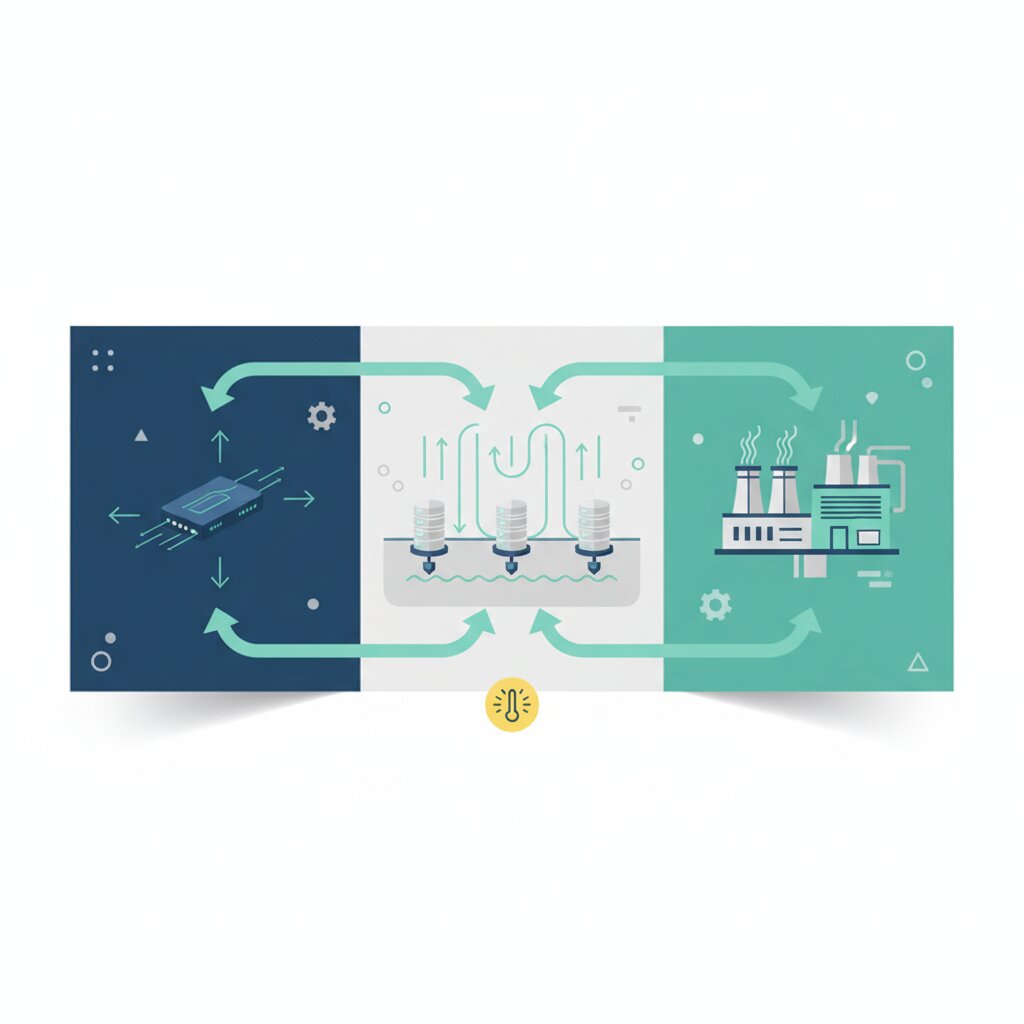

Space sits at 2.7 K — a few degrees above absolute zero. And cooling is still the hardest engineering problem facing orbital data centres. Understanding why tells you most of what you need to know about alternative compute environments.
This is a technical comparison of thermal management across three environments: traditional terrestrial, orbital vacuum, and underwater ocean thermal. Real PUE numbers, specific facility data, and physics that doesn’t bend for vendor narratives. It connects to the broader case for computing beyond the terrestrial grid.
Why Is Cooling the Binding Constraint for High-Density Compute?
Cooling eats roughly 40% of total energy in a traditional data centre. That’s the economic motivation behind every alternative-environment deployment being discussed right now.
PUE — Power Usage Effectiveness — is the ratio of total facility power to IT equipment power. A PUE of 1.54 means 54 cents of overhead for every dollar spent on compute. Theoretical minimum is 1.0. The Uptime Institute’s 15th Annual Global Data Center Survey found the global average stuck at 1.54 for the sixth consecutive year. That’s not a great scorecard.
The problem gets worse as GPU power density climbs. NVIDIA GB200 NVL72 racks draw up to 120 kW per rack. Air cooling simply can’t manage that at full utilisation. Vertiv reported liquid cooling revenue more than doubled in Q1 2025, with 40% CAGR projected through 2028. Lawrence Berkeley National Laboratory projects US data centre energy consumption reaching 325–580 TWh annually by 2028, up from 176 TWh in 2023. The cooling overhead scales at the same rate. The rest of this article tests whether alternative environments can change that equation.
How Do Traditional Data Centres Actually Manage Heat — and What Does It Cost?
Earth gives you three mechanisms for moving heat: conduction, convection, and radiation. Traditional data centres rely almost entirely on conduction and convection — and both require a fluid medium, which on Earth you have in abundance.
Traditional HVAC-cooled facilities average PUE 1.54. Co-location and enterprise often run 1.58–1.80. Hyperscalers do better. Google, Meta, Microsoft, and Amazon achieve PUE 1.10–1.15 through purpose-built infrastructure combined with free cooling — using ambient environmental temperature rather than mechanical refrigeration. Google reported 1.09 in 2025. Free cooling is the key lever, and geography determines whether it’s available: cold ambient air in northern Europe, cold seawater near coastlines.
Even the best hyperscalers run into an engineering floor around 1.05–1.10. Power conversion losses can’t be eliminated. To beat hyperscaler-class efficiency, an alternative environment needs to achieve PUE measurably below 1.10. That’s the bar.
Why Can’t You Just Use the Cold Vacuum of Space to Cool Servers?
Vacuum is a thermal insulator. That’s the whole answer — but it needs unpacking.
On Earth, heat moves via conduction and convection. Both require a medium. Vacuum eliminates both. The 2.7 K cosmic microwave background is extraordinarily cold, but there’s nothing to carry heat from your server to that background. Temperature and cooling capacity are not the same property in a vacuum. This is where most people’s intuition about space being “cold” falls apart.
The only mechanism available in orbit is thermal radiation: every object above absolute zero emits infrared energy. The rate is governed by the Stefan-Boltzmann Law — radiated power per unit area scales as the fourth power of absolute temperature (P = εσT⁴, where σ = 5.67 × 10⁻⁸ W·m⁻²·K⁻⁴). Double an object’s temperature in Kelvin and it radiates 16 times more heat. Radiator temperature, not just surface area, is what determines how fast heat actually leaves.
At 20°C, a radiator panel with emissivity 0.9 emits roughly 633 W per square metre. To radiate 1 MW, you need approximately 1,200 m² of surface — the area of four tennis courts. And that’s for just 1 MW. Raising operating temperature is the more powerful lever than better surface coatings alone.
For the solar energy side of the orbital energy budget, see the orbital solar energy cost equation.
How Much Radiator Does an Orbital AI Data Centre Actually Need?
This is where physics translates into engineering constraints you can actually cost out.
ABI Research figures put each NVIDIA H100 GPU at approximately 1.1 m² of required radiator area in orbit. A full DGX H100 system — eight H100s plus support hardware — needs approximately 16 m² of radiators. That’s the size of a large living room, for a single server unit.
At rack scale, a standard 42U rack running H100-class hardware at full load could require 50–100 m² of radiator panel. Per rack. Per satellite. Radiator panels weigh 5–9 kg per square metre, so the mass implications build fast.
Heat moves from processor to radiator fin via heat pipes — sealed tubes using a working fluid’s phase change. No moving parts, no pumps, individual failures don’t cascade. That’s the standard approach in all current orbital designs: Starcloud, Axiom Space’s ISS nodes, Sophia Space. For the operational cooling reality in current ISS deployments, the Axiom Space article details how these constraints play out in practice.
Starcloud-2 will carry what Starcloud CEO Chris Johnston describes as “the largest deployable radiator flown on a private satellite.” Deployable means stored compactly during launch and mechanically extended in orbit — necessary because Stefan-Boltzmann demands large surface areas and launch volume is finite. It’s an elegant engineering problem with expensive answers.
The governing framework is SWaP — Size, Weight, and Power. Spacecraft engineering treats all three as a single unified budget. The cooling radiator consumes the largest share of all three. Launch costs to LEO run 1, 000–5,000 per kg, so radiator mass directly multiplies total system cost.
Two-phase fluid loops and space-rated heat pumps are under development for megawatt-class cooling, expected operational around 2027. Not available yet. For NVIDIA’s Space-1 thermal specifications, see NVIDIA’s Vera Rubin Space-1 module.
How Does Seawater Passive Cooling Turn the Ocean Into a Heat Sink?
The underwater case runs on a completely different set of physics.
In an underwater data centre, servers operate in a sealed pressure vessel surrounded by seawater. Waste heat conducts through the vessel wall to the ambient ocean — no mechanical chillers, no pumps, no HVAC. The ocean does the work.
The BHDT (Beijing Highlander Digital Technology) Hainan facility is the operational benchmark: a 1,433-ton sealed cabin at 35 m depth off Lingshui county, running 24 racks and up to 500 servers. Reported PUE: 1.07 — better than Google’s best reported 1.09, achieved simply by eliminating HVAC overhead entirely.
There’s a second architecture worth knowing about: the Subsea Cloud Jules Verne pod near Port Angeles, Washington, at 9 m depth. Rather than a sealed-air vessel, it uses pressure equalisation and submerges servers in dielectric immersion fluid — a non-conductive liquid that extracts heat directly from hardware. Sixteen racks, approximately 800 servers, 1 MW IT capacity.
BHDT’s sealed-air design keeps servers in familiar environments — standard rack hardware, standard air cooling inside the cabin. Subsea Cloud’s immersion approach is more direct but requires specialised hardware preparation. Neither has a clear winner yet.
The historical precedent is Microsoft’s Project Natick, deployed off the Orkney Islands in 2018 with 864 servers for two years. It proved technical feasibility, reported excellent server reliability, then was discontinued citing maintenance concerns. BHDT Hainan is the first commercial operation to build on what Natick demonstrated. Two open questions remain: biofouling and seawater corrosion aren’t yet quantified for multi-year operations.
For more depth on the seawater cooling specifics, see China’s underwater data centres and Microsoft’s Project Natick.
Orbital Vacuum vs. Ocean Thermal vs. Terrestrial: How Do They Compare?
Here’s the direct comparison across the three environments.
Terrestrial (traditional): Air and HVAC convection. PUE 1.54 global average; 1.09–1.15 for hyperscalers with free cooling. Infrastructure: HVAC plant, chillers, cold aisles. Challenge: 30–40% energy overhead at scale. Examples: enterprise data centres globally.
Underwater (ocean thermal): Seawater passive conduction through the hull. PUE 1.07 (BHDT Hainan) — the only commercial operational data point so far. Infrastructure: sealed pressure vessel or pressure-equalised immersion pod. Challenge: biofouling, maintenance access at depth, cable management. Examples: BHDT Hainan (35 m), Subsea Cloud Jules Verne (9 m).
Orbital vacuum: Thermal radiation only. PUE not yet measurable at commercial scale — radiator mass is the binding constraint, not energy overhead. Infrastructure: deployable radiator arrays, heat pipes. Challenge: SWaP budget, launch cost per kg, eclipse cycles. Examples: Starcloud-1 (H100, 60 kg satellite, launched November 2025), Axiom Space ISS nodes (launched January 2026).
The near-term practicable alternative is underwater ocean thermal. PUE 1.07 is proven and operational today. Orbital cooling is physics-constrained in a way that makes PUE almost the wrong metric — the real binding constraint is radiator mass and launch cost. ABI Research’s TCO analysis puts orbital compute cost at upward of 78 times the terrestrial equivalent at current economics, with convergence forecast by 2035 contingent on launch prices dropping substantially. For the full picture of why these environments are attracting investment despite current cost premiums, the comprehensive alternative data centre overview covers the market context alongside the engineering fundamentals explored here.
PUE doesn’t capture what orbital uniquely offers: solar power with no grid dependency, geographical neutrality, potential regulatory arbitrage, zero water consumption. Voyager Technologies CEO Dylan Taylor describes orbital cooling as “one of the most serious technical barriers facing space-based computing infrastructure.” That’s an honest assessment of where the engineering sits today.
For the planning framework built on this data, see the case for computing beyond the terrestrial grid.
Assessing infrastructure this far outside the mainstream playbook takes genuinely senior engineering judgement. That kind of experience is thin in any local market, and one evaluation rarely justifies its own hiring round. SoftwareSeni’s extended development teams put senior developers on the work inside Australian business hours, sourced without running that search yourself.
see how extended development teams add senior engineering capacity without a hiring round →
“I’ve worked with SoftwareSeni for many years now across different CTO roles. Davo and his team are such a pleasure to work with and they have always provided the best and most capable resources when I needed them. They run a well oiled process to ensure they find and present the best candidates, plus they ensure smooth onboarding process. I highly recommend SoftwareSeni to any company that is wanted to expand their team and keen to explore an embedded team model.”
— Simon Farrell, VP of Engineering, Forage
Frequently Asked Questions
Why is space cold but bad at cooling servers? Space has a background temperature of 2.7 K, but vacuum is a thermal insulator — there’s no air or liquid to carry heat away from a server. The only available mechanism is thermal radiation, which is far slower and more area-intensive than conduction or convection. Temperature and cooling capacity are not the same property in a vacuum.
What is PUE and why does 1.07 matter? PUE (Power Usage Effectiveness) is the ratio of total facility power to IT equipment power. A PUE of 1.07 — the BHDT Hainan figure — means only 7 cents of overhead per dollar of compute. The global average is 1.54 (54 cents overhead). The BHDT figure outperforms Google’s best reported 1.09 and approaches the theoretical minimum.
What is the Stefan-Boltzmann law in plain English? It describes how much energy a surface radiates based on its temperature. The key point: radiated power scales with the fourth power of temperature — an object twice as hot (in Kelvin) radiates 16 times more energy. For spacecraft radiators, operating at higher temperatures reduces the surface area required, but there’s a ceiling set by the electronics being cooled.
How does the BHDT Hainan underwater data centre work? BHDT operates a 1,433-ton sealed cabin at 35 m depth off Lingshui county, Hainan. Servers run inside a sealed air environment. Waste heat conducts through the cabin wall directly into ambient seawater — no mechanical pumping required. The facility runs 24 racks at PUE 1.07.
What is the difference between BHDT and Subsea Cloud’s cooling approach? BHDT uses a sealed-air pressure vessel — servers are air-cooled inside the cabin and hull conduction transfers heat to the ocean. Subsea Cloud’s Jules Verne pod uses pressure equalisation and submerges servers in dielectric immersion fluid for direct heat extraction. Different trade-offs in hardware compatibility and maintenance complexity.
What is a deployable radiator and why does Starcloud need one? A deployable radiator is a lightweight panel stored compactly during launch and mechanically extended in orbit. Because the Stefan-Boltzmann law requires large surface areas to reject GPU-class heat loads in vacuum, and launch costs run thousands of dollars per kilogram, radiators must fold for launch and unfold on orbit. Starcloud-2’s deployable radiator is described as the largest commercial example yet flown on a private satellite.
What were the results of Microsoft’s Project Natick? Deployed off the Orkney Islands in 2018, with 864 servers at approximately 36 m depth for two years. It demonstrated ocean-cooled computing viability and reported excellent server reliability. Microsoft discontinued the programme citing maintenance and lifecycle concerns. BHDT Hainan is the first commercial operation to build on Natick’s proof-of-concept.
What is the SWaP constraint in orbital data centres? SWaP stands for Size, Weight, and Power — a spacecraft engineering framework that treats all three as a unified budget. In orbital data centres, the cooling radiator consumes the largest share of all three. Increasing radiator area to handle more compute means more mass, more launch cost, and a larger structure to orient and deploy. Cooling, not compute, determines the upper limit of orbital data centre capacity.
Does seawater cooling cause environmental harm? At current operational scales (BHDT Hainan: 24 racks), heat rejection into the ocean is negligible relative to natural thermal variation. At the larger scales planned — the Hainan government’s 14th Five-Year Plan targets 100 underwater cabins — cumulative heat discharge and biofouling become open questions not yet addressed in available research.
Can orbital data centres achieve better PUE than hyperscalers? PUE is the wrong metric for orbital environments. Terrestrial hyperscalers achieve 1.09–1.15 by optimising energy overhead. Orbital facilities are constrained by radiator mass, not energy overhead. A hypothetical orbital facility with unlimited radiator area could approach PUE 1.0, but the launch economics at current prices would make per-FLOP cost far higher than terrestrial alternatives.
What is free cooling and which environments benefit from it? Free cooling means using ambient environmental temperature rather than mechanical refrigeration to reject heat. Hyperscalers in northern Europe use cold ambient air; underwater data centres use cold seawater. In both cases, the mechanical chiller plant is partially or entirely eliminated.
What happens to an orbital data centre during an eclipse? During eclipse, the satellite enters Earth’s shadow — solar power availability drops and the radiator’s orientation relative to the sun changes. Radiators previously emitting toward deep space may face warm terrestrial infrared. Thermal throttling may occur if the cooling system can’t maintain processor temperatures within spec. No published source currently quantifies eclipse-cycle impact on compute throughput for orbital data centre designs.
Worth building this kind of evaluation capability in-house, or having senior engineers ready when you need it? Talk to SoftwareSeni about extended development teams